Chest Freezer Manufacturer Guide: How to Choose Equipment That Maintains Stable Cooling and Long-Term Durability
In many commercial setups, chest freezers don’t fail suddenly—they degrade quietly.
You might notice:
- Frost builds up faster than expected
- Temperature varies between top and bottom layers
- Cooling becomes slower after months of use
- Energy consumption gradually increases
These issues are often mistaken for maintenance problems. In reality, they usually come from design limitations in the freezer itself.
At Snowsea, we’ve worked with distributors and wholesalers who replaced multiple batches before realizing the root cause was structural and thermal design. By optimizing insulation density, cooling balance, and cabinet structure, we help eliminate these recurring issues from the beginning.
Where Chest Freezers Typically Lose Performance
Before selecting a chest freezer manufacturer, it’s important to understand where performance loss usually starts.
According to ASHRAE, thermal stability in static cooling systems (like chest freezers) is highly dependent on insulation efficiency and internal heat distribution.
Common Weak Points
- Top-to-Bottom Temperature Difference
Cold air settles, creating uneven layers - Frost Accumulation
Caused by moisture infiltration and poor sealing - Heat Gain Through Walls
Low-density insulation allows faster thermal exchange - Compressor Cycling Instability
Leads to inconsistent cooling performance
Understanding these limitations helps buyers focus on the right evaluation criteria.
Inside the Build: Materials and Structural Design That Matter
Chest freezers rely heavily on structure rather than airflow systems, which makes material quality even more critical.
Key Structural Components
- High-Density PU Insulation (70–80mm)
Reduces heat penetration and stabilizes internal temperature - Inner Liner Design
Smooth aluminum or coated steel improves thermal reflection - Reinforced Cabinet Body
Prevents deformation under heavy storage loads - Lid Sealing System
Ensures minimal air exchange during opening
We refer to this integrated approach as “passive thermal stability design”—a system that maintains temperature with minimal fluctuation even without forced airflow.
Why Choose Snowsea: Experience in High-Load Freezer Design
Once structural fundamentals are clear, execution becomes the deciding factor.
At Snowsea, we apply:
- Standardized insulation density across all production batches
- Pre-shipment thermal retention testing
- Load-based performance calibration
- Reinforced cabinet structures for heavy commercial use
Our experience comes from supplying distributors, supermarkets, and cold storage operators where consistency is critical—not optional.
Comparing Real-World Performance Between Different Manufacturers
Many chest freezers look similar externally, but performance differences become clear during operation.
📊 Performance Comparison
| Factor | Entry-Level Manufacturer | Snowsea |
|---|---|---|
| Temperature Stability | ±3°C | ±1°C |
| Frost Build-Up Rate | Fast | Controlled |
| Energy Consumption | Higher | Reduced by 20%+ |
| Structural Durability | Moderate | Reinforced |
| Lifespan | 2–3 years | 5–8 years |
These differences directly impact maintenance cost and operational efficiency.
How Usage Scenarios Affect Chest Freezer Performance
Chest freezers are used across different environments, each placing unique demands on performance.
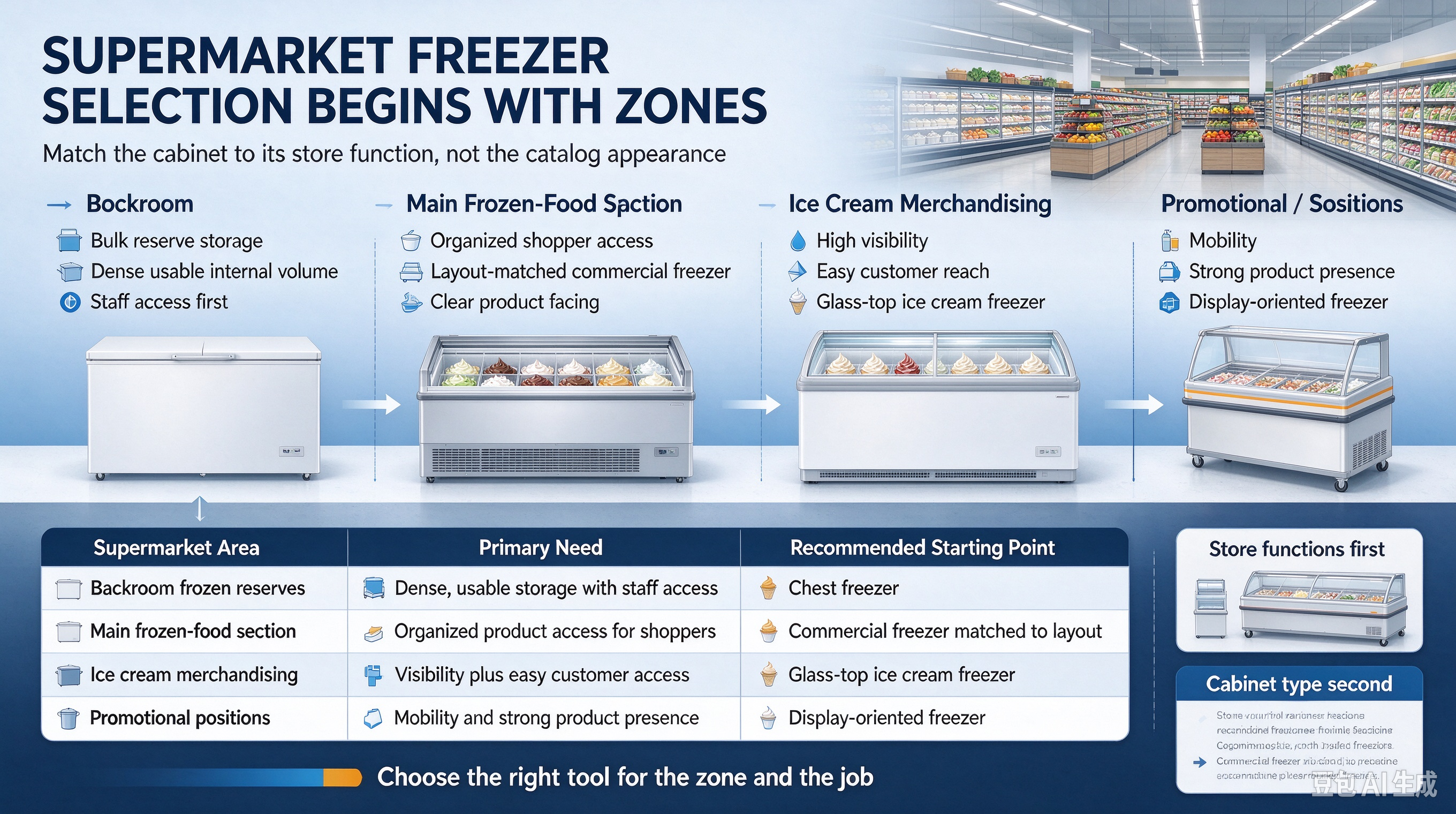
🏪 Retail and Supermarkets
Frequent lid opening requires strong thermal retention to minimize temperature loss
🍖 Meat and Frozen Food Storage
Heavy load conditions demand strong structural support and consistent cooling depth
🧊 Bulk Storage Applications
Large-volume storage requires uniform cooling across deep compartments
🌍 High-Temperature Regions
External heat increases thermal pressure, requiring thicker insulation and optimized cooling cycles
At Snowsea, we implement “load-adaptive cooling balance”, ensuring stable performance regardless of usage intensity.
Case Example: Reducing Frost and Improving Efficiency
A distributor supplying frozen food stores faced recurring issues.
Initial Situation
- Rapid frost buildup requiring frequent defrosting
- Increased energy consumption
- Uneven product temperature
Improvements Implemented
- Increased insulation thickness
- Improved lid sealing system
- Optimized compressor cycle
Results
- Frost buildup reduced significantly
- Energy consumption reduced by ~20%
- More consistent product quality
This demonstrates how structural improvements directly impact operational performance.
What Buyers Should Examine Before Choosing a Chest Freezer Manufacturer
When selecting a chest freezer manufacturer, evaluation should focus on three core dimensions:
✔ Thermal Retention Capability
- What is the insulation thickness and density?
- How well does the freezer retain cold after opening?
👉 Snowsea Solution:
We use high-density PU insulation and optimized cabinet design to maintain stable internal temperatures.
✔ Structural Durability
- Can the cabinet handle heavy loads over time?
- Is the lid sealing system reliable under frequent use?
👉 Snowsea Advantage:
We reinforce cabinet structures and use durable sealing systems designed for commercial environments.
✔ Production Consistency
- Are materials standardized across batches?
- Is performance tested before shipment?
👉 Snowsea Capability:
We implement batch-level quality control and thermal testing to ensure consistent output.
Frequently Asked Questions
Q: Why do chest freezers often develop frost quickly?
A: This is usually due to poor sealing and moisture infiltration rather than normal operation.
Q: Why is cooling uneven inside chest freezers?
A: Natural air stratification causes temperature layering if insulation and design are not optimized.
Q: How can I improve freezer lifespan?
A: Choose equipment with strong insulation, stable compressor cycles, and reinforced structure.
Building a More Reliable Cold Storage Solution
Choosing a chest freezer manufacturer is about more than selecting a product—it’s about ensuring stable storage performance over time.
At Snowsea, we focus on:
- Passive thermal stability design
- Reinforced structural engineering
- Consistent manufacturing processes
👉 Explore Our Chest Freezer Solutions
If you are comparing different freezer types or configurations, you can review our product range here:
👉 https://www.snowseax.com/products
👉 Contact Us for Your Project Needs
If you are sourcing chest freezers or planning bulk procurement, our team can help you choose the right configuration for your business.
👉 https://www.snowseax.com/contact