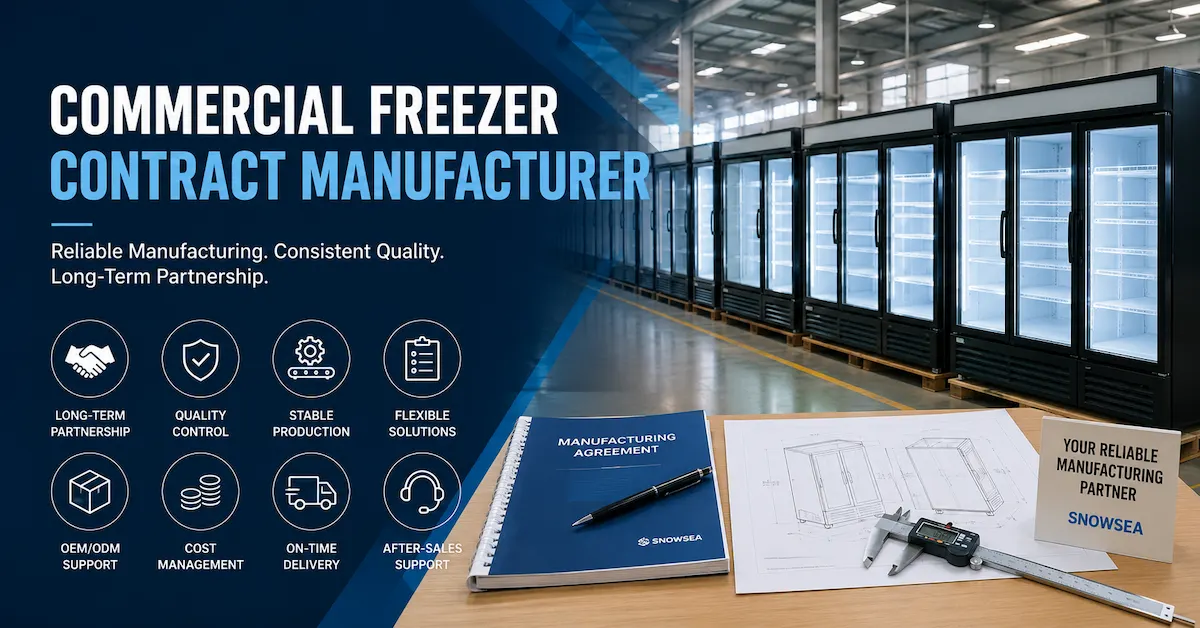
Why Choosing the Right Commercial Freezer Contract Manufacturer Matters
A Commercial Freezer Contract Manufacturer is not simply a factory that produces one purchase order.
Contract manufacturing usually involves longer-term cooperation where the buyer expects the manufacturer to repeatedly produce commercial refrigeration equipment according to agreed specifications, quality standards, branding requirements, delivery schedules, and commercial terms.
Typical buyers include:
- Commercial refrigeration brands
- Importers
- Regional distributors
- Private-label companies
- Retail equipment companies
- Food-service equipment suppliers
- Multi-market refrigeration businesses
The supplier may need to manufacture the same freezer family across multiple orders, countries, and years.
This means buyers should evaluate much more than unit price.
Important considerations include:
- Specification control
- BOM consistency
- Component availability
- Quality agreements
- Production capacity
- Lead times
- Forecast management
- Engineering changes
- Cost control
- Spare parts
- Export support
Snowsea supports OEM and ODM commercial refrigeration manufacturing for global B2B buyers developing long-term freezer supply programs.
What Is Commercial Freezer Contract Manufacturing?
Commercial freezer contract manufacturing is an arrangement where a buyer appoints a manufacturer to produce refrigeration equipment according to defined commercial and technical requirements.
The buyer may control:
- Product specification
- Brand
- Model number
- Packaging
- Component requirements
- Target market
- Quality standards
The manufacturer manages activities such as:
- Material sourcing
- Component purchasing
- Production
- Assembly
- Refrigeration installation
- Testing
- Packaging
- Shipment preparation
Compared with one-time sourcing, contract manufacturing usually requires stronger production and documentation control.
Contract Manufacturing vs OEM, ODM and Private Label
These models often overlap, but their focus differs.
| Model | Primary Focus | Typical Buyer Requirement |
|---|---|---|
| Contract Manufacturing | Long-term controlled production | Repeatable supply under agreed manufacturing terms |
| OEM | Manufacturing to buyer requirements | Product made to defined specification |
| ODM | Product development + manufacturing | Supplier contributes design and engineering |
| Private Label | Buyer branding | Product sold under buyer's own brand |
A contract manufacturing relationship may include OEM or private-label requirements.
For example, a distributor may use a standard freezer platform, apply its own brand, define selected components, and contract the factory to manufacture repeated annual orders.
Buyers comparing manufacturing models can also review Snowsea's commercial freezer OEM factory guide and commercial freezer private label factory guide.
Which Buyers Need a Contract Manufacturing Partner?
Contract manufacturing is particularly suitable when buyers need:
- Repeated production
- Multiple annual orders
- Stable specifications
- Consistent branding
- Predictable lead times
- Long-term component availability
- Scalable production
It may be useful for distributors expanding into several countries or private-label brands building a permanent commercial freezer product line.
For occasional small orders, a standard wholesale purchasing arrangement may be simpler.
How to Control Product Specifications and BOM
The foundation of contract manufacturing is specification control.
A commercial freezer specification may define:
- Cabinet dimensions
- Capacity
- Temperature range
- Compressor
- Refrigerant
- Controller
- Insulation
- Cabinet material
- Door structure
- Electrical configuration
- Accessories
These requirements should connect to a controlled bill of materials, or BOM.
Approved Samples and Golden Samples
Before repeated mass production, buyers should approve a representative sample.
The approved sample can act as a reference for:
- Product appearance
- Dimensions
- Components
- Cooling performance
- Labels
- Packaging
However, a physical sample should not replace written specifications.
The strongest approach uses both.
Component and Supplier Control
Important components may include:
- Compressor
- Controller
- Fan motor
- Condenser
- Evaporator
- Door gasket
- Glass
- Electrical parts
The buyer should identify which components require approval before substitution.
This reduces unexpected differences between production batches.
Engineering Change Approval
Commercial refrigeration components may eventually change because of:
- Supplier discontinuation
- Regulatory requirements
- Cost changes
- Technical upgrades
- Component shortages
A controlled engineering change process should define:
- What component is changing
- Why the change is required
- Technical impact
- Cost impact
- Testing requirements
- Buyer approval
Uncontrolled component substitution is a major long-term sourcing risk.
Production Capacity and Annual Volume Planning
A contract manufacturer should understand the buyer's expected purchasing volume.
Buyers may provide:
- Estimated annual demand
- Quarterly forecasts
- Peak season requirements
- Model mix
- Destination markets
The manufacturer can then plan:
- Materials
- Components
- Production capacity
- Labor
- Packaging
- Shipment scheduling
Factory capacity should be evaluated against peak demand, not only average monthly volume.
MOQ, Forecasts and Rolling Purchase Orders
Contract manufacturing does not eliminate MOQ.
MOQ may still depend on:
- Product model
- Cabinet material
- Compressor purchasing
- Carton printing
- Branding
- Custom components
However, long-term forecasts can improve planning.
A rolling forecast may identify:
- Expected orders for the next 3 months
- Probable demand for the next 6 months
- Annual estimated volume
Forecasts are especially valuable for components with longer procurement lead times.
Snowsea's commercial freezer bulk order price guide explains how volume and order structure affect manufacturing economics.
How to Maintain Quality Across Production Batches
A reliable Commercial Freezer Contract Manufacturer must reproduce approved quality across multiple shipments.
Quality consistency requires more than final inspection.
Manufacturing control may include:
Incoming Material Inspection
Verify key materials and purchased components before production.
In-Process Inspection
Monitor:
- Cabinet assembly
- Foaming
- Refrigeration installation
- Wiring
- Door alignment
Functional Testing
Depending on the freezer model, testing may include:
- Pull-down performance
- Temperature stability
- Compressor operation
- Controller response
- Fan function
Final Inspection
Confirm:
- Appearance
- Labels
- Accessories
- Packaging
- Quantity
Snowsea's commercial freezer quality testing procedure provides a broader framework for production and pre-shipment inspection.
Cost Control in Long-Term Manufacturing Contracts
Contract manufacturing cost should not be evaluated only through the first quotation.
Long-term cost may be influenced by:
- Raw materials
- Components
- Order quantity
- Forecast accuracy
- Packaging
- Customization
- Freight
- Payment terms
Buyers should define how price changes will be handled.
For example:
- Annual price review
- Material-cost adjustment
- Volume-based pricing
- Component-change approval
Clear pricing mechanisms reduce disputes during long-term cooperation.
Who Owns Tooling, Artwork and Product Assets?
Customized projects may involve:
- Molds
- Tooling
- Packaging artwork
- Labels
- Manuals
- Drawings
- Product specifications
Buyers should clearly document ownership and usage rights.
Questions to clarify include:
- Who paid for tooling?
- Can tooling be used for other customers?
- Who owns artwork files?
- Who controls model numbers?
- Can specifications be shared?
These issues become more important as the product line grows.
OEM and Private Label Options
Contract manufacturing programs often expand over time.
A buyer may begin with:
- Standard cabinet
- Custom logo
- Custom carton
Later, the project may include:
- Custom colors
- Different controllers
- Market-specific refrigerants
- Unique model numbers
- Packaging systems
Snowsea's OEM/ODM capabilities can support buyers developing commercial refrigeration programs from simple branding to more customized manufacturing.
Supply Chain and Component Availability
Long-term freezer production depends on supply-chain stability.
Buyers should ask:
- Which components have long lead times?
- Are backup suppliers available?
- Which parts are single-source?
- How are shortages communicated?
- Are alternatives pre-approved?
Supply-chain risk is particularly important when the same freezer model must remain consistent for several years.
Quality Testing and Pre-Shipment Inspection
Large contract orders may require additional inspection arrangements.
Options include:
- Factory internal QC
- Buyer inspection
- Third-party inspection
- Random sampling
- Full functional testing for selected parameters
Inspection requirements should be agreed before production.
This prevents disagreements when goods are ready to ship.
Export Packaging and Delivery Management
Contract manufacturing often includes repeated international shipments.
Packaging specifications should therefore remain controlled.
Important requirements may include:
- Foam protection
- Cabinet corner protection
- Door fixation
- Carton strength
- Pallet or base requirements
- Shipping marks
Snowsea's freezer export packaging drop protection guide explains how packaging design can reduce transportation damage.
Spare Parts and After-Sales Planning
Long-term contract buyers should establish a spare-parts strategy.
Common parts may include:
- Controllers
- Gaskets
- Fan motors
- Hinges
- Handles
- Lighting components
- Electrical parts
The manufacturing agreement may define:
- Spare-parts percentage
- Price
- Availability period
- Part-number system
- Warranty responsibility
This is particularly important for distributors supporting equipment for several years.
How to Evaluate a Commercial Freezer Contract Manufacturer
Use a structured evaluation instead of choosing solely by price.
| Evaluation Area | What Buyers Should Verify |
|---|---|
| Manufacturing | Production capability and experience |
| Engineering | Specification and change control |
| Supply chain | Component sourcing stability |
| Quality | Defined QC procedures |
| Capacity | Ability to support forecast volume |
| OEM/ODM | Customization capability |
| Documentation | BOM and specification control |
| Pricing | Transparent long-term mechanism |
| Packaging | Repeatable export standard |
| Spare parts | Long-term availability |
| Communication | Fast technical response |
| Delivery | Consistent lead-time performance |
The best contract manufacturer is usually the one that can control changes and reproduce the approved product consistently.
What Should Buyers Include in an RFQ or Manufacturing Agreement?
A detailed RFQ should include:
- Product type
- Technical specifications
- Required capacity
- Temperature range
- Voltage and frequency
- Refrigerant
- Target market
- Approved components
- Branding requirements
- Packaging requirements
- MOQ
- Estimated annual volume
- Forecast method
- Quality requirements
- Inspection method
- Lead time
- Spare-parts requirements
- Warranty terms
- Change-control requirements
- Pricing review mechanism
For long-term cooperation, important technical and commercial terms should eventually be included in a formal manufacturing agreement.
FAQ
What is a commercial freezer contract manufacturer?
It is a manufacturer that produces commercial freezers for a buyer under agreed long-term specifications, quality requirements, production terms, and delivery arrangements.
Is contract manufacturing the same as OEM?
Not exactly. OEM focuses on manufacturing to buyer requirements, while contract manufacturing usually emphasizes an ongoing production relationship and repeated supply.
Can contract manufacturing include private labeling?
Yes. Contract manufacturing can include logos, model numbers, packaging, labels, and other private-label requirements.
How do buyers maintain consistent freezer quality?
Use controlled specifications, BOMs, approved samples, inspection procedures, and formal approval for important component changes.
Should buyers provide annual forecasts?
Forecasts can help manufacturers plan components, capacity, production, and lead times, especially for recurring orders.
Can manufacturers change components without approval?
Buyers should define which components require written approval before changes are made.
How should contract manufacturing prices be managed?
Long-term agreements may use annual reviews, volume tiers, or agreed adjustment mechanisms for significant material and component changes.
Should spare parts be included in the contract?
For distributors and long-term programs, spare-parts availability, pricing, and support periods should be defined early.
What should buyers audit before signing a manufacturing agreement?
Evaluate production capability, quality control, supply-chain management, technical documentation, capacity, export experience, and after-sales support.
Can Snowsea support commercial freezer contract manufacturing?
Snowsea supports OEM/ODM and commercial refrigeration manufacturing for B2B buyers. Customers can provide product specifications, annual volume, branding, target market, and quality requirements for project evaluation.
Conclusion
Choosing the right Commercial Freezer Contract Manufacturer is a long-term supply-chain decision rather than a one-time purchasing decision.
For refrigeration brands, importers, distributors, and private-label companies, success depends on stable specifications, controlled components, consistent production, transparent pricing, quality management, supply-chain planning, and dependable delivery.
A capable manufacturing partner should be able to reproduce approved commercial freezer specifications across repeated orders while managing inevitable changes in components, costs, and market requirements through a controlled process.
Snowsea supports global B2B commercial refrigeration manufacturing projects. Explore Snowsea's commercial refrigeration products, review its OEM/ODM solutions, or contact Snowsea with your product specifications, estimated annual volume, target market, and contract manufacturing requirements.