What Is Commercial Freezer Factory Direct Price?
Commercial Freezer Factory Direct Price generally refers to a quotation provided directly by the manufacturer rather than through a distributor or another resale layer.
For B2B buyers, factory-direct sourcing can provide more direct access to:
- Product specifications
- Manufacturing details
- OEM customization
- Quality-control requirements
- Packaging options
- Production schedules
- Technical communication
However, a factory quotation should not be interpreted as a guaranteed lowest market price.
The buyer may still need to manage:
- International freight
- Customs clearance
- Import duties
- Inspection
- Warehousing
- Local delivery
- Spare parts
- Warranty service
Therefore, the real sourcing question is not simply:
“Is the factory price cheaper?”
A better question is:
“Does the factory-direct purchasing model create a better total cost and risk structure for my business?”
Snowsea provides commercial refrigeration products for importers, distributors, private-label brands, and commercial refrigeration projects with different sourcing requirements.
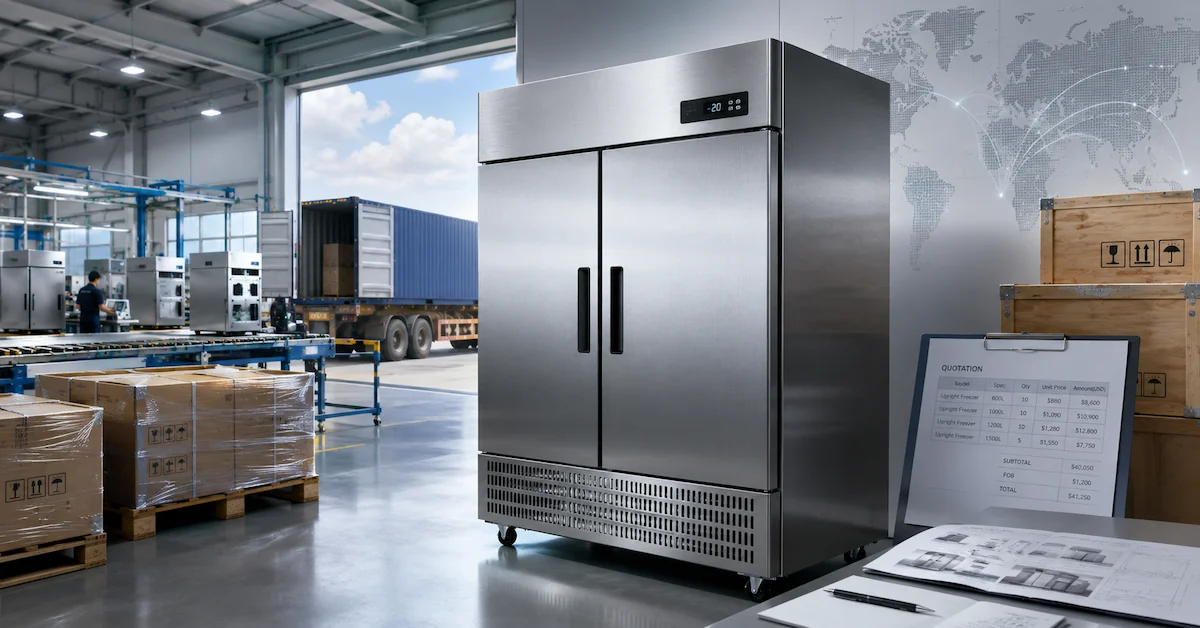
Factory Direct Price vs Wholesale Price
Factory-direct pricing and wholesale pricing are related but not identical.
Wholesale price generally describes a B2B selling price for commercial quantities.
Factory-direct price focuses on the buyer purchasing directly from the manufacturing source.
| Comparison Area | Factory Direct | General Wholesale |
|---|---|---|
| Seller | Manufacturer | Manufacturer, wholesaler, or distributor |
| Production visibility | Higher potential visibility | Depends on seller |
| OEM communication | Usually more direct | May involve additional communication |
| MOQ | Often production-based | May be more flexible |
| Inventory availability | Production schedule dependent | Stock may be available |
| Technical changes | More direct | Depends on supplier |
| Local support | Buyer may manage more | Distributor may provide support |
Buyers researching overall product cost can also review Snowsea's commercial freezer wholesale price guide.
Does Buying Direct From a Factory Always Cost Less?
No.
Factory-direct purchasing may remove some resale margins, but it can also transfer more sourcing responsibilities to the buyer.
A distributor or trading supplier may provide services such as:
- Consolidating products
- Holding local stock
- Managing smaller quantities
- Arranging logistics
- Offering local warranty service
- Providing credit terms
These services have value.
Factory-direct sourcing is generally most attractive when the buyer has enough order volume, technical capability, logistics experience, and after-sales infrastructure to manage the process efficiently.
What Determines Commercial Freezer Factory Price?
A realistic Commercial Freezer Factory Direct Price depends on the agreed specification.
Freezer Type
Factory cost varies between:
- Chest freezers
- Upright freezers
- Display freezers
- Ice cream freezers
- Glass-door refrigerators
- Commercial refrigerators
Different structures require different materials, components, labor, and refrigeration systems.
Capacity and Dimensions
Larger cabinets can require:
- More sheet metal
- More insulation
- Larger evaporators
- Larger condensers
- Different compressors
- More packaging material
Capacity alone should not be used as the only price-comparison factor.
Refrigeration Components
Important cost variables include:
- Compressor
- Refrigerant
- Condenser
- Evaporator
- Fan system
- Temperature controller
- Defrost components
Two visually similar freezers may therefore have substantially different technical configurations.
Cabinet Material
Common cost differences can come from:
- Coated steel
- Stainless steel
- Inner liner materials
- Panel thickness
- Surface finishing
For applications involving moisture or aggressive environments, buyers can review Snowsea's freezer cabinet anti corrosion material guide.
Insulation
Insulation affects both manufacturing cost and thermal performance.
Important factors include:
- Insulation material
- Thickness
- Foam density
- Cabinet construction
Snowsea's freezer cabinet insulation performance comparison explains how these factors influence freezer performance.
How MOQ Affects Factory Direct Pricing
Factories normally structure MOQ around manufacturing economics rather than retail purchasing convenience.
MOQ may be influenced by:
- Component supplier requirements
- Production setup
- Packaging printing
- OEM branding
- Custom materials
- Production scheduling
A low MOQ may be useful for market testing but may not produce the most efficient unit cost.
Buyers should request several quotation levels, such as:
- Sample
- Trial order
- Standard MOQ
- Bulk order
- Container order
Snowsea's commercial freezer bulk order price guide explains how quantity and model mix can influence larger purchasing programs.
Sample Price Is Not Mass-Production Price
One common sourcing mistake is comparing sample cost directly with the expected production price.
Sample orders may include:
- Individual production handling
- Special packaging
- Engineering preparation
- Manual customization
- Express logistics
The sample's purpose is product verification.
Before approving mass production, buyers should request a separate production quotation based on the final approved specification and quantity.
How OEM Customization Changes Factory Price
Direct factory sourcing is particularly useful when buyers need customized commercial refrigeration products.
Basic OEM requirements can include:
- Logo
- Cabinet color
- Rating label
- User manual
- Carton artwork
- Product stickers
Deeper customization may involve:
- Compressor selection
- Refrigerant
- Controller
- Cabinet material
- Shelving
- Door configuration
- Defrost system
- Electrical configuration
Each change can affect price differently.
Buyers should therefore avoid requesting “OEM price” without defining the actual customization scope.
Snowsea provides OEM and ODM commercial refrigeration solutions for buyers developing private-label and customized freezer programs.
ODM Development and One-Time Costs
ODM projects may include costs that do not repeat with every production order.
Examples include:
- Engineering
- Prototype development
- Mold tooling
- Fixtures
- Testing
- Design revisions
These are often easier to evaluate when separated from recurring unit price.
A buyer should ask:
- Which costs are one-time?
- Which costs are included in unit price?
- Who owns the tooling?
- How many prototype revisions are included?
- Does a design change require new tooling?
This makes long-term product economics easier to understand.
Factory Direct Price vs EXW, FOB and Landed Cost
Factory direct describes the sourcing relationship.
EXW, FOB, and other trade terms describe different commercial responsibilities.
They should not be treated as the same concept.
EXW-Level Purchasing
A buyer may need to manage more logistics activity from the factory onward.
FOB-Level Purchasing
The supplier handles an agreed portion of the export process before responsibility transfers according to the commercial terms.
Landed Cost
The buyer's landed cost may include:
- Product price
- Inland transport
- Export handling
- Freight
- Insurance
- Import duties
- Customs clearance
- Port charges
- Local transportation
For procurement decisions, landed cost is usually more useful than factory unit price alone.
Hidden Costs of Factory-Direct Purchasing
Direct sourcing can reduce some costs while increasing buyer responsibility.
Potential hidden costs include:
Factory Inspection
Buyers may use:
- Internal QC teams
- Third-party inspectors
- Pre-shipment inspections
Product Testing
Additional testing may be required for certain projects or markets.
Logistics Coordination
The buyer may need to coordinate:
- Forwarders
- Containers
- Documentation
- Customs processes
Local After-Sales Support
A direct factory may supply parts and technical guidance, but the importer may still need a local service network.
Inventory
Factory purchases often involve larger quantities than local distributor purchases.
Inventory carrying cost should therefore be included in the financial model.
Why Quality Control Matters More Than a Small Price Difference
A freezer with a slightly lower factory price can become more expensive if it creates high destination-market failure costs.
Potential problems include:
- Temperature instability
- Door leakage
- Compressor issues
- Defrost faults
- Cabinet damage
- Electrical defects
- Shipping damage
Buyers should ask which tests are included in the quoted product.
Snowsea's commercial freezer quality testing procedure provides a detailed B2B framework covering temperature, refrigeration, sealing, airflow, electrical checks, appearance, and pre-shipment inspection.
Export Packaging Should Be Included in Factory Quote Comparison
Factory quotations may use different packaging specifications.
A buyer should compare:
- Carton construction
- Foam cushioning
- Corner protection
- Glass-door protection
- Bottom reinforcement
- Pallet requirements
- Product fixation
Lower-cost packaging can increase shipping damage risk.
Snowsea's freezer export packaging drop protection guide explains how packaging should be evaluated for international transportation.
How to Verify a Real Commercial Freezer Factory
Factory-direct pricing is valuable only when the buyer knows who actually manufactures the equipment.
Useful verification methods include:
Factory Information
Ask for:
- Company details
- Factory location
- Production capabilities
- Main product categories
Production Process
Understand which processes are handled:
- In-house
- By component suppliers
- By subcontractors
Factory Audit
For important projects, buyers may conduct:
- On-site audits
- Video factory reviews
- Third-party inspections
Product Testing
Ask to see how finished freezers are tested.
Documentation Consistency
Business documents, invoices, company information, and manufacturing details should be consistent.
The goal is not simply to prove that a building exists.
The goal is to understand who controls the product specification and production process.
Factory Direct vs Trading Company: Which Is Better?
Neither model is automatically better.
| Buyer Situation | Factory Direct May Be Better | Trading Supplier May Be Better |
| Large recurring orders | Yes | Possible |
| Deep OEM customization | Strong advantage | Depends on factory access |
| Small mixed orders | Less flexible | Often useful |
| Need multiple product categories | Limited to factory range | Can consolidate |
| Technical engineering changes | Direct communication | Depends on intermediary |
| Local service needed | Buyer may manage | Distributor can be stronger |
| Factory audit required | Direct access | Requires coordination |
B2B buyers should choose the sourcing model according to operational needs rather than assuming one channel is always cheaper.
How to Compare Factory Direct Quotations
A proper Commercial Freezer Factory Direct Price comparison should normalize specifications first.
| Quotation Item | Factory A | Factory B | Factory C |
| Model | Confirm | Confirm | Confirm |
| Capacity | Confirm | Confirm | Confirm |
| Compressor | Confirm | Confirm | Confirm |
| Refrigerant | Confirm | Confirm | Confirm |
| Cabinet material | Confirm | Confirm | Confirm |
| Insulation | Confirm | Confirm | Confirm |
| Door configuration | Confirm | Confirm | Confirm |
| Defrost | Confirm | Confirm | Confirm |
| Controller | Confirm | Confirm | Confirm |
| OEM requirements | Confirm | Confirm | Confirm |
| QC scope | Confirm | Confirm | Confirm |
| Packaging | Confirm | Confirm | Confirm |
| Spare parts | Confirm | Confirm | Confirm |
| MOQ | Confirm | Confirm | Confirm |
| Lead time | Confirm | Confirm | Confirm |
| Trade term | Confirm | Confirm | Confirm |
Only after these factors are aligned should buyers decide which quotation provides the strongest commercial value.
What Should Buyers Include in a Factory Direct RFQ?
A complete RFQ should include:
- Freezer type
- Model or reference product
- Required capacity
- Dimensions if restricted
- Temperature range
- Ambient operating conditions
- Voltage and frequency
- Refrigerant
- Door configuration
- Cabinet material
- Defrost requirement
- Controller requirements
- Destination market
- Branding
- Packaging
- Required quantity
- Expected annual volume
- Compliance requirements
- Requested trade term
- Target delivery schedule
Clear specifications reduce quotation errors and unnecessary price differences.
When Factory Direct Sourcing May Not Be the Best Choice
Factory-direct purchasing may be less suitable when a buyer:
- Needs only one or two units
- Requires immediate local stock
- Needs several unrelated equipment categories
- Does not manage importing
- Needs strong local installation support
- Cannot hold inventory
- Prefers local warranty responsibility
In these situations, a distributor or commercial equipment supplier may provide more total value even at a higher unit price.
FAQ
What is commercial freezer factory direct price?
It is a quotation offered directly by the commercial freezer manufacturer rather than through an additional resale channel.
Is factory direct always cheaper?
No. Direct sourcing can reduce some channel costs, but the buyer may assume additional logistics, inspection, inventory, and service responsibilities.
What affects commercial freezer factory price?
Price can be influenced by freezer type, capacity, compressor, refrigeration system, cabinet materials, insulation, doors, controls, defrost, customization, quantity, and packaging.
Does factory MOQ affect unit price?
Yes. Production quantity can influence component purchasing, setup efficiency, packaging, and other manufacturing costs.
Is sample price the same as bulk production price?
Usually not. Sample preparation and handling can create a different cost structure from mass production.
Can buyers negotiate directly with a commercial freezer factory?
Yes. B2B buyers can discuss specifications, quantities, OEM requirements, packaging, testing, and commercial terms directly with manufacturers.
Is OEM cheaper when buying factory direct?
Direct communication can simplify OEM development, but customization may still add component, packaging, tooling, engineering, or testing costs.
How do I know if a supplier is a real freezer factory?
Review company information, production capabilities, factory processes, test procedures, audit evidence, and documentation consistency.
What should I compare besides factory unit price?
Compare product specification, QC, packaging, MOQ, lead time, spare parts, warranty, trade terms, and landed cost.
Can Snowsea provide factory-direct commercial freezer quotations?
Buyers can submit Snowsea their required models, specifications, quantities, destination market, and OEM/ODM needs for project evaluation and quotation.
Conclusion
Commercial Freezer Factory Direct Price should be evaluated as part of a complete sourcing model rather than as proof that a product is automatically cheaper.
For importers, distributors, private-label brands, and commercial refrigeration buyers, purchasing directly from a manufacturer can improve access to product specifications, customization, production information, and quality requirements.
However, buyers also need to evaluate MOQ, inspection, export packaging, freight, landed cost, inventory, spare parts, and after-sales responsibilities.
The most valuable factory-direct quotation is therefore not necessarily the lowest number. It is the quotation that provides the right specification, quality-control scope, commercial terms, and long-term supply structure for the buyer's market.
Snowsea supports international B2B commercial refrigeration projects. Explore Snowsea's commercial refrigeration products, review its OEM/ODM solutions, or contact Snowsea with your required specification, order quantity, destination market, and sourcing requirements.