Why Choosing the Right Commercial Freezer ODM Supplier Matters
Selecting a Commercial Freezer ODM Supplier is different from purchasing an existing freezer and adding a private label.
ODM projects often involve product development decisions that can affect cabinet dimensions, appearance, refrigeration configuration, airflow, insulation, doors, controls, packaging, tooling, compliance, and production cost.
For importers, distributors, refrigeration brands, supermarket equipment companies, and businesses developing proprietary product lines, the supplier needs to do more than manufacture.
The partner may also need to support:
- Product concept evaluation
- Engineering feasibility
- Structural design
- Refrigeration-system matching
- Prototype development
- Tooling or mold preparation
- Performance validation
- Engineering changes
- Mass-production transfer
- Quality control
- Packaging development
A weakness at the development stage can become expensive once tooling is completed or mass production begins.
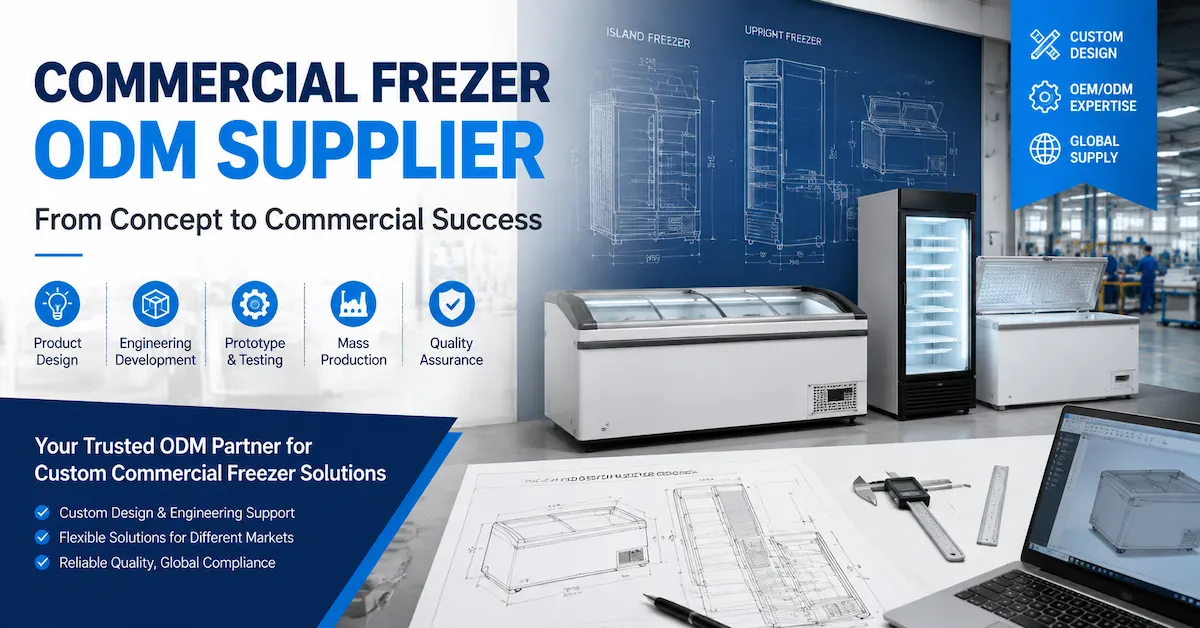
Snowsea provides OEM and ODM commercial refrigeration solutions for B2B buyers developing products for different commercial applications and markets.
What Is a Commercial Freezer ODM Supplier?
An ODM supplier supports both product development and manufacturing based on a buyer's commercial requirements.
The development may start from:
- An existing factory platform
- A modified standard freezer
- A buyer's reference product
- A concept drawing
- A technical specification
- A new cabinet configuration
The amount of engineering work varies significantly between projects.
A simple ODM project may modify an existing platform, while a more complex project may require changes to cabinet structure, airflow, tooling, controls, refrigeration components, and appearance.
OEM vs ODM: What Is the Difference for Freezer Buyers?
OEM and ODM are often used interchangeably in sourcing discussions, but buyers should clarify the actual scope of work.
| Area | OEM Project | ODM Project |
|---|---|---|
| Existing product platform | Usually used | May be used or redesigned |
| Private label | Common | Common |
| Color and logo changes | Common | Common |
| Structural development | Limited to moderate | Moderate to extensive |
| Engineering input | Buyer often defines more | Supplier may contribute more |
| Prototype development | Sometimes | Usually important |
| New tooling | Possible | More likely |
| Development cost | Usually lower | Can be higher |
| Development lead time | Usually shorter | Often longer |
| Technical risk | Lower for standard models | Higher for new designs |
The key question is not which label the supplier uses.
Buyers should define who is responsible for design, engineering, testing, tooling, documentation, and final production approval.
What Development Capabilities Should an ODM Supplier Have?
A capable Commercial Freezer ODM Supplier should be able to translate a commercial requirement into measurable technical specifications.
Product Requirement Definition
Before design work begins, the supplier should understand:
- Target application
- Freezer type
- Required capacity
- Temperature range
- Product loading
- Door-opening frequency
- Installation environment
- Destination market
- Target price range
- Expected annual volume
A product designed for a convenience store may require different priorities from one intended for seafood retail or bulk frozen-food storage.
Cabinet Engineering
Cabinet development may include:
- Exterior dimensions
- Internal volume
- Door structure
- Shelf spacing
- Handle position
- Evaporator location
- Air ducts
- Drainage
- Service access
Structural changes can influence thermal performance and production tooling, so they should be reviewed before prototypes are built.
Refrigeration System Development
The refrigeration system may require matching between:
- Compressor
- Condenser
- Evaporator
- Refrigerant
- Fan system
- Capillary or expansion device
- Temperature controller
- Defrost method
Changing cabinet volume without reviewing refrigeration capacity can create slow pull-down or unstable temperature performance.
For compressor-related evaluation, buyers can review Snowsea's commercial freezer compressor reliability test.
Existing Platform Modification vs New Product Development
Not every ODM project needs to start from zero.
Existing Platform Modification
Using an existing freezer platform may reduce:
- Development time
- Tooling investment
- Engineering risk
- Sample iterations
Typical modifications may include:
- Color
- Logo
- Controller
- Shelving
- Handles
- Packaging
- Selected components
Deeper Product Development
A more differentiated product may require:
- New cabinet dimensions
- Different door geometry
- New internal layout
- Modified airflow
- New molds
- Revised refrigeration configuration
- Customized control functions
This can create stronger product differentiation but also increases cost, development time, and validation requirements.
Prototype and Sample Validation
A custom freezer should not move directly from drawing approval to bulk production.
Prototype validation helps identify problems before they become mass-production defects.
Buyers should review:
- Dimensions
- Appearance
- Cabinet assembly
- Door operation
- Temperature performance
- Temperature uniformity
- Pull-down performance
- Airflow
- Noise
- Defrost
- Controller operation
- Packaging
If airflow has been modified, Snowsea's guide to commercial freezer airflow circulation design explains why product loading and air-distribution paths should be considered during validation.
Tooling, Molds and NRE Costs
ODM projects may require one-time development expenses.
These are sometimes described as:
- Tooling cost
- Mold cost
- Engineering fee
- Development fee
- NRE, or non-recurring engineering cost
Buyers should confirm what each charge includes.
Questions should include:
- What tooling is required?
- Who pays for it?
- Who can use the tooling?
- How many revisions are included?
- What happens if the prototype fails?
- Is tooling maintenance included?
- Are future modifications charged separately?
Tooling ownership and usage rights should be clearly documented in the commercial agreement rather than assumed.
Engineering Change Management
ODM projects often change during development.
A buyer may request:
- Different compressor
- New handle
- Revised shelf spacing
- Different controller
- Thicker insulation
- Modified packaging
- New branding
Changes should be documented because one modification can affect other specifications.
For example, changing internal cabinet geometry may affect airflow, usable volume, insulation, tooling, or packaging.
A good engineering change process should identify:
- What is changing
- Why it is changing
- Cost impact
- Lead-time impact
- Testing required
- Version number
- Approval status
This becomes especially important when development moves into mass production.
How Quality Testing Should Support ODM Development
A custom product needs validation against the final approved specification.
Important areas may include:
Temperature Performance
Evaluate:
- Pull-down
- Stability
- Uniformity
- Recovery
Cabinet Performance
Review:
- Insulation
- Door sealing
- Structural consistency
- Material quality
Snowsea's freezer cabinet insulation performance comparison provides additional information on thermal insulation factors.
Functional Testing
Depending on the design:
- Fans
- Lighting
- Controller
- Defrost
- Switches
- Doors
- Electrical components
Final Production Inspection
The approved prototype should become the reference for production rather than allowing uncontrolled changes during manufacturing.
Snowsea's commercial freezer quality testing procedure provides a broader checklist for factory testing and pre-shipment verification.
From Prototype to Mass Production
One of the highest-risk stages in an ODM project is transferring a successful prototype into repeatable production.
A handmade sample may perform well but use processes that are difficult to reproduce consistently at scale.
Before mass production, buyers should confirm:
- Final drawings
- Final BOM
- Component suppliers
- Approved sample
- Tooling status
- Production work instructions
- QC checkpoints
- Testing requirements
- Packaging specification
Pilot Production
For more complex projects, a pilot batch can help identify production issues before the full order begins.
This may reveal:
- Assembly difficulties
- Component fit problems
- Variation between units
- Packaging problems
- Longer-than-expected production time
MOQ and Lead Time for ODM Projects
ODM MOQ depends on development depth and component requirements.
Projects with unique materials, special compressors, custom glass, new molds, or customized electronics may require higher quantities because suppliers must also manage upstream component MOQs.
Buyers should distinguish between:
Sample lead time
Time required to develop and validate the prototype.
Tooling lead time
Time required for new molds or fixtures.
Mass-production lead time
Time required after final approval.
A supplier promising an unusually short ODM schedule should still explain how engineering validation and production preparation will be completed.
How to Compare Commercial Freezer ODM Suppliers
Use a structured supplier comparison rather than comparing quotation price alone.
| Evaluation Factor | What Buyers Should Check |
| Development capability | Can the supplier convert requirements into specifications? |
| Existing platforms | Are suitable base models available? |
| Engineering support | Can structural and refrigeration changes be evaluated? |
| Prototype process | Are samples built and tested before production? |
| Tooling capability | Are mold requirements and ownership clear? |
| QC system | Are testing and acceptance criteria defined? |
| Change control | Are engineering revisions documented? |
| Production transfer | Can the approved design be reproduced consistently? |
| Packaging | Is export packaging developed with the product? |
| After-sales | Are spare parts and technical support available? |
The best supplier is not always the one offering the greatest number of custom options.
The stronger partner is usually the one that can explain what can be customized, what should not be changed, what needs validation, and what each decision costs.
Key ODM Sourcing Risks
Starting Without Clear Requirements
An unclear brief creates repeated sample revisions and delays.
Too Much Customization at Once
Every new component or structure increases development risk.
Changing Parts Without Revalidation
A lower-cost component may affect performance or reliability.
Moving to Production Too Early
Mass production should begin only after specifications and samples are formally approved.
Ignoring Packaging Development
A custom cabinet can require new foam protection or carton dimensions.
See Snowsea's freezer export packaging drop protection for related transport-risk considerations.
Unclear Design and Tooling Rights
Buyers should document ownership, usage rights, confidentiality requirements, and approved product scope in their commercial agreements.
What Should Buyers Include in an ODM RFQ?
A useful RFQ should include:
- Product type
- Application
- Reference photos or drawings
- Target dimensions
- Capacity
- Temperature range
- Destination market
- Voltage and frequency
- Refrigerant preference
- Door configuration
- Cabinet material
- Required functions
- Branding
- Packaging
- Expected quantity
- Target launch date
- Existing certifications or compliance needs
Also state which requirements are mandatory and which are flexible.
This gives the supplier more room to propose technically and commercially realistic solutions.
FAQ
What does a commercial freezer ODM supplier do?
An ODM supplier supports product development and manufacturing, potentially including cabinet design, refrigeration configuration, prototyping, tooling, testing, branding, and mass production.
How is ODM different from OEM?
OEM commonly focuses on manufacturing to defined buyer specifications, while ODM usually involves greater supplier participation in product design and development. Actual project scope should always be confirmed.
Can an ODM supplier develop a completely new freezer?
Potentially, but feasibility depends on engineering capability, tooling, budget, development time, projected volume, and technical requirements.
Is ODM more expensive than OEM?
ODM can involve higher initial development and tooling costs, although using an existing product platform may reduce these costs.
How many samples are needed before production?
There is no universal number. The project should continue through sample iterations until the agreed specifications and acceptance requirements are achieved.
Who owns the mold in an ODM project?
This depends on the commercial agreement. Tooling ownership and usage rights should be documented before payment.
Can the compressor and refrigerant be customized?
Potentially, but changes should be technically matched with the entire refrigeration system and validated for the target application.
What should be tested on a custom freezer?
Depending on the design, testing may cover pull-down, temperature stability, airflow, recovery, doors, insulation, defrost, controls, electrical functions, appearance, and packaging.
What is the biggest risk in an ODM freezer project?
One major risk is approving development without sufficiently clear specifications and then discovering technical or production problems after tooling or mass production has begun.
Can Snowsea support ODM commercial freezer projects?
Snowsea provides OEM/ODM commercial refrigeration solutions. Buyers can submit product concepts, specifications, target markets, branding needs, and expected quantities for project evaluation.
Conclusion
Choosing a Commercial Freezer ODM Supplier requires evaluating much more than manufacturing price.
For B2B buyers developing differentiated refrigeration products, the supplier should demonstrate engineering capability, prototype validation, tooling management, change control, quality testing, production transfer, export packaging, and long-term supply support.
A successful ODM project begins with clear commercial requirements, converts them into measurable technical specifications, validates the design before mass production, and controls changes throughout the product lifecycle.
Snowsea supports commercial refrigeration OEM and ODM projects for global B2B buyers. Explore Snowsea's OEM/ODM solutions, browse commercial refrigeration products, or contact Snowsea to discuss product concepts, development requirements, prototypes, and custom commercial freezer projects.