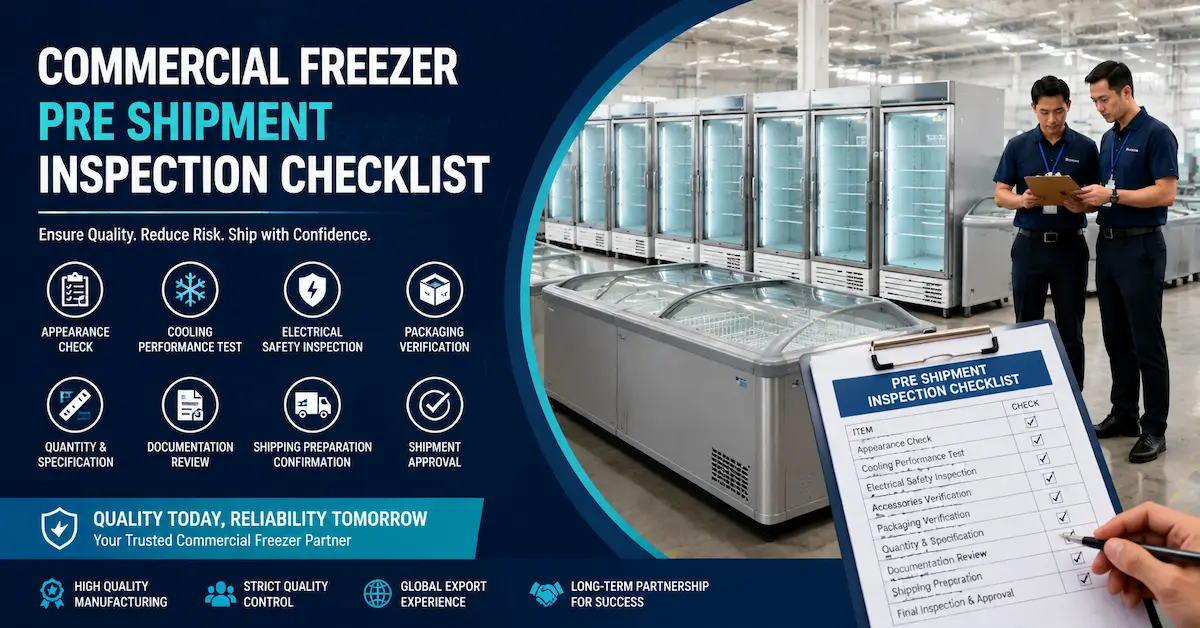
Commercial freezer quality standards should tell a buyer exactly what “acceptable product” means before production begins. A freezer reaching a low temperature once is not enough. Neither is a clean cabinet, an impressive compressor name or a final inspector signing a checklist. For distributors, importers and private-label refrigeration brands, commercial freezer quality should be evaluated as a complete system: approved specification, cabinet construction, insulation, refrigeration components, temperature performance, electrical operation, controls, manufacturing consistency, packaging and shipment acceptance. SNOWSEA’s current OEM/ODM manufacturing process separates production into material processing, structural assembly, insulation, refrigeration installation, final assembly, performance testing, inspection and packing, which provides a useful framework for building an order-specific quality plan.
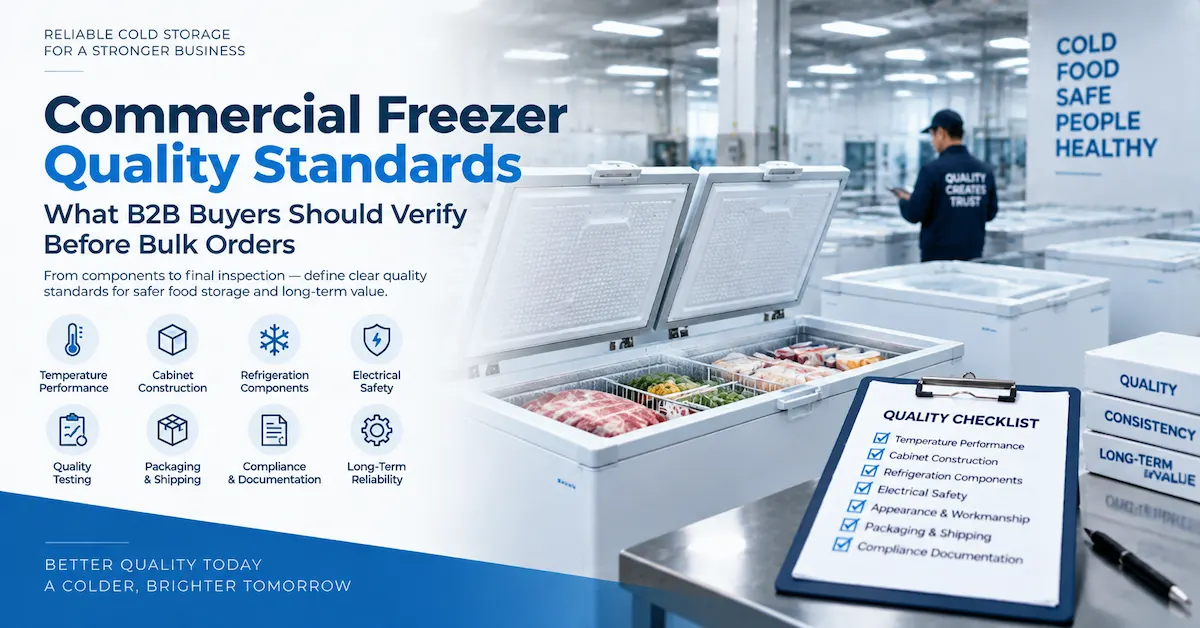
Commercial Freezer Quality Standards Are Not One Single Number
For B2B procurement, the phrase “quality standards” is often used too broadly. Three different requirements should be kept separate. Product requirements define what the freezer must do for the intended application. Market or compliance requirements define which documents, markings or approvals may be required for a particular destination. Factory quality-control requirements define how the approved product is manufactured and inspected consistently.
Mixing these three creates problems. A supplier may show a compliance document, but that does not tell you whether the door gasket is aligned correctly. A cabinet may pass final appearance inspection, but that does not prove temperature uniformity. A prototype may perform well, but that does not prove the next 500 units will use the same controller or refrigeration configuration.
A useful purchasing specification therefore converts “good quality” into measurable and traceable acceptance points.
1.Start With an Approved Product Specification
Before defining inspection standards, define the product. Every quality decision should refer back to an approved model and configuration.
A commercial freezer specification can include the intended application, nominal or usable capacity, cabinet dimensions, temperature requirement, refrigerant, cooling and defrost configuration, voltage, frequency, plug type, controller, liner, baskets, doors or glass, lighting, locks, branding and packaging.
| Quality-Control Area | What the Buyer Should Define | What the Supplier Should Confirm |
|---|---|---|
| Model | Exact freezer reference | Production model/version |
| Application | Frozen food,ice cream or another defined use | Suitability of proposed platform |
| Capacity | Required storage/loading | Published and usable configuration |
| Dimensions | Maximum installation space | Cabinet and packed dimensions |
| Temperature | Required holding conditions | Test basis and acceptance criteria |
| Electrical | Voltage, frequency,plug | Correct market version |
| Refrigeration | Cooling/defrost requirement | Approved system configuration |
| Components | Controller and critical parts | Final approved versions |
| Accessories | Baskets, locks, wheels, lighting | Included vs.optional |
| Branding | Standard or private label | Artwork revision |
| Packaging | Export route and protection need | Packing specification |
| QC | Required inspection items | Factory inspection plan |
This first step is important because quality cannot be inspected against an undefined product. SNOWSEA’s recent OEM specification-control content likewise emphasizes linking the approved configuration to production rather than relying on a model name alone.
2. Incoming Components Should Match the Approved Configuration
Commercial freezer quality begins before cabinet assembly. Depending on the product, important incoming items can include compressors, controllers, fan motors, electrical components, door gaskets, glass, cabinet panels and other refrigeration components.SNOWSEA’s published OEM factory guidance identifies these as relevant incoming-control areas.
The objective is not to insist that every component must come from one famous brand. The more useful purchasing question is whether the approved configuration is clearly defined and whether substitutions are controlled.
Ask:
What component is approved?
Are alternatives pre-approved?
Who decides when a substitution is necessary?
Does the buyer need to approve the change?
Does the change affect testing or documentation?
For repeat orders, this matters because two cabinets with the same exterior model name can become different service products if controls, motors or other important parts change without traceability.
3. Cabinet Construction Should Be Inspected as Part of Refrigeration Quality
A freezer cabinet is part of the refrigeration system.Panel alignment, insulation, gasket contact, lid or door fit and structural workmanship can all affect how the equipment operates and how it survives daily use.
A cabinet QC checklist can include:
- External dimensions
- Surface condition
- Lid or door alignment
- Opening and closing operation
- Gasket seating
- Handle and lock operation
- Basket or shelf fit
- Drain accessibility
- Castor or foot installation where applicable
- Control-panel installation
- Interior finish
- Visible gaps or deformation
SNOWSEA’s OEM factory content similarly treats insulation quality, door alignment, gasket sealing and airflow distribution as quality considerations rather than judging performance through the compressor alone.
For a private-label project, the approved appearance sample should be retained separately from technical inspection criteria. “Looks similar to the sample” should not replace measurable dimensional or workmanship requirements.
4. Insulation Quality Needs Process Control, Not Marketing Language
Commercial freezer insulation is largely hidden after assembly, so buyers cannot judge it only from the finished exterior. The manufacturing process becomes important.
SNOWSEA lists foaming and insulation as a distinct production stage in its OEM/ODM process. Buyers should ask how the selected cabinet construction is controlled during that stage and how a custom cabinet or insulation change is handled.
Avoid converting terms such as “high-density foam” or “thick insulation” directly into claims of a specific energy-saving percentage unless suitable test evidence exists.
The procurement requirement should instead focus on the approved construction and the resulting performance under defined conditions.
5. Refrigeration-System Quality Should Be Evaluated as a System
A commercial freezer is not simply a compressor inside a box.Performance depends on the relationship between the compressor, condenser, evaporator, refrigerant circuit, controller, sensors, cabinet, insulation, airflow where applicable and defrost system.
This is why changing one component can affect previous performance results.
When evaluating the refrigeration system, buyers can verify:
- Approved compressor configuration
- Refrigerant configuration
- Refrigeration piping workmanship
- Controller and sensor configuration
- Condenser and evaporator arrangement
- Fan operation where applicable
- Refrigeration-system operation
- Leak-related production checks where applicable to the factory process
- Defrost operation where applicable
- Stable compressor cycling after stabilization
SNOWSEA’s recent compressor-cycling technical content notes that changes to components such as the compressor, controller, sensor, condenser, evaporator, fan, cabinet or door configuration can require previous operating behavior to be reviewed.
That is an important principle for commercial freezer quality standards: test results belong to a defined configuration.
6. Pull-Down Temperature Is Only One Performance Check
A supplier may demonstrate that a cabinet reaches the target temperature, but pull-down alone does not describe complete operating quality.
SNOWSEA’s current technical content distinguishes several different performance checks:
Pull-down performance — how the cabinet reaches the required condition.
Temperature stability — how temperature behaves after stabilization.
Temperature uniformity — how temperatures differ across locations inside the usable cabinet.
Recovery performance — how the freezer responds after door opening, lid opening or product loading.
Loaded performance — how the cabinet behaves with a representative product or simulated load.
These should not be combined into one statement such as “temperature test passed.” SNOWSEA’s temperature-range guidance separately identifies pull-down, temperature mapping, load testing, recovery and ambient-condition testing as meaningful evaluation areas.
7. Temperature Uniformity Needs Defined Measurement Conditions
One temperature reading cannot prove that every part of a freezer maintains the same conditions. SNOWSEA’s published temperature-uniformity guidance explicitly notes that a controller reading does not describe the entire cabinet and recommends documenting ambient condition, loading, sensor quantity and locations, recording duration, door behavior and temperature extremes.
For a B2B quality specification, record:
| Temperature Test Detail | Buyer Question |
|---|---|
| Ambient condition | Under what surrounding condition was testing performed? |
| Cabinet condition | Empty,partially loaded or loaded? |
| Setpoint | What was the controller trying to maintain? |
| Measurement locations | Where were sensors positioned? |
| Stabilization | When did measurement begin? |
| Recording period | How long was performance monitored? |
| Door/lid operation | Was normal access simulated? |
| Defrost | Was a defrost event included where relevant? |
| Results | Maximum,minimum and average values available? |
| Acceptance | What result constitutes a pass? |
Two suppliers should not be compared using temperature-uniformity figures measured under completely different conditions.
8. Door-Opening and Loading Recovery Can Matter More Than an Empty-Cabinet Test
Retail and foodservice freezers rarely remain closed and empty. Staff replenish stock, customers open glass lids, restaurant workers retrieve ingredients and new products enter the cabinet.
Temperature recovery therefore becomes relevant when the application includes frequent disturbances.
SNOWSEA’s temperature guidance identifies product loading, door opening, customer traffic and cleaning as situations that can change cabinet temperature.
A buyer does not necessarily need the same recovery test for every application. A reserve freezer opened twice a day is different from a high-traffic retail display. Define the test according to the actual use case.
That is more meaningful than applying one arbitrary recovery requirement across every freezer model.
9. Defrost Quality Standards Depend on the Selected System
Manual-defrost and no-frost products should not be evaluated with identical assumptions.
SNOWSEA publishes the BD/BC-227WA no-frost freezer as an air-cooled no-frost platform with electronic control. For such a configuration, buyers should understand fan control, defrost operation, controller parameters and temperature behavior during the operating cycle. SNOWSEA’s controller guidance also lists fan control, defrost operation, compressor restart delay, sensor response and temperature recovery among relevant customized-controller checks.
For a conventional chest freezer, scheduled manual defrost and drain accessibility may be more relevant.
Do not convert “no frost” directly into “higher quality.” It is a system choice. Quality means the chosen system performs as specified and is manufactured consistently.
10. Electrical Quality Should Be Checked Separately From Cooling Performance
A freezer can cool correctly and still have an electrical or control issue.
Commercial freezer quality control may include checking:
- Correct voltage/frequency configuration
- Wiring workmanship
- Plug type
- Controller operation
- Switch operation
- Lighting where fitted
- Fan operation where fitted
- Sensor response
- Compressor switching logic
- Power-cycle behavior
- Applicable safety-related factory inspection items
SNOWSEA’s ice cream freezer wholesale content separates electrical inspection from refrigeration and cabinet inspection, including controller, wiring, lighting and safety-function checks.
For export buyers, make sure the rating label matches the electrical version actually installed. A correctly printed label on the wrong electrical configuration is not acceptable, and a technically correct unit carrying the wrong identification also creates downstream risk.
11.Energy Consumption Must Be Compared Under the Same Test Basis
A number such as “1.8 kWh/day” is incomplete without context. SNOWSEA’s commercial freezer energy-testing article makes the same point: load condition, cabinet temperature, ambient environment, door operation, lighting and defrost behavior can influence the result.
If energy is a purchasing criterion, request:
- Exact model and configuration
- Ambient condition
- Operating target
- Loaded or empty state
- Door-opening condition
- Defrost treatment where applicable
- Lighting status
- Test duration
- Recorded consumption
- Production configuration linked to the result
Do not compare an empty freezer tested under one environment with a loaded freezer tested under another and then declare one factory more efficient.
Energy performance should be a controlled comparison, not a marketing adjective.
12.Glass, Door and Gasket Quality Needs Application-Specific Checks
Glass-top ice cream freezers and solid-lid storage freezers create different inspection priorities.
For an ice cream freezer, check:
- Glass condition
- Frame alignment
- Sliding movement
- Customer access
- Basket fit
- Product visibility
- Gasket/sealing condition
- Glass protection in export packaging
For a storage chest freezer, lid alignment, hinges, gasket contact and loading access may matter more.
SNOWSEA’s ice cream freezer range includes glass-top designs intended for frozen display applications, while its wholesale guidance specifically calls out glass condition, door operation and interior structure as shipment-quality items.
A single “door quality: pass” line is too broad when different cabinet types use different access systems.
13. Compare Commercial Freezer Models With Different QC Priorities
Different product structures create different quality risks. The following examples show why a universal one-page checklist may miss important items.
| SNOWSEA Model | Published Starting Point | Main QC Focus for Buyers |
|---|---|---|
| BD-308 | 308L chest freezer | Cabinet workmanship, basket/accessory configuration, loading, controls |
| BD-500 | 500L double-lid chest freezer | Lid alignment, larger cabinet structure, loading, refrigeration and packaging |
| BD/BC-227WA | 227L air-cooled no-frost freezer | Controller, fan/defrost behavior, airflow and electrical configuration |
| SD/SC-268PM | 268L flat sliding-glass ice cream freezer | Glass, baskets, product visibility, access and transport protection |
The purpose is not to declare one model higher quality. Quality standards should reflect the product architecture and application being purchased.
14.Factory QC Should Have Three Different Levels
A useful commercial freezer quality plan separates sample validation, production control and pre-shipment inspection.
Sample validation establishes whether the proposed configuration meets the agreed requirement.
Production control checks whether bulk manufacturing continues to use the approved configuration and process.
Pre-shipment inspection verifies the completed order before release.
SNOWSEA’s commercial freezer project content uses the same distinction, noting that sample validation establishes what should be made, production checks verify consistency and pre-shipment inspection checks finished goods against agreed acceptance items.
Combining all three under “QC passed” hides too much information.
15. Quality Records Are More Useful Than Inspection Equipment Alone
Seeing test equipment in a factory is helpful.Seeing how results are recorded and connected to actual products is more useful.
Ask:
- Which product was tested?
- Which revision or configuration?
- When was it tested?
- What result was recorded?
- What was the acceptance limit?
- What happened when a unit failed?
- Was it reworked and retested?
- Who released the unit?
- Can the record be linked to a batch or production run?
This approach turns quality control into traceability rather than presentation.
Buyers planning a first bulk order can combine this article with SNOWSEA’s commercial freezer factory audit guide, which focuses on following an approved model through actual factory processes.
16. OEM Quality Standards Must Include Change Control
For OEM and private-label projects, quality is not limited to temperature and cabinet workmanship.It also includes keeping the approved product version unchanged unless a new change is accepted.
Control:
- Private-label model number
- Base factory model
- Controller
- Refrigeration components
- Cabinet configuration
- Electrical version
- Logo
- Rating label
- Manual
- Carton
- Accessories
- Approved alternatives
If a component changes, ask whether the previous test data still represents the production version.
SNOWSEA’s commercial freezer OEM specification-control guide focuses specifically on this issue: the approved sample must become a controlled production specification rather than an informal reference.
For repeat orders, use a specification revision and require proposed deviations to be disclosed before production.
17. Compliance Documents Must Match the Model and Destination
Commercial freezer quality and compliance overlap, but they are not identical.
Buyers should identify destination-market requirements and request applicable documents for the exact model, electrical version and configuration being purchased. A general certificate displayed on a company page should not automatically be treated as evidence for every freezer or every private-label variation.
SNOWSEA’s current procurement content repeatedly advises buyers to match compliance evidence to the product and destination rather than assuming universal coverage.
If a custom controller, refrigeration component or structural design changes, ask whether the relevant documentation needs another review.
This also means marketing claims should be controlled. Do not print specific efficiency, noise, freezing-speed or compliance claims on an OEM carton until they are supported for the actual production version.
18. Bulk-Production Quality Means Batch Consistency
A perfect prototype is not enough for a distributor ordering hundreds of units.
Bulk quality means the approved configuration and acceptable performance are reproduced across production batches. Ask how the factory ensures that the same model, components, controller parameters, accessories and packaging remain consistent.
For ice cream freezer procurement, SNOWSEA’s factory-quality content highlights exactly this concern: buyers may receive a strong sample while later batches show differences in temperature behavior, glass, sealing or structure.
The buyer’s quality standard should therefore include both unit acceptance and batch consistency.
A unit can pass individually while the overall manufacturing process still shows too much variation.
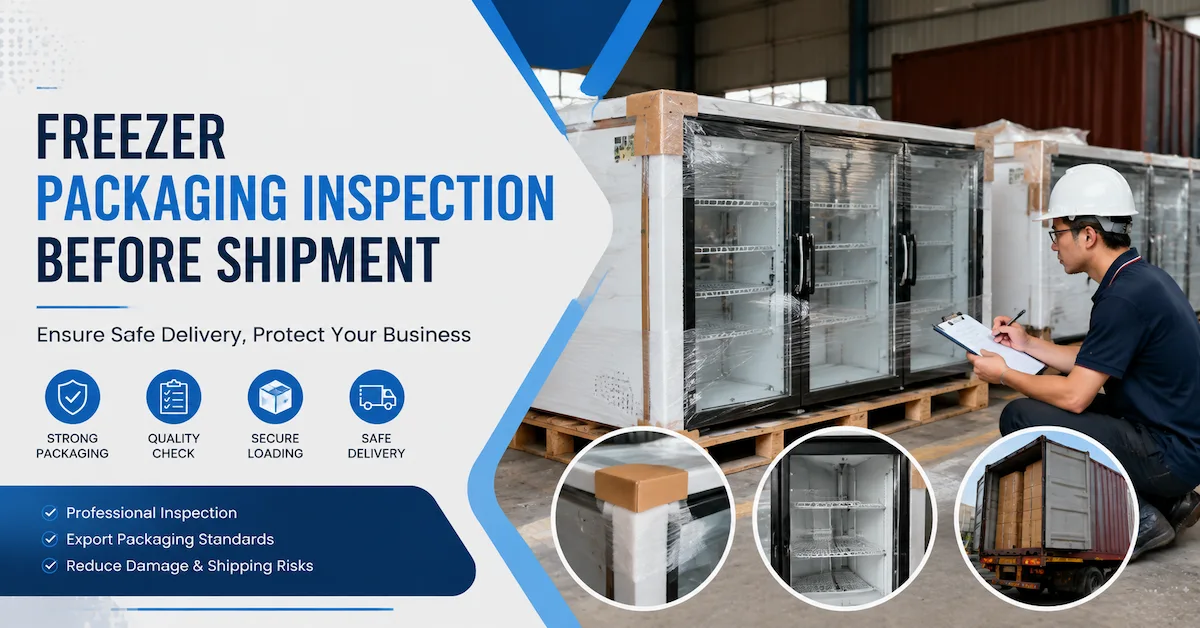
19. Export Packaging Is Part of Commercial Freezer Quality
A freezer is not successfully manufactured if it leaves the factory in good condition but repeatedly arrives damaged.
Packaging quality can include:
- Protective film
- Foam cushioning
- Corner protection
- Reinforced carton
- Bottom/base protection
- Lid or door fixation
- Glass protection
- Accessory fixation
- Model identification
- Shipping marks
SNOWSEA’s pricing and wholesale guidance treats packaging as part of procurement quality because insufficient protection can create cabinet, glass and shipping damage.
Ask for final packed dimensions and packaging specifications for the version you are actually buying. Customized cartons or product dimensions can change container planning.
20. Pre-Shipment Inspection Needs Written Acceptance Criteria
Do not wait until the shipment is finished to decide what final QC should inspect.
A pre-shipment checklist can cover:
| Final Inspection Area | Example Check |
|---|---|
| Model | Matches PO/specification |
| Quantity | Matches shipment requirement |
| Electrical version | Correct voltage/frequency/plug |
| Appearance | Agreed workmanship standard |
| Doors/lids/glass | Correct operation and condition |
| Controls | Functional and correct version |
| Accessories | Correct quantities |
| Identification | Rating label/model/artwork |
| Documentation | Manuals and required files |
| Functional checks | Agreed production QC items |
| Packaging | Correct protection and markings |
| Batch information | Traceable where required |
Decide which checks apply to every unit and which use an agreed sampling method.
The inspection company, buyer and factory should not be debating what counts as a defect while the container is already booked.
21. Quality Standards Should Include the After-Sales Feedback Loop
Field performance can reveal issues that final inspection cannot reproduce.
Distributors should track:
- Failure type
- Model/version
- Production batch
- Time in service
- Operating environment
- Diagnosis
- Replacement part
- Corrective action
- Repeated occurrence
SNOWSEA’s About Us information describes spare-parts availability, technical documentation and remote support. Buyers should still confirm model-specific warranty, parts, labor and freight responsibilities for their order.
A useful supplier relationship feeds repeated field problems back into production and engineering instead of treating every warranty case as an isolated event.
How Should Buyers Build a Commercial Freezer QC Standard?
A practical quality plan can be built in five layers:
Layer 1 — Product Specification: what exactly are we buying?
Layer 2 — Validation Requirements: what must the sample prove?
Layer 3 — Production Controls: what must stay consistent during manufacturing?
Layer 4 — Shipment Acceptance: what must be checked before release?
Layer 5 — Field Feedback: how are real failures traced and improved?
This is more effective than a one-page inspection checklist because it controls quality across the product lifecycle.
SNOWSEA’s OEM/ODM manufacturing process provides the production structure; buyers should add their own application-specific specifications and acceptance criteria rather than assume one universal checklist can serve every commercial freezer project.
What Should You Send SNOWSEA With Your Quality Requirements?
A strong quality RFQ should provide the destination market, intended freezer application, selected model or capacity requirement, stored products, package dimensions, operating conditions, electrical configuration, order quantity, OEM requirements and the tests or documents required by your project.
Ask SNOWSEA to identify:
- Recommended model
- Standard configuration
- Optional items
- Model-specific test scope
- Inspection process
- Applicable documentation
- Sample requirements
- Production QC
- Final inspection scope
- Packaging
- Spare-parts plan
- Unresolved items
Use the SNOWSEA project contact page to submit these requirements before bulk production. This makes the quality discussion part of the quotation and specification rather than an issue discovered after the order is complete.
Frequently Asked Questions
1.What are commercial freezer quality standards?
Commercial freezer quality standards are the agreed requirements used to define, manufacture, test and accept a freezer. For B2B procurement, they can include specification control, cabinet workmanship, refrigeration performance, electrical operation, temperature testing, production consistency, packaging and shipment inspection, together with applicable destination-market requirements.
2. Is reaching the target temperature enough to prove freezer quality?
No. Buyers should also consider temperature stability, uniformity, loading conditions, recovery behavior and the test environment where relevant. One controller reading does not describe performance throughout the complete cabinet.
3. How should commercial freezer temperature uniformity be evaluated?
Define ambient conditions, loading, sensor positions, stabilization, recording duration and acceptance criteria before comparing results. SNOWSEA’s temperature uniformity guide explains why results without test conditions have limited procurement value.
4. What should factory QC inspect on a commercial freezer?
Depending on the model, QC may include cabinet construction, seals, doors or glass, refrigeration components, electrical systems, controls, accessories, temperature performance, product identification and packaging.
5. Are all commercial freezer models tested in exactly the same way?
Not necessarily. Different products use different cabinet, cooling, control and display systems. Buyers should confirm the model-specific validation and production inspection plan rather than assume one test applies to every freezer.
6. How should OEM freezer quality be controlled?
Link the approved sample to a controlled specification revision covering the technical configuration, electrical version, artwork, labels, accessories and packaging. Require important changes to be approved before implementation. Review SNOWSEA’s OEM specification-control guide for this workflow.
7. Is a pre-shipment inspection the same as factory quality control?
No. Factory QC takes place throughout manufacturing, while pre-shipment inspection checks completed goods against the agreed order before shipment. Both can be useful, but they perform different functions.
8. How should energy-consumption quality claims be compared?
Compare results only when the model, test conditions, temperature target, loading, door operation, defrost and test duration are understood. SNOWSEA’s energy consumption test guide explains why an isolated kWh/day figure is insufficient.
9. Why is packaging included in commercial freezer quality standards?
Because poor protection can create cabinet, glass, control or structural damage after a freezer has already passed production tests. For export orders, packaging should be included in final acceptance.
10.What information should I send before requesting commercial freezer quality documentation?
Send the exact model or application, destination market, electrical version, order quantity, intended operating conditions, OEM requirements and any required test or inspection criteria. Use SNOWSEA Contact Us to request a model-specific quality and quotation discussion.
Conclusion
Commercial freezer quality standards should turn the word “quality” into a set of requirements that purchasing, engineering, production and inspection teams can verify. Start with a controlled product specification, then evaluate incoming components, cabinet construction, insulation, refrigeration configuration, temperature stability and uniformity, controls, electrical operation, energy data, documentation, packaging and batch consistency under clearly defined conditions. Separate sample validation, production QC and pre-shipment inspection, and make OEM changes traceable so repeat orders remain connected to the approved version. SNOWSEA provides commercial freezer platforms together with an OEM/ODM manufacturing process for B2B orders. If you are preparing a distributor order, private-label freezer range or project purchase, send SNOWSEA your product specification, target market, quantity and quality requirements and request a model-specific proposal covering configuration, testing, QC, documentation, packaging and shipment acceptance.