Commercial Freezer Supplier: How to Improve Storage Efficiency and Reduce Cold Air Loss in High-Traffic Retail Environments
In retail and food service environments, freezer performance is not just about temperature—it is about how efficiently space and airflow are managed during constant usage.
Operators often encounter these issues:
- Products are stacked inefficiently, wasting usable storage space
- Frequent door openings lead to rapid temperature loss
- Cooling systems struggle to recover during peak hours
- Energy consumption increases due to repeated thermal disturbance
These are not isolated operational mistakes. They are design limitations that affect daily efficiency and profitability.
At Snowsea, we work with supermarkets, convenience stores, and commercial kitchens where equipment must perform under constant interaction. By optimizing cabinet layout, airflow pathways, and door systems, we help improve both storage efficiency and cooling stability.
Why Storage Efficiency and Air Loss Are Critical in Commercial Use
In high-traffic environments, freezer systems operate under constant disturbance.
According to ASHRAE, frequent door openings significantly increase thermal load and disrupt airflow balance, leading to energy loss and temperature fluctuation.
Key Performance Challenges
- Cold Air Escape During Door Opening
Vertical freezers lose cold air rapidly due to gravity-driven airflow - Inefficient Storage Layout
Poor shelf design limits usable space and disrupts airflow - Airflow Blockage by Product Placement
Overloaded or poorly arranged products restrict circulation - Extended Recovery Time
Systems take longer to return to set temperature after each opening
These factors reduce both operational efficiency and product quality.
Engineering Solutions: Optimizing Storage and Airflow Together
Improving performance requires integrating storage design with thermal engineering.
Key Design Strategies
- Airflow Channel Optimization
Ensures cold air circulates evenly even when shelves are fully loaded - Multi-Layer Shelf Design
Maximizes storage capacity without blocking airflow - Door Sealing and Auto-Closing Systems
Reduces duration of cold air exposure - Air Curtain and Internal Flow Control
Minimizes temperature loss during door opening
We define this approach as “usage-driven airflow management”, where design is based on real interaction patterns rather than static conditions.
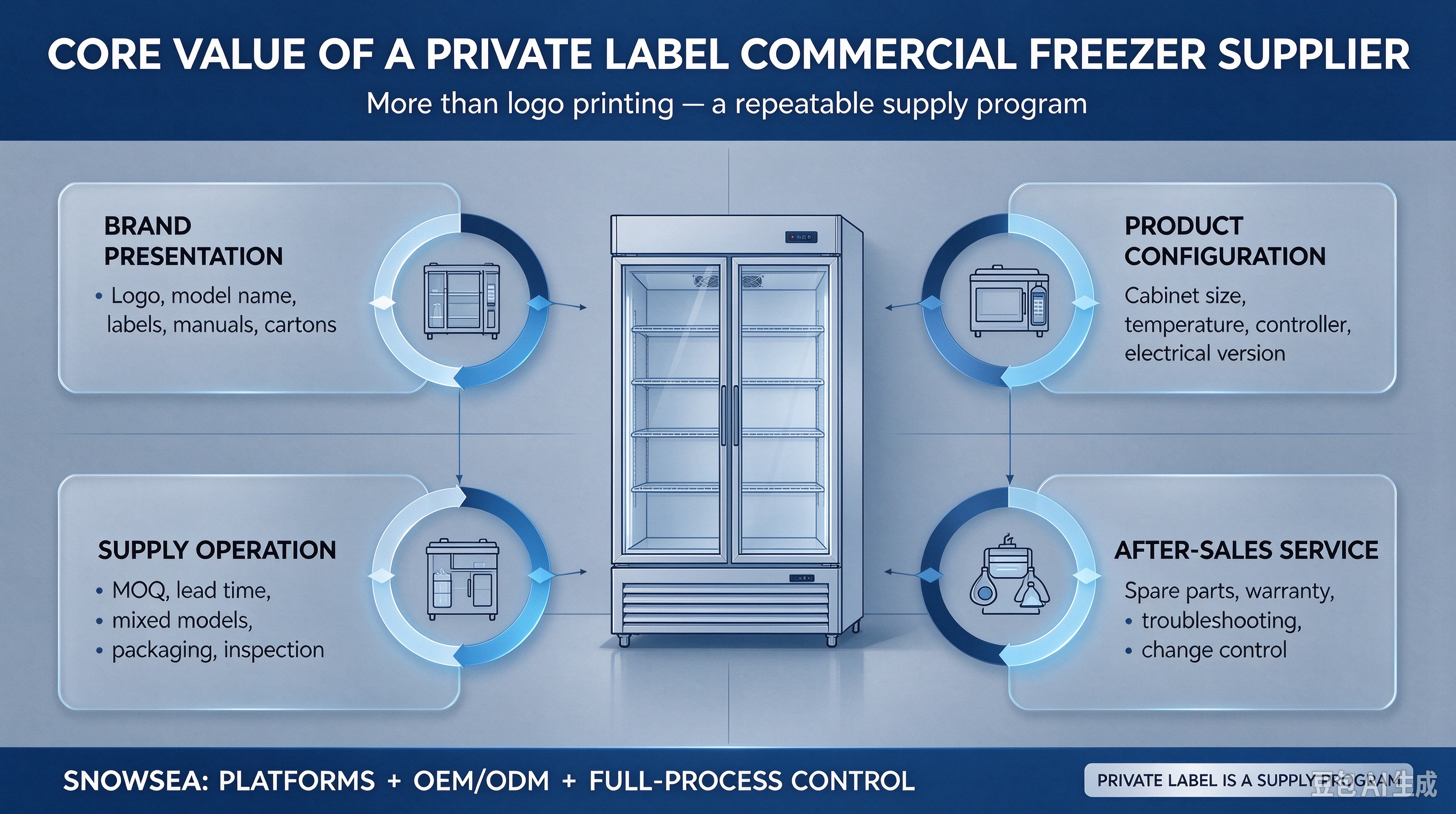
Why Choosing the Right Commercial Freezer Supplier Matters
In high-frequency usage environments, design details directly affect business performance.
A qualified commercial freezer supplier must:
- Understand real customer interaction patterns
- Design for frequent access rather than occasional use
- Balance storage capacity with airflow efficiency
At Snowsea, we focus on:
- Layout optimization based on product types
- Airflow design that adapts to real usage
- Consistent production ensuring repeatable performance
This allows equipment to perform reliably even in demanding environments.
Measurable Impact on Retail Operations
Design improvements lead to measurable operational benefits.
Performance Comparison
| Parameter | Standard Design | Snowsea Optimized System |
|---|---|---|
| Storage Utilization | Limited | Increased by 15–25% |
| Temperature Recovery Time | 5–7 minutes | 2–3 minutes |
| Energy Consumption | Higher | Reduced by 20% |
| Product Accessibility | Moderate | Improved |
| Cooling Consistency | Uneven | Balanced |
These improvements directly impact sales efficiency and operational cost.
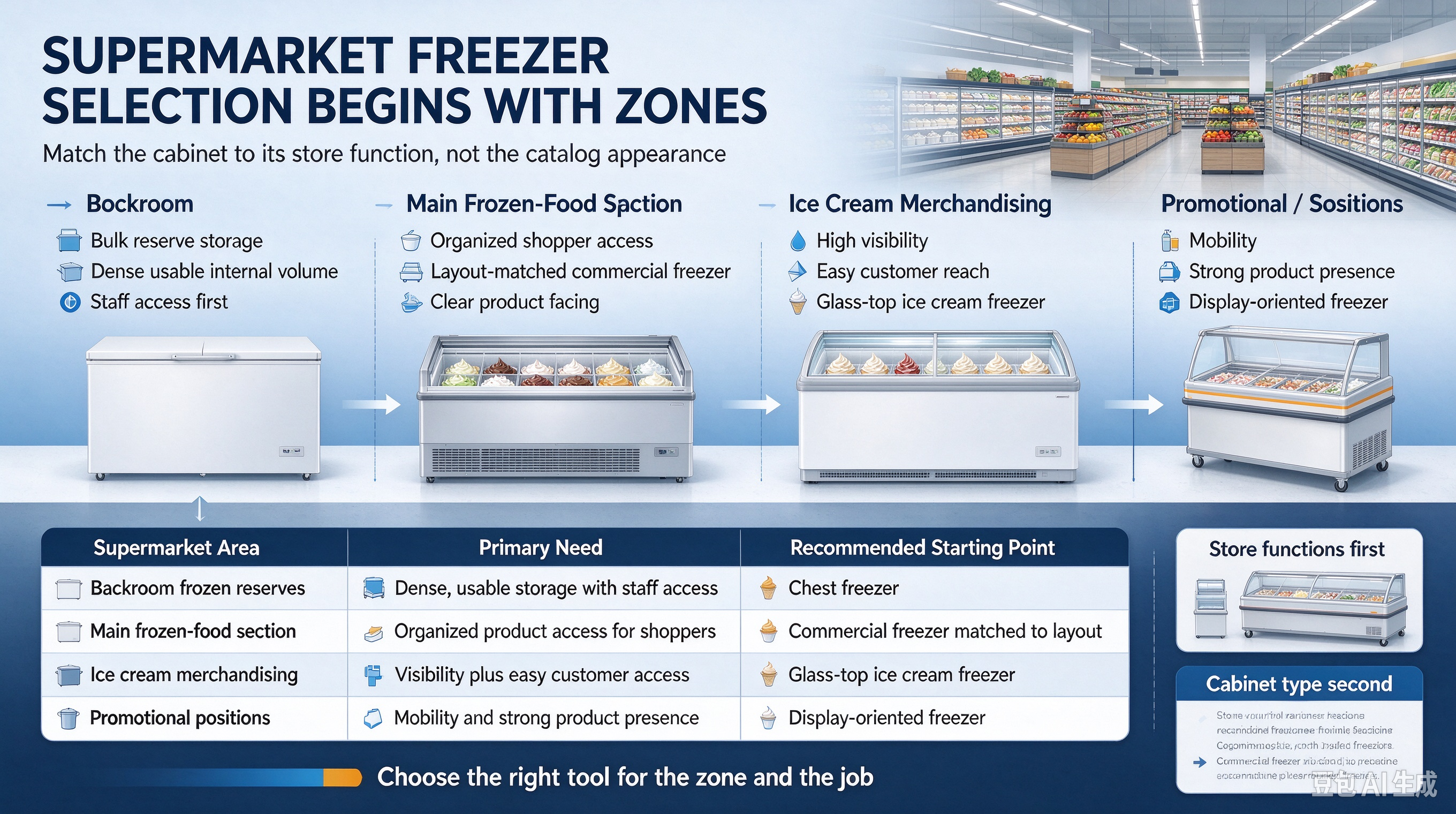
Real Usage Scenarios and Design Requirements
Different commercial environments place different demands on freezer performance.
Supermarkets and Retail Stores
High customer interaction leads to frequent door opening.
Challenges:
- Continuous cold air loss
- Uneven product temperature
- Energy inefficiency
Engineering response:
- Fast recovery cooling systems
- Optimized airflow distribution
- Improved door sealing
Convenience Stores
Limited space requires maximum storage efficiency.
Challenges:
- Space constraints
- High turnover of products
- Frequent access
Engineering response:
- Compact high-capacity design
- Efficient shelf layout
- Balanced airflow system
Commercial Kitchens
Fast-paced environments require quick access and durability.
Challenges:
- Frequent opening during peak hours
- Exposure to external heat
- Heavy usage
Engineering response:
- Reinforced structure
- Fast cooling recovery
- Durable components
Beverage and Display Applications
Visual presentation and temperature consistency are both critical.
Challenges:
- Product arrangement affecting airflow
- Temperature variation across shelves
Engineering response:
- Controlled airflow channels
- Uniform cooling distribution
At Snowsea, we apply interaction-based thermal design, ensuring that systems adapt to real usage patterns.
Case Example: Improving Efficiency in a Retail Chain
A retail client faced operational inefficiencies across multiple locations.
Initial Situation
- Low storage utilization
- High energy consumption
- Uneven product cooling
Improvements Implemented
- Redesigned internal layout
- Optimized airflow system
- Improved door sealing
Results
- Storage capacity increased by 20%
- Energy consumption reduced
- Product consistency improved
This demonstrates how design optimization directly improves business performance.
What Buyers Should Evaluate When Choosing a Commercial Freezer Supplier
When selecting a commercial freezer supplier, focus on three key areas.
Storage and Layout Efficiency
- Is space utilization optimized?
- Does shelf design support airflow?
Snowsea solution: Integrated layout and airflow design.
Airflow and Temperature Control
- Is airflow consistent across all zones?
- Can the system recover quickly after door opening?
Snowsea advantage: Balanced airflow systems for real usage.
Durability and Usage Adaptation
- Can the system handle frequent use?
- Is performance stable over time?
Snowsea capability: Reinforced design for high-frequency environments.
Frequently Asked Questions
Q: Why does temperature fluctuate in retail freezers?
A: Frequent door openings and airflow disruption are the main causes.
Q: How can I improve storage efficiency?
A: Use systems with optimized shelf design and airflow channels.
Q: Does layout affect cooling performance?
A: Yes. Poor layout can block airflow and create uneven cooling zones.
Improving Efficiency in High-Traffic Freezer Environments
Choosing the right commercial freezer supplier is essential for improving storage efficiency and reducing energy loss.
At Snowsea, we focus on:
- Usage-driven airflow management
- Optimized storage layout
- Consistent performance under real conditions
Explore Our Product Range
To find commercial freezer solutions designed for retail and high-traffic environments, visit:
https://www.snowseax.com/products
Contact Us for Project Support
If you are optimizing freezer efficiency in your business, contact our team for tailored solutions:
https://www.snowseax.com/contact