Why Chains Need the Right Commercial Freezer Vendor
Buying refrigeration equipment for one store is very different from managing equipment across 20, 100, or more locations.
A suitable Commercial Freezer Vendor for Chains must help procurement teams control more than the initial freezer price. Chain businesses also need consistent specifications, repeatable quality, predictable replenishment, standardized spare parts, and coordinated delivery for new store openings.
Typical chain buyers include:
- Supermarket groups
- Convenience store chains
- Frozen-food retailers
- Ice cream brands
- Restaurant groups
- Food-service networks
- Regional retail distributors
When each location purchases different equipment independently, the business can gradually develop too many freezer models, components, spare parts, and service procedures.
Centralized freezer procurement reduces this complexity.
Snowsea supplies commercial refrigeration products for distributors, retail groups, private-label brands, and multi-location B2B projects.
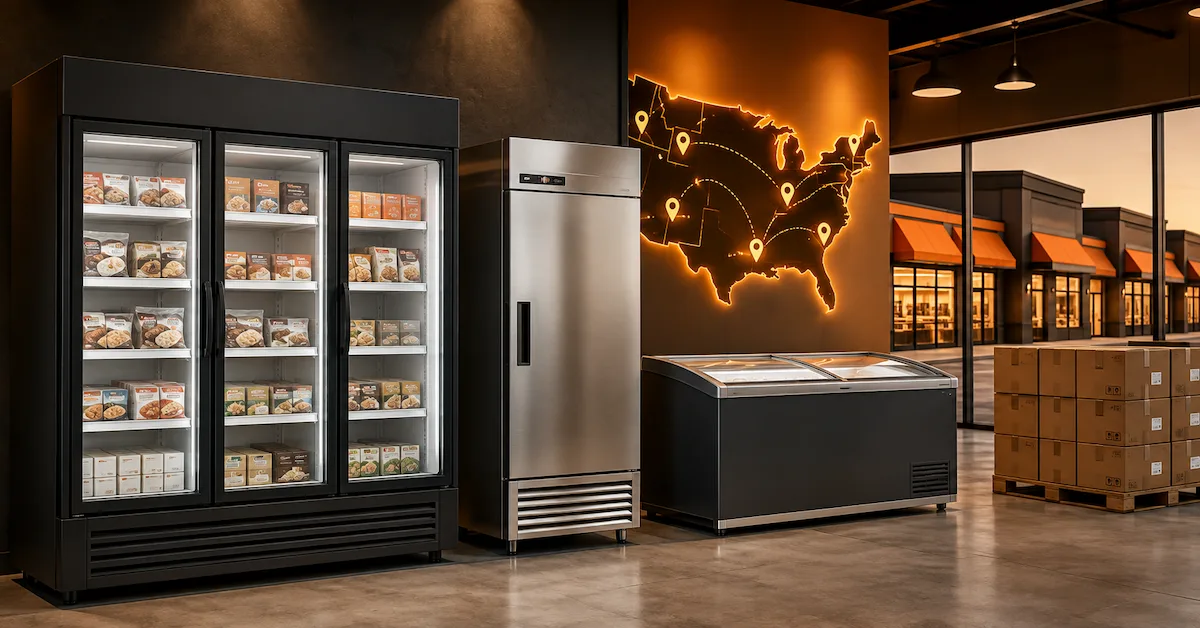
What Is a Commercial Freezer Vendor for Chains?
A Commercial Freezer Vendor for Chains is a manufacturer or supply partner capable of supporting repeated refrigeration purchases across multiple stores, regions, or expansion phases.
The vendor may support:
- Product selection
- Standardized specifications
- Volume pricing
- Annual forecasts
- OEM/private-label branding
- Production planning
- Quality control
- Phased deliveries
- Spare-parts supply
- Repeat orders
The goal is to create a freezer supply system that can be reproduced as the chain grows.
Why Store-by-Store Purchasing Creates Problems
Allowing every store to source freezers independently may seem flexible, but it can create long-term operational problems.
Common issues include:
- Different freezer dimensions
- Different controllers
- Different compressors
- Different gaskets
- Different spare parts
- Inconsistent appearance
- Different warranty procedures
A chain may eventually maintain many nearly identical freezer types that require different service parts.
Centralized procurement allows the company to reduce model variation and create approved equipment standards.
How Chains Standardize Commercial Freezer Specifications
A strong specification standard should define the freezer in enough detail that future orders can be reproduced consistently.
Model Standardization
Chains can establish approved models based on store format.
For example:
| Store Format | Typical Freezer Requirement |
|---|---|
| Small convenience store | Compact glass door freezer |
| Standard retail store | Upright + chest freezer |
| Large supermarket | Multiple display and storage models |
| Ice cream outlet | Dedicated display freezer |
Reducing unnecessary model variations simplifies purchasing and service.
Branding and Appearance
Retail chains may standardize:
- Cabinet color
- Logo placement
- Header panels
- Model numbers
- Product labels
Consistent equipment appearance helps maintain brand identity across stores.
Electrical and Refrigeration Specifications
Procurement teams should define:
- Voltage
- Frequency
- Refrigerant
- Temperature range
- Controller requirements
For chains operating in multiple countries, different market versions should be clearly identified.
Spare Parts Standardization
Freezer specifications should also consider common service components.
These may include:
- Controllers
- Fan motors
- Door gaskets
- Hinges
- Handles
- LED components
Standardizing components can reduce spare-parts inventory.
What Freezer Types Do Chain Businesses Commonly Need?
Large retail networks usually require several freezer categories.
Glass Door Freezers
Glass-door models support frozen-food merchandising and customer visibility.
Important factors include:
- Door sealing
- Glass performance
- LED lighting
- Temperature stability
Buyers can review Snowsea's glass door freezer wholesale supplier guide.
Upright Freezers
Upright freezers provide efficient vertical storage and organized shelves.
They are useful for:
- Convenience stores
- Supermarkets
- Food-service locations
See Snowsea's upright freezer wholesale supplier guide for key sourcing considerations.
Chest Freezers
Chest freezers are suitable where large frozen-storage capacity is required.
Retail chains should compare:
- Capacity
- Insulation
- Lid configuration
- Temperature recovery
Snowsea's chest freezer wholesale manufacturer guide provides additional purchasing guidance.
Ice Cream Freezers
Ice cream retailers and frozen dessert brands may require specialized display models with stronger emphasis on:
- Product visibility
- Temperature consistency
- Customer access
Buyers can review Snowsea's ice cream freezer wholesale supplier guide.
How a Vendor Supports Multi-Store Expansion
A chain expansion program may involve opening stores in stages rather than purchasing all equipment at once.
A capable vendor should be able to manage:
- Approved freezer specifications
- Forecast quantities
- Production windows
- Store-opening schedules
- Shipping batches
- Repeat-order requirements
The objective is to avoid redesigning or reselecting equipment every time a new store opens.
For larger retail projects, Snowsea's supermarket freezer project supplier guide explains broader project planning considerations.
Centralized Procurement and Annual Forecasting
Retail chains often gain better control by combining store requirements into a centralized purchasing plan.
Forecasts can include:
- Planned new stores
- Replacement demand
- Seasonal purchasing
- Regional expansion
- Estimated annual volume
Forecasting helps manufacturers plan:
- Components
- Materials
- Production capacity
- Packaging
- Delivery schedules
A forecast is not necessarily a purchase order, but it gives both sides greater visibility.
Volume Pricing and Repeat-Order Cost Control
Chain buyers should avoid comparing only the price of the first order.
Long-term purchasing economics may depend on:
- Annual volume
- Quantity per order
- Model mix
- Custom packaging
- Component standardization
- Production frequency
Buyers should request pricing for several quantity levels.
| Purchase Stage | Purpose |
|---|---|
| Sample | Product evaluation |
| Trial order | Initial market rollout |
| Standard bulk order | Routine replenishment |
| Container order | Larger-volume purchasing |
| Annual program | Long-term supply planning |
Snowsea's commercial freezer bulk order price guide explains how quantity and model mix affect purchasing cost.
How to Manage Phased Delivery for New Store Openings
Not every freezer should necessarily arrive at the same time.
A retail chain may open stores in different cities over several months.
Phased delivery can help coordinate equipment with:
- Construction schedules
- Store handover
- Warehouse capacity
- Installation planning
Before ordering, buyers should clarify:
- Production lead time
- Shipment frequency
- Minimum quantities per shipment
- Storage responsibilities
- Packaging requirements
Clear scheduling reduces the risk of equipment arriving too early or too late.
Quality Consistency Across Multiple Production Batches
One of the most important requirements for a Commercial Freezer Vendor for Chains is repeat-order consistency.
A freezer purchased for store number 80 should not unexpectedly differ from the equipment installed in store number 10.
Important controls include:
- Approved specifications
- BOM management
- Reference samples
- Production inspection
- Component-change approval
Buyers should define which components cannot change without written approval.
Snowsea's commercial freezer quality testing procedure provides a framework for production and pre-shipment inspection.
How to Manage Specification Changes
Long-term supply programs eventually face changes.
Reasons may include:
- Component discontinuation
- Regulatory changes
- Supplier changes
- Product upgrades
- Cost changes
A structured change process should identify:
- Proposed change
- Reason
- Technical impact
- Cost impact
- Testing requirement
- Approval status
This prevents one store batch from receiving an unexpected configuration.
For deeper long-term manufacturing control, see Snowsea's commercial freezer contract manufacturer guide.
Spare Parts and Warranty Management for Chain Stores
After-sales management becomes more complex as store count increases.
A chain may operate hundreds of freezer units.
The procurement team should establish:
- Spare-parts list
- Part numbers
- Recommended stock quantities
- Warranty claim process
- Technical documentation
Standardizing freezer models reduces the number of parts the business needs to maintain.
Buyers should also clarify whether replacement components remain available for future orders.
OEM and Private Label Freezers for Retail Chains
Retail groups may want refrigeration equipment to match their store identity.
OEM/private-label options can include:
- Logo
- Cabinet color
- Header panel
- Model number
- Rating label
- Packaging
- Manuals
A multi-store program should use controlled artwork and specifications to keep branding consistent.
Snowsea supports OEM and ODM commercial refrigeration solutions for retail chains, distributors, and private-label businesses.
Export Packaging for Multi-Store Orders
International chain projects may require repeated container shipments.
Packaging should remain standardized across orders.
Important protection areas include:
- Glass doors
- Cabinet corners
- Handles
- Hinges
- Compressor compartment
- Exterior surfaces
Consistent packaging also helps distributors develop standard warehouse and handling procedures.
Snowsea's freezer export packaging protection guide explains common transportation risks.
How to Evaluate a Commercial Freezer Vendor for Chains
Chain procurement teams should use a structured vendor scorecard.
| Evaluation Area | What Buyers Should Verify |
|---|---|
| Product range | Supports required store formats |
| Standardization | Can maintain controlled specifications |
| Capacity | Supports expansion volume |
| Quality | Consistent testing process |
| OEM | Supports chain branding |
| Forecasting | Can plan recurring demand |
| Delivery | Supports phased shipments |
| Spare parts | Standardized and available |
| Documentation | Clear model and part records |
| Change control | Approval before major changes |
| Pricing | Repeat-order transparency |
| Communication | Reliable project coordination |
The best vendor is not simply the one offering the lowest unit price.
The stronger partner is usually the one that can support consistent equipment across years of store growth.
What Should Chain Procurement Teams Include in an RFQ?
A chain procurement RFQ should include:
- Store formats
- Required freezer types
- Capacity requirements
- Temperature ranges
- Electrical specifications
- Refrigerant requirements
- Branding requirements
- Quantity per model
- Number of planned stores
- Estimated annual volume
- Rollout schedule
- Destination markets
- Packaging requirements
- Spare-parts requirements
- Warranty expectations
- Quality requirements
- Required certifications
- Forecasting expectations
The more standardized the RFQ, the easier it becomes to compare vendors objectively.
FAQ
What is a commercial freezer vendor for chains?
It is a supplier or manufacturer capable of supporting recurring commercial freezer purchases for multi-location retail, food-service, or supermarket businesses.
Why should retail chains standardize freezer models?
Standardization can simplify purchasing, spare parts, maintenance, staff training, warranty management, and future store expansion.
Can different store formats use different freezer models?
Yes. Chains can create approved equipment packages for small, standard, and large store formats while keeping specifications controlled.
How should chains manage freezer pricing?
Compare trial, bulk, container, and annual-volume pricing while keeping product specifications consistent.
Can a freezer vendor support phased store openings?
Yes. Buyers should coordinate forecasts, production schedules, shipment timing, and minimum shipment quantities with the vendor.
Why is spare-parts standardization important?
Using common parts across multiple freezer models can reduce inventory complexity and make service easier across many stores.
Can commercial freezers be customized for chain branding?
Yes. OEM programs can include logos, cabinet colors, labels, model numbers, packaging, and other controlled branding elements.
How can chains maintain freezer quality across repeat orders?
Use approved specifications, BOM control, quality testing, reference samples, and written approval for significant component changes.
Should chains use one freezer vendor for every model?
Not necessarily. The objective should be manageable supplier and SKU standardization while maintaining appropriate product quality, supply continuity, and commercial risk control.
Can Snowsea support multi-store commercial freezer programs?
Snowsea supports commercial refrigeration and OEM/ODM programs for global B2B buyers. Retail chains can provide store formats, required freezer models, rollout schedules, annual volume, branding, and target markets for project evaluation.
Conclusion
Selecting the right Commercial Freezer Vendor for Chains requires a different approach from purchasing equipment for a single store.
Multi-location businesses need standardized specifications, repeatable quality, controlled costs, phased delivery, spare-parts support, and reliable replenishment as new stores open.
For supermarket groups, convenience stores, frozen-food retailers, and food-service chains, the strongest vendor relationship is one that reduces operational complexity while supporting continued expansion.
Snowsea supports commercial refrigeration programs for global multi-store buyers. Explore Snowsea's commercial refrigeration products, review its OEM/ODM solutions, or contact Snowsea with your store formats, freezer requirements, rollout schedule, annual volume, and target markets.