Ice Cream Freezer Manufacturer: How to Prevent Melting and Improve Product Display in Retail Environments
In ice cream retail, freezer performance directly influences product quality, customer perception, and ultimately, sales conversion.
Unlike standard frozen goods, ice cream is highly sensitive to even minor temperature fluctuations. In real retail environments, operators often encounter:
- Ice cream near the glass softens during peak hours
- Surface recrystallization reduces visual appeal
- Temperature varies between front and rear zones
- Product texture becomes inconsistent throughout the day
These are not isolated operational issues. They are the result of unstable thermal control combined with display-oriented design limitations.
At Snowsea, as an ice cream freezer manufacturer, we analyze real retail usage patterns—high-frequency door opening, uneven product loading, and ambient heat exposure—to engineer systems that maintain both structural stability and visual consistency throughout daily operation.
Why Ice Cream Requires More Precise Temperature Control
Ice cream behaves differently from other frozen products due to its composition and sensitivity to thermal cycling.
According to International Dairy Federation, repeated temperature fluctuations lead to ice crystal growth, which degrades texture and reduces perceived freshness.
Key Technical Risks
- Temperature Fluctuation (> ±2°C)
Initiates partial melting and recrystallization - Radiant Heat Transfer Through Glass
Display freezers absorb external heat more rapidly - Localized Airflow Imbalance
Creates micro temperature zones within the cabinet - Moisture Ingress and Frost Formation
Reduces cooling efficiency and visual clarity
Over time, these effects accumulate and directly impact both product quality and customer purchasing behavior.
Engineering Solutions for Stable Ice Cream Storage and Display
To maintain consistent product quality, ice cream freezer systems must combine temperature control, airflow engineering, and display optimization.
Key Design Parameters
- Stable Low Temperature Range (-18°C to -22°C, ±1°C variance)
Maintains structural integrity of ice cream - Controlled Airflow Distribution (2.0–2.5 m/s)
Ensures uniform cooling across all product zones - Low-Emission Glass with Anti-Condensation Coating
Reduces thermal transfer while maintaining visibility - Fast Recovery Time (2–3 minutes after door opening)
Prevents cumulative temperature rise during peak hours
This integrated approach can be defined as display-stable refrigeration engineering, where visual merchandising and thermal control are designed together.
Why Choosing the Right Ice Cream Freezer Manufacturer Matters
In retail environments, performance is measured not just by temperature—but by consistency and visual impact.
A qualified ice cream freezer manufacturer must ensure:
- Stable temperature under high-frequency usage
- Uniform airflow across all display layers
- Clear visibility without condensation or frost
At Snowsea, we validate performance through:
- Multi-point temperature testing across cabinet zones
- Continuous operation simulation under real retail conditions
- Airflow mapping to eliminate warm zones
This ensures that equipment performance remains stable throughout actual store operation.
Impact on Sales and Product Quality (Measured Performance Data)
Performance differences translate directly into measurable business outcomes.
Performance Comparison
| Parameter | Standard Display Freezer | Snowsea Optimized System |
|---|---|---|
| Temperature Fluctuation | ±3°C to ±4°C | ±0.8°C to ±1.2°C |
| Ice Cream Softening Rate (Peak Hours) | 15%–25% of exposed SKUs | <5% |
| Frost Formation Frequency | Every 2–3 days | Reduced by 60%–80% |
| Product Appearance Consistency | 70%–80% uniformity | >90% uniformity |
| Energy Consumption | Baseline | Reduced by 15%–22% |
| Sales Conversion Impact | Baseline | +8% to +15% |
These ranges are based on typical high-traffic retail environments, particularly supermarkets and convenience chains.
Real Retail Scenarios and Operational Challenges
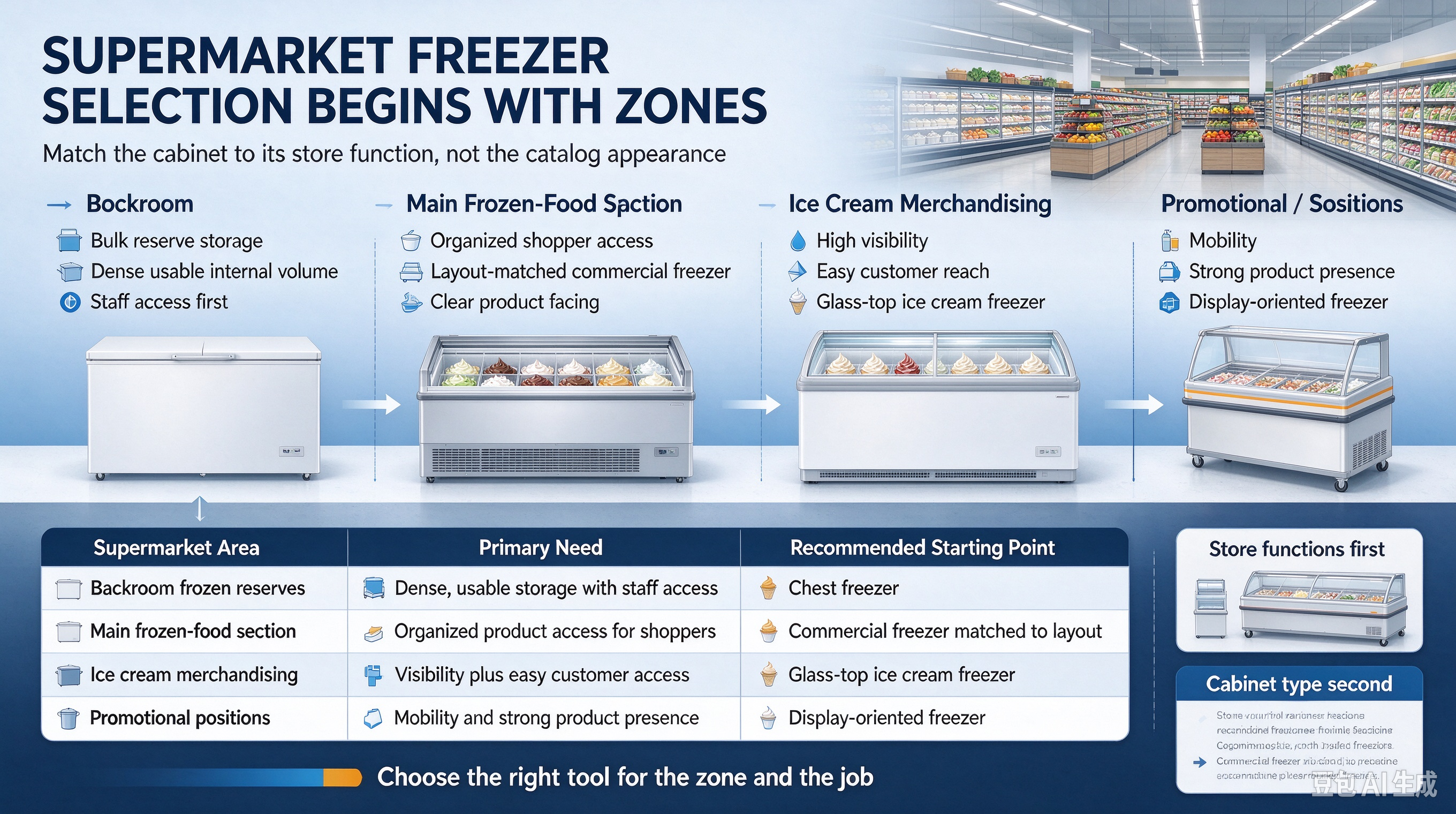
Different retail environments impose very different thermal and usage conditions on ice cream freezers. Understanding these differences is critical for proper equipment selection.
Supermarkets (High Traffic, Extended Operating Hours)
In supermarkets, freezers are opened continuously throughout the day.
Operational Conditions:
- 20–40 door openings per hour during peak periods
- Mixed product loading with varying thermal mass
- Continuous ambient heat exposure
Technical Impact:
- Cold air loss accumulates throughout the day
- Temperature near the front rises 2–4°C higher than rear zones
- Repeated partial melting leads to texture degradation
Engineering Response:
- High-speed thermal recovery systems
- Front-zone airflow reinforcement
- Optimized sealing to reduce air exchange
Ice Cream Specialty Stores (Display-Driven Sales)
In dedicated ice cream shops, visual presentation directly affects purchase decisions.
Operational Conditions:
- Open-top or glass-top display
- Frequent customer interaction
- Long display durations
Technical Impact:
- Slight softening reduces surface gloss
- Frost or haze reduces visual clarity
- Product appearance directly influences perceived freshness
Engineering Response:
- Precise temperature control within ±1°C
- Anti-fog glass systems
- Stable airflow to maintain surface integrity
Convenience Stores (Limited Space, High Turnover)
Convenience stores operate with compact layouts and high product turnover.
Operational Conditions:
- Dense product stacking
- Limited internal space
- High frequency of access
Technical Impact:
- Airflow obstruction due to product placement
- Localized temperature rise in blocked zones
- Reduced cooling efficiency
Engineering Response:
- Structured airflow channels between shelves
- Optimized internal layout for circulation
- Compact but high-efficiency cooling systems
High Ambient Temperature Markets (Southeast Asia / Middle East)
In hot climates, refrigeration systems operate under significantly higher external load.
Operational Conditions:
- Ambient temperatures of 30–45°C
- High humidity levels
- Extended compressor operation cycles
Technical Impact:
- Increased condenser load
- Reduced cooling efficiency
- Faster system wear
Engineering Response:
- Enlarged condenser surface (+20–30%)
- Enhanced ventilation design
- High-temperature system calibration
At Snowsea, we implement environment-adaptive display cooling systems, ensuring stable performance across diverse retail environments.
Case Example: Improving Sales Performance Through System Optimization
A regional retail chain experienced declining ice cream sales despite stable demand.
Initial Conditions
- Visible product inconsistency across stores
- Increased customer complaints about texture
- Frequent frost buildup
Optimization Measures
- Airflow redistribution within cabinets
- Improved temperature stability
- Upgraded glass and sealing systems
Results
- Product consistency significantly improved
- Frost-related issues reduced
- Sales increased by approximately 10–12%
This demonstrates that freezer performance directly influences retail revenue.
What Buyers Should Evaluate When Choosing an Ice Cream Freezer Manufacturer
When selecting an ice cream freezer manufacturer, buyers should focus on three key dimensions:
Temperature Stability Under Real Usage
Can the system maintain stable temperature during peak traffic?
Snowsea solution: Real-condition simulation testing.
Airflow Distribution Across Display Zones
Is temperature uniform across all product positions?
Snowsea advantage: Balanced airflow engineering.
Display and Customer Interaction Performance
Does the design support visibility and accessibility?
Snowsea capability: Display-integrated refrigeration design.
Frequently Asked Questions
Q: Why does ice cream develop ice crystals in display freezers?
A: Due to repeated temperature fluctuations causing partial melting and refreezing cycles.
Q: Does freezer design affect retail sales?
A: Yes. Product visibility and consistency directly influence customer purchasing decisions.
Q: Can stronger cooling alone solve melting issues?
A: No. Airflow distribution and insulation design must work together with cooling capacity.
Improving Retail Performance with the Right Freezer System
Choosing the right ice cream freezer manufacturer is essential for maintaining product quality and maximizing sales performance.
At Snowsea, we focus on:
- Display-stable refrigeration engineering
- Environment-adaptive system design
- Consistent performance under real retail conditions
Explore Our Product Range
To find ice cream freezer solutions tailored for retail environments:
https://www.snowseax.com/products
Contact Us for Retail Optimization Support
If you are looking to improve product consistency and sales performance:
https://www.snowseax.com/contact