 What a Serious OEM Glass Door Freezer Partnership Actually Looks Like
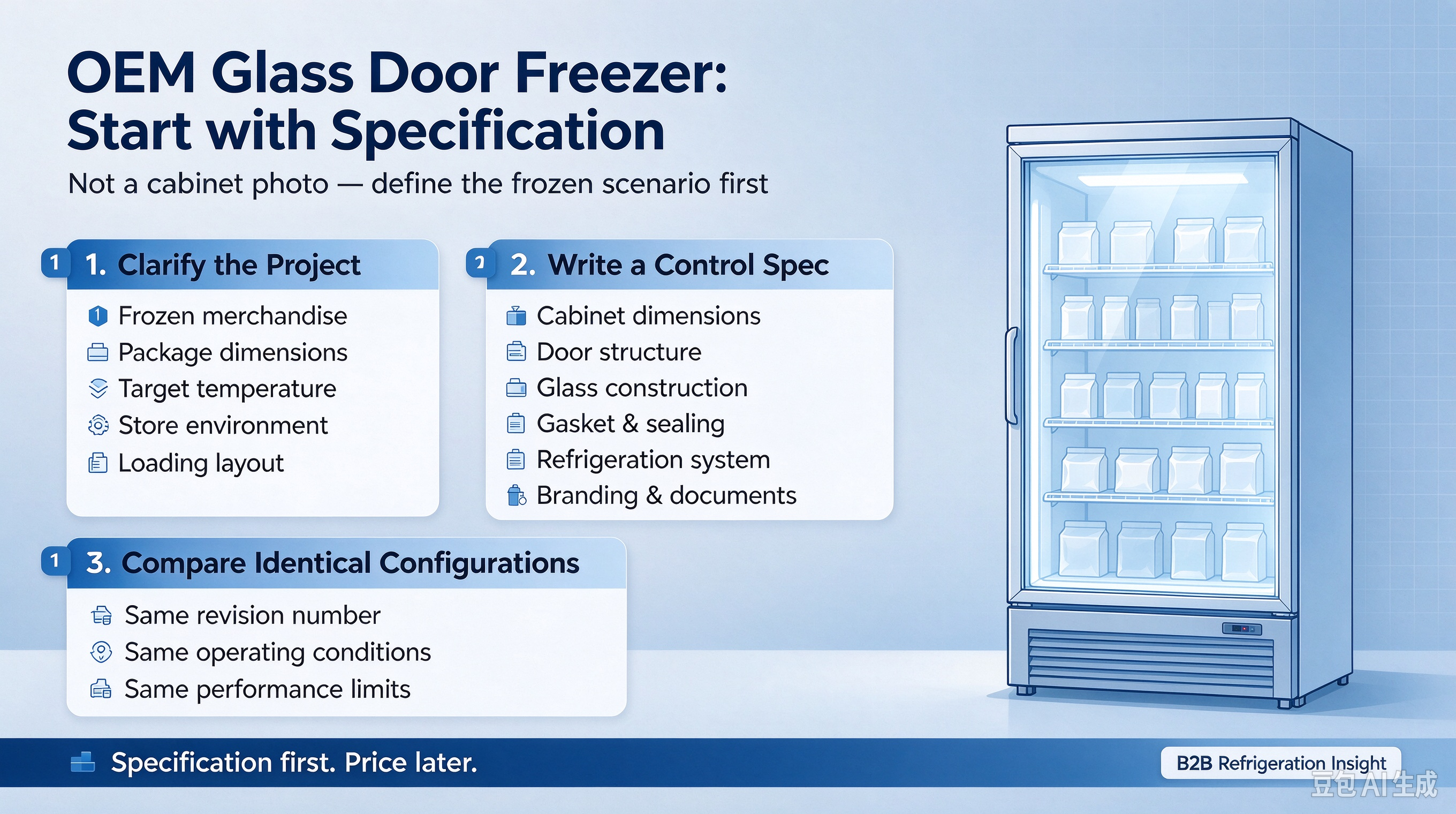
An OEM glass door freezer manufacturer should never be just a factory that attaches your logo to a standard cabinet. In a genuine B2B project, the supplier converts your storage scenario, retail environment, package sizes, door-use frequency, destination market and branding needs into one controlled, documented production specification.
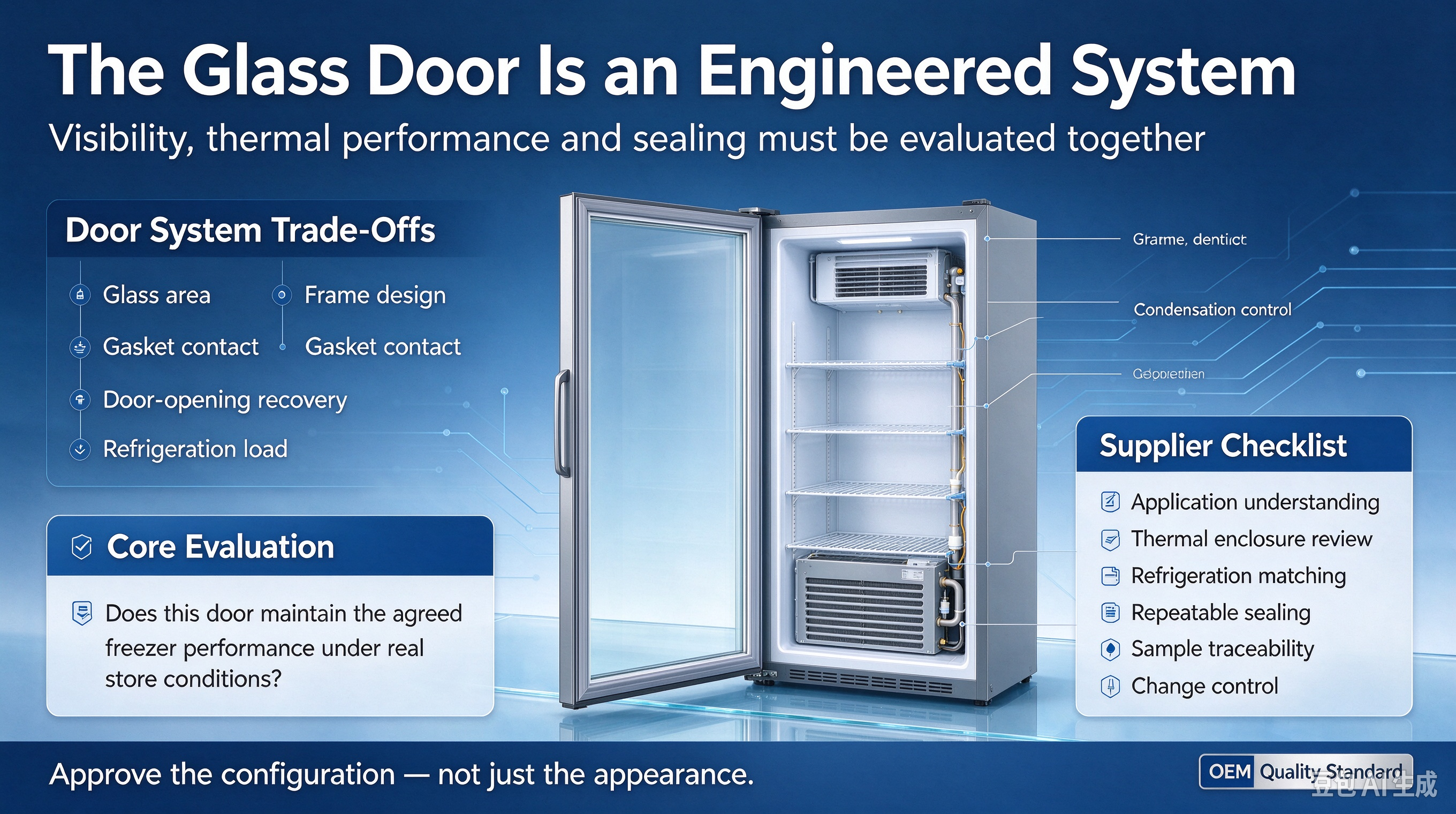
The door deserves special attention here. Because the glass door is part of the freezer's thermal enclosure, any adjustment to its dimensions, construction, frame, gasket, opening style or condensation strategy can shift heat gain, air sealing, refrigeration load, temperature pull-down, power draw, packaging and future service work. A professional OEM program therefore treats the door as an engineered component, not a styling choice.
SNOWSEA supports OEM/ODM commercial refrigeration projects through an integrated workflow that covers material processing, structural assembly, insulation, refrigeration installation, final assembly, performance testing, inspection, packing and shipment. Buyers can examine this OEM/ODM manufacturing process before scoping a custom door project.
Start Here: Is This a Freezer Project or a Chilled Showcase Project?
The most consequential sourcing mistake happens before anyone talks about doors.
In international trade, "glass door freezer" is used carelessly. An upright glass-door cabinet that looks identical to a freezer may in fact be engineered as a chilled beverage or dairy showcase. SNOWSEA's own materials separate frozen-display equipment from chilled showcase applications and caution buyers against choosing equipment purely by appearance.
Key differences to clarify:
· Merchandise type — frozen packaged food versus beverages, dairy and chilled goods.
· Core requirement — holding a specified frozen condition versus holding a specified chilled condition.
· Primary thermal concern — heat gain and frozen-temperature recovery versus door-opening recovery and chilled uniformity.
· Display priority — visibility without sacrificing frozen performance versus product facing, lighting and shelf access.
· Door-system priority — insulation, sealing and condensation control versus visibility, access, airflow and sealing.
· Evidence required — freezer performance data versus showcase/refrigerator performance data.
Your RFQ should open with the merchandise and its required holding conditions, not with a photo of a cabinet you like. If the job is chilled merchandising, review SNOWSEA's Showcase category. If it is frozen merchandising, the supplier must confirm a true freezer platform with matching performance data — never assume a chilled glass-door product can simply be run at freezer temperatures.
Which Buyers Need an OEM Glass Door Freezer Supplier?
OEM cooperation pays off most for:
· Refrigeration distributors building private-label catalogs
· Frozen-food brands deploying branded cabinets in retail
· Supermarket equipment companies standardizing fixtures across stores
· Importers developing region-specific freezer ranges
· Commercial refrigeration brands that need stable, repeatable specifications
Each of these buyers has a different emphasis — a distributor may want several capacities sharing one appearance and service-part base; a frozen-food brand may prioritize visibility and branded graphics; a supermarket project may care most about dimensions, customer access and standardization; an importer may need market-specific voltage, plugs, labels, manuals and export packaging.
But all of them share one non-negotiable requirement: the freezer must be reproducible long after the first order ships. Repeatability is therefore one of the most important selection criteria for any OEM glass door freezer supplier.
Write the Specification Before You Compare Prices
A quote is only meaningful when every supplier prices the same configuration. "Glass door freezer, 500L" is not a technical description.
Before requesting quotations, define or confirm:
· Application and operating scenario
· Merchandise package dimensions and loading method
· Cabinet dimensions and usable layout
· Door structure: hinged, sliding or another approved arrangement
· Glass construction approved for the chosen design
· Frame material and structure
· Gasket and door-sealing arrangement
· Refrigeration system configuration
· Defrost strategy, where applicable
· Controller type and settings, where relevant
· Voltage, frequency and plug
· Interior: shelves, baskets and loading layout
· Branding: logo, artwork, model designation
· Documents: labels, manuals and languages
· Packaging and export protection
· Testing and inspection requirements
Give the finished document a revision number, and make sure the quotation, sample, purchase order and every repeat order all reference that same revision.
 Visibility vs. Thermal Performance: The Core Door Trade-Off
Retail teams naturally push for the largest possible transparent area, since it lifts product visibility. But every increase in glass changes the thermal behavior of the cabinet.
A competent supplier evaluates the door as one part of the whole refrigeration system. Relevant variables include glass area, glass construction, frame design, sealing quality, gasket contact, thermal bridges, how often the door is opened, and the method chosen to handle condensation. SNOWSEA's OEM freezer custom glass door guide makes the same point: altering the glass door can affect heat transfer, sealing, temperature recovery, refrigeration workload, packaging and cost.
So the wrong question to ask is: "Can you enlarge the glass?"
The right question is: "Can this door design deliver the visibility we need while holding the agreed freezer performance under our real operating conditions?"
Choose Door Operation Based on Real Store Behavior
Door style shapes both customer convenience and energy behavior. A hinged upright glass door fits front-facing retail access. Sliding glass structures fit other cabinet formats. Top-opening sliding glass appears in some ice-cream display formats, but it should never be assumed to equal an upright glass-door freezer.
Per SNOWSEA's custom freezer door type guidance, switching between hinged, sliding, solid or glass configurations can alter cabinet dimensions, insulation, sealing, accessibility, temperature recovery, energy consumption and packaging.
Before settling on a format, map the actual routine: where the shopper stands, which way the door swings, how often staff restock, whether neighboring fixtures block movement, and whether several customers need access at once.
Condensation Control: Define Conditions, Not Component Names
A door that stays clear in a showroom may fog badly in a humid store.
Condensation risk is the product of several interacting factors: indoor temperature, humidity, glass surface temperature, opening frequency, sealing quality and overall cabinet design. Depending on the platform and engineering needs, manufacturers may consider different condensation-management approaches, and no single technology is automatically standard on every model.
The practical move is to state your environment and define the expected result, for example:
The glass must maintain commercially acceptable visibility under the agreed test conditions.
That wording is far more useful than asking for "anti-fog glass," because it lets engineering evaluate the complete system instead of treating one component name as a magic fix.
Gaskets and Sealing: Small Parts, Big Consequences
Door gaskets and frame alignment directly control how much warm air leaks into the cabinet. A weak seal raises heat entry, inflates refrigeration workload, destabilizes temperature and can generate frame condensation.
During sample inspection, check that the door closes evenly around its full perimeter and that gasket contact is uniform. In mass production, the factory needs an inspection method that catches alignment and sealing defects before packing. This is a key reason to judge an OEM glass door freezer manufacturer on production consistency, not only on design skill.
The Refrigeration System Must Match the Final Door Configuration
A classic OEM error is enlarging or reshaping the glass while assuming the original refrigeration setup needs no review.
Because the door structure changes heat transfer, the refrigeration system has to be evaluated against the finished cabinet, not the base product alone. The engineering review may need to cover the compressor, condenser, evaporator, refrigerant circuit, airflow, fans where fitted, defrost strategy, controller, temperature sensors, cabinet insulation and the heat gain through the glass door.
You do not have to specify every component yourself. Define the required operating outcome, and ask the engineering team to demonstrate that the proposed configuration achieves it.
Frost Management and Defrost Strategy
Frost control becomes critical when frozen equipment combines shopper access, glass surfaces and constant door openings. The right defrost approach depends on the freezer architecture and must be confirmed for the exact configuration on order.
When comparing suppliers, ask how defrost influences temperature behavior, visibility, operating cycles and service needs. Do not choose a unit merely because the brochure says "no-frost." Understand how the whole system works, what conditions were tested, and whether the design fits your application. SNOWSEA's No Frost Series is one reference point when judging whether a no-frost platform suits your project.
Design the Interior Around Real Packages
Glass creates visibility; the interior decides whether shoppers can actually see and reach the product.
Instead of comparing nominal capacities in liters, hand the supplier your real package dimensions. A serious loading study should establish how many SKUs can be faced, how much reserve stock sits behind the front row, whether staff can restock quickly, and whether lower shelves stay usable. That turns freezer selection from a liters contest into a retail-space decision.
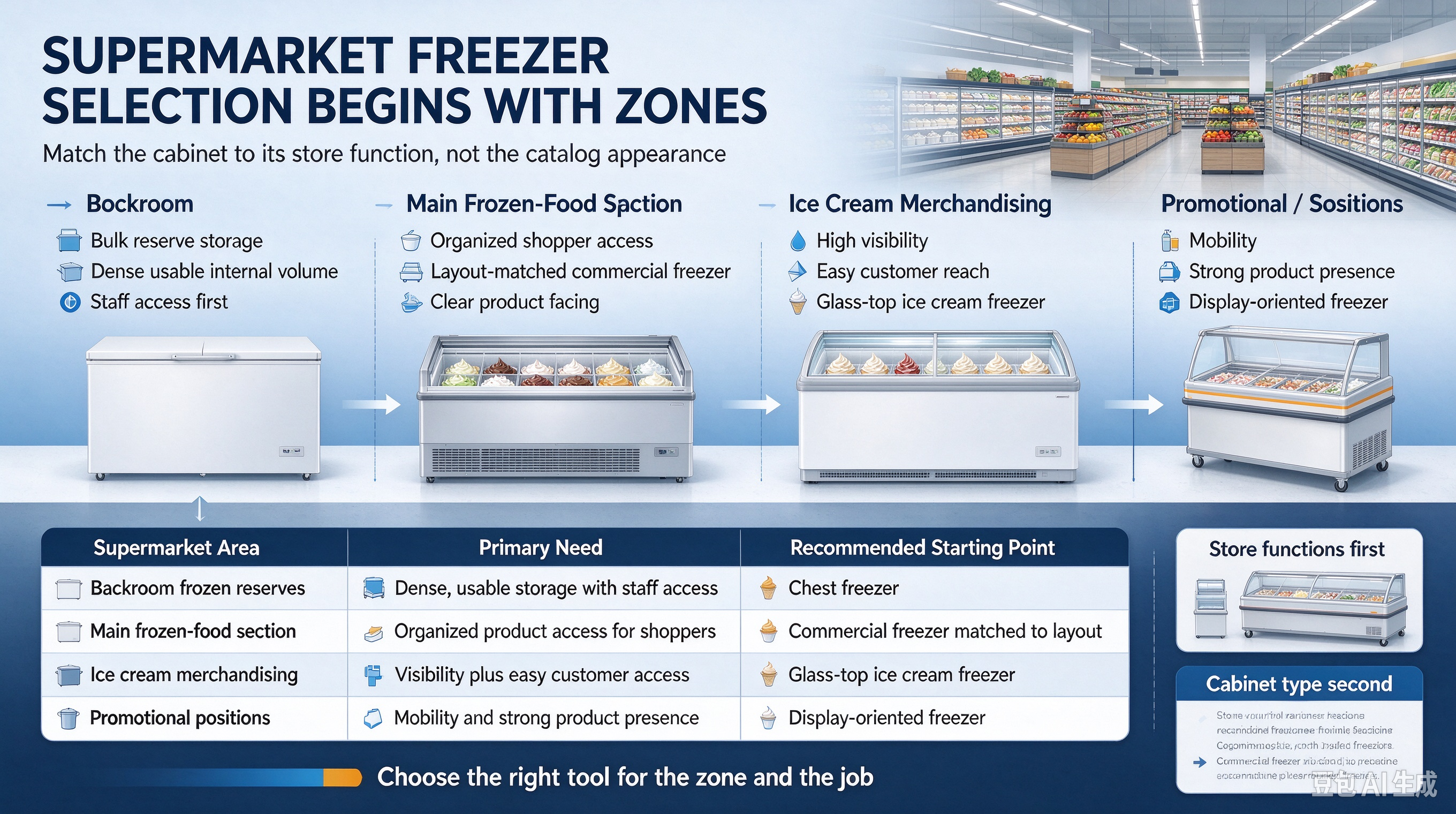
For display-oriented frozen formats, SNOWSEA's Ice Cream Freezer range offers useful platform examples before deeper customization is requested.
Customize in Levels, Not From Zero
OEM work rarely requires a ground-up redesign. Starting from an established platform reduces engineering uncertainty, tooling cost, supply-chain risk and repeat-order surprises.
A practical hierarchy:
· Level 1 — Branding: logo, artwork, labels, manuals, cartons.
· Level 2 — Configuration: baskets, shelves, handles, locks, electrical version and other compatible options.
· Level 3 — Engineering: glass structure, door dimensions, cabinet geometry, refrigeration architecture or controller logic.
The deeper the level, the stricter your sample validation and production control should be.
Keep Private-Label Branding Separate From Engineering Approval
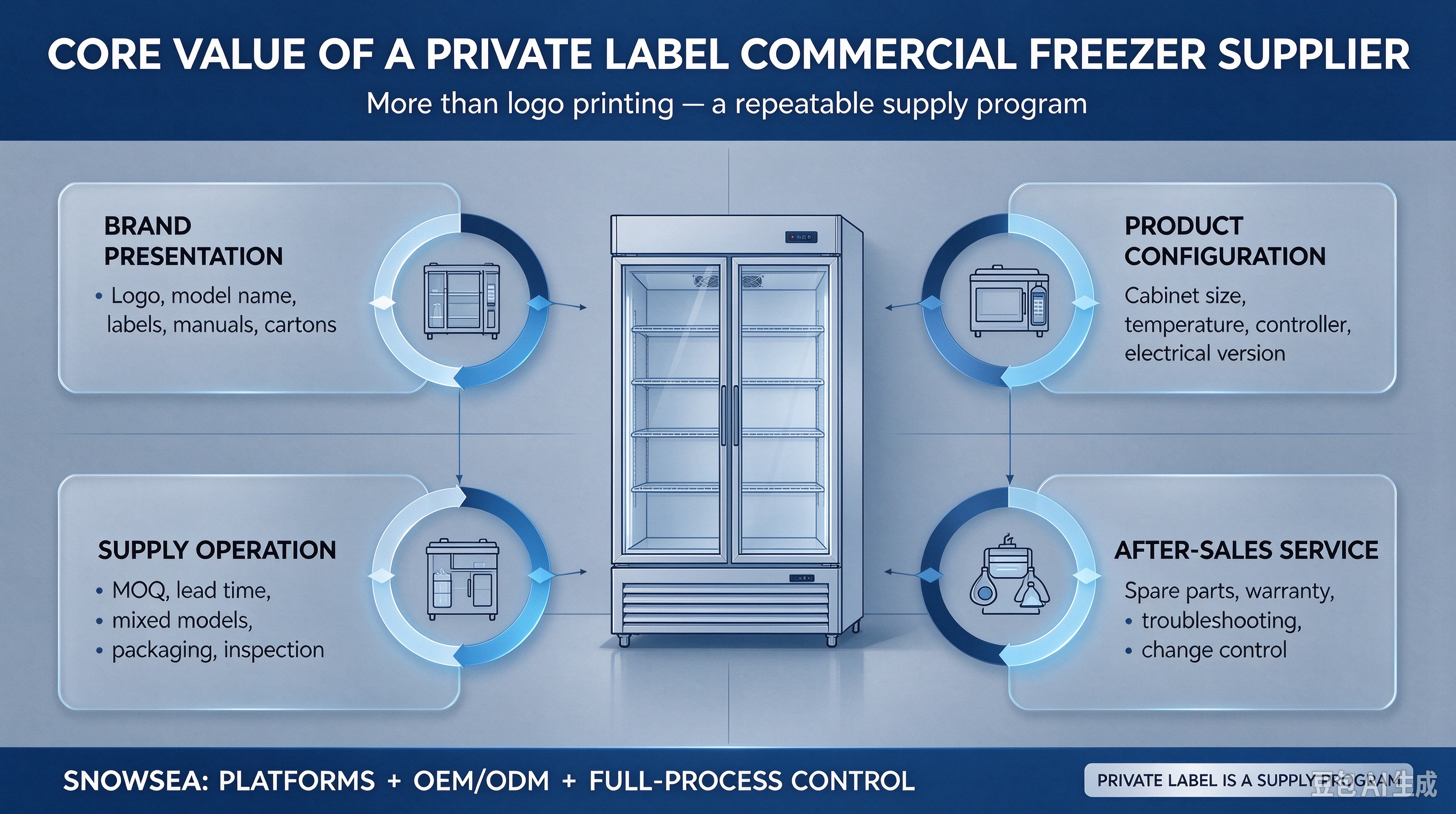
Branding matters commercially, but it must never be tangled with technical sign-off. A private-label glass door freezer may need cabinet graphics, logo, model name, rating label, manual, carton artwork and market-specific markings — and these should be approved on their own track, separate from refrigeration and door engineering. That keeps revisions clean: a logo update, for example, should never create doubt about whether the compressor, controller or glass system changed too. SNOWSEA's OEM/ODM service is the right entry point for discussing how branding and configuration are managed inside a larger manufacturing project.
Approve a Sample That Truly Represents Production
The golden rule: never approve a generic unbranded sample when mass production will use a substantially different door or technical setup.
A proper sample review covers four areas:
1. Application fit — load real frozen packages and assess visibility, access and restocking.
2. Technical configuration — confirm cabinet, glass door, frame, refrigeration system, controller, electrical version and agreed accessories.
3. Performance — run the agreed temperature and operating evaluation under defined conditions.
4. Commercial finish — check color, logo, graphics, model number, labels, manual and packaging.
Record the sample revision and photograph key details so the production reference stays traceable.
Define What "Tested" Actually Means
"Tested before shipment" is not an acceptance criterion for a customized project. You need to define what is tested, under which conditions, and against which limits. For a custom glass door freezer, the plan may cover cabinet temperature, stability, recovery after defined disturbances, door operation, sealing, condensation behavior and relevant electrical or functional checks — the exact scope depends on the design and target market.
And if the glass area, refrigeration configuration or another key element changes after approval, ask explicitly whether the earlier performance validation still holds. This matters even more for private-label products, because field performance becomes your customer's experience of your brand.
Turning the Approved Sample Into a Production Standard
Sample approval and production transfer are two different milestones. The factory must convert your approved sample into controlled information that line workers can follow. SNOWSEA states that its OEM/ODM workflow covers structural assembly, foaming and insulation, refrigeration installation, assembly, performance testing, final inspection, packing and shipment — and on a custom project you should pinpoint where your door, controller, electrical version, artwork and packaging requirements enter that flow.
One question reveals a lot:
How will our approved glass-door configuration be identified during normal production?
A good answer involves controlled specifications, work instructions, model coding and inspection criteria — never informal memory.
MOQ and Lead Time: Ask at the Right Level
You might order 300 units split across three capacities, two electrical versions and several branded cartons — so the project is not one 300-unit configuration. Ask what drives the MOQ for each variation: custom glass, cabinet color, electrical parts, printed packaging and unique accessories often carry different minimums. The goal is not always to push every MOQ down; sometimes standardizing low-value features lets the supplier keep materials stable across models.
Lead time should likewise be split into stages: requirement confirmation, engineering review, component preparation, sample production, sample testing, buyer approval, artwork confirmation, material purchasing, production, inspection and shipment readiness. A branding-only job and a structural door redesign follow very different schedules, and one single "lead time number" before scoping is meaningless.
Export Packaging: Glass Changes the Risk Equation
Glass surfaces multiply shipping risk. Export packaging must protect the glass, frame, hinges or sliding system, handles, cabinet corners and base structure through handling and container transport. Verify how accessories are secured inside the cabinet, and if you request custom cartons, display graphics or extra protection, confirm final packed dimensions before computing loading quantities. SNOWSEA's workflow includes final inspection and packing before storage and shipment, but the packaging standard for your specific OEM model still needs to be agreed in writing.
Plan Spare Glass and Door Parts Before the First Shipment
The door system is the most visible and service-sensitive part of the freezer. Before production starts, ask which components can be supplied as spares and how they will be identified — potentially glass assemblies, gaskets, handles, hinges, door frames, sensors, controllers and other model-specific items.
Your private-label model number must stay linked to the factory model and production revision, so that three years later both sides can identify the correct replacement part without trading comparison photos over email.
Protect Repeat Orders With Change Control
A repeat order must not quietly turn into a different product. Require advance notification of any change to glass construction, door hardware, controller, refrigeration components, electrical parts, insulation, packaging or other controlled specifications. A simple clause covers it:
Manufacture according to the approved specification revision. The supplier must disclose any proposed technical, component, artwork or packaging change before implementation.
This preserves product consistency and keeps after-sales support straightforward.
Evaluating Suppliers: A Buyer's Checklist
Judge each candidate OEM glass door freezer supplier on project-specific evidence rather than generic factory claims:
· Application understanding — frozen requirement pinned down before cabinet selection
· Door engineering — door handled as part of the thermal enclosure
· Refrigeration matching — system reviewed against the final cabinet
· Condensation strategy — evaluated for your intended environment
· Sealing control — repeatable alignment and gasket discipline
· Interior layout — validated with actual merchandise
· OEM process — branding kept separate from technical changes
· Sample control — approved revision fully traceable
· Testing — final configuration genuinely evaluated
· Manufacturing transfer — sample reproducible on the normal line
· Packaging — glass adequately protected for export
· Spare parts — door-related service items identifiable
· Change control — repeat orders shielded from silent substitutions
Compare Total Program Cost, Not Unit Price
The cheapest quoted freezer rarely produces the cheapest program. OEM glass-door projects can add costs for glass customization, tooling, sample development, testing, private-label graphics, packaging, spare parts, inspection, freight and after-sales stock. Separate one-time development costs from recurring unit costs, and judge whether each customization earns its keep: a custom handle that adds little value but forces its own MOQ may not be worth it, while a door configuration that noticeably improves access in your target store probably is.
What to Put in Your RFQ
A useful RFQ includes: destination country, intended frozen merchandise, package dimensions, required loading quantity, target temperature condition, store environment, installation space, preferred cabinet style, glass-door concept, opening frequency, electrical version, branding scope, first-order quantity, annual forecast and expected launch date. If you currently use another freezer, add photos and explain what must improve — a supplier can respond far more precisely once it knows why the existing product falls short.
You can start by reviewing SNOWSEA's commercial refrigeration products, OEM/ODM capabilities and existing glass door freezer purchasing guidance, then submit a model-specific inquiry through Contact Us.
Frequently Asked Questions
1. What does an OEM glass door freezer supplier do?
It manufactures freezer equipment against an agreed buyer specification and can support private-label branding, market-specific electrical setups, door-system customization, packaging and technically feasible engineering changes.
2. Is every upright glass-door cabinet a freezer?
No. Some are chilled showcases or beverage coolers. Confirm the merchandise and required temperature before choosing the cabinet.
3. Can glass door size be customized?
Possibly, subject to the base platform and engineering feasibility. Size changes affect heat gain, sealing, structure, refrigeration load and packaging, so the whole system needs review.
4. Can the supplier provide anti-condensation glass?
Anti-condensation can be evaluated as part of the door system, but the right approach depends on the model and operating conditions. Define your temperature and humidity environment first.
5. Should I customize an existing model or develop a new one?
Start from an existing platform when it covers most requirements. Deeper development makes sense only when the current product cannot solve a measurable market, loading, dimensional or performance problem.
6. How should an OEM glass door freezer sample be tested?
Test the approved configuration for its real use: actual loading, door operation, temperature performance, sealing, visibility and any agreed environmental conditions.
7. What drives MOQ on an OEM glass door freezer?
Cabinet model, glass configuration, electrical version, color, branded artwork, cartons and custom components can each set a different minimum. Ask which item creates the MOQ.
8. What must be confirmed before mass production?
Specification revision, approved sample, glass-door structure, refrigeration configuration, electrical version, branding, packaging, QC requirements, spare-parts plan and production identification.
9. How do importers reduce repeat-order risk?
Reference the approved specification on every purchase order and require disclosure of any proposed technical or component change before production.
10. How do I request an OEM glass door freezer proposal from SNOWSEA?
Prepare your frozen-product application, package and loading data, target temperature, installation dimensions, market, electrical requirements, preferred door configuration, branding scope and expected volumes, then send the project through SNOWSEA Contact Us for evaluation.
SNOWSEA offers commercial freezer, chest freezer and ice cream freezer platforms together with OEM/ODM support for retail, distributor and project requirements. Food retailers planning a new frozen category, store rollout or equipment standardization program can submit store formats, merchandise data, package dimensions, replenishment plans and expected quantities through SNOWSEA Contact Us to evaluate an appropriate freezer mix before bulk purchasing.