Introduction
Many buyers mistakenly believe that private label commercial freezer services only involve stamping a new brand logo on standard equipment. In reality, professional private label supply is a complete, sustainable product operation system rather than a simple branding service. For refrigeration distributors, equipment importers and regional appliance brands, a reliable supplier’s core value lies in providing a standardized, replicable product solution. This covers the entire business chain including quotation confirmation, sample verification, mass manufacturing, quality inspection, customized packaging, batch reordering and after-sales technical support under the buyer’s independent brand.
A standardized private label project requires seamless integration of commercial operation and technical manufacturing. The commercial dimension includes brand positioning, product portfolio planning, customized packaging and channel adaptation rules; the technical dimension covers cabinet structural design, refrigeration system configuration, intelligent control parameters, electrical specification adaptation, accessory matching and standardized quality inspection criteria. Without unified controlled production specifications, disjointed operations of purchasing, marketing, engineering and production teams will lead to inconsistent product batches and uncontrollable market risks. As a professional commercial refrigeration manufacturer, Snowsea provides mature freezer product platforms and one-stop OEM/ODM customization solutions to support buyers in building standardized private label product lines.
Private Label Supply: A Systematic Operation Program, Not Superficial Branding
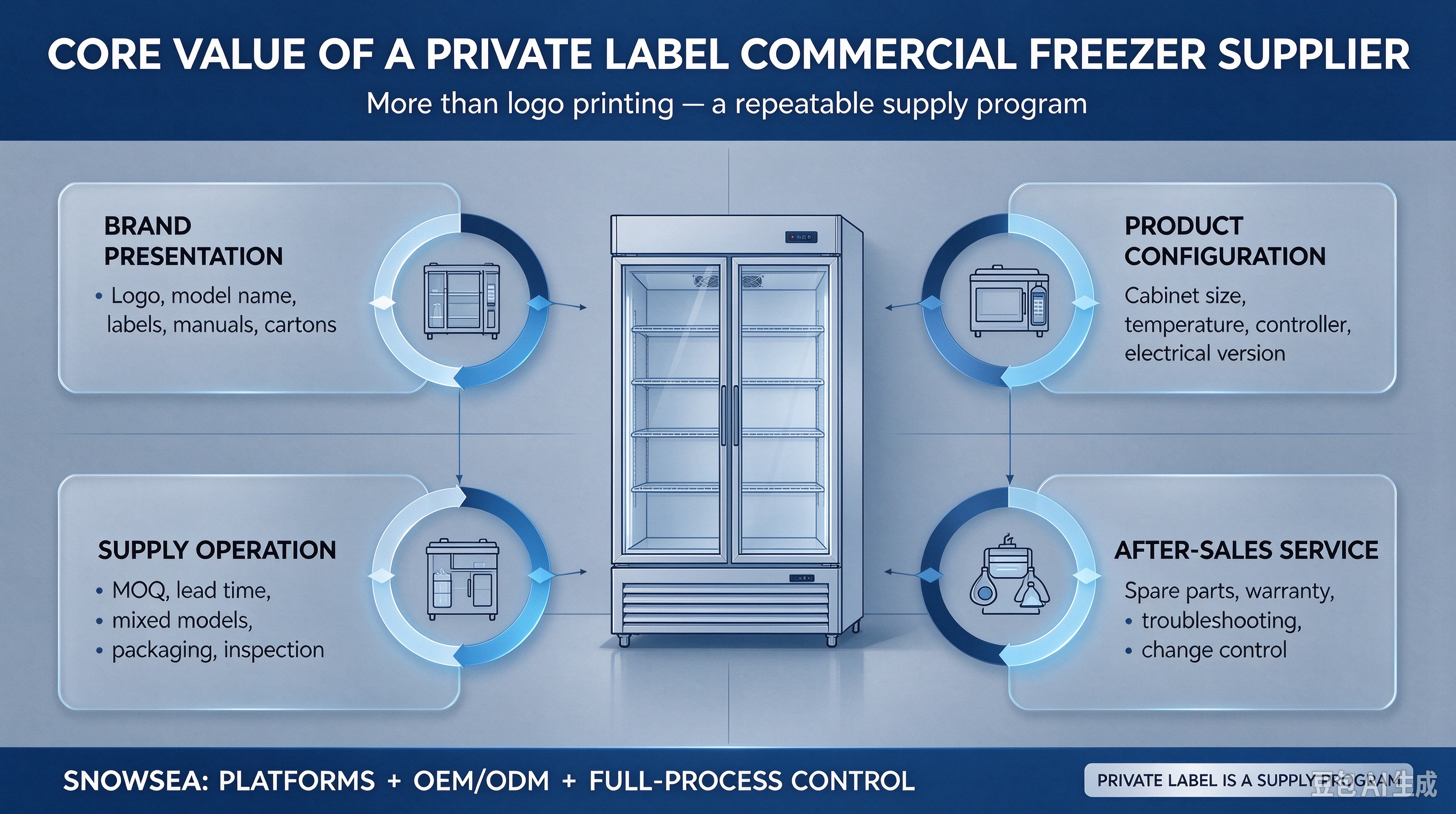
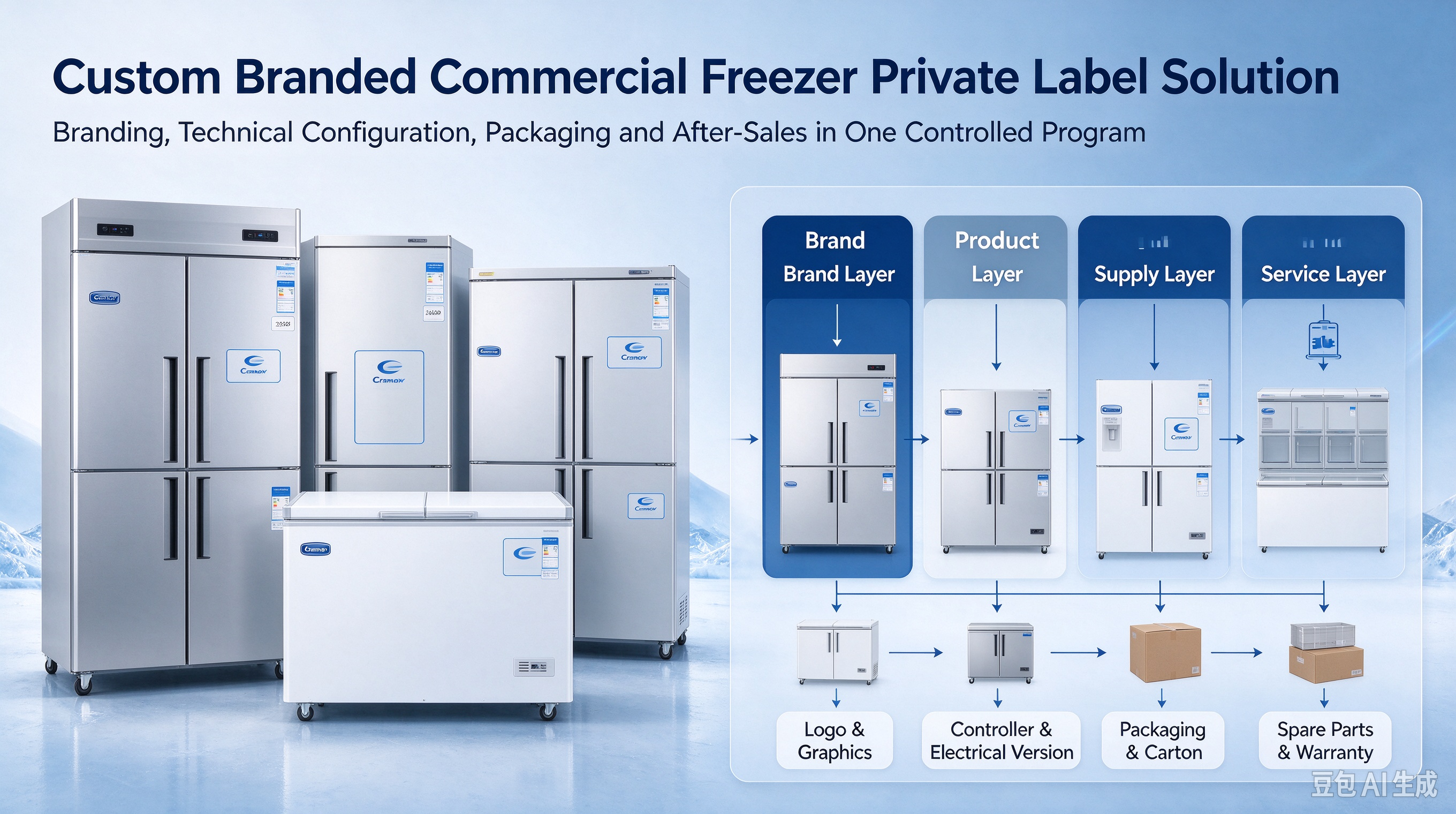
Elementary private label cooperation only modifies external brand identifiers, while mature private label cooperation helps buyers build a complete, market-competitive product system with long-term operability. A standardized private label program consists of four core dimensions, all of which must be coordinated and unified:
1. Brand Dimension: Covers all brand-related visual customization, including exclusive logos, custom model naming, cabinet body printing, product rating labels, user manuals and export carton design.
2. Product Dimension: Defines the core product attributes, including cabinet specifications, applicable refrigeration temperature scenarios, internal structural layout, controller parameters, refrigeration system configuration, supporting accessories and market-specific electrical standards.
3. Supply Chain Dimension: Includes minimum order quantity (MOQ) standards, production lead time, mixed-model order support, customized packaging solutions, container loading planning, pre-shipment inspection and stable batch replenishment mechanisms.
4. After-Sales Service Dimension: Involves complete spare parts supply system, product version traceability, professional fault troubleshooting guidelines, clear warranty liability division and standardized component change management rules.
A qualified supplier must ensure the four dimensions are fully aligned, helping buyers avoid fragmented customization and long-term operational risks.
Target Customers for Private Label Commercial Freezer Customization
Private label refrigeration solutions are tailored for long-term bulk procurement customers, not for one-time temporary purchases. The core applicable groups include cross-border importers, commercial refrigeration distributors, catering equipment brands, supermarket cold chain equipment suppliers and regional home appliance brands.
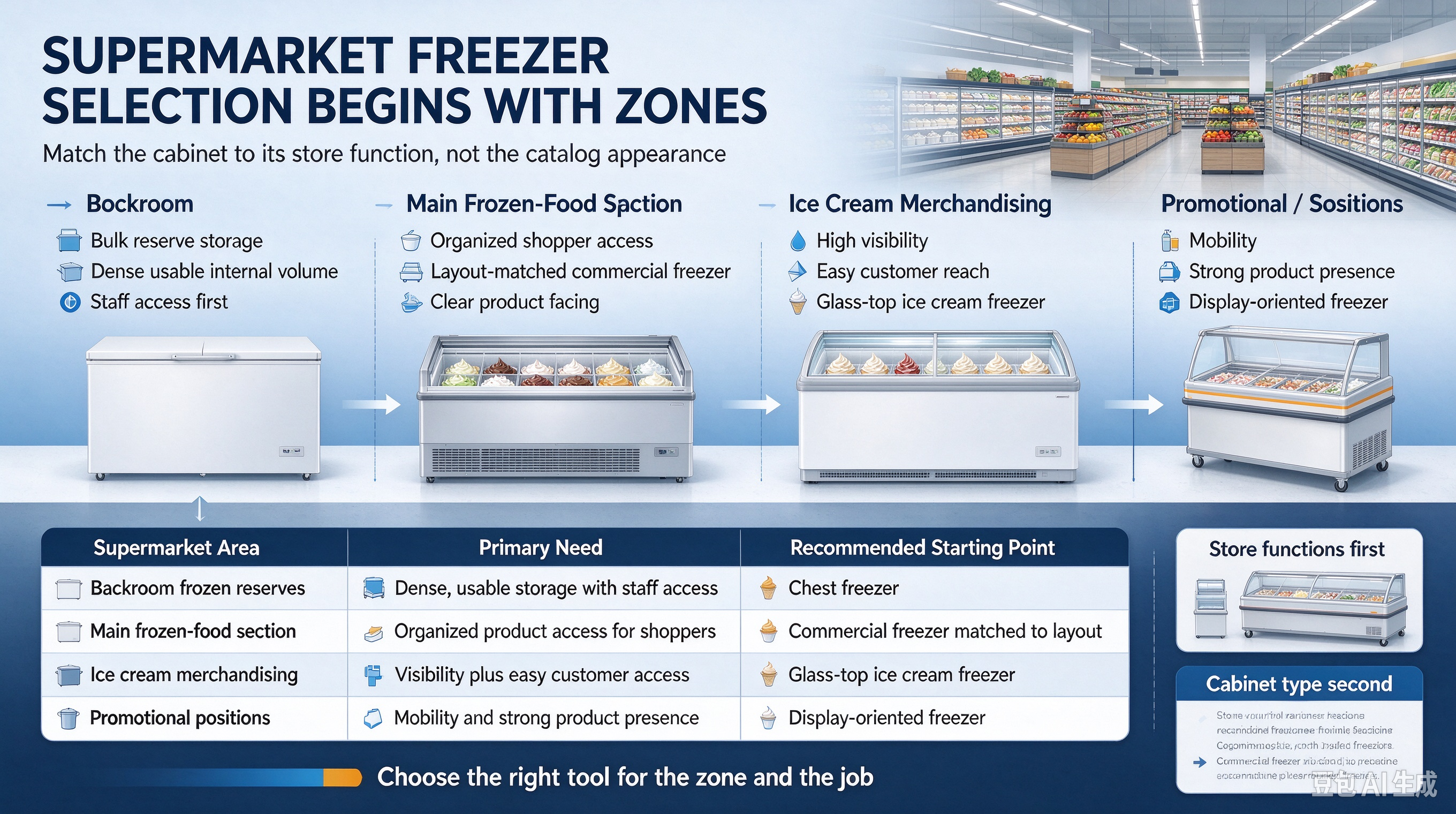
Different buyers have differentiated customization demands: refrigeration distributors need a streamlined product portfolio covering mainstream capacity models to meet diversified terminal needs; catering equipment brands focus on practical chest freezers for kitchen frozen storage; retail importers often match multi-scenario products including storage freezers, ice cream display freezers and commercial showcase freezers; regional brands need to adapt to multi-country electrical standards while maintaining unified brand visual recognition. Professional suppliers will formulate targeted private label solutions based on buyers’ sales channels and terminal application scenarios.
Build Scientific Product Portfolio Architecture Prior to Model Selection
The biggest pitfall in private label customization is blindly expanding product SKUs. Rich factory product lines do not equal a reasonable buyer product system. Each SKU in the buyer’s product portfolio must have clear market positioning and customer groups to avoid redundant models, excess inventory and increased after-sales costs.
Before selecting cooperative models, buyers need to clarify core product planning logic by answering key business questions: Who are the core end users? What types of goods need refrigeration and storage? What are the installation and usage scenarios? What capacity gradients need to be covered? What functional differences distinguish each model? Which products share universal spare parts? Which models are for entry-level cost-effective markets, core mainstream sales and high-end customized scenarios respectively?
The core goal of product planning is to build the most streamlined and practical product family, fully covering terminal market demands while controlling inventory, procurement and after-sales maintenance costs. This is especially critical for container-based bulk importers, as each additional customized model will change MOQ standards, packaging specifications and spare parts management systems.
Prioritize Mature Standard Platforms to Avoid Unnecessary Custom R&D Risks
Private label cooperation does not require full product redesign in most cases. Adopting mature mass-produced standard platforms is the most stable, low-risk and cost-effective way for brand building. Buyers can select Snowsea’s verified commercial freezer platforms that match target market demands, and only carry out targeted optimization and customization on the basis of mature products.
The optimal customization sequence is fixed: mature standard product platform → private label brand visual upgrade → compatible accessory and configuration fine-tuning → targeted engineering technical customization (only for special scenario demands).
If the existing standard models fully meet the terminal’s storage environment, dimensional specification and loading demands, buyers only need to complete brand customization and packaging optimization. Unnecessary overall structural redesign and refrigeration system modification will only bring additional verification costs, higher MOQ thresholds and complex spare parts management problems without bringing substantial market competitive advantages.
Classify Customization Items to Distinguish Brand Upgrades and Technical Modifications
All private label customization requirements can be divided into two categories with completely different implementation standards, risk levels and costs. Suppliers must implement differentiated approval and production processes to avoid technical risks caused by simple brand modification:
Brand Visual Customization: Including logo printing, model name adjustment, cabinet pattern design, label and manual localization, carton artwork replacement. The main risk is version confusion and inconsistent brand presentation.
Functional & Technical Customization: Including accessory matching, voltage and plug adaptation, controller parameter debugging, cabinet size adjustment, internal layout optimization, refrigeration system and component replacement, packaging protection upgrading. Such modifications may affect product performance, requiring professional engineering verification and batch testing.
Professional suppliers will not equate simple brand printing with technical modification projects, and will formulate independent quotation, sample confirmation and production supervision processes for different customization types.
Formulate Unified Version-Locked Specifications for Each Private Label SKU
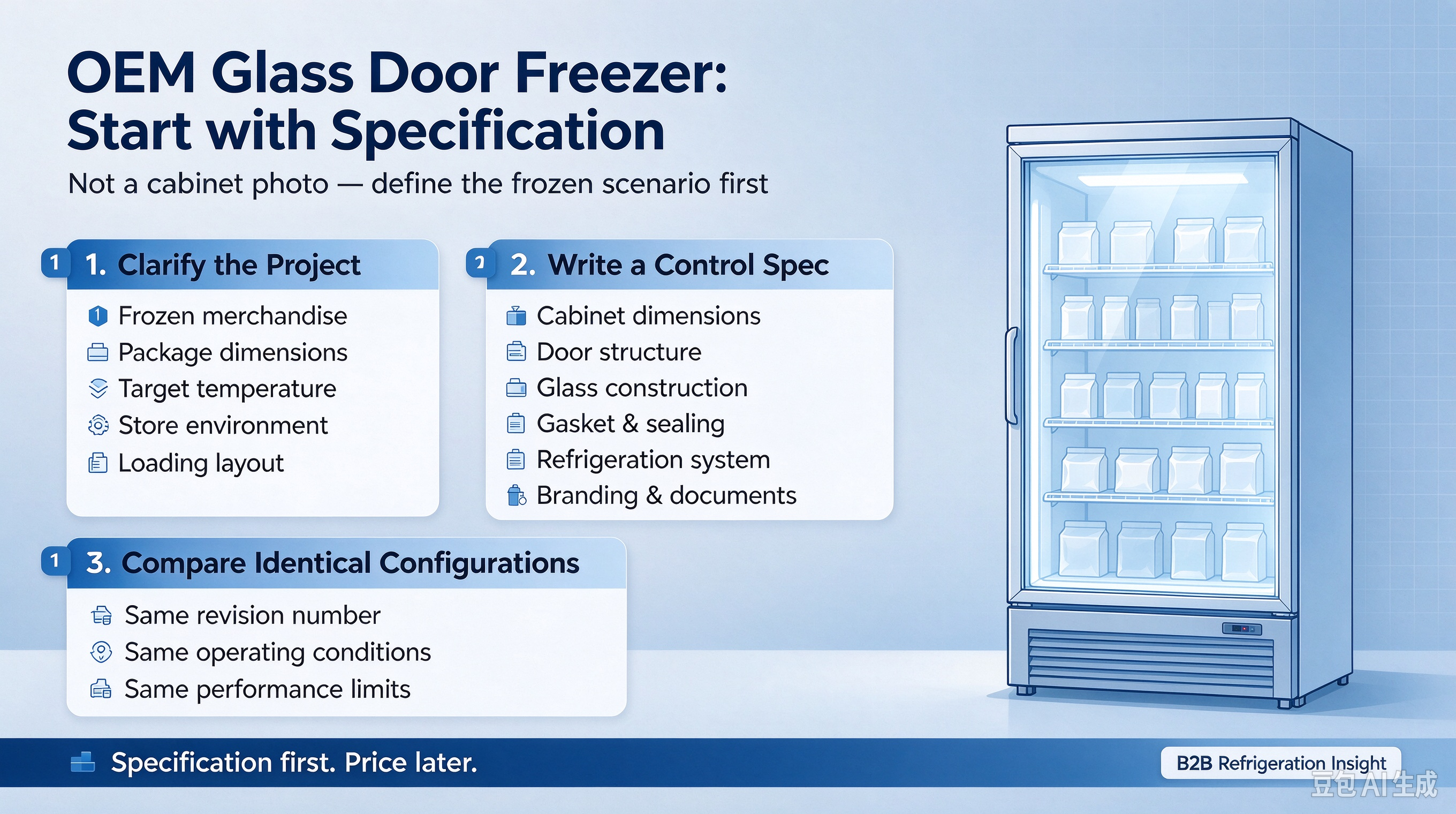
Verbal agreements and scattered quotation notes cannot support long-term stable private label cooperation. Each customized SKU must correspond to an independent, revision-controlled formal specification document, which unifies the standards for purchasing, engineering inspection, factory production and after-sales service.
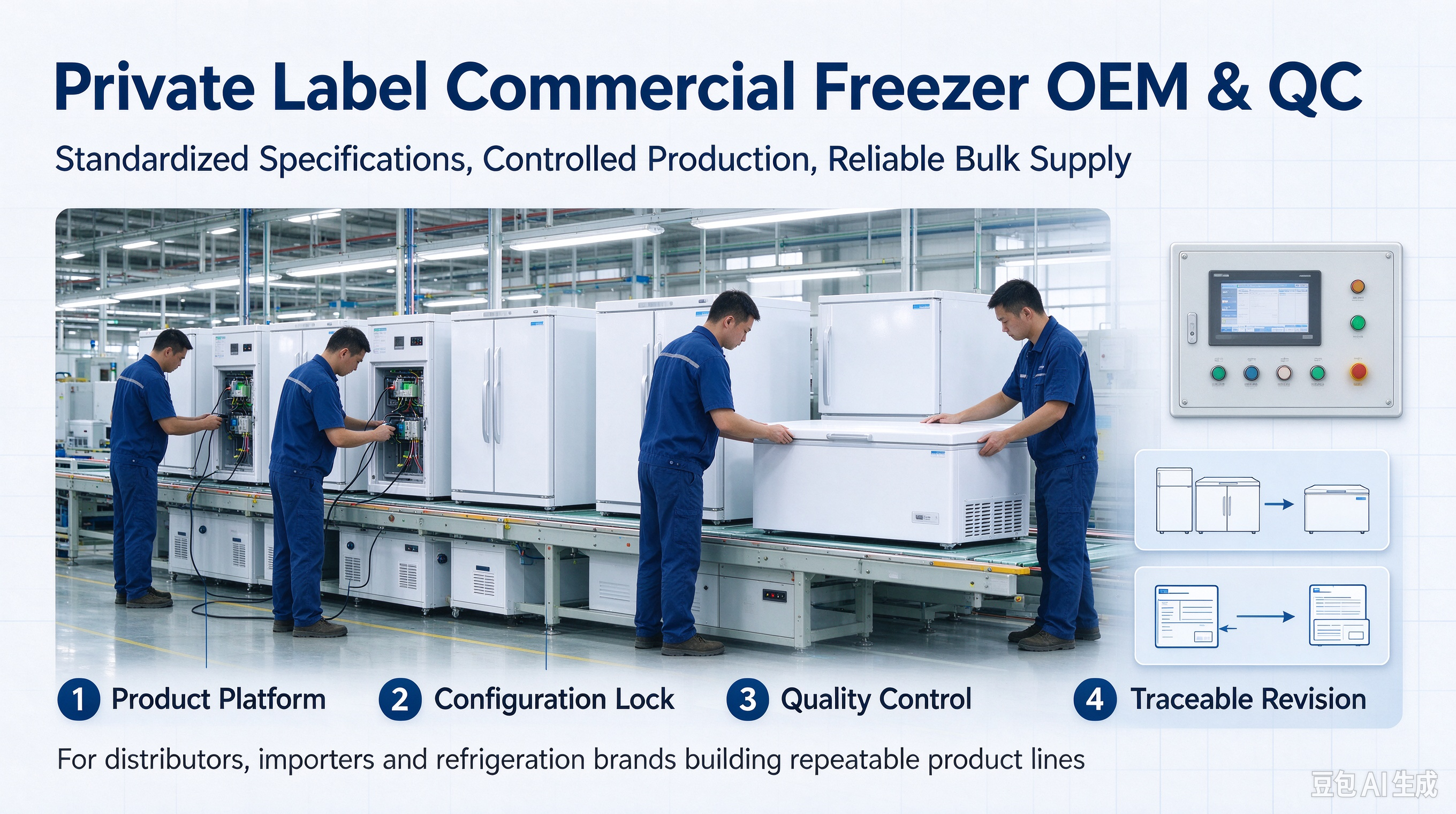
The standardized specification document needs to lock all core information: exclusive private label model number, corresponding factory standard platform, product application scenario, cabinet dimensional standard, constant temperature operation requirement, refrigeration system configuration, controller hardware and parameters, electrical specification parameters, matching accessories, brand artwork revision, label and manual version, export packaging standard and factory inspection acceptance criteria. All specifications must be marked with unified revision numbers to ensure traceability of batch production.
Establish Unique Traceable Identification for All Custom Models
Visually identical freezers may have completely different internal configurations and market adaptation standards, so a scientific SKU coding system is essential to avoid procurement and after-sales errors. The external consumer-oriented model number can be simple and easy to remember, but the internal management system must accurately distinguish core variable parameters.
The internal identification system needs to cover cabinet capacity, electrical adaptation version, door/lid type, refrigeration functional positioning, controller version, target sales market and packaging specification version. This effectively avoids quality and safety risks caused by mixed shipment of visually similar but technically different products for multi-market batch orders.
Optimize Brand Customization to Adapt to Actual Production Scenarios
Brand design that meets online display aesthetics may not be suitable for physical printing on freezer cabinets, metal nameplates and export cartons. All brand customization content must be verified based on actual production processes and product surfaces.
Before mass production, both parties need to confirm logo size, printing position, color standard, spraying process, model number layout, nameplate format, manual brand presentation and carton barcode identification standards. Meanwhile, all brand artwork files must implement version management to prevent the reuse of outdated design files in repeat orders and ensure consistent brand presentation of all batch products.
Lock Technical Specifications First Before Confirming Rating Labels
Product rating labels are not only brand display carriers but also carry core technical parameters and market compliance information. The final confirmation of label artwork must be completed after all product technical specifications are finalized and locked.
For global multi-market private label projects, unified label templates cannot be used indiscriminately. Different countries and regions have differentiated requirements for voltage parameters, safety certification marks and product parameter identification. Buyers need to confirm targeted label, manual and packaging text standards according to the target market’s compliance specifications to avoid customs clearance and market sales risks.
Sample Approval Must Be Based on Formal Mass Production Standards
Initial factory standard samples are only for preliminary product evaluation and cannot be directly used as the final confirmation standard for private label customized products. The officially approved pre-production samples must be completely consistent with the subsequent mass production configuration.
Sample inspection and approval need to cover four core dimensions: commercial appearance (brand logo, finish, model identification), scenario adaptability (actual goods loading, storage space matching, installation applicability), technical configuration (electrical standards, controller parameters, refrigeration system, accessories) and complete documents (labels, manuals, packaging artwork). All approval results must be linked to the latest specification and artwork versions to form traceable approval records.
Implement SKU-Specific Precision Quality Control
Vague slogans such as "strict quality control" have no practical guiding significance for private label orders. Suppliers must formulate targeted inspection standards according to the customized configuration of each independent SKU.
The full-process quality inspection system covers cabinet manufacturing workmanship, door/lid opening and closing performance, electrical circuit safety, controller operation stability, accessory matching integrity, functional test data, product identification accuracy and finished product packaging quality. For projects involving technical modification, all inspection criteria need to be re-verified and formulated according to the latest configuration to avoid universal inspection standards leading to unqualified customized functions.
On-Site Factory Audit Centered on Customized Product Verification
Factory audits should not only focus on workshop scale and equipment sophistication. The core of private label project audit is to track the whole production process of customized products, verifying whether the factory can stably replicate the approved product configuration in batch production.
Key audit verification points include: the independent identification method of private label SKUs on the production line, the isolation and production management of special electrical components, the approval and use process of customized artwork, the inspection and handling mechanism of defective products, and the update and iteration rules of production specifications. Through systematic audit verification, the consistency of mass production products and sample standards is ensured.
Confirm MOQ Based on Single SKU Configuration Rather Than Total Order Volume
A large total order quantity does not mean all customized configurations meet the factory’s mass production standards. A mixed order with multiple sizes, electrical versions and packaging styles usually contains multiple small-batch customized configurations, each with independent MOQ constraints.
Buyers need to clearly confirm the minimum order quantity and restrictive factors of each independent SKU with suppliers. MOQ constraints may come from cabinet mold standards, customized carton printing, special color spraying, dedicated electrical components and personalized accessories. Clarifying the root cause of MOQ restrictions helps buyers reasonably plan order allocation and reduce procurement costs.
Scientifically Plan Mixed-Model Orders Based on Market Demand
Mixed-model container loading can effectively improve container utilization and optimize procurement costs, but blind order filling merely for space utilization will lead to slow-moving inventory and capital occupation.
The correct order planning logic is: terminal market demand → reasonable SKU sales ratio → factory single-model MOQ standard → customized packaging size verification → final container loading plan. Buyers need to prioritize market demand matching, avoid adding non-demand models to fill container space, and reduce long-term inventory and after-sales management pressure.
Refine Lead Time Management with Phased Milestone Confirmation
Private label project cycles involve multiple variable links, and a single delivery cycle data cannot reflect the actual project progress. The complete project cycle includes specification confirmation, sample production and verification, artwork approval, material preparation, mass production, quality inspection, finished product packaging and shipment arrangement.
Different customization types have different cycle arrangements: pure brand customization projects have a shorter cycle, while technical modification projects require additional engineering verification and testing cycles. Refining phased milestones can quickly locate delay links (buyer artwork confirmation, special component procurement, production scheduling, etc.) and ensure orderly project progress.
Treat Export Packaging as a Core Part of Private Label Products
Customized packaging undertakes dual functions of product safety protection and brand image display, and is the first touchpoint for terminal customers to perceive the brand. All private label packaging must be customized according to product characteristics and export transportation scenarios.
The packaging standard needs to cover cabinet corner anti-collision protection, door/lid fixing protection, controller area safety protection, overall bottom reinforcement and accessory positioning fixing. For multi-SKU inventory management scenarios, cartons need to have clear product identification information to facilitate warehouse classification and shipment management. Buyers must confirm the final packaged size before container loading calculation to avoid errors in logistics planning.
Build a Unified Spare Parts System for Product Families
Most new private label buyers only focus on initial product procurement costs and ignore long-term after-sales service costs. A sound spare parts supply system is the core guarantee for sustainable brand operation.
In the early stage of project launch, buyers need to sort out the universal and exclusive parts of all customized SKUs, prioritize the standardized design of common accessories, and build a complete spare parts list. It is necessary to avoid misjudging part universality merely based on product appearance. Each private label model must be bound to the corresponding factory production version to ensure the accuracy of after-sales part matching.
Clarify Warranty Liability Division Before Brand Launch
As the brand operator, the buyer is the first responsible person for terminal after-sales services. Therefore, the supply contract must clearly define the warranty liability division between the supplier and the buyer.
Both parties need to confirm fault diagnosis standards, warranty evidence requirements, spare parts supply methods, freight bearing standards for different scenarios and problem escalation mechanisms in advance. On this basis, buyers can formulate reasonable terminal dealer warranty policies, avoiding inconsistent service commitments and actual supply capabilities that damage brand reputation.
Establish Strict Change Control Mechanisms for Repeat Orders
Batch consistency of repeat orders is the core standard to measure mature private label supply capabilities. Component replacement, process adjustment and packaging modification in factory production are unavoidable, but all technical and configuration changes must be notified and approved by the buyer in advance.
All repeat orders must be produced based on the latest approved specification version. Suppliers need to take the initiative to disclose all possible changes involving refrigeration components, controllers, electrical accessories, cabinet structures, labels and packaging. Unauthorized modification of batch product configurations is prohibited to ensure long-term product consistency.
Evaluate Suppliers Based on Comprehensive Private Label Service Capabilities
When selecting suppliers, the lowest unit price of standard products cannot be used as the sole evaluation criterion. Buyers need to conduct comprehensive assessment based on the supplier’s private label systematic service capabilities, including product platform richness, scenario matching degree, standardized customization process, version control capability, sample verification system, batch production stability, transparent MOQ rules, professional packaging solutions, complete spare parts supply, clear warranty mechanism and repeat-order change control system.
Excellent suppliers can provide overall product line planning solutions for buyers, rather than only providing independent single-product quotation services.
Evaluate Total Project Cost Instead of Single Unit Price
The comprehensive cost of private label projects covers the whole life cycle, including sample development fees, customization fees, artwork production fees, customized packaging costs, inspection fees, logistics and customs clearance fees, spare parts inventory costs and warranty risk costs. The inventory pressure caused by redundant SKUs also belongs to the implicit cost of the project.
Therefore, when comparing suppliers, buyers should focus on the overall profitability of the product line operation. A slightly higher-priced but more stable platform with universal spare parts and low MOQ is often more suitable for long-term brand operation than low-cost products with unstable quality and complex after-sales maintenance.
Distinguish Between Ordinary Private Label Customization and In-Depth Engineering R&D
Secondary development and full structural customization are only applicable to special scenarios where standard products cannot meet extreme demands, such as special store size restrictions, non-standard cargo loading requirements and special industry refrigeration standards.
For most distributors and brand operators, standardized private label customization based on mature platforms can fully meet market demands. Blind in-depth engineering modification merely for "product differentiation" will increase project risks and costs without bringing actual market value.
Standardized RFQ Method for Private Label Freezer Projects
A qualified inquiry should clarify the buyer’s overall business plan, not just single product parameter demands. Buyers need to inform suppliers of the target sales market, terminal customer type, product application scenarios, required capacity gradient, planned SKU quantity, local electrical standards, customization scope, expected order volume and annual sales forecast in detail.
For each customized SKU, buyers need to obtain clear feedback including matched factory base model, optional customization items, technical modification plans, MOQ standards, sample verification processes, packaging specifications and repeat-order cooperation terms. Snowsea supports buyers to submit project demands through the official contact channel, and provides targeted product line planning and private label cooperation solutions.
Standard Workflow of Private Label Commercial Freezer Project
A standardized and controllable private label project process ensures the sustainable development of brand product lines, with the complete workflow as follows: clarify target customer positioning → formulate SKU product portfolio architecture → select mature factory product platforms → classify brand and technical customization items → lock formal product specifications → produce and verify pre-production samples → complete scenario and technical performance verification → confirm final artwork and packaging standards → formulate exclusive quality inspection criteria → launch mass production → complete pre-shipment full inspection → establish long-term spare parts management and change control mechanism for repeat orders.
This closed-loop process unifies the work standards of marketing, purchasing, engineering and production teams, turning each batch of orders into a solid foundation for long-term brand operation.
FAQs
1. What is the core service of a private label commercial freezer supplier?
Professional private label suppliers provide full-cycle customized manufacturing services based on buyers’ independent brands, covering brand customization, configuration adjustment, packaging optimization, batch production, quality control and long-term after-sales support, realizing replicable and sustainable brand product operation.
2. What is the difference between private label and OEM?
Private label focuses on building buyers’ independent brand product systems, while OEM is a broader manufacturing cooperation mode. Private label cooperation includes brand customization and standardized configuration solidification, which is more suitable for buyers to build long-term independent product lines. The actual cooperation scope and responsibilities shall be defined according to project demands.
3. How many SKUs are suitable for a new private label brand to launch?
There is no fixed quantity standard. The SKU quantity should be determined according to terminal market demand and sales capacity. It is necessary to avoid excessive overlapping models, focus on covering core customer demands, and control inventory and after-sales management costs.
4. Can I simply print my logo on standard freezers for private label cooperation?
Simple logo printing is the basic private label service, but it needs to be matched with factory MOQ standards and production processes. Formal brand cooperation also needs to complete specification locking and version management to ensure batch consistency.
5. What core information needs to be locked in private label product specifications?
It includes base model parameters, exclusive private label model number, application scenario, cabinet size, refrigeration performance standards, controller parameters, electrical specifications, supporting accessories, brand artwork version, document standards, packaging specifications and inspection criteria.
6. Is pre-production sample approval necessary?
It is essential. Pre-production samples can verify the consistency of brand effect, technical configuration, scenario adaptability and document packaging, effectively avoiding batch quality and customization errors in mass production.
7. What factors affect private label product MOQ?
MOQ is restricted by multiple factors such as base model mold, customized color, exclusive packaging, special electrical components and personalized accessories. Each customized SKU has independent minimum order standards.
8. How to manage spare parts for private label product lines?
Establish a one-to-one binding relationship between private label SKUs and factory production versions, sort out universal and exclusive spare parts, and build a complete spare parts inventory and supply system to ensure after-sales maintenance efficiency.
9. How to ensure the consistency of repeat orders?
Take the approved version-locked specification as the production standard, require suppliers to disclose all configuration changes in advance, and implement strict change approval and record management mechanisms.
10. How to apply for Snowsea’s private label freezer cooperation solution?
Buyers can clarify target market, application scenarios, SKU planning, electrical standards, customization demands and order volume, and submit project demands through Snowsea’s official contact channel to obtain exclusive product line planning and quotation solutions.
Conclusion
Private label commercial freezer cooperation is a systematic brand supply chain construction project, not a simple logo printing and product procurement business. Excellent private label suppliers can help buyers build standardized, low-risk and sustainable product operation systems through scientific SKU planning, mature platform selection, standardized specification locking, classified customization management and perfect after-sales support.
Snowsea relies on rich commercial refrigeration product platforms and mature OEM/ODM customization systems to provide one-stop private label solutions for global distributors, importers and brand operators. We support full-process customized services from product planning, sample verification, batch production to long-term after-sales replenishment. Buyers can submit project demands to obtain targeted private label cooperation plans and build their own competitive refrigeration product lines.
To explore available models, visit the Snowseax Products Page. For freezer design and custom manufacturing projects, visit the Snowseax OEM/ODM Page and contact the Snowseax team for a tailored solution.