Choosing the best commercial freezer for meat display requires more than comparing cabinet dimensions or purchase prices. Meat retailers, supermarkets, butcher shops, food distributors, and frozen-food stores need equipment that maintains a stable temperature while presenting products clearly and supporting safe, efficient daily operation.
The right freezer should help a business:
- Protect meat quality
- Maintain consistent frozen storage conditions
- Improve product visibility
- Simplify stock rotation
- Reduce temperature loss
- Support hygienic cleaning
- Use floor space efficiently
- Control long-term energy costs
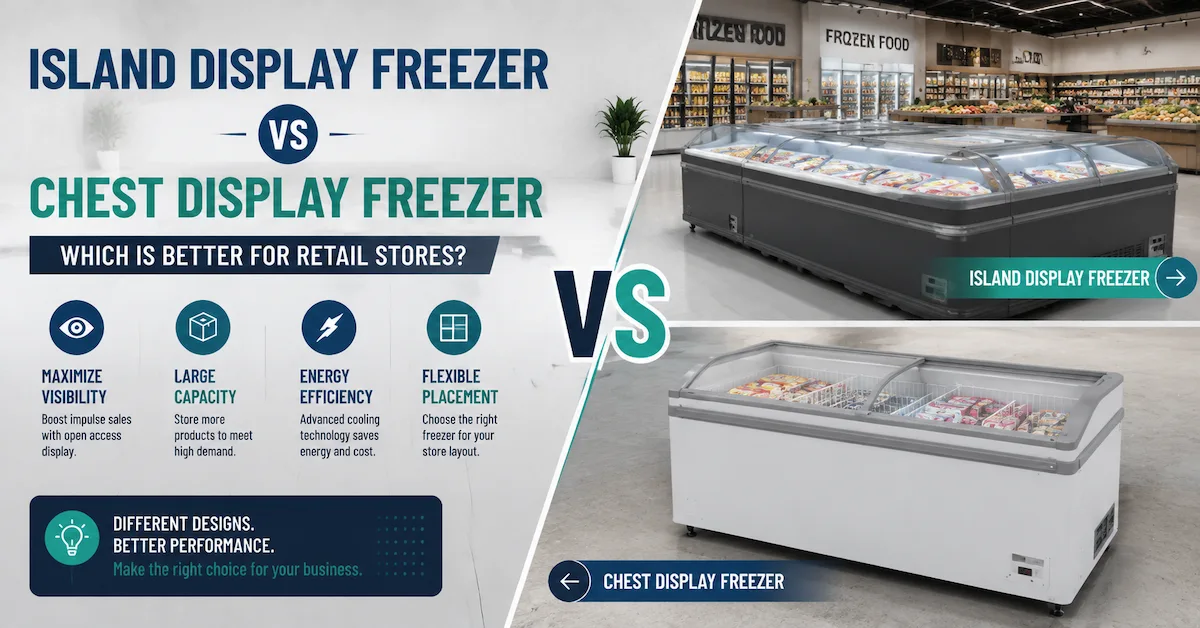
Different commercial freezer designs offer different advantages. An island freezer may provide strong promotional visibility, while an upright glass-door freezer may organize many packaged meat products within a smaller footprint. A chest freezer may be suitable for bulk storage, but it may not provide the best customer-facing display.
This guide explains how to compare the main freezer types and select a suitable solution for a specific meat types and select a suitable solution for a specific meat retail environment.
First Determine Whether the Meat Is Chilled or Frozen
Before selecting a freezer, buyers must confirm whether the products require chilled or frozen storage.
This distinction determines the required equipment category.
| Meat Condition | Typical Equipment Direction |
|---|---|
| Fresh chilled meat | Refrigerated meat display cabinet |
| Packaged chilled meat | Glass-door refrigerator or multideck display |
| Frozen packaged meat | Commercial display freezer |
| Bulk frozen meat | Chest freezer or storage freezer |
| Premium frozen cuts | Upright glass-door freezer |
| Promotional frozen meat | Island display freezer |
A freezer is designed for sub-zero storage. It is not automatically suitable for fresh chilled meat.
Using equipment outside its intended temperature range can lead to:
- Poor product presentation
- Excessive frost
- Unstable storage conditions
- Higher energy consumption
- Reduced product quality
Buyers should clearly state the meat type, packaging format, required temperature, and expected ambient environment when requesting a product recommendation.
Which Freezer Types Are Commonly Used for Meat Display?
The most common options include:
- Island display freezers
- Upright glass-door freezers
- Sliding-glass chest freezers
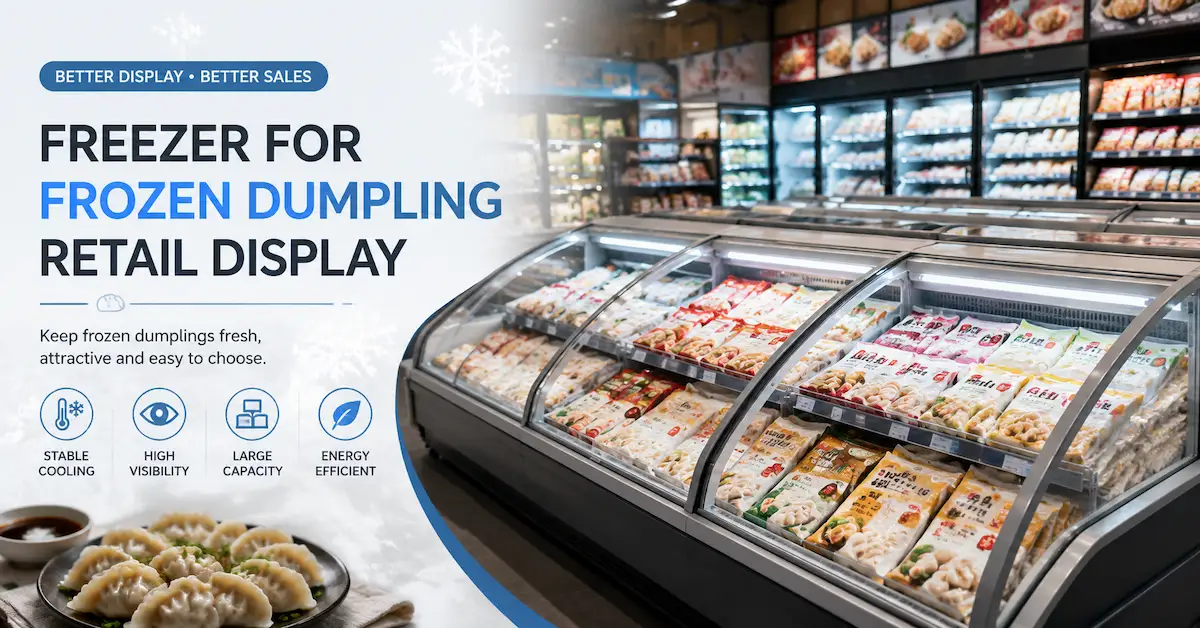
- Curved-glass display freezers
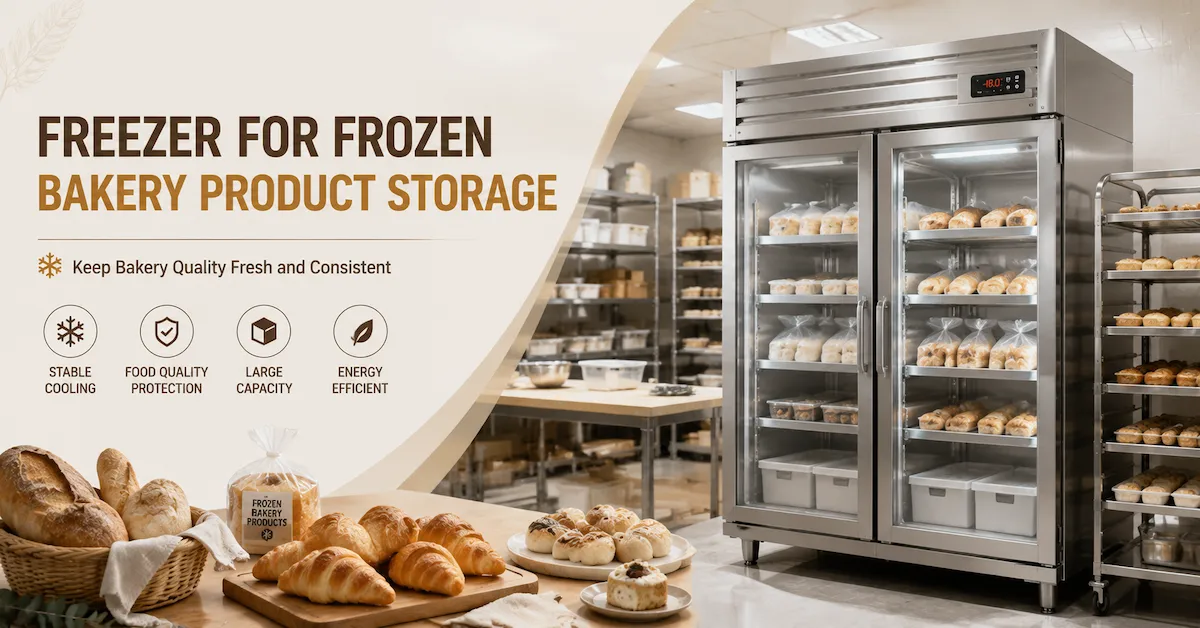
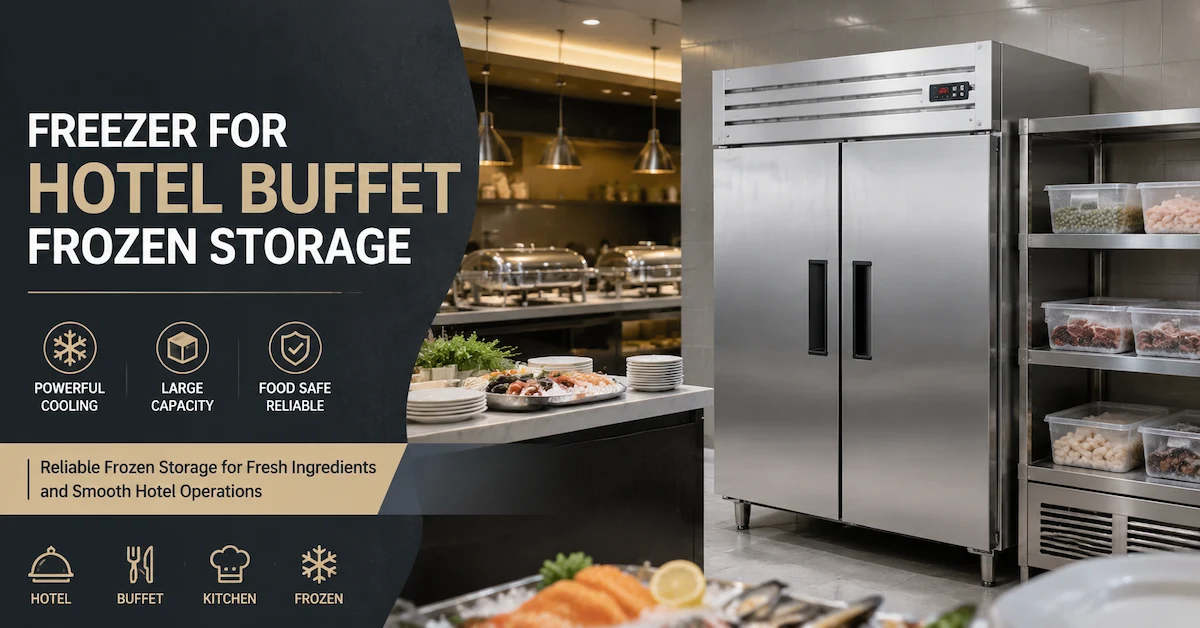
- Solid-door storage freezers
- Customized supermarket freezer lines
Each design serves a different retail or storage purpose.
Island Freezers for High-Volume Meat Display
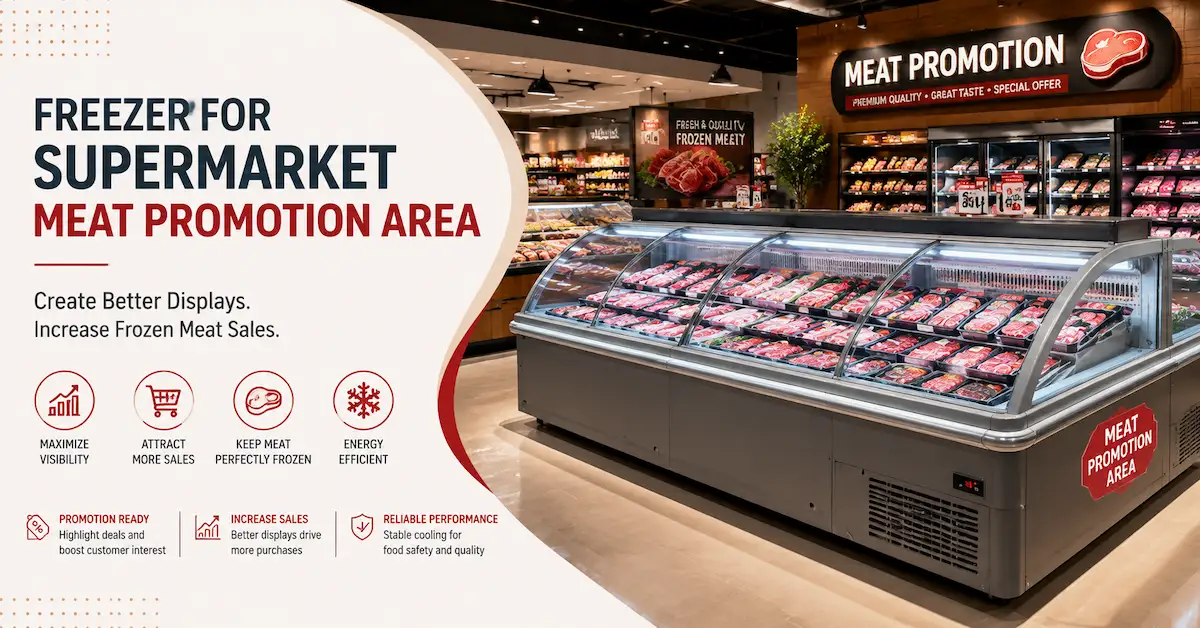
Island freezers are commonly installed in the central aisles of supermarkets and large frozen-food stores.
They usually feature horizontal cabinets with sliding glass lids, straight glass, or curved glass.
Main advantages
Island freezers provide:
- A wide product-display surface
- Easy access from multiple sides
- Strong visibility for promotions
- High storage capacity
- Flexible use of baskets and dividers
- Efficient presentation of packaged meat
They are particularly suitable for:
- Frozen beef
- Frozen pork
- Poultry products
- Packaged meat portions
- Frozen seafood
- Promotional meat bundles
- Family-size frozen products
Limitations
Island freezers require substantial floor space. Buyers must leave enough aisle clearance for shopping carts and customer movement.
Products may also become difficult to organize when too many SKUs are placed in one cabinet.
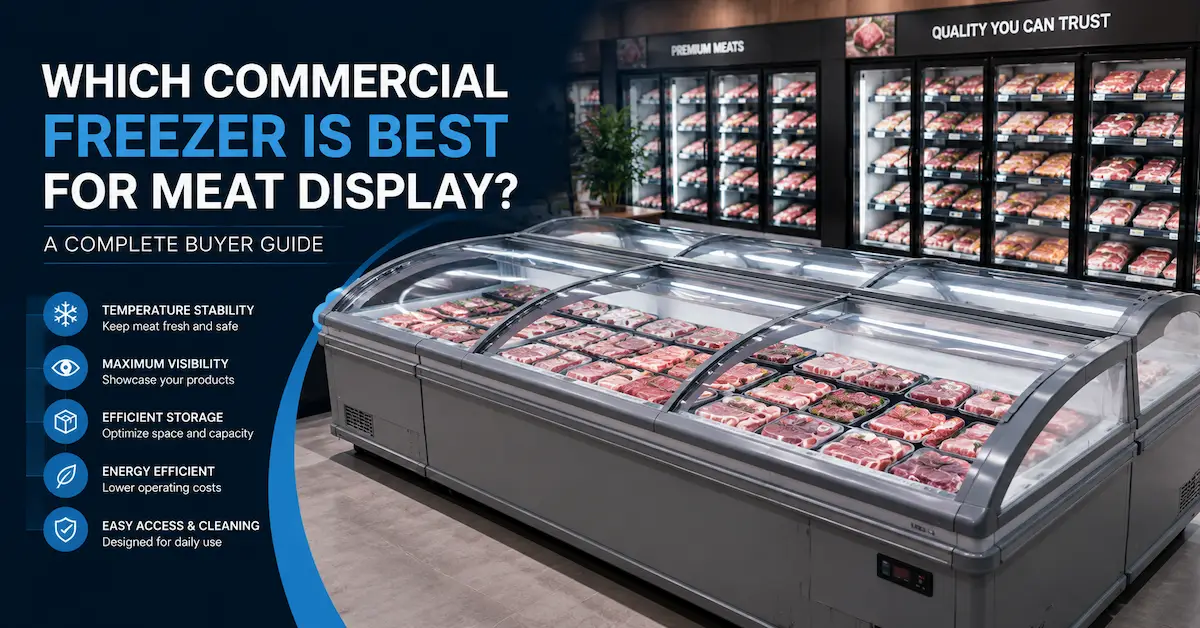
An island freezer is often the best commercial freezer for meat display when the priority is high-volume self-service merchandising in a supermarket environment.
Upright Glass-Door Freezers for Organized Meat Products
Upright display freezers use vertical space and normally include one, two, three, or more glass doors.
They are suitable for packaged meat products that need clear category organization.
Main advantages
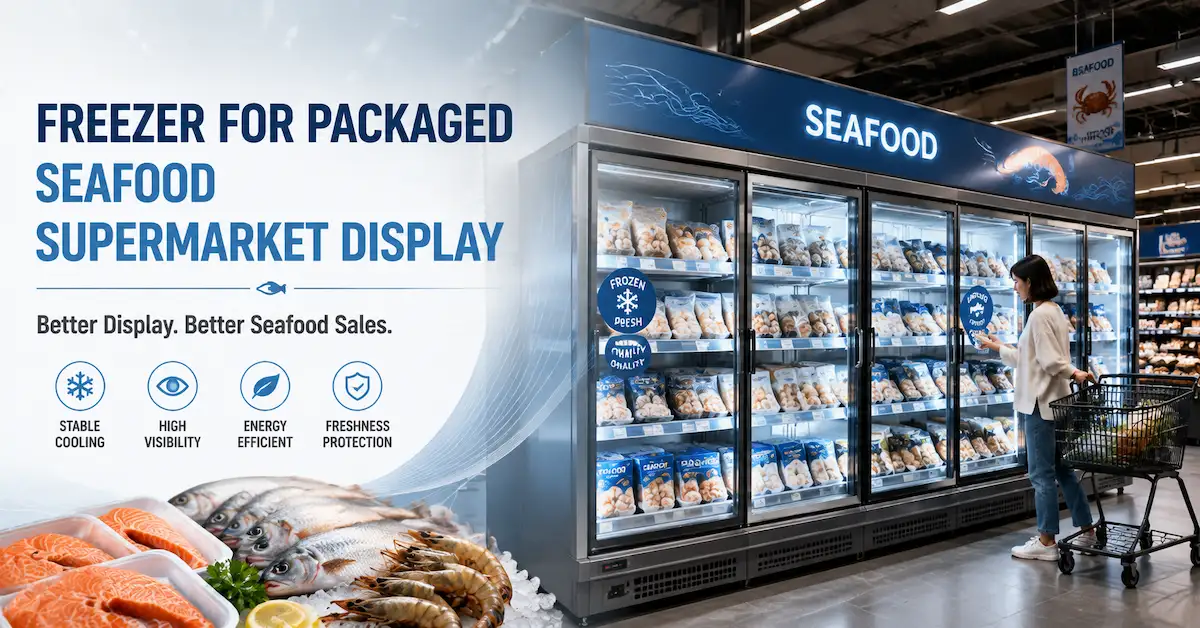
Upright freezers offer:
- Strong front-facing product visibility
- Adjustable shelving
- Clear separation between meat categories
- A relatively small floor footprint
- Easy stock identification
- Good use of wall space
- Convenient product access
They are often used for:
- Premium frozen meat
- Boxed steaks
- Packaged poultry
- Frozen processed meat
- Ready-to-cook meat products
- Private-label frozen food
- Small and medium-sized meat packages
Limitations
Glass doors are opened frequently in busy retail environments, which can increase temperature recovery requirements.
Shelves must also be configured according to the weight of the products. Heavy meat packages require strong shelf construction.
An upright glass-door cabinet may be the best choice when buyers need organized presentation, multiple SKUs, and efficient use of limited floor space.
Sliding-Glass Chest Freezers for Value-Focused Retail
Chest freezers have a horizontal cabinet and often use sliding glass lids for commercial display.
They are commonly used by:
- Butcher shops
- Discount supermarkets
- Frozen-food retailers
- Small grocery stores
- Food distributors
- Wholesale outlets
Main advantages
Chest freezers typically provide:
- Strong cold retention
- Large internal capacity
- Simple construction
- Flexible basket arrangements
- Competitive purchasing cost
- Reliable bulk frozen storage
Cold air remains inside more effectively when the top is opened because cold air is heavier than warm air.
Limitations
Products located at the bottom may be difficult to see or reach. Frequent rearrangement may be required to maintain an attractive display.
A chest freezer is suitable when storage capacity and cost are more important than premium product presentation.
Curved-Glass Freezers for Promotional Meat Displays
Curved-glass freezers improve visibility by allowing customers to view products from above and from the front.
They are often used for promotional areas and selected frozen products.
Benefits include:
- Attractive presentation
- Clear viewing angle
- Strong impulse-purchase potential
- Easy customer access
- Good branding opportunities
However, curved-glass structures may affect usable internal space and packaging requirements during transportation.
They are most suitable for meat products that benefit from promotional presentation rather than dense bulk storage.
Solid-Door Freezers for Backroom Meat Storage
Solid-door commercial freezers are designed primarily for storage rather than customer-facing presentation.
They may be used in:
- Butcher-shop preparation areas
- Restaurant kitchens
- Supermarket backrooms
- Food-processing facilities
- Distribution warehouses
Advantages include:
- Strong insulation
- Organized storage
- Reduced light exposure
- Durable construction
- Efficient use of preparation areas
A solid-door cabinet is usually not the best display solution because customers cannot see the products. However, it may be combined with a glass-display freezer to provide additional backstock capacity.
Comparison of Meat Display Freezer Types
| Freezer Type | Product Visibility | Capacity | Floor-Space Efficiency | Best Application |
|---|---|---|---|---|
| Island freezer | High | High | Moderate | Supermarket meat promotions |
| Upright glass-door freezer | Very high | Medium to high | High | Organized packaged meat |
| Sliding-glass chest freezer | Medium | High | Moderate | Bulk and value-focused retail |
| Curved-glass freezer | High | Medium | Moderate | Promotional meat display |
| Solid-door freezer | None | High | High | Backroom meat storage |
The final choice should reflect the store format, available space, number of products, customer behavior, and replenishment process.
Temperature Stability Is the First Selection Priority
Meat quality depends on stable storage conditions.
A suitable freezer should provide:
- Consistent internal temperature
- Fast pull-down performance
- Reliable temperature recovery
- Even airflow
- Accurate controller operation
- Effective door or lid sealing
Buyers should ask the manufacturer how the freezer performs during:
- Frequent door opening
- High ambient temperatures
- Full product loading
- Peak store hours
- Defrost cycles
An attractive cabinet is not useful if it cannot maintain stable conditions in the actual store environment.
Compare Airflow and Product Loading Design
Air circulation affects both temperature stability and usable capacity.
Products should not block:
- Air outlets
- Return-air channels
- Fans
- Sensors
- Recommended loading lines
Overloading a display freezer may cause:
- Uneven temperatures
- Slow cooling recovery
- Frost accumulation
- Higher compressor workload
- Reduced product visibility
Island and chest freezers should have clearly marked loading limits. Upright freezers should provide enough space between shelves for cold-air circulation.
Product Visibility Influences Meat Sales
The freezer is also a merchandising system.
Clear visibility helps customers compare:
- Meat types
- Brands
- Package sizes
- Prices
- Cuts
- Promotional offers
For premium packaged meat, an upright glass-door freezer may provide better presentation because products can be arranged at eye level.
For high-volume promotions, island freezers allow large quantities to be displayed in open supermarket areas.
The best cabinet should balance storage density with easy product recognition.
Evaluate the Number and Size of Meat Packages
Freezer size should be based on actual product dimensions rather than liters alone.
Buyers should calculate:
- Number of SKUs
- Package width
- Package depth
- Package height
- Average package weight
- Required facings per SKU
- Daily sales volume
- Replenishment frequency
- Safety-stock requirement
Large boxes of frozen meat need a different cabinet configuration from small vacuum-packed portions.
Sharing package samples or dimensions with the manufacturer can improve model selection and internal layout planning.
Shelves and Baskets Must Support Meat Weight
Frozen meat is relatively heavy.
Shelf and basket construction should be checked carefully.
Important considerations include:
- Maximum shelf load
- Basket strength
- Shelf-support design
- Corrosion resistance
- Adjustability
- Ease of removal
- Cleaning accessibility
Light-duty shelves designed for ice cream or packaged snacks may not be appropriate for heavy meat boxes.
The product specification should confirm the permitted load per shelf or basket.
Hygiene and Cleaning Requirements
Meat-display equipment must be easy to clean.
Buyers should inspect:
- Interior corners
- Drainage design
- Shelf removal
- Basket removal
- Gasket accessibility
- Condensation management
- Surface materials
- Door tracks
- Handle design
Smooth, accessible surfaces help reduce dirt accumulation and simplify routine maintenance.
Sliding-lid tracks should be removable or easy to clean. Upright freezer shelves should be washable and resistant to corrosion.
The equipment should also allow staff to remove damaged packaging or leaked product quickly.
Glass Type and Anti-Condensation Performance
Glass visibility can be affected by fogging or condensation.
Buyers should ask about:
- Insulated glass
- Heated glass options
- Anti-fog performance
- Door-frame heating
- Ambient humidity suitability
- Glass strength
- Safety construction
In humid stores, unclear glass can reduce product visibility and force customers to open doors more frequently.
This increases temperature loss and operating costs.
The glass configuration should match the expected ambient temperature and humidity.
Door or Lid Configuration
The opening system affects customer convenience and energy efficiency.
Sliding glass lids
Suitable for:
- Narrow aisles
- Island freezers
- Chest freezers
- High-volume self-service areas
They do not project into the aisle when opened.
Hinged glass doors
Suitable for:
- Upright cabinets
- Organized product categories
- Wall-mounted freezer lines
Buyers should confirm:
- Door swing clearance
- Self-closing function
- Handle position
- Gasket quality
- Opening angle
The correct configuration depends on store layout and customer traffic.
Store Layout and Available Floor Space
Before ordering, buyers should measure:
- Available width
- Available depth
- Maximum cabinet height
- Aisle width
- Door-opening space
- Ventilation clearance
- Delivery entrance
- Corridor width
- Elevator dimensions
A large island freezer may provide excellent capacity but create congestion in a small store.
An upright cabinet may be more suitable when wall space is available and floor area is limited.
Buyers can review Snowsea’s available commercial freezer products before comparing cabinet dimensions and configurations.
Ambient Temperature and Store Conditions
The operating environment affects freezer performance.
The manufacturer should know whether the unit will be installed:
- In an air-conditioned supermarket
- Near a store entrance
- Close to sunlight
- In a hot-climate region
- In a humid environment
- Near cooking or preparation equipment
- In a warehouse without air conditioning
Higher ambient temperatures may require stronger refrigeration capacity or a different condenser configuration.
Ignoring store conditions can result in slower cooling, longer compressor operation, and higher energy use.
Energy Consumption and Total Operating Cost
The purchase price is only part of the freezer’s total cost.
Buyers should also consider:
- Energy consumption
- Compressor efficiency
- Insulation quality
- Glass construction
- Lighting
- Defrost method
- Door-opening frequency
- Maintenance
- Spare parts
- Product lifespan
A larger cabinet may increase sales capacity, but it may also increase operating costs when it is consistently underloaded.
Selecting the correct size is therefore as important as choosing an efficient refrigeration system.
Static Cooling or Fan Cooling?
Commercial display freezers may use different air-distribution methods.
Static cooling
Potential advantages include:
- Simple structure
- Lower fan noise
- Reduced airflow around exposed products
- Competitive cost
Temperature distribution may be less uniform in some cabinet designs.
Fan-assisted cooling
Potential advantages include:
- More even temperature distribution
- Faster recovery
- Better performance in frequently opened cabinets
However, airflow design must prevent excessive drying or packaging disturbance.
The correct system depends on the cabinet type, meat packaging, loading density, and retail environment.
Defrost System
Defrost performance affects daily operation.
Buyers should compare:
- Manual defrost
- Automatic defrost
- Defrost frequency
- Water management
- Temperature variation
- Maintenance requirements
Manual defrost may be acceptable for simple chest freezers but requires scheduled shutdown and cleaning.
Automatic defrost can reduce labor, although the system should maintain appropriate product temperatures during each cycle.
Recommended Freezers by Meat-Retail Scenario
| Retail Scenario | Recommended Direction |
|---|---|
| Large supermarket frozen-meat section | Island and upright freezer combination |
| Premium packaged-meat display | Upright glass-door freezer |
| Discount meat retailer | Sliding-glass chest freezer |
| Small butcher shop | Compact chest or upright freezer |
| Promotional frozen-meat campaign | Island or curved-glass freezer |
| Wholesale frozen-meat outlet | High-capacity chest freezer |
| Backroom meat inventory | Solid-door storage freezer |
Many businesses benefit from using more than one freezer type.
For example, a supermarket may use upright cabinets for premium packaged products and island freezers for promotions and high-volume stock.
Meat Display Freezer Selection Checklist
| Selection Area | Questions to Ask |
|---|---|
| Product condition | Is the meat chilled or frozen? |
| Packaging | What are the package dimensions and weights? |
| Capacity | How many products must be displayed? |
| Visibility | Is premium front-facing display required? |
| Store layout | How much floor and wall space is available? |
| Temperature | What operating range is required? |
| Ambient conditions | How hot and humid is the store? |
| Shelving | Can shelves support the product weight? |
| Hygiene | Are internal surfaces easy to clean? |
| Glass | Is anti-condensation performance required? |
| Energy | What is the expected operating cost? |
| Customization | Are branding, color, or dimensions required? |
Common Mistakes When Selecting a Meat Display Freezer
Choosing Only by Capacity
A high liter rating does not guarantee good product organization or visibility.
Using a Storage Freezer as a Display Freezer
Solid-door storage equipment may protect products but cannot support customer-facing merchandising.
Ignoring Package Weight
Shelves or baskets may deform when they are not designed for heavy meat products.
Selecting a Cabinet That Is Too Deep
Customers may struggle to reach products at the bottom of a deep chest freezer.
Ignoring Condensation
Fogged glass reduces visibility and increases unnecessary door opening.
Overlooking Cleaning Access
Complicated tracks, corners, and fixed baskets can make hygiene management difficult.
Failing to Consider Store Traffic
Door type and aisle clearance must support peak customer flow.
Buying an Oversized Freezer
Unused capacity increases floor-space and operating costs without improving sales.
How Snowsea Supports Meat Display Freezer Projects
Snowsea provides commercial refrigeration solutions for supermarkets, meat retailers, frozen-food distributors, butcher shops, and food-service suppliers.
Available support may include:
- Freezer-type recommendations
- Capacity and dimension selection
- Island freezer solutions
- Upright glass-door freezer solutions
- Chest freezer configurations
- Shelf and basket customization
- Voltage and plug customization
- Cabinet color and logo options
- Export packaging
- Quality inspection
- Bulk-order production
Buyers requiring private-label products or special supermarket layouts can review Snowsea’s OEM and ODM refrigeration services.
FAQ
Which commercial freezer is best for frozen meat display?
Island freezers are suitable for high-volume supermarket displays, while upright glass-door freezers are better for organized packaged meat and premium product presentation.
Is a chest freezer suitable for displaying meat?
A sliding-glass chest freezer can be suitable for bulk or value-focused frozen-meat retail, although products at the bottom may be less visible.
What temperature should a meat display freezer maintain?
The required temperature depends on the meat type, packaging, local requirements, and storage conditions. Buyers should confirm the target range with the product supplier and freezer manufacturer.
Are upright freezers suitable for heavy meat packages?
Yes, provided the shelves and support structure are designed for the required load. Buyers should confirm the maximum load per shelf.
Which freezer uses supermarket floor space most efficiently?
Upright glass-door freezers use vertical space efficiently, while island freezers require more floor area but provide a larger promotional display.
How can I prevent glass doors from fogging?
Choose suitable insulated or heated glass, maintain proper store humidity, and ensure the freezer is designed for the expected ambient conditions.
Can meat display freezers be customized?
Commercial freezer manufacturers may provide customized colors, logos, shelf layouts, baskets, voltage configurations, packaging, and dimensions.
Conclusion
The best commercial freezer for meat display depends on the product type, package dimensions, sales volume, store layout, customer traffic, temperature requirement, and merchandising strategy.
Island freezers are effective for high-volume supermarket promotions. Upright glass-door freezers provide organized presentation and efficient use of wall space. Sliding-glass chest freezers offer strong capacity for value-focused retail, while solid-door cabinets are better suited to backroom storage.
Snowsea supports commercial meat retailers and refrigeration distributors with freezer selection, OEM customization, quality inspection, export packaging, and bulk production.
Explore Snowsea’s commercial refrigeration products or submit your meat-display requirements through the OEM and ODM service page for a suitable freezer recommendation.