What Is Commercial Freezer Anti Fog Glass?
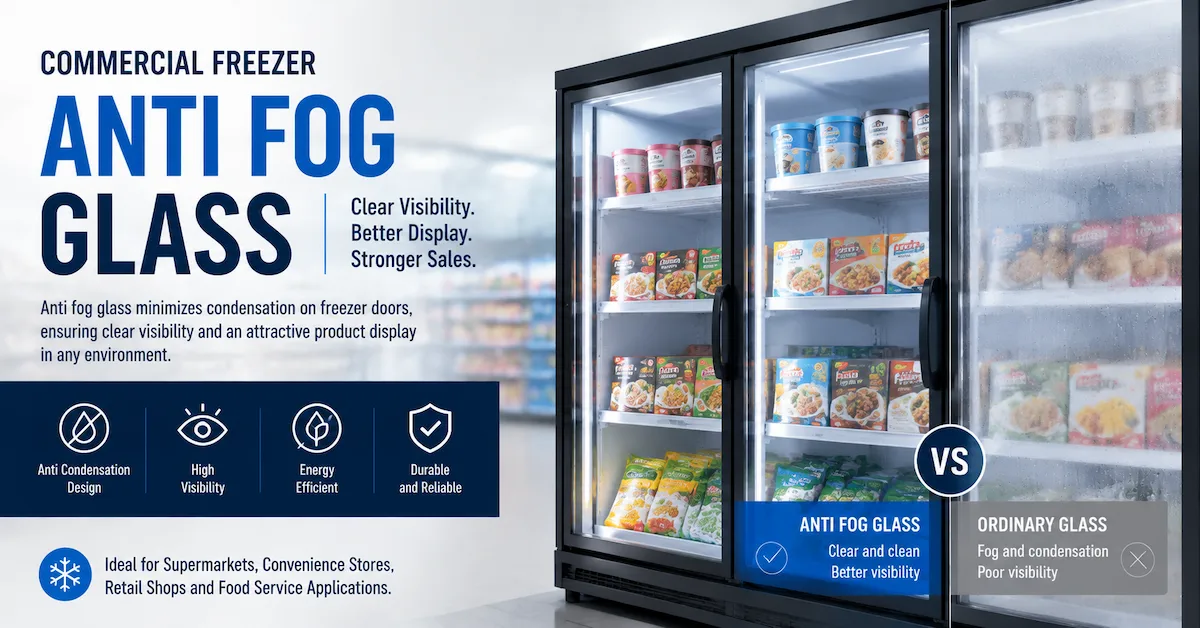
Commercial freezer anti fog glass refers to freezer door glass solutions designed to reduce fogging and condensation on viewing surfaces, helping maintain product visibility in commercial refrigeration applications.
Unlike ordinary glass, freezer door glass must perform under challenging conditions:
- Low internal cabinet temperatures
- Warm external environments
- Humidity changes
- Frequent door opening
- Continuous commercial operation
For supermarkets, convenience stores, restaurants, and foodservice applications, glass visibility is part of the product experience.
A fogged freezer door can affect:
- Product display visibility
- Customer purchasing experience
- Store appearance
- Operational convenience
However, anti fog glass is not only a glass material choice.
It is part of a complete freezer door system that includes:
- Glass structure
- Door frame
- Heater integration
- Gasket sealing
- Insulation design
- Environmental conditions
- Energy management
Why Does Commercial Freezer Glass Fog?
Fogging occurs when warm humid air contacts a surface that is below the dew point temperature.
In commercial freezer applications, this can happen when:
- External humidity is high
- Doors are opened frequently
- Glass surface temperature becomes too low
- Door sealing is insufficient
- Ambient conditions change rapidly
Typical fogging areas include:
- Glass surface
- Glass edges
- Door frame area
- Seal interface
The risk can become higher in:
- Tropical regions
- Coastal markets
- High-traffic retail stores
- Commercial kitchens
For this reason,anti fog glass design should be evaluated according to the actual operating environment rather than only laboratory conditions.
Anti Fog Glass Is Different From Door Heater Design
Anti fog glass and door heaters are related, but they solve different problems.
| Solution | Main Function |
|---|---|
| Anti fog glass | Maintain clear glass visibility and reduce surface condensation |
| Door heater | Provide controlled heat around selected door areas |
A commercial freezer may use one or both approaches depending on:
- Door structure
- Climate condition
- Application requirement
- Energy target
A strong door system normally considers:
Glass + Heater + Frame + Gasket + Insulation
as one integrated design.
For related door heating considerations, see:
Commercial Freezer Door Heater Design
Why Anti Fog Glass Matters for Commercial Applications
Maintain Product Visibility
For display freezers, visibility directly affects the customer experience.
Clear glass allows customers to quickly identify:
- Frozen products
- Beverages
- Ice cream
- Food packages
Fogging can reduce visibility and make customers open doors unnecessarily.
Improve Retail Presentation
Commercial freezers are not only refrigeration equipment.
They are also product display equipment.
Clear glass supports:
- Better product presentation
- Easier product selection
- Improved shopping experience
This is especially important in:
- Supermarkets
- Convenience stores
- Beverage displays
- Frozen food sections
Support Efficient Commercial Operation
When customers can clearly see products through the glass, unnecessary door opening may be reduced.
However, anti fog glass should not be considered a replacement for proper refrigeration design.
It works together with:
- Door sealing
- Cabinet insulation
- Temperature control
- Airflow design
Commercial Freezer Anti Fog Glass Design Factors
Glass Layer Structure
Commercial freezer doors often use specially designed glass structures to balance:
- Visibility
- Thermal performance
- Condensation resistance
- Structural reliability
Important design considerations include:
- Number of glass layers
- Insulation characteristics
- Edge sealing
- Frame integration
The goal is to reduce unwanted heat transfer while maintaining clear visibility.
Heated Glass Solutions
Some freezer door designs may use heated glass technologies to reduce condensation on viewing surfaces.
The principle is controlled heat management.
The purpose is not to warm the freezer area.
Instead, the system helps maintain suitable surface conditions where condensation risk exists.
The correct solution depends on:
- Glass size
- Door structure
- Ambient humidity
- Energy requirements
- Application environment
There is no universal heating configuration suitable for every freezer.
Glass Edge and Frame Design
Glass edges often require special attention because they connect multiple components:
- Glass panel
- Frame
- Heater area
- Seal structure
Poor integration may create:
- Local condensation areas
- Thermal leakage paths
- Reduced visibility
For OEM projects, buyers should evaluate the complete door assembly instead of reviewing glass separately.
Anti Fog Glass and Energy Consumption
One of the most common buyer concerns is:
“Will anti fog glass increase freezer energy consumption?”
The answer depends on the complete design.
Factors affecting energy performance include:
- Glass structure
- Heating method
- Operating duration
- Ambient humidity
- Door opening frequency
- Cabinet insulation
- Refrigeration system efficiency
A solution with additional heating elements may require energy input, but the goal is to achieve reliable visibility and condensation control without unnecessary consumption.
Energy evaluation should consider the complete freezer system.
Related guide:
Commercial Freezer Energy Consumption Test
Anti Fog Glass Performance in High Humidity Environments
Humidity is a major factor in freezer glass performance.
Applications in humid environments may include:
- Tropical supermarkets
- Coastal regions
- Restaurant kitchens
- Convenience stores
Higher humidity increases condensation risk.
For these applications, buyers should provide:
- Destination climate
- Installation environment
- Expected humidity condition
- Door usage frequency
This allows suppliers to evaluate the door system according to real operating conditions.
Related topic:
Commercial Freezer Tropical Climate Design
Door Opening Frequency Affects Glass Fogging
Commercial freezer doors are frequently opened during daily operation.
Each opening can introduce:
- Warm air
- Humidity
- Temperature disturbance
A freezer installed in a busy retail environment may experience different condensation behavior compared with a freezer in a low-access storage area.
During evaluation, buyers should consider:
- Expected door opening frequency
- Customer access pattern
- Recovery behavior
- Ambient environment
A closed-door test alone may not represent actual commercial use.
Relationship Between Anti Fog Glass and Thermal Bridge Control
Anti fog glass and thermal bridge control are connected through overall door thermal performance.
Thermal bridge control focuses on reducing unwanted heat transfer through structural paths.
Anti fog glass focuses on maintaining clear viewing surfaces.
Together, they influence:
- Door performance
- Condensation behavior
- Energy efficiency
- Long-term reliability
A complete freezer door design should consider:
- Glass structure
- Frame design
- Heater integration
- Insulation continuity
- Sealing performance
Related guide:
Commercial Freezer Thermal Bridge Control
How Should Buyers Evaluate Anti Fog Glass Performance?
B2B buyers should evaluate more than the glass specification.
A complete review should include:
| Evaluation Area | Buyer Should Verify |
|---|---|
| Glass structure | What type of glass design is used? |
| Anti fog method | Heated glass or other condensation-control method? |
| Climate condition | Was humidity considered? |
| Door system | How does glass work with frame and gasket? |
| Energy impact | How is additional energy managed? |
| Testing | Were condensation conditions evaluated? |
| Production | Is glass installation consistent? |
| OEM capability | Can the door design be customized? |
A supplier should explain the design logic behind the solution, not only provide a component description.
How Is Commercial Freezer Anti Fog Glass Tested?
Condensation Testing
Condensation evaluation should define:
- Ambient temperature
- Humidity condition
- Cabinet temperature
- Door configuration
- Test duration
Important areas may include:
- Glass surface
- Glass edges
- Door frame
- Seal areas
Visibility Evaluation
For display freezers,buyers should also consider:
- Product visibility
- Fog recovery
- Appearance during operation
- Customer viewing experience
Energy Testing
Anti fog performance should be evaluated together with freezer energy performance.
Important factors include:
- Glass heating operation
- Compressor operation
- Fan operation
- Cabinet temperature
There is no single anti fog specification that applies to every commercial freezer.
The correct evaluation depends on the application requirement.
Common Procurement Mistakes
| Mistake | Why It Creates Risk |
|---|---|
| Comparing glass thickness only | Does not show condensation performance |
| Ignoring humidity conditions | Real fogging risk may be underestimated |
| Testing only closed doors | Does not represent commercial operation |
| Choosing maximum heating output | May increase energy consumption |
| Ignoring gasket design | Poor sealing can still cause condensation |
| Changing door structure after testing | Previous results may no longer apply |
A professional supplier should evaluate the complete door system rather than one glass component.
OEM Considerations for Custom Anti Fog Glass Solutions
For OEM freezer projects, buyers should define requirements early.
Useful project information includes:
- Freezer type
- Door type
- Glass size
- Cabinet dimensions
- Target temperature
- Ambient climate
- Humidity condition
- Door opening frequency
- Visibility requirement
- Energy target
- Testing requirements
- Destination market
- Order quantity
Based on these requirements,engineers can evaluate:
- Glass door structure
- Anti fog solution
- Heater integration
- Thermal performance
- Testing scope
- Production feasibility
OEM customization should match the actual application rather than use one standard solution for every market.
How Should Buyers Compare Anti Fog Glass Suppliers?
| Evaluation Area | Questions to Ask |
|---|---|
| Glass solution | What anti fog method is used? |
| Door system | How does glass integrate with the frame? |
| Climate | Has humidity been considered? |
| Condensation | What testing was performed? |
| Energy | How is power consumption controlled? |
| Production | Is installation consistency controlled? |
| OEM | Can the solution match project requirements? |
The best supplier is not necessarily the one offering the most complex glass technology.
It is the supplier who can match the glass system with the freezer application.
What Should Buyers Send Snowsea for Evaluation?
For an OEM commercial freezer anti fog glass project,buyers should provide:
- Freezer type or reference model
- Door configuration
- Glass door size
- Cabinet dimensions
- Target storage temperature
- Ambient operating environment
- Humidity condition
- Door opening frequency
- Condensation-control requirement
- Energy target
- Testing standard
- Destination market
- Sample requirement
- Initial order quantity
- Annual purchasing forecast
Snowsea can evaluate glass door structure, anti fog requirements, heater integration, thermal design, testing scope,and OEM feasibility according to the selected freezer platform and project conditions.
FAQ
What is commercial freezer anti fog glass?
Commercial freezer anti fog glass is a freezer door glass solution designed to reduce fogging and condensation while maintaining clear product visibility.
Why does freezer glass become foggy?
Fogging occurs when warm humid air contacts a cold glass surface below the dew point temperature.
How does anti fog glass work?
Anti fog glass solutions help maintain suitable glass surface conditions through specialized glass structures or controlled heating methods.
Is anti fog glass the same as a door heater?
No. Anti fog glass focuses on glass visibility, while door heaters mainly manage condensation around selected door areas.
Does anti fog glass increase freezer energy consumption?
Energy impact depends on the complete door design, heating method, operating conditions, and overall freezer efficiency.
How does humidity affect freezer glass fogging?
Higher humidity increases condensation risk and may require more careful door system design.
Can anti fog glass improve customer experience?
Yes. Clear freezer doors improve product visibility and support better commercial display performance.
How should buyers test anti fog glass performance?
Testing should define humidity, temperature, door operation, condensation observation, and energy evaluation conditions.
What information should OEM buyers provide?
Buyers should provide freezer type, door design, climate conditions, visibility requirements, energy targets, and testing expectations.
Can Snowsea customize freezer glass door solutions?
Snowsea can evaluate anti fog glass requirements, door structures, thermal design, and OEM project conditions according to customer applications.
Conclusion
Commercial freezer anti fog glass is an important part of modern display freezer design because it affects visibility, customer experience, condensation control, and long-term operating performance.
For B2B buyers, selecting the right solution requires more than comparing glass materials.
A complete evaluation should consider:
- Glass structure
- Door frame design
- Heater integration
- Gasket performance
- Climate conditions
- Energy impact
- Testing methods
- Production consistency
The best anti fog glass solution is not simply the one with the strongest heating capability.
It is the one that maintains clear visibility while working efficiently with the complete freezer door system.
Send Snowsea your freezer type, door configuration, glass requirements, cabinet dimensions, target temperature, climate conditions, humidity environment, condensation expectations, energy target, testing standards, destination market, and estimated order quantity through the Snowsea contact page.
Snowsea can evaluate anti fog glass design, door structure, thermal performance, testing requirements, OEM feasibility, and commercial project needs before preparing a technical proposal and quotation.