What Is Commercial Freezer Sensor Placement?
Commercial freezer sensor placement refers to the position and installation method of temperature sensors used to monitor operating conditions inside a freezer system.
Although a sensor is a small component, its location can significantly influence how the entire refrigeration system responds.
A freezer controller does not measure the temperature of the entire cabinet directly.
Instead, it receives information from sensors installed at specific locations and makes decisions based on those measurements.
The sensor location can affect:
- Temperature readings
- Compressor operation
- Defrost control
- Alarm response
- Cooling recovery
- Overall temperature stability
For B2B buyers, sensor placement should be considered as part of the complete refrigeration design rather than a simple installation detail.
A reliable commercial freezer system requires coordination between:
- Sensor location
- Controller logic
- Airflow design
- Refrigeration capacity
- Cabinet structure
- Application environment
Why Commercial Freezer Sensor Placement Matters
Commercial freezers operate under constantly changing conditions.
Unlike laboratory environments, real commercial applications involve:
- Frequent door opening
- Different product loads
- Ambient temperature changes
- Humidity variation
- Customer interaction
These factors create temperature changes inside the cabinet.
If a sensor is placed in a location that does not represent the intended control target, the controller may receive inaccurate information about actual operating conditions.
Potential risks include:
- Delayed cooling response
- Excessive compressor operation
- Temperature fluctuation
- Incorrect system adjustments
For this reason, professional freezer manufacturers evaluate sensor placement together with the complete cabinet design.
The Relationship Between Sensor Placement and Controller Accuracy
Sensor placement and controller accuracy are closely connected.
The control process can be understood as:
Actual freezer condition → Sensor measurement → Controller decision → Refrigeration response
The sensor is the first step in this process.
Even a high-quality controller cannot make correct decisions if the temperature information it receives does not represent the intended condition.
For example, a sensor located too close to a cooling source may detect a different condition compared with the product storage area.
This does not necessarily mean the sensor is inaccurate.
The issue may be that the measurement location does not match the control objective.
For more information about control performance, see:
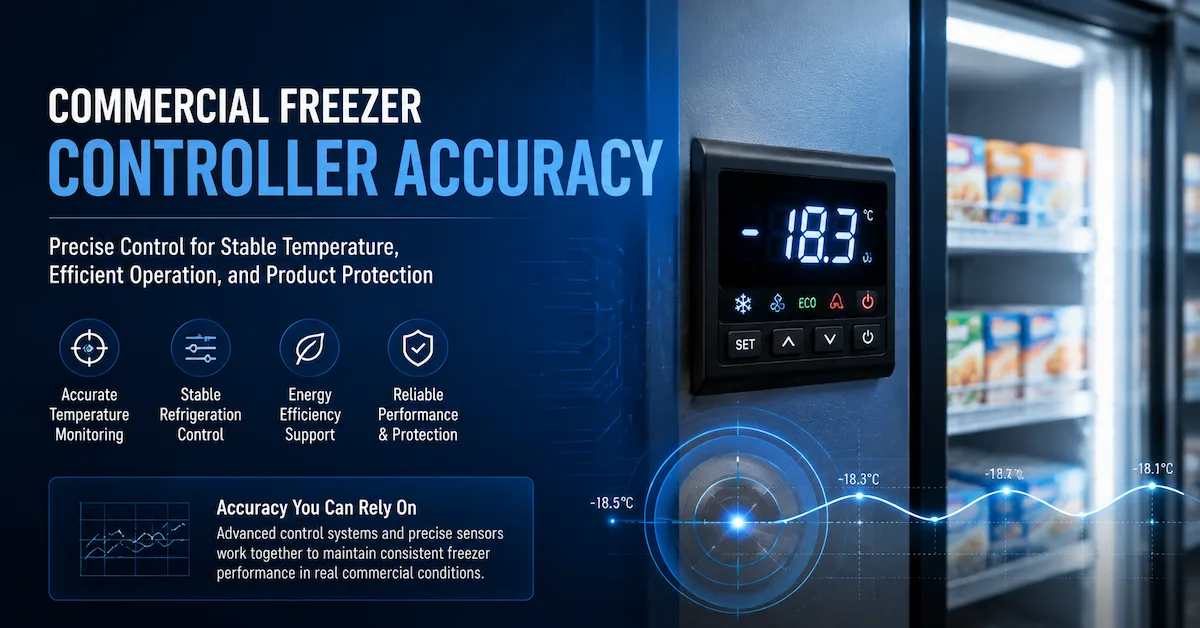
Commercial Freezer Controller Accuracy
Sensor Placement and Temperature Measurement
A Sensor Measures a Specific Point, Not the Entire Cabinet
One common misunderstanding in freezer purchasing is assuming that one sensor reading represents the complete internal environment.
In reality, temperature inside a commercial freezer may vary because of:
- Air movement
- Product arrangement
- Evaporator position
- Door opening
- Cabinet structure
A sensor provides information from its installation point.
Therefore, buyers should ask suppliers:
- Where is the sensor installed?
- Why was this location selected?
- What condition does the measurement represent?
These questions are often more valuable than comparing sensor specifications alone.
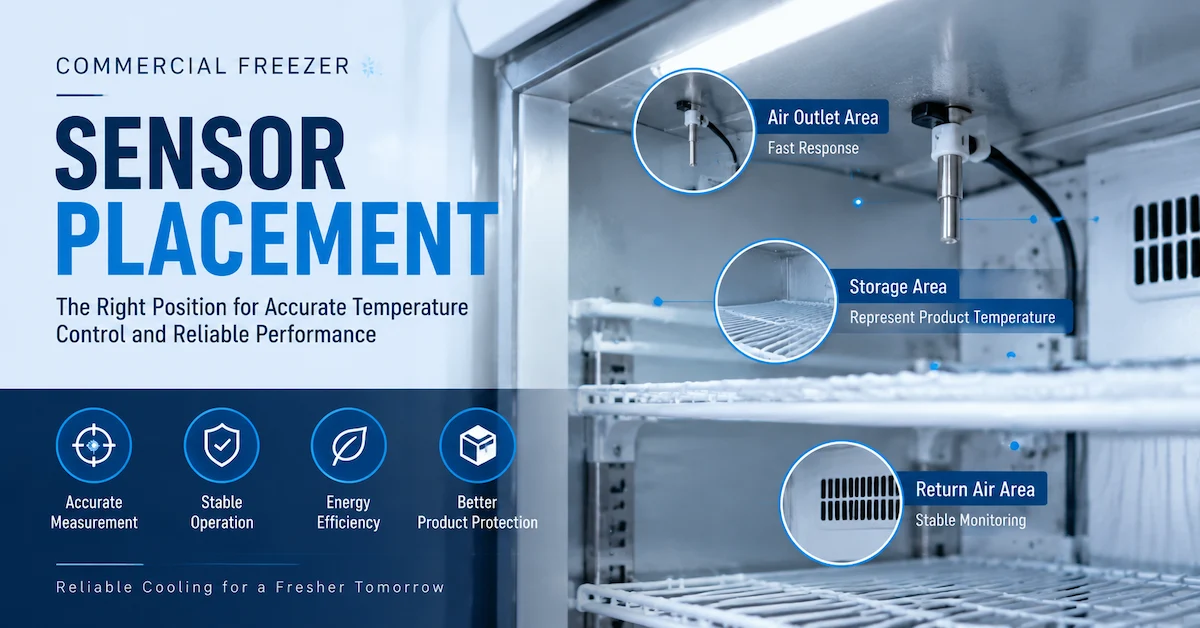
Common Commercial Freezer Sensor Locations
Air Outlet Sensor Placement
Some freezer designs place sensors near areas where cooled air enters the cabinet.
Potential advantages include:
- Fast response to cooling changes
- Quick detection of airflow conditions
However, this location may not always represent average storage temperature because the air near the outlet can differ from other cabinet areas.
Return Air Sensor Placement
Return air areas can provide information about air conditions after circulation through the cabinet.
This type of measurement may help evaluate overall cooling behavior.
However, the suitability depends on:
- Cabinet design
- Airflow direction
- Control strategy
Storage Area Sensor Placement
For certain applications, measuring closer to the product storage area may provide more relevant information.
This is especially important when the goal is understanding product protection conditions.
However, product loading and placement can influence the measurement.
Evaporator Area Sensor Placement
Sensors near evaporator-related components may provide useful refrigeration information.
However, these readings may not always represent the temperature experienced by stored products.
The correct location depends on the control purpose.
Sensor Placement and Temperature Uniformity
Sensor placement has a strong relationship with temperature uniformity, but they are not the same concept.
Temperature uniformity focuses on:
Whether different areas inside the freezer maintain similar temperatures
Sensor placement focuses on:
Whether the measurement point provides useful information for controlling the freezer
A freezer can have:
- Accurate sensor placement but poor airflow distribution
- Good airflow but unsuitable sensor location
A complete evaluation should consider both measurement strategy and cabinet performance.
Related article:
Commercial Freezer Temperature Uniformity
Sensor Placement and Cold Air Distribution
Airflow design determines how cold air moves inside the freezer.
Sensor placement determines how the control system understands those conditions.
These two systems must work together.
For example:
If airflow creates different temperature zones inside the cabinet, placing a sensor in only one area may not provide a complete picture.
A supplier should evaluate:
- Air movement
- Sensor position
- Cooling demand
- Storage requirements
Related guide:
Commercial Freezer Cold Air Distribution
How Sensor Placement Affects Compressor Operation
The controller uses sensor information to determine refrigeration demand.
Therefore, sensor placement can influence compressor behavior.
An unsuitable sensor location may contribute to:
- Longer cooling cycles
- Delayed response
- Frequent adjustments
However, compressor operation is influenced by many other factors:
- Compressor capacity
- Refrigeration system design
- Ambient temperature
- Insulation performance
- Product loading
Sensor placement should be evaluated as part of the complete refrigeration system.
Related article:
Commercial Freezer Compressor Cycling
Sensor Placement and Energy Efficiency
The control system affects how the freezer operates over time.
Sensor information influences:
- Compressor runtime
- Cooling response
- Defrost decisions
Poor measurement conditions may lead to inefficient operation.
However, energy consumption is never determined by the sensor alone.
A complete energy evaluation should include:
- Compressor efficiency
- Controller settings
- Sensor arrangement
- Cabinet insulation
- Airflow design
- Operating environment
For more information:
Commercial Freezer Energy Consumption Test
Sensor Placement in High Ambient Applications
High ambient environments create additional challenges for temperature control.
Applications in:
- Tropical regions
- Outdoor commercial areas
- High-temperature warehouses
- Busy retail stores
may experience:
- Higher heat loads
- Faster temperature changes
- More frequent cooling demand
In these environments, sensor placement becomes even more important because the system needs reliable information to respond effectively.
Buyers should provide suppliers with:
- Destination climate
- Installation environment
- Expected operating conditions
Related guide:
Commercial Freezer High Ambient Performance
Testing Methods for Commercial Freezer Sensor Placement
Temperature Mapping
Temperature mapping helps identify differences between cabinet areas.
It can help evaluate:
- Sensor representativeness
- Hot and cold zones
- Airflow influence
Sensor Response Testing
Response testing evaluates how quickly the measurement system reacts to temperature changes.
Important factors include:
- Operating condition
- Sensor location
- Controller response
Long-Term Operation Testing
Short tests may not show actual commercial performance.
Long-term testing can provide information about:
- Stability
- Control consistency
- Operating behavior
Testing should always match the intended application.
How Should B2B Buyers Evaluate Sensor Placement?
Before selecting a freezer supplier, buyers should review more than the sensor model.
| Evaluation Area | Buyer Should Verify |
|---|---|
| Sensor location | Why was this position selected? |
| Control purpose | What condition does it represent? |
| Measurement accuracy | How is performance verified? |
| Controller integration | How does the system respond? |
| Testing | Were different conditions evaluated? |
| Production | Is installation consistent? |
| OEM capability | Can placement be customized? |
A professional supplier should explain the engineering reason behind sensor placement decisions.
Common Procurement Mistakes
| Mistake | Why It Creates Risk |
|---|---|
| Selecting sensor location randomly | Measurement may not represent actual conditions |
| Comparing sensors only by specification | Installation position is ignored |
| Testing empty cabinets only | Real product conditions may differ |
| Ignoring airflow design | Temperature readings may be misleading |
| Changing sensor position after approval | Control performance may change |
OEM Considerations for Custom Sensor Placement
For OEM commercial freezer projects, sensor requirements should be defined during the design stage.
Important information includes:
- Freezer type
- Cabinet structure
- Target storage temperature
- Control objective
- Sensor measurement requirements
- Airflow design
- Defrost method
- Energy target
- Climate condition
- Testing requirements
- Destination market
- Order quantity
Based on these requirements, engineers can evaluate:
- Sensor arrangement
- Controller integration
- Temperature monitoring strategy
- Testing plan
- Production feasibility
OEM customization should match the actual application rather than use one standard sensor position for every project.
What Should Buyers Ask a Freezer Supplier?
Before approving a freezer design, buyers should ask:
- Where are temperature sensors installed?
- Why were these locations selected?
- How does sensor information control refrigeration operation?
- Are temperature maps available?
- How is sensor installation checked during production?
- Can sensor positions be adjusted for different applications?
These questions help buyers understand whether the supplier has a complete approach to refrigeration control.
FAQ
What is commercial freezer sensor placement?
Commercial freezer sensor placement refers to selecting suitable locations for temperature sensors to monitor freezer conditions accurately.
Why is sensor placement important in commercial freezers?
Because the sensor provides the temperature information used by the controller to manage refrigeration operation.
Does sensor location affect temperature readings?
Yes. Different locations can measure different temperature conditions inside the cabinet.
Is controller accuracy enough without proper sensor placement?
No. A controller depends on accurate and representative sensor information.
Can one sensor represent the entire freezer temperature?
Not always. Internal temperature can vary depending on airflow, loading, and cabinet design.
How does sensor placement affect compressor operation?
Sensor information influences cooling decisions, which may affect compressor cycles.
How should buyers test sensor placement?
Buyers should use temperature mapping, response testing, and long-term operation evaluation.
Does sensor placement affect energy consumption?
It can influence control behavior, but total energy performance depends on the complete freezer system.
Can OEM buyers customize sensor locations?
Yes. Sensor placement can be adjusted according to freezer design and application requirements.
How does sensor placement relate to temperature uniformity?
Sensor placement determines measurement quality, while temperature uniformity evaluates temperature differences across the cabinet.
Conclusion
Commercial freezer sensor placement is a critical part of refrigeration control design because it determines how accurately the system understands temperature conditions and responds to operational changes.
For B2B buyers, selecting a freezer supplier requires more than checking the controller model or sensor specifications.
A complete evaluation should consider:
- Sensor location
- Controller integration
- Airflow design
- Temperature mapping
- Compressor response
- Energy performance
- Testing methods
- OEM customization capability
Sensor placement should work together with other freezer technologies, including:
- Commercial Freezer Controller Accuracy for reliable temperature processing and control decisions
- Commercial Freezer Temperature Uniformity for evaluating temperature differences across cabinet areas
- Commercial Freezer Cold Air Distribution for understanding how airflow affects measurement results
- Commercial Freezer Energy Consumption Test for assessing complete system efficiency
The best sensor placement is not simply the easiest position to install.
It is the location that provides meaningful temperature information and helps the complete refrigeration system achieve stable, efficient, and reliable performance under real commercial conditions.
Send Snowsea your freezer type, cabinet dimensions, target temperature, application environment, airflow requirements, sensor expectations, testing standards, destination market, and estimated order quantity through the Snowsea contact page.
Snowsea can evaluate sensor placement strategy, controller integration, temperature monitoring requirements, testing scope, OEM feasibility, and commercial freezer project needs before preparing a technical proposal and quotation.