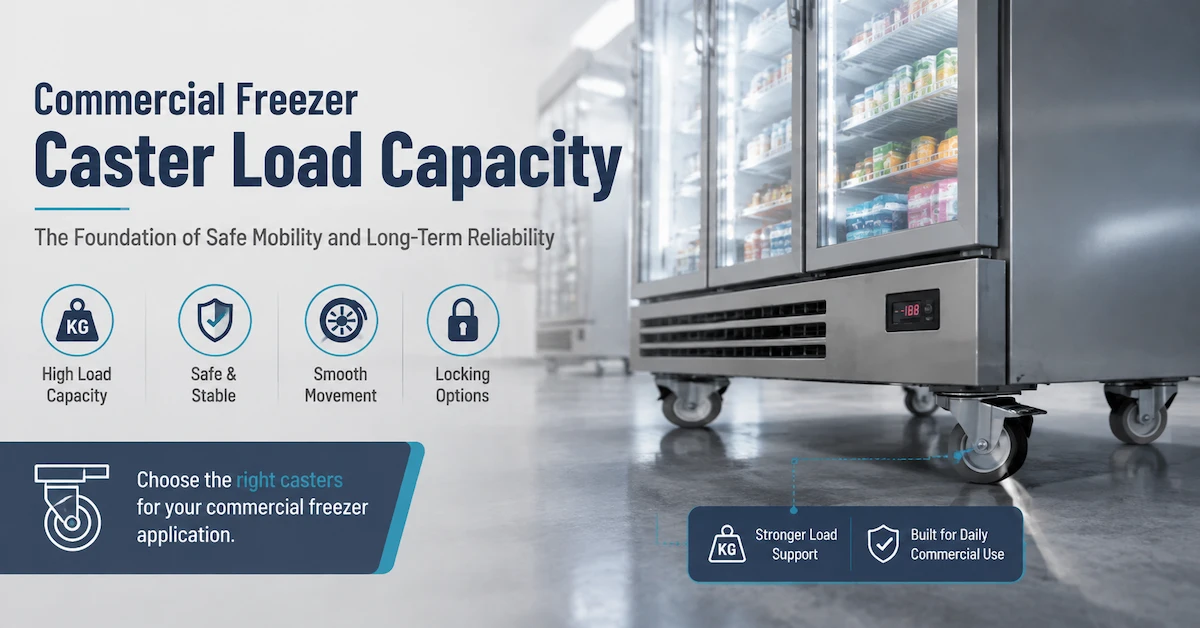
What Is Commercial Freezer Caster Load Capacity?
Commercial Freezer Caster Load Capacity refers to the maximum weight that freezer casters can safely support during installation, operation, and movement.
Commercial freezer casters must support more than the empty equipment weight. The actual load usually includes:
- Empty freezer weight
- Stored frozen products
- Shelves and accessories
- Additional operational loads
A properly selected caster system helps improve:
- Equipment stability
- Safe movement
- Installation convenience
- Long-term durability
For commercial refrigeration projects, Snowsea provides commercial refrigeration products designed for supermarkets, restaurants, catering businesses, and global B2B applications.
Why Does Caster Load Capacity Matter for Commercial Freezers?
Casters are not only used for moving equipment. They also support the entire freezer structure during daily operation.
Equipment Safety
Correct caster capacity helps prevent:
- Wheel damage
- Structural stress
- Equipment instability
A properly designed caster system improves workplace safety and reduces maintenance risks.
Easier Installation and Maintenance
Commercial freezers may need to be moved for:
- Installation
- Cleaning
- Equipment adjustment
- Service access
Reliable casters make these tasks easier and more efficient.
Long-Term Durability
Using suitable casters helps reduce:
- Wheel wear
- Frame deformation
- Floor damage
How to Calculate Commercial Freezer Caster Load Capacity?
Selecting caster capacity requires calculating the total equipment load.
A basic calculation method is:
Required Caster Capacity = Total Equipment Load ÷ Number of Casters × Safety Factor
The calculation should include:
Empty Freezer Weight
This includes:
- Cabinet structure
- Compressor system
- Doors
- Internal components
Product Storage Weight
The stored product can significantly increase the total load.
Examples:
- Frozen food
- Meat products
- Seafood
- Ice cream
For storage-related considerations, see Snowsea's commercial freezer shelf capacity guide.
Safety Margin
A safety factor should consider:
- Frequent movement
- Uneven floors
- Dynamic loading conditions
Factors Affecting Commercial Freezer Caster Load Capacity
Freezer Weight and Size
Larger commercial freezers usually require:
- Higher load capacity casters
- Stronger mounting structures
- Larger wheels
Equipment dimensions directly affect caster selection.
For installation planning, see Snowsea's commercial freezer dimensions for stores guide.
Product Loading Weight
The maximum operating condition should be considered when selecting casters.
A freezer storing heavy products requires stronger caster support than an empty unit.
Caster Material
Different materials provide different performance characteristics.
| Material | Features |
|---|---|
| Nylon | Lightweight and corrosion resistant |
| Rubber | Quiet operation and floor protection |
| Polyurethane | Durable and smooth movement |
| Steel | Heavy-duty applications |
Material selection depends on:
- Floor conditions
- Weight requirements
- Movement frequency
Wheel Diameter
Wheel size affects movement performance.
Larger wheels provide:
- Easier movement
- Better obstacle handling
- Lower pushing force
Smaller wheels are suitable for equipment that rarely moves.
Types of Commercial Freezer Casters
Fixed Casters
Fixed casters provide:
- Straight-line movement
- Strong stability
They are suitable for equipment installed in fixed locations.
Swivel Casters
Swivel casters provide:
- Flexible movement
- Easier direction changes
They are commonly used in:
- Commercial kitchens
- Restaurants
- Food service environments
Locking Casters
Locking casters combine mobility with stability.
Benefits include:
- Easy positioning
- Improved safety
- Reduced unwanted movement
Caster Load Capacity for Different Applications
Supermarket Freezers
Supermarkets usually require:
- Stable positioning
- Easy cleaning access
- Safe customer environments
Caster systems should balance mobility and stability.
For retail solutions, see Snowsea's supermarket freezer project supplier guide.
Restaurant Freezers
Restaurants often require:
- Frequent movement
- Compact equipment placement
- Floor protection
Reliable casters help improve kitchen workflow.
Catering Storage Freezers
Catering applications usually require:
- Higher loading capacity
- Strong durability
- Long-term operation reliability
For catering solutions, see Snowsea's commercial freezer supplier for caterers guide.
Caster Design and Floor Protection
Commercial refrigeration equipment may operate on different floor surfaces.
Suitable caster designs help reduce:
- Floor scratches
- Operating noise
- Vibration
Soft materials such as rubber and polyurethane are often preferred where floor protection is important.
Caster Installation and Mounting Design
Caster performance depends not only on the wheel itself but also on installation structure.
Mounting Plate Strength
A strong mounting plate helps distribute load evenly.
Caster Position
Proper caster placement improves:
- Equipment balance
- Stability
- Load distribution
Frame Structure
The freezer frame must support:
- Static load
- Movement forces
- Repeated operation
How Manufacturers Test Freezer Caster Performance
Professional manufacturers evaluate caster systems through multiple tests.
Load Testing
Measures:
- Maximum weight capacity
- Structural performance
Movement Testing
Evaluates:
- Rolling performance
- Direction control
Durability Testing
Checks:
- Wheel wear
- Long-term reliability
Safety Testing
Verifies:
- Stability
- Brake performance
For overall equipment evaluation, see Snowsea's commercial freezer quality testing guide.
Common Mistakes When Selecting Freezer Casters
Choosing Only Based on Price
Low-cost casters may result in:
- Faster wear
- Reduced safety
- Higher replacement costs
Ignoring Product Load
Selecting casters based only on empty freezer weight may create safety issues.
Choosing Small Wheels
Small wheels may cause:
- Difficult movement
- Higher pushing force
- Poor performance on uneven floors
Ignoring Floor Conditions
Different environments require different caster materials.
How to Choose the Right Commercial Freezer Casters
A practical selection process includes:
Step 1: Calculate Total Load
Consider:
- Freezer weight
- Product weight
- Operating conditions
Step 2: Determine Movement Requirements
Evaluate:
- How often equipment moves
- Floor conditions
- Installation environment
Step 3: Select Caster Type
Compare:
- Fixed casters
- Swivel casters
- Locking casters
Step 4: Verify Supplier Quality
Check:
- Load testing
- Material quality
- Manufacturing standards
What Information Should You Send a Freezer Supplier?
To receive accurate caster recommendations, buyers should provide:
- Freezer model
- Equipment weight
- Maximum product load
- Movement frequency
- Floor conditions
- Caster preference
- Operating environment
- Quantity requirements
- Certification requirements
- Customization needs
FAQ
What is commercial freezer caster load capacity?
Commercial freezer caster load capacity is the maximum weight that freezer wheels can safely support during operation and movement.
How do I calculate caster capacity for a commercial freezer?
Calculate total equipment weight, divide by the number of casters, and apply an appropriate safety margin.
Do stored products affect caster selection?
Yes. Product weight can significantly increase the total load on freezer casters.
What caster material is best for commercial freezers?
Polyurethane, rubber, nylon, and steel casters are commonly used depending on load requirements and operating conditions.
Are larger wheels better for commercial freezers?
Larger wheels generally provide easier movement and better performance on uneven surfaces.
What are locking casters used for?
Locking casters prevent unwanted movement and improve equipment stability.
Can casters affect freezer safety?
Yes. Incorrect caster selection may cause instability, wheel failure, or structural damage.
How are freezer casters tested?
Manufacturers test load capacity, movement performance, durability, and safety performance.
Can commercial freezer casters be customized?
Yes. Suppliers can customize caster specifications based on equipment weight and application requirements.
Does Snowsea provide customized freezer solutions?
Yes. Snowsea provides commercial refrigeration solutions based on customer application requirements.
Conclusion
Commercial Freezer Caster Load Capacity is an important factor affecting equipment safety, mobility, and long-term reliability.
Choosing the right caster system requires evaluating:
- Total equipment weight
- Product loading capacity
- Wheel material
- Wheel size
- Operating environment
For supermarkets, restaurants, catering businesses, and global refrigeration buyers, properly selected casters improve installation convenience, reduce maintenance risks, and support safer commercial freezer operation.
Snowsea supports global B2B customers with commercial refrigeration products and OEM/ODM solutions. Explore Snowsea's commercial refrigeration products, review its OEM/ODM solutions, or contact Snowsea with your caster requirements, application details, and project goals.