What Is Commercial Freezer Climate Class?
Commercial Freezer Climate Class refers to the environmental temperature range in which a commercial freezer is designed to operate effectively.
It describes the external conditions around the freezer, not the temperature inside the cabinet.
Many buyers confuse climate class with freezer temperature settings.
The difference is:
- Climate Class → surrounding ambient temperature
- Freezer Temperature Range → internal storage temperature
For example, a freezer designed for tropical markets needs to maintain cooling performance even when the surrounding environment is hot.
Climate class affects:
- Compressor workload
- Cooling stability
- Energy consumption
- Equipment reliability
Snowsea provides commercial refrigeration products designed for supermarkets, restaurants, distributors, and global B2B refrigeration projects.
Why Climate Class Matters for Commercial Freezer Buyers
Commercial freezers operate in different environments around the world.
A freezer installed in a cool European warehouse may experience very different conditions from one installed in:
- Southeast Asia
- Middle East
- Africa
- Tropical regions
If the selected climate class does not match the installation environment, possible problems may include:
- Longer compressor running time
- Reduced cooling efficiency
- Higher electricity consumption
- Temperature instability
- Increased component stress
For export buyers, climate class is an important specification when selecting refrigeration equipment for different markets.
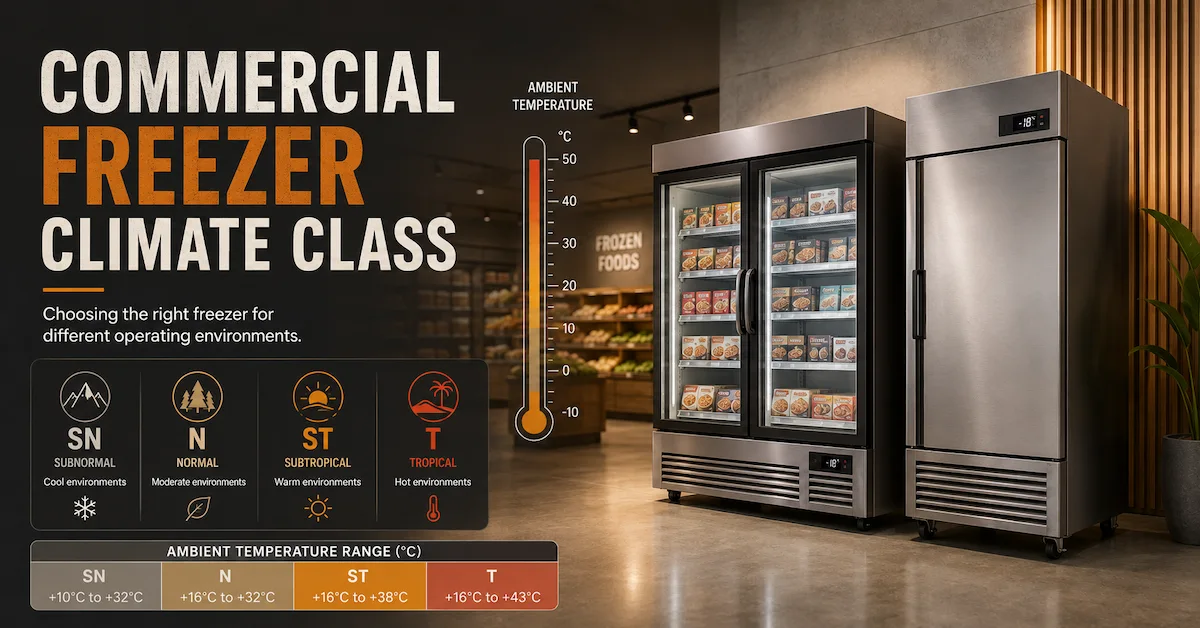
Commercial Freezer Climate Class Ratings Explained
Commercial refrigeration products commonly use climate class ratings to indicate operating environments.
| Climate Class | Ambient Temperature Range | Typical Application |
|---|---|---|
| SN | +10°C to +32°C | Cooler environments |
| N | +16°C to +32°C | Standard indoor applications |
| ST | +16°C to +38°C | Warm climates |
| T | +16°C to +43°C | Tropical and hot regions |
Actual classification requirements may vary depending on product standards, certifications, and market regulations.
Buyers should confirm the climate class listed in the supplier specification sheet before purchasing.
SN, N, ST and T: Which Climate Class Do You Need?
SN Climate Class Freezers
SN models are designed for relatively cooler environments.
Typical applications include:
- Temperature-controlled storage rooms
- Cooler regions
- Indoor commercial locations with moderate temperatures
They may not be the best choice for very hot climates.
N Climate Class Freezers
N is a common standard classification for normal operating environments.
Suitable applications include:
- Indoor supermarkets
- Restaurants
- General commercial spaces
It is commonly used where ambient temperatures remain within standard ranges.
ST Climate Class Freezers
ST models are designed for warmer environments.
They are suitable for:
- Warm countries
- Commercial kitchens
- Retail stores in hot regions
Compared with standard models, ST-class equipment is designed to handle higher ambient temperatures.
T Climate Class Freezers
T-class freezers are designed for tropical environments.
Typical markets include:
- Tropical countries
- High-temperature regions
- Outdoor-adjacent commercial applications
These environments often require:
- Stronger refrigeration performance
- Efficient heat rejection
- Reliable compressors
Climate Class for Different Commercial Applications
Different businesses have different environmental challenges.
Supermarket Freezer Climate Requirements
Supermarkets often experience:
- Frequent door opening
- Customer traffic
- Long operating hours
- Heat from lighting and equipment
Climate class selection should consider:
- Store temperature
- Installation location
- Seasonal temperature changes
For larger retail projects, buyers can review Snowsea's supermarket freezer project supplier guide.
Restaurant Freezer Climate Requirements
Restaurant kitchens can create challenging conditions because of:
- Cooking heat
- Limited ventilation
- Frequent staff access
A suitable climate class helps maintain stable operation in busy kitchen environments.
Convenience Store Freezer Climate Requirements
Convenience stores often operate continuously and have:
- High customer access frequency
- Frequent door opening
- Limited equipment space
Climate class selection should consider both store temperature and equipment placement.
Catering and Food Storage Applications
Catering businesses may require reliable freezing performance because of:
- Large inventory
- Frequent loading
- Long storage periods
For catering applications, climate suitability should be evaluated together with capacity and temperature requirements.
See Snowsea's commercial freezer supplier for caterers guide.
Climate Class vs Commercial Freezer Temperature Range
Climate class and internal freezer temperature are related but different.
| Factor | Meaning |
|---|---|
| Climate Class | External operating environment |
| Temperature Range | Internal freezer storage condition |
For example:
A T-class freezer means the equipment can operate in hotter surroundings.
It does not mean the freezer stores products at a lower internal temperature.
Temperature selection depends on:
- Product requirements
- Food safety standards
- Storage purpose
For internal temperature selection, see Snowsea's commercial freezer temperature range guide.
How Ambient Temperature Affects Freezer Performance
The surrounding environment directly influences refrigeration performance.
High Ambient Temperature
Hot environments increase:
- Compressor workload
- Cooling demand
- Energy consumption
A freezer operating in a hot climate requires sufficient refrigeration capacity.
Poor Ventilation
Insufficient airflow around the freezer can cause:
- Heat accumulation
- Reduced condenser efficiency
- Longer operating cycles
Proper installation space is essential.
Installation Location
Avoid placing freezers near:
- Direct sunlight
- Heat-producing equipment
- Poorly ventilated areas
Installation planning should include:
- Airflow
- Clearance
- Room temperature
Relationship Between Climate Class and Energy Consumption
Climate conditions influence electricity usage.
In hotter environments:
- Compressor runs longer
- Cooling load increases
- Energy consumption may rise
Choosing the correct climate class helps maintain efficiency.
However, energy performance also depends on:
- Compressor efficiency
- Insulation quality
- Door sealing
- Temperature settings
For energy analysis, see Snowsea's commercial freezer power consumption guide.
Climate Class and Compressor Selection
The compressor plays an important role in climate adaptability.
Hot environments require refrigeration systems capable of handling:
- Higher heat loads
- Longer operating cycles
- Greater cooling demand
Important factors include:
- Compressor reliability
- Refrigeration system design
- Condenser performance
For component evaluation, see Snowsea's commercial freezer compressor reliability guide.
How Suppliers Test Commercial Freezer Climate Class
Professional manufacturers evaluate freezer performance under controlled conditions.
Common tests include:
Ambient Temperature Testing
Checks whether the freezer operates correctly under different environmental temperatures.
Cooling Performance Testing
Evaluates:
- Pull-down performance
- Temperature stability
- Cooling capability
Compressor Operation Testing
Checks:
- Running performance
- Heat management
- Long-term reliability
Temperature Stability Testing
Measures whether the freezer maintains consistent internal conditions.
For quality evaluation methods, buyers can review Snowsea's commercial freezer quality testing guide.
Common Mistakes When Choosing Climate Class
Choosing Based Only on Purchase Price
A lower-cost freezer may not perform well in demanding climates.
Ignoring Local Climate Conditions
Equipment should match the destination market environment.
Confusing Climate Class With Freezing Temperature
Climate class describes outside conditions, not product storage temperature.
Installing Standard Models in Hot Areas
Hot environments often require higher climate ratings.
Ignoring Ventilation Requirements
Even a suitable climate-class freezer needs correct installation conditions.
How to Select the Right Climate Class for Your Market
A practical selection process:
Step 1: Identify Destination Climate
Consider:
- Average temperature
- Seasonal changes
- Indoor conditions
Step 2: Evaluate Installation Environment
Check:
- Store temperature
- Ventilation
- Heat sources
Step 3: Match Climate Class
Select:
- SN
- N
- ST
- T
according to actual operating conditions.
Step 4: Confirm Supplier Documentation
Request:
- Specification sheet
- Climate class rating
- Test information
- Certification documents
What Information Should You Send a Freezer Supplier?
To receive accurate recommendations, buyers should provide:
- Destination country
- Local climate conditions
- Installation location
- Required freezer type
- Capacity requirement
- Temperature requirement
- Operating hours
- Quantity
- Certification requirements
- Customization needs
This helps suppliers recommend suitable refrigeration solutions.
FAQ
What does commercial freezer climate class mean?
Commercial freezer climate class indicates the ambient temperature range in which a freezer is designed to operate effectively.
Is climate class the same as freezer temperature?
No. Climate class refers to external environment conditions, while freezer temperature refers to the internal storage temperature.
What climate class is best for tropical countries?
T-class freezers are generally designed for hotter tropical environments, but buyers should confirm requirements based on local conditions.
What is the difference between ST and T climate class?
ST is designed for warm environments, while T is designed for higher ambient temperatures typically found in tropical regions.
Why is climate class important for export buyers?
Because refrigeration equipment must match the climate conditions of the destination market to maintain reliable performance.
Does climate class affect electricity consumption?
Yes. A freezer operating outside its suitable climate range may require more energy to maintain temperature.
Can a standard freezer work in hot climates?
It depends on the design. Standard models may experience reduced performance in high-temperature environments.
How do suppliers test climate class performance?
Manufacturers test freezers under controlled ambient conditions to verify cooling performance and reliability.
Should restaurants consider climate class?
Yes. Restaurant kitchens can have higher ambient temperatures due to cooking equipment and frequent operation.
Can Snowsea recommend the right climate class freezer?
Yes. Snowsea can recommend suitable commercial refrigeration solutions based on destination market, application, temperature requirements, and operating environment.
Conclusion
Understanding Commercial Freezer Climate Class helps businesses select refrigeration equipment that matches their operating environment.
Climate class is not about how cold the freezer can become. It defines how well the equipment can maintain performance under different ambient temperatures.
For supermarkets, restaurants, distributors, and international buyers, selecting the correct climate class improves:
- Cooling reliability
- Energy efficiency
- Equipment lifespan
- Long-term operating value
Snowsea supports global B2B buyers with commercial refrigeration products and OEM/ODM solutions. Explore Snowsea's commercial refrigeration products, review its OEM/ODM solutions, or contact Snowsea with your market requirements, climate conditions, capacity needs, and project details.