What Is Commercial Freezer Fan Motor Selection?
Commercial Freezer Fan Motor Selection refers to choosing the appropriate fan motor based on airflow requirements, freezer design, cooling capacity, and operating conditions.
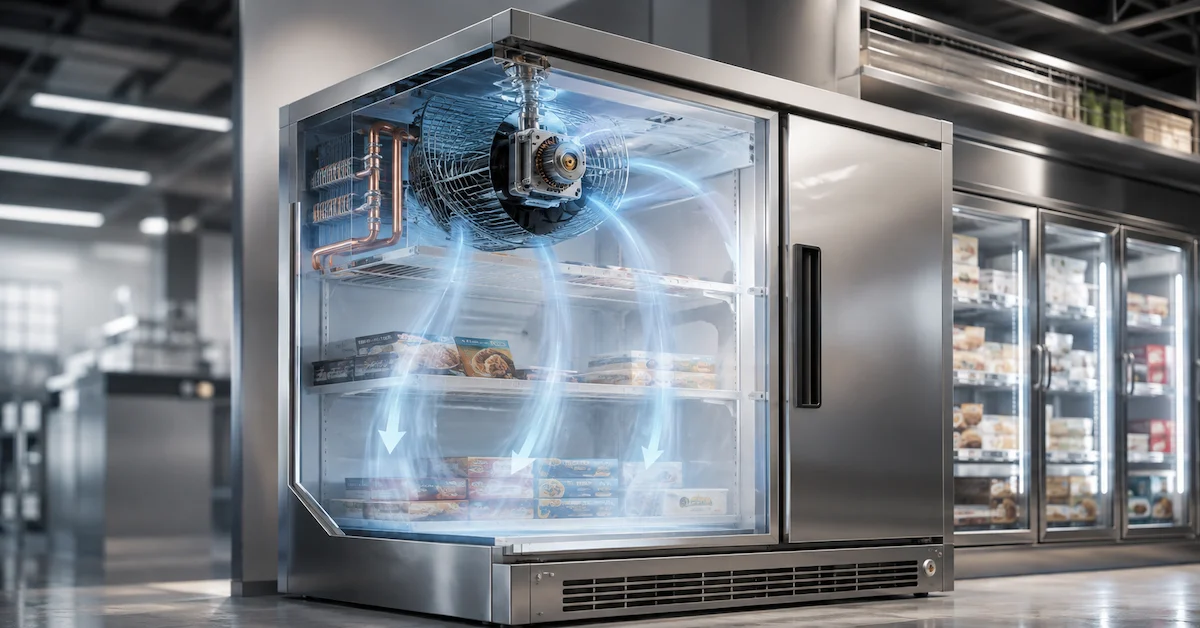
In commercial refrigeration systems, fan motors play an important role in moving cold air throughout the cabinet and improving heat exchange performance.
A properly selected fan motor helps achieve:
- Better air circulation
- More stable temperatures
- Faster cooling recovery
- Lower energy consumption
- Reliable long-term operation
The fan motor works together with other refrigeration components, including the evaporator, condenser, and compressor, to maintain efficient cooling performance.
Snowsea provides commercial refrigeration products designed for supermarkets, restaurants, catering businesses, and global B2B refrigeration projects.
Why Does Fan Motor Selection Matter for Commercial Freezers?
The fan motor determines how effectively cold air moves inside the refrigeration system.
An unsuitable fan motor may cause:
- Uneven temperature distribution
- Reduced cooling efficiency
- Increased energy consumption
- Higher operating noise
A correctly selected fan motor improves:
Airflow Performance
A suitable fan motor provides:
- Stable airflow volume
- Better air circulation
- Improved evaporator heat exchange
Efficient airflow helps cold air reach different areas of the cabinet more effectively.
Temperature Uniformity
Good air circulation helps reduce:
- Hot spots
- Temperature fluctuations
- Uneven product cooling
For temperature control requirements, see Snowsea's commercial freezer temperature range guide.
Energy Efficiency
High-efficiency fan motors can reduce unnecessary power usage.
Benefits include:
- Lower operating costs
- Reduced electrical consumption
- Improved refrigeration efficiency
For energy-saving solutions, see Snowsea's Energy Efficiency Solutions.
The Role of Fan Motors in Commercial Refrigeration
Fan motors perform several important functions in freezer systems.
Supporting Evaporator Performance
The evaporator absorbs heat from inside the cabinet.
The fan motor helps:
- Move air across the evaporator coil
- Improve heat exchange
- Distribute cooled air
For evaporator technology, see Snowsea's commercial freezer evaporator design guide.
Improving Air Distribution
Proper airflow design helps:
- Maintain consistent temperatures
- Improve cooling recovery
- Support product protection
Reducing Temperature Fluctuation
Stable airflow helps commercial freezers recover faster after:
- Door opening
- Product loading
- Frequent operation cycles
Key Factors for Commercial Freezer Fan Motor Selection
Selecting the right fan motor requires evaluating several technical factors.
Airflow Requirements
Airflow is one of the most important selection factors.
Requirements depend on:
- Cabinet size
- Evaporator structure
- Cooling capacity
- Storage application
Insufficient airflow may result in:
- Slow cooling
- Uneven temperatures
- Reduced refrigeration performance
Fan Motor Power
Fan motor power should match system requirements.
A motor with insufficient power may cause:
- Weak airflow
- Poor cooling distribution
An oversized motor may lead to:
- Higher energy consumption
- Increased operating costs
The goal is to achieve the required airflow with optimized power usage.
Fan Speed (RPM)
Fan speed affects:
- Air velocity
- Cooling response
- Noise level
Higher RPM can improve airflow but may increase:
- Noise
- Power consumption
A balanced design is required for commercial applications.
Motor Efficiency
Common fan motor options include:
- AC fan motors
- EC fan motors
Efficiency considerations affect:
- Operating costs
- Long-term performance
- Energy savings
AC Fan Motor vs EC Fan Motor
| Factor | AC Fan Motor | EC Fan Motor |
|---|---|---|
| Efficiency | Standard efficiency | Higher efficiency |
| Speed Control | Limited | Better control |
| Energy Saving | Moderate | Higher |
| Initial Cost | Lower | Higher |
EC motors are increasingly used in energy-efficient commercial refrigeration systems because they offer better control and lower power consumption.
Fan Motor Matching With Evaporator Design
The fan motor must be properly matched with the evaporator system.
Important factors include:
- Coil size
- Airflow path
- Heat exchange requirements
Incorrect matching may cause:
- Poor cooling distribution
- Reduced heat transfer efficiency
- Higher energy usage
For evaporator design information, see Snowsea's commercial freezer evaporator design guide.
Fan Motor and Condenser Airflow
Fan motors are also important in condenser systems.
Proper airflow helps:
- Improve heat rejection
- Reduce compressor workload
- Maintain system efficiency
For condenser technology, see Snowsea's commercial freezer condenser design guide.
Fan Motor Noise Control
Noise is an important consideration for:
- Supermarkets
- Restaurants
- Retail stores
Noise reduction methods include:
- Balanced fan blades
- Efficient motor design
- Vibration control
- Optimized airflow
A quiet fan motor improves user experience in commercial environments.
Fan Motor Selection for Different Applications
Supermarket Freezers
Supermarkets require:
- Long operating hours
- Stable airflow
- Low operating noise
Reliable fan motors help maintain consistent cooling performance.
For retail solutions, see Snowsea's supermarket freezer project supplier guide.
Restaurant Freezers
Restaurants often require:
- Compact designs
- Fast cooling recovery
- Reliable daily operation
Catering Storage Freezers
Catering applications require:
- Continuous airflow
- Stable temperature control
- Long operating reliability
For catering solutions, see Snowsea's commercial freezer supplier for caterers guide.
Fan Motor Performance in Different Ambient Conditions
Ambient temperature affects refrigeration system workload.
In hot environments:
- Cooling demand increases
- Fan operation becomes more important
- Motor reliability requirements become higher
A suitable fan motor design helps maintain performance under different operating conditions.
For environmental considerations, see Snowsea's commercial freezer ambient temperature guide.
Fan Motor Maintenance Requirements
Regular maintenance helps maintain fan performance.
Important tasks include:
- Cleaning fan blades
- Checking motor operation
- Inspecting vibration
- Checking airflow performance
Proper maintenance helps:
- Maintain efficiency
- Reduce failures
- Extend service life
How Manufacturers Test Fan Motor Performance
Professional suppliers evaluate fan motors through multiple tests.
Airflow Testing
Measures:
- Air volume
- Air distribution performance
Noise Testing
Evaluates:
- Operating sound level
- Vibration performance
Power Consumption Testing
Checks:
- Energy usage
- Motor efficiency
Reliability Testing
Verifies:
- Long-term operation capability
- Mechanical durability
For overall equipment evaluation, see Snowsea's commercial freezer quality testing guide.
Common Mistakes When Selecting Fan Motors
Choosing Only Based on Price
Lower-cost motors may result in:
- Higher energy consumption
- Reduced reliability
Ignoring Airflow Requirements
Insufficient airflow affects cooling performance.
Selecting Incorrect Motor Power
Wrong power selection may reduce efficiency.
Ignoring Noise Requirements
High-noise systems may affect commercial environments.
Not Considering Operating Conditions
Climate and usage conditions influence motor selection.
How to Choose the Right Commercial Freezer Fan Motor
A practical selection process includes:
Step 1: Define Application Requirements
Confirm:
- Freezer type
- Storage purpose
- Operating environment
Step 2: Determine Airflow Requirements
Evaluate:
- Cabinet size
- Cooling capacity
- Evaporator design
Step 3: Select Suitable Motor Type
Compare:
- AC motor
- EC motor
- Efficiency requirements
Step 4: Verify Performance Testing
Review:
- Airflow data
- Noise levels
- Reliability testing
What Information Should You Send a Freezer Supplier?
To receive accurate fan motor recommendations, buyers should provide:
- Freezer application
- Cabinet dimensions
- Cooling requirements
- Operating temperature
- Ambient conditions
- Noise requirements
- Energy efficiency targets
- Quantity requirements
- Certification needs
- Customization requirements
FAQ
What is commercial freezer fan motor selection?
Commercial freezer fan motor selection is the process of choosing a suitable motor based on airflow, cooling requirements, and system design.
Why is a fan motor important in commercial freezers?
Fan motors improve air circulation, temperature uniformity, and evaporator performance.
What factors affect fan motor selection?
Key factors include airflow, motor power, RPM, efficiency, noise, and operating conditions.
What is the difference between AC and EC fan motors?
EC motors generally provide higher efficiency and better speed control compared with traditional AC motors.
Can fan motors affect freezer energy consumption?
Yes. Efficient fan motors reduce unnecessary power usage and improve overall system efficiency.
How does a fan motor work with an evaporator?
The fan moves air across the evaporator coil to improve heat exchange and cooling distribution.
Does fan speed affect freezer performance?
Yes. Fan speed influences airflow, cooling response, noise, and energy consumption.
How are fan motors tested?
Manufacturers test airflow, noise, power consumption, and reliability performance.
Should fan motors be customized for different freezer applications?
Yes. Different freezer designs may require different airflow and motor specifications.
Can Snowsea provide customized refrigeration solutions?
Yes. Snowsea provides commercial refrigeration solutions based on application requirements and technical specifications.
Conclusion
Commercial Freezer Fan Motor Selection is an important part of refrigeration system design that affects airflow, cooling performance, temperature stability, and energy efficiency.
A properly selected fan motor improves air circulation, supports evaporator performance, reduces energy waste, and helps commercial freezers operate reliably in different environments.
For supermarkets, restaurants, catering companies, and global refrigeration buyers, evaluating airflow requirements, motor efficiency, noise performance, and supplier testing capability helps ensure better equipment performance.
Snowsea supports global B2B customers with commercial refrigeration products and OEM/ODM solutions. Explore Snowsea's commercial refrigeration products, review its OEM/ODM solutions, or contact Snowsea with your fan motor selection requirements, application details, and project goals.