What Is Commercial Freezer Foam Density?
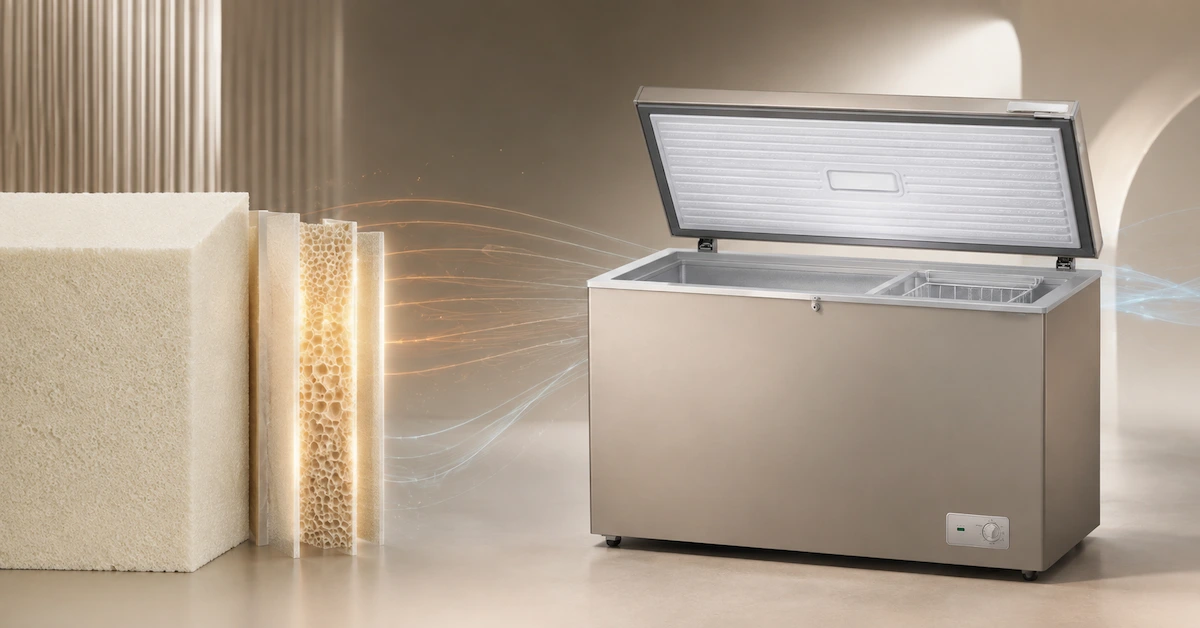
Commercial Freezer Foam Density refers to the weight of polyurethane (PU) insulation foam per unit volume inside a freezer cabinet.
It is usually measured in:
kg/m³
Foam density is an important specification because it affects:
- Thermal insulation performance
- Cabinet strength
- Heat transfer control
- Long-term refrigeration efficiency
In commercial freezers, PU foam is commonly injected between the inner liner and outer cabinet panel to create an insulation barrier.
A properly designed foam structure helps:
- Reduce heat entering the cabinet
- Maintain stable temperatures
- Reduce compressor workload
- Improve operating efficiency
Snowsea provides commercial refrigeration products designed for supermarkets, restaurants, catering businesses, and global B2B refrigeration projects.
Why Does Foam Density Matter in Commercial Freezers?
The insulation system directly affects how efficiently a freezer maintains low temperatures.
Foam density influences several important performance factors.
Thermal Insulation Performance
Higher-quality PU foam structures help reduce heat transfer from the external environment.
Benefits include:
- Better cold retention
- Lower temperature fluctuation
- Improved cooling stability
Energy Efficiency
Better insulation reduces the amount of heat entering the freezer.
This can help:
- Reduce compressor running time
- Lower electricity consumption
- Improve long-term operating efficiency
For energy-related evaluation, see Snowsea's Energy Efficiency Solutions.
Cabinet Structural Strength
PU foam also contributes to cabinet rigidity.
A well-designed foam structure helps improve:
- Panel stability
- Cabinet durability
- Resistance to deformation
PU Foam Density vs Insulation Thickness
Foam density and insulation thickness are related but represent different aspects of freezer insulation.
| Factor | Foam Density | Insulation Thickness |
|---|---|---|
| Focus | Material structure quality | Insulation layer depth |
| Unit | kg/m³ | mm |
| Main Function | Thermal resistance and strength | Reduce heat transfer distance |
| Evaluation | Foam quality | Cabinet design |
A thicker insulation layer does not always mean better performance.
Two freezers with the same insulation thickness may have different efficiency because their foam density and structure are different.
For thickness evaluation, see Snowsea's commercial freezer insulation thickness guide.
Common PU Foam Density Range for Commercial Freezers
The suitable foam density depends on:
- Freezer type
- Temperature requirements
- Cabinet design
- Energy efficiency targets
Typical commercial applications may use:
| Application | Typical Foam Density |
|---|---|
| Standard commercial freezers | 35–45 kg/m³ |
| Energy-efficient freezer cabinets | 40–50 kg/m³ |
| Heavy-duty refrigeration systems | Higher density designs |
Actual specifications vary depending on manufacturer technology and product requirements.
How Foam Density Affects Thermal Performance
Foam density influences the internal structure of the insulation layer.
Important factors include:
- Closed-cell structure
- Foam uniformity
- Thermal conductivity
- Material stability
A well-produced PU foam layer helps achieve:
- Lower heat transfer
- Better temperature retention
- Improved insulation efficiency
High Density Foam vs Low Density Foam
High Density PU Foam
Advantages include:
- Better insulation performance
- Stronger cabinet structure
- Improved durability
- Better thermal resistance
Suitable applications include:
- Commercial freezers
- Heavy-duty storage equipment
- High-performance refrigeration systems
Low Density PU Foam
Lower-density insulation may result in:
- Higher heat transfer
- Reduced structural strength
- Lower long-term efficiency
For commercial refrigeration equipment, insulation quality should be evaluated together with other system components.
Foam Density and Commercial Freezer Energy Consumption
Insulation performance directly influences energy usage.
Better foam density helps reduce:
- Heat leakage
- Compressor workload
- Cooling cycle frequency
However, total energy consumption also depends on:
- Compressor efficiency
- Refrigerant type
- Door sealing
- Ambient temperature
- Temperature settings
For more information, see Snowsea's commercial freezer power consumption guide.
Foam Density and Temperature Stability
A quality insulation system helps maintain stable internal temperatures.
Benefits include:
- Faster recovery after door opening
- Reduced temperature fluctuation
- Better frozen product protection
This is especially important for:
- Supermarkets
- Convenience stores
- Restaurants
- Catering storage facilities
PU Foam Injection Process and Quality Control
Commercial freezer insulation performance depends heavily on manufacturing processes.
Foam Mixing Process
Manufacturers must control:
- Chemical ratios
- Material consistency
- Foam formulation
Foam Injection Process
Proper injection affects:
- Foam distribution
- Cabinet filling quality
- Insulation uniformity
Curing Process
A controlled curing process helps ensure:
- Foam stability
- Long-term insulation performance
- Structural reliability
How Manufacturers Test Freezer Foam Quality
Professional manufacturers evaluate insulation through multiple tests.
Density Testing
Measures:
- Foam weight
- Material consistency
- Production stability
Thermal Conductivity Testing
Evaluates:
- Heat transfer resistance
- Insulation performance
Cabinet Strength Testing
Checks:
- Panel structure
- Mechanical durability
Temperature Performance Testing
Verifies:
- Cooling stability
- Temperature retention
For overall product evaluation, see Snowsea's commercial freezer quality testing guide.
Foam Density Requirements for Different Applications
Supermarket Freezers
Supermarkets require:
- Long operating hours
- Stable temperatures
- Energy-efficient operation
Good insulation helps reduce operating costs.
For retail projects, see Snowsea's supermarket freezer project supplier guide.
Restaurant Freezers
Restaurants often face:
- Frequent door opening
- Kitchen heat
- High operating intensity
Reliable insulation helps maintain consistent freezing performance.
Catering Storage Freezers
Catering applications require:
- Large storage volume
- Stable temperature control
- Reliable long-term operation
For catering solutions, see Snowsea's commercial freezer supplier for caterers guide.
Foam Density and Tropical Climate Applications
Hot environments create higher thermal loads.
In tropical markets, freezers often require:
- Better insulation performance
- Suitable foam structure
- Strong thermal resistance
Insulation works together with:
- Climate class
- Compressor capability
- Refrigeration system design
For environmental considerations, see Snowsea's commercial freezer ambient temperature guide.
Common Mistakes When Evaluating Foam Density
Choosing Only Based on Thickness
Thickness alone does not determine insulation quality.
Buyers should also evaluate:
- Foam density
- Thermal conductivity
- Manufacturing quality
Ignoring Foam Quality
Poor foam structure can reduce long-term performance.
Not Asking for Technical Specifications
Professional buyers should request:
- Insulation material details
- Foam density information
- Testing data
Choosing Low-Cost Insulation Systems
Lower initial cost may result in:
- Higher energy consumption
- Reduced equipment lifespan
How to Choose a Commercial Freezer With Good Foam Density
A practical selection process includes:
Step 1: Confirm Insulation Material
Check:
- PU foam type
- Insulation structure
- Manufacturing method
Step 2: Review Foam Density Data
Evaluate:
- Density range
- Thermal performance
- Supplier specifications
Step 3: Compare Overall Efficiency
Consider:
- Insulation thickness
- Compressor efficiency
- Refrigeration system
Step 4: Check Supplier Capability
Review:
- Manufacturing experience
- Quality control
- Testing procedures
What Information Should You Send a Freezer Supplier?
To receive accurate recommendations, buyers should provide:
- Application type
- Target market
- Ambient temperature
- Storage temperature requirement
- Freezer capacity
- Energy efficiency expectations
- Operating hours
- Quantity
- Certification requirements
- Customization needs
FAQ
What is commercial freezer foam density?
Commercial freezer foam density refers to the weight of PU insulation foam per unit volume, usually measured in kg/m³.
Why is PU foam density important for freezers?
PU foam density affects insulation performance, cabinet strength, temperature stability, and energy efficiency.
Is higher foam density always better?
Not necessarily. The best performance depends on foam density, thickness, material quality, and overall cabinet design.
What foam density is commonly used in commercial freezers?
Many commercial freezers use PU foam densities around 35–50 kg/m³, depending on design requirements.
Does foam density affect electricity consumption?
Yes. Better insulation performance can reduce heat transfer and compressor workload.
What is the difference between foam density and insulation thickness?
Foam density describes insulation material quality, while thickness describes the size of the insulation layer.
Why is PU foam used in commercial freezers?
PU foam provides excellent thermal insulation, structural support, and durability.
How do manufacturers test PU foam quality?
Manufacturers test density, thermal conductivity, cabinet strength, and temperature performance.
Do tropical markets need higher insulation performance?
Many hot-climate applications require stronger insulation designs to reduce heat transfer.
Can Snowsea customize freezer insulation design?
Yes. Snowsea can provide refrigeration solutions based on application, climate conditions, and energy efficiency requirements.
Conclusion
Commercial Freezer Foam Density is an important factor affecting insulation performance, energy efficiency, and refrigeration reliability.
While insulation thickness is important, foam density, material quality, manufacturing process, and cabinet design work together to determine overall freezer performance.
For supermarkets, restaurants, catering companies, and global refrigeration buyers, evaluating PU foam quality helps ensure lower operating costs, stable temperatures, and long-term equipment value.
Snowsea supports global B2B buyers with commercial refrigeration products and OEM/ODM solutions. Explore Snowsea's commercial refrigeration products, review its OEM/ODM solutions, or contact Snowsea with your insulation requirements, application details, and project goals.