Retail equipment distributors do more than purchase commercial freezers and resell them. They must build a product portfolio that meets local market demand, supports different customer applications, generates sufficient margins, and remains reliable after installation.
Choosing the right commercial freezer supplier for distributors can influence:
- Product quality
- Distributor profitability
- Inventory turnover
- Customer satisfaction
- Warranty costs
- Delivery reliability
- Long-term brand reputation
A suitable supplier should support both immediate purchasing requirements and future business growth.
Retail equipment distributors may serve:
- Supermarkets
- Convenience stores
- Frozen-food retailers
- Hotels and restaurants
- Meat and seafood shops
- Food-service companies
- Cold-chain businesses
These customers require different freezer models, capacities, temperatures, and display configurations. A supplier with limited products or weak customization capability may not support a distributor’s complete market strategy.
What Is a Commercial Freezer Supplier for Distributors?
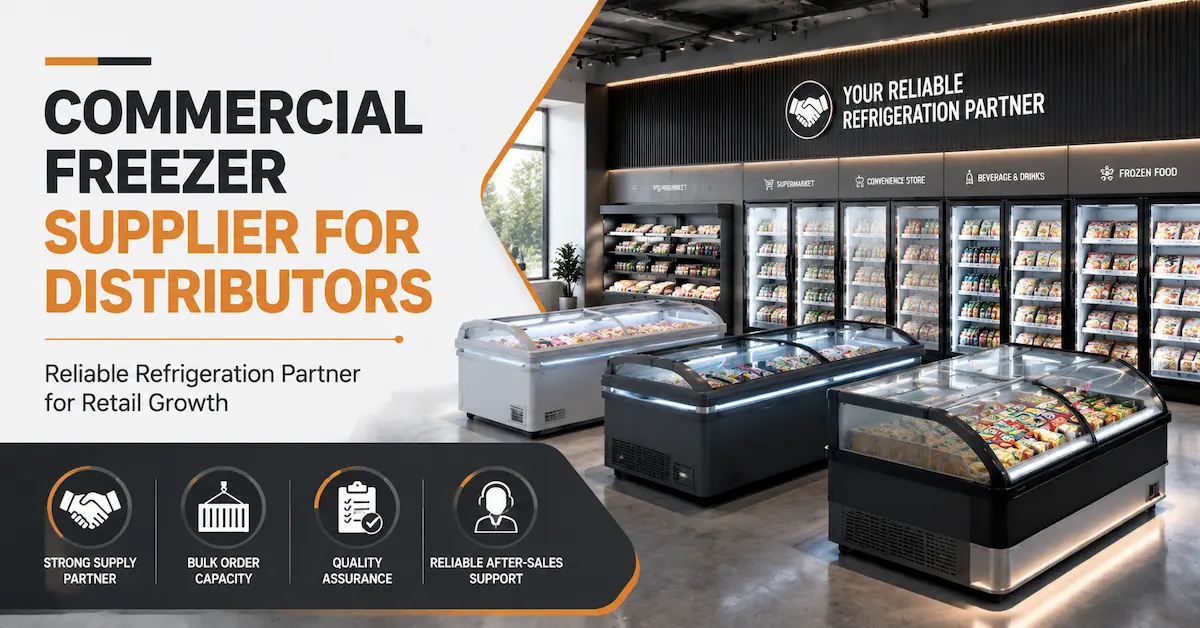
A commercial freezer supplier serving distributors is a manufacturing or wholesale partner that can provide freezer products in repeatable volumes for resale, projects, private-label programs, and regional dealer networks.
Unlike a supplier serving only individual end users, a distributor-focused manufacturer should understand:
- Wholesale purchasing
- Mixed-model orders
- Product portfolio planning
- OEM branding
- Distributor margins
- Container loading
- Export documentation
- Spare-parts requirements
- Repeat-order consistency
The supplier should help distributors build a commercially practical refrigeration range rather than simply provide a long product catalog.
Build the Right Commercial Freezer Product Portfolio
A distributor’s product range should cover the most common local applications without creating excessive inventory complexity.
Core Storage Freezers
Core products may include:
- Chest freezers
- Solid-door upright freezers
- Warehouse freezers
- Commercial storage cabinets
These models serve customers that prioritize capacity, durability, and frozen inventory management.
Retail Display Freezers
Retail-facing products may include:
- Glass-door upright freezers
- Island display freezers
- Sliding-glass chest freezers
- Frozen-food display cabinets
- Ice cream freezers
These models help supermarkets and frozen-food stores improve product visibility and customer access.
Food-Service Freezers
Hotels, restaurants, and commercial kitchens may require:
- Stainless-steel upright freezers
- Heavy-duty storage cabinets
- Compact kitchen freezers
- Bulk ingredient storage freezers
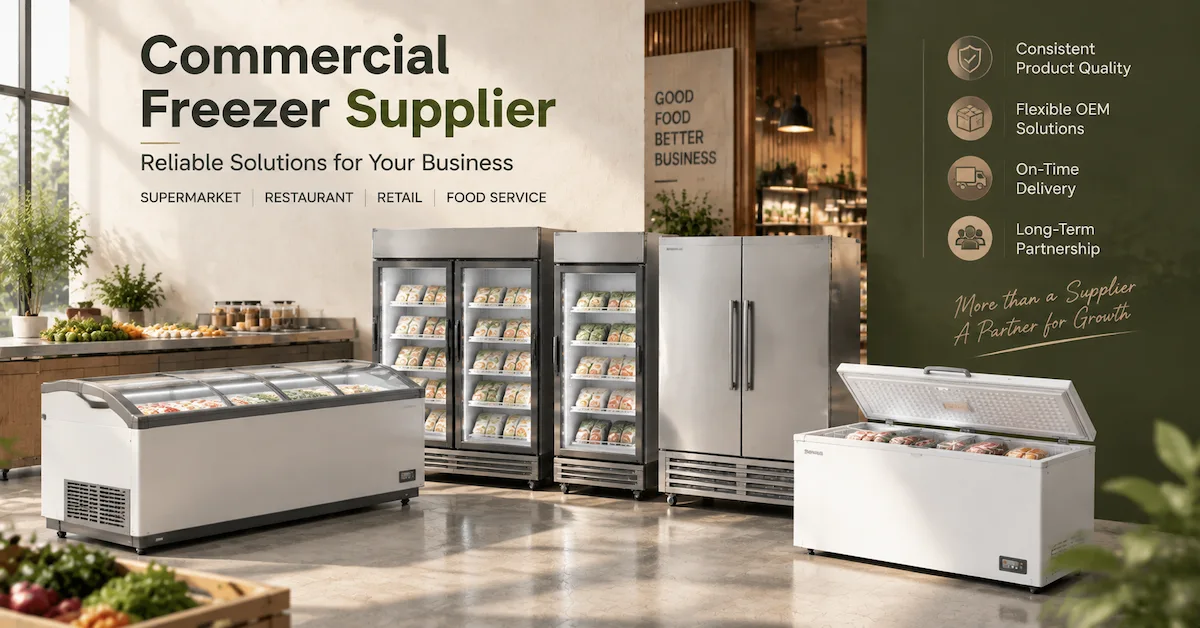
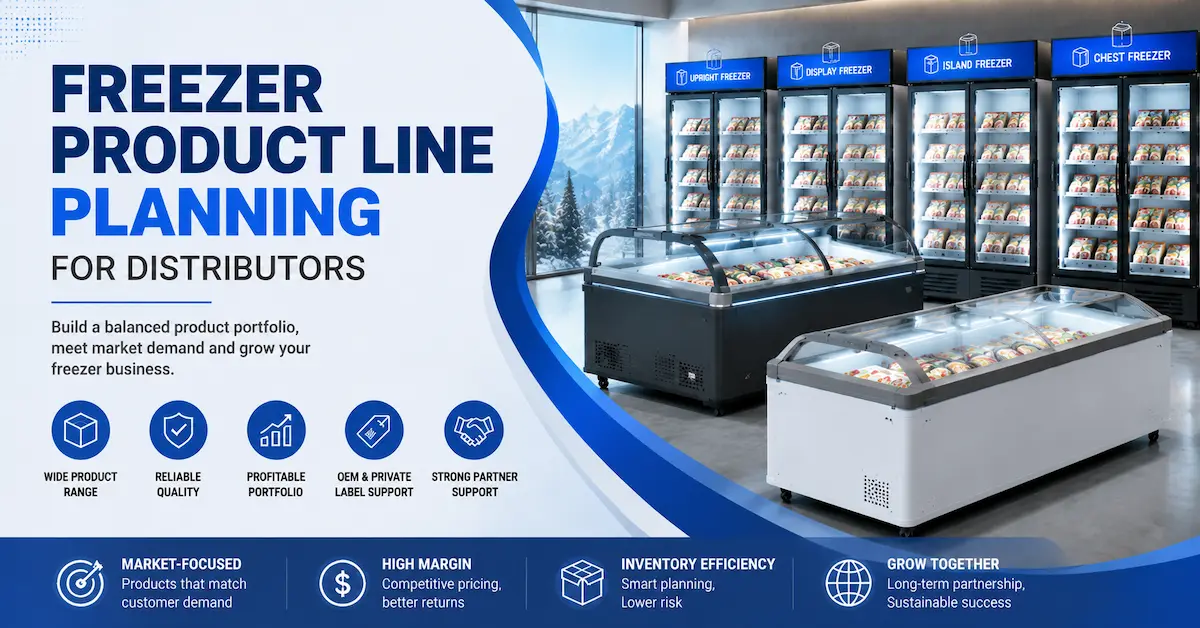
Distributors can review Snowsea’s commercial refrigeration product range when planning a portfolio for different retail and food-service applications.
Evaluate the Supplier’s Manufacturing Capability
A reliable supplier should demonstrate that it can consistently manufacture the required products.
Important evaluation areas include:
- Factory facilities
- Production equipment
- Assembly lines
- Engineering resources
- Quality-control teams
- Material warehouses
- Finished-product testing
- Monthly production capacity
Distributors should ask:
- Is the company a manufacturer or an intermediary?
- Which freezer categories are produced in-house?
- Can the factory support repeat orders?
- How does production capacity change during peak seasons?
- Can the supplier manufacture several models simultaneously?
- How are specifications controlled between different batches?
A supplier may produce a good sample but still struggle with large-volume consistency. Production management is therefore as important as sample quality.
Compare OEM and Private-Label Capability
Many distributors want to sell commercial freezers under their own brand.
A capable OEM supplier should support several customization levels.
Basic Branding
Basic options may include:
- Distributor logo
- Rating labels
- Custom model numbers
- User manuals
- Carton printing
- Shipping marks
Product Appearance
Appearance customization may include:
- Cabinet colors
- Decorative panels
- Branded lightboxes
- Product graphics
- Handle styles
Product Configuration
Technical customization may include:
- Voltage
- Frequency
- Plug type
- Temperature controller
- Shelves
- Baskets
- Door arrangements
- Internal lighting
ODM Development
Advanced distributors may require:
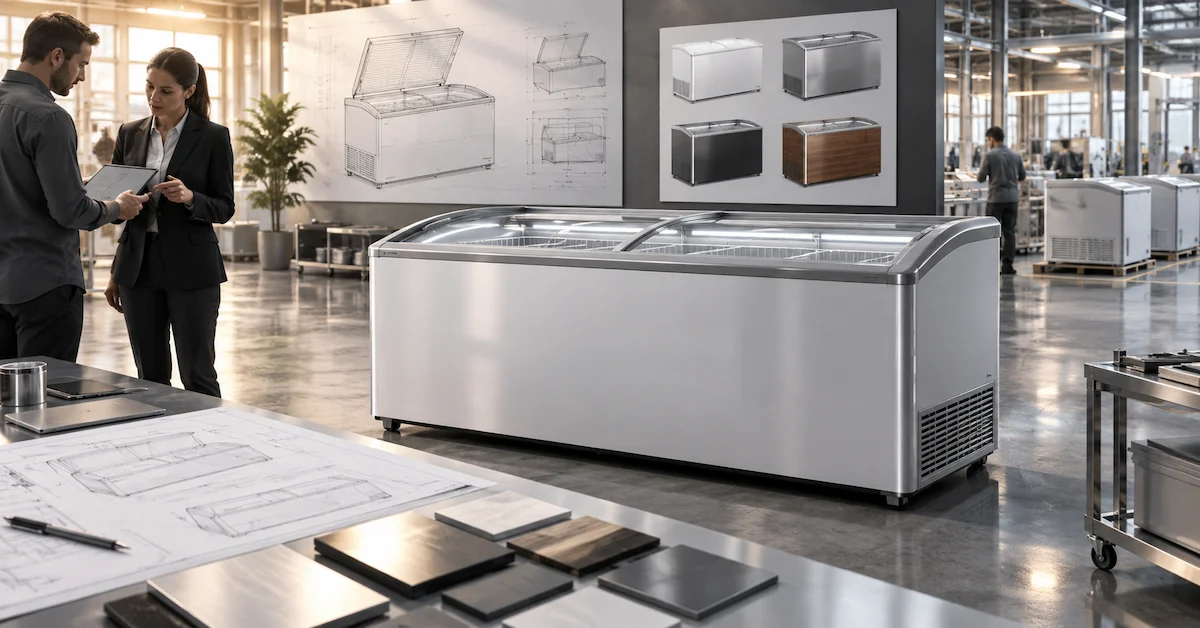
- New cabinet dimensions
- Exclusive product structures
- Modified refrigeration systems
- Market-specific designs
- Exclusive product families
Snowsea provides OEM and ODM commercial refrigeration services for distributors developing private-label and customized freezer products.
Review Product Quality and Main Components
Commercial freezer quality depends on the complete refrigeration system, not only cabinet appearance.
Distributors should evaluate:
Compressor
Important factors include:
- Cooling capacity
- Energy efficiency
- Operating stability
- Noise level
- Spare-parts availability
Cabinet and Insulation
Check:
- Cabinet structure
- Material thickness
- Surface finishing
- Insulation quality
- Door alignment
- Gasket performance
Refrigeration System
Review:
- Condenser
- Evaporator
- Refrigerant piping
- Fan system
- Defrost design
Electrical System
Confirm:
- Temperature controller
- Sensors
- Wiring
- Lighting
- Electrical protection
- Destination-market voltage
Two products with similar dimensions can have very different component quality and long-term performance. Distributor quotations should therefore include detailed specifications.
Confirm the Quality-Control Process
A professional supplier should apply quality control throughout production.
A complete process may include:
| Inspection Stage | Main Purpose |
|---|---|
| Incoming material inspection | Verify components and materials |
| Production inspection | Check assembly and workmanship |
| Electrical inspection | Confirm safety and configuration |
| Cooling test | Verify temperature performance |
| Appearance inspection | Check cabinet, glass, and finishing |
| Packaging inspection | Confirm export protection |
| Loading inspection | Verify quantity and loading condition |
Distributors should ask whether:
- Every unit receives a cooling test
- Temperature results are recorded
- Electrical specifications are verified
- Inspection photos are available
- Defective units are repaired and retested
- Third-party inspection is accepted
Consistent quality control helps distributors reduce warranty claims and customer dissatisfaction.
Compare Wholesale Pricing Correctly
Price comparison should use equivalent product specifications.
Two freezer quotations may differ because of:
- Compressor brand
- Cabinet material
- Insulation thickness
- Glass construction
- Controller type
- Refrigerant
- Packaging
- Certification
- Warranty coverage
A low quotation may exclude important costs such as:
- Reinforced packaging
- OEM labels
- Spare parts
- Export documents
- Inspection
- Container loading
Distributors should request a clear quotation showing:
- Unit price
- MOQ
- Quantity per container
- OEM charges
- Packaging cost
- Sample cost
- Payment terms
- Production lead time
- Shipping term
The most useful quotation is transparent and based on confirmed specifications.
Understand MOQ and Mixed-Model Orders
MOQ affects how distributors test new products and manage inventory.
A supplier may set MOQ according to:
- Model
- Cabinet color
- Voltage
- Branding
- Packaging
- Component configuration
For market-entry orders, distributors may prefer a mixed-model container containing several freezer types.
This approach can help:
- Test product demand
- Build a wider catalog
- Reduce risk per model
- Serve different customer segments
However, too many models can complicate production and reduce loading efficiency.
Distributors should work with the supplier to create a balanced order containing a manageable number of core models.
Evaluate Production Lead Time and Delivery Reliability
Delivery reliability is critical because distributors often promise delivery dates to dealers, supermarkets, and project customers.
Lead time may include:
- Specification confirmation
- Artwork approval
- Component preparation
- Production scheduling
- Assembly
- Cooling tests
- Packaging
- Inspection
- Container booking
- Loading
Buyers should confirm when the official lead time begins.
Possible starting points include:
- Deposit receipt
- Purchase-order confirmation
- Final specification approval
- Sample approval
- Packaging-artwork approval
A reliable supplier should provide realistic schedules and communicate changes early rather than offering an unrealistic short delivery promise.
Check Export Packaging and Container Loading
Commercial freezers require professional export protection.
Packaging may include:
- Protective film
- Foam inserts
- Corner protection
- Reinforced cartons
- Pallet bases
- Wooden frames
- Moisture protection
- Securing straps
Glass-door freezers and display cabinets require additional protection around:
- Glass edges
- Door frames
- Handles
- Controllers
- Upper corners
Distributors should request:
- Packaging specifications
- Carton dimensions
- Gross weight
- Container-loading quantity
- Mixed-model loading plan
- Loading photos
- Container and seal records
Effective packaging reduces transportation damage and protects distributor margins.
Plan Spare Parts and After-Sales Support
Retail equipment distributors are often responsible for local customer service.
The supplier should help prepare a spare-parts strategy covering:
- Controllers
- Sensors
- Fans
- Door gaskets
- Hinges
- Handles
- LED lights
- Electrical components
- Compressor-related parts
Important after-sales questions include:
- What is the warranty period?
- Which parts are covered?
- How are warranty claims submitted?
- How quickly does the supplier respond?
- Are wiring diagrams available?
- Can technical videos be provided?
- Are spare parts included with bulk orders?
- How long will parts remain available?
A strong after-sales system can become an important distributor advantage in the local market.
Assess Technical Communication
A supplier’s communication quality should be evaluated before the first order.
A professional team should provide:
- Accurate specification sheets
- Clear technical drawings
- Application recommendations
- Container-loading information
- Production updates
- Inspection reports
- Fast problem resolution
Warning signs include:
- Specifications changing between quotations
- Unclear answers about components
- Missing technical documents
- Repeated misunderstandings
- Inconsistent product information
Clear communication reduces errors during OEM development, production, packaging, and delivery.
Consider Market and Application Support
The best manufacturing partner should understand how distributors sell products.
Useful supplier support may include:
- Model comparison tables
- Application recommendations
- Product photos and videos
- Technical data sheets
- Marketing materials
- Installation guidance
- Energy information
- Sales training
These resources help distributor sales teams explain:
- Which freezer fits each application
- How models differ
- What customization is available
- Why a product provides long-term value
Distributor Supplier Evaluation Checklist
| Evaluation Area | Questions to Ask |
|---|---|
| Product range | Can the supplier cover core market applications? |
| Manufacturing | Are products made in a real factory? |
| OEM capability | Can branding and configurations be customized? |
| Quality | What testing is completed before shipment? |
| Pricing | Is the quotation complete and transparent? |
| MOQ | Are mixed-model trial orders possible? |
| Capacity | Can repeat and large orders be supported? |
| Delivery | Are lead times realistic and documented? |
| Packaging | Is protection suitable for export shipping? |
| Spare parts | Are common replacement parts available? |
| Warranty | Is the claim process clearly defined? |
| Communication | Are technical responses accurate and timely? |
Common Mistakes Distributors Should Avoid
Choosing Only the Lowest Price
Low prices can result in higher warranty costs, poor customer satisfaction, and damaged distributor reputation.
Launching Too Many Models
A broad initial portfolio can create slow inventory turnover and complicated spare-parts management.
Ignoring Container Utilization
Poor product and carton dimensions can increase freight cost per unit.
Skipping Sample Validation
Samples should be evaluated for cooling, appearance, accessories, branding, and packaging before mass production.
Neglecting After-Sales Planning
Commercial refrigeration customers expect technical assistance and spare parts.
Comparing Incomplete Specifications
Quotations are only meaningful when products use equivalent configurations.
Why Distributors Work With Snowsea
Snowsea supports retail equipment distributors, refrigeration wholesalers, supermarket suppliers, and private-label brands with commercial freezer manufacturing and export services.
Available support includes:
- Product portfolio recommendations
- Commercial freezer manufacturing
- OEM and ODM customization
- Quality inspection
- Export packaging
- Container-loading coordination
- Technical documents
- Spare-parts planning
- Repeat-order support
Distributors can learn more about Snowsea’s manufacturing capabilities and export experience on the About Snowsea page.
FAQ
How should I choose a commercial freezer supplier for distributors?
Evaluate product range, factory capability, OEM options, component quality, inspection procedures, MOQ, pricing, delivery reliability, packaging, warranty, and spare-parts support.
What freezer models should retail equipment distributors sell?
A practical portfolio may include chest freezers, upright glass-door freezers, island display freezers, storage cabinets, and selected food-service models.
Can distributors order several freezer models in one container?
Mixed-model loading may be available, depending on MOQ, production planning, carton dimensions, and container utilization.
Should distributors develop private-label freezers?
Private-label products can strengthen distributor branding, improve customer loyalty, and reduce direct price comparison when order volume supports customization.
What documents should a freezer supplier provide?
Useful documents include specification sheets, drawings, inspection reports, packing lists, manuals, loading details, and required export documents.
Why is spare-parts planning important?
Spare-parts availability helps distributors respond faster to service requests, reduce equipment downtime, and improve customer confidence.
Conclusion
Selecting the right commercial freezer supplier for distributors requires more than comparing product catalogs and unit prices.
Retail equipment distributors should evaluate product coverage, manufacturing capability, OEM support, quality control, wholesale pricing, delivery planning, export packaging, technical communication, and long-term after-sales service.
A reliable supplier helps distributors build a competitive freezer portfolio, maintain consistent product quality, reduce supply risks, and develop stronger customer relationships.
Snowsea supports distributors with commercial refrigeration manufacturing, customized product development, quality control, export logistics, and long-term supply coordination.