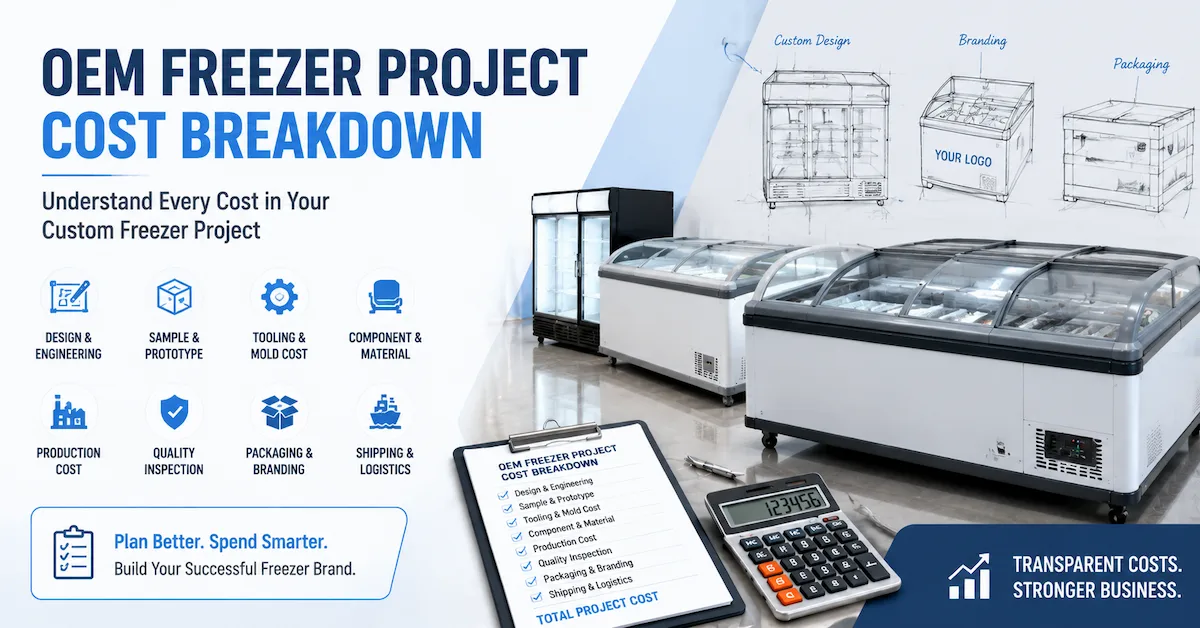
What Does Custom Freezer OEM Actually Mean?
A custom freezer OEM project should begin with an existing commercial freezer platform and a defined reason to change it. The objective is not to customize as many parts as possible. It is to modify only the areas necessary to satisfy a market, application, branding or channel requirement while keeping the remaining product on a proven manufacturing platform.
This distinction matters because every customization can create consequences elsewhere. Changing cabinet dimensions can alter usable volume, insulation geometry, refrigeration load and packaging. Changing glass can affect heat transfer, sealing and transport protection. Changing a controller can affect sensor logic, compressor operation, defrost and service parts. Even a private-label carton can change packed dimensions and container planning.
SNOWSEA already provides multiple commercial freezer platforms as starting points and supports project customization through its OEM/ODM service. For B2B buyers, the stronger sourcing strategy is therefore standardize what does not create customer value and customize what solves an identifiable requirement.
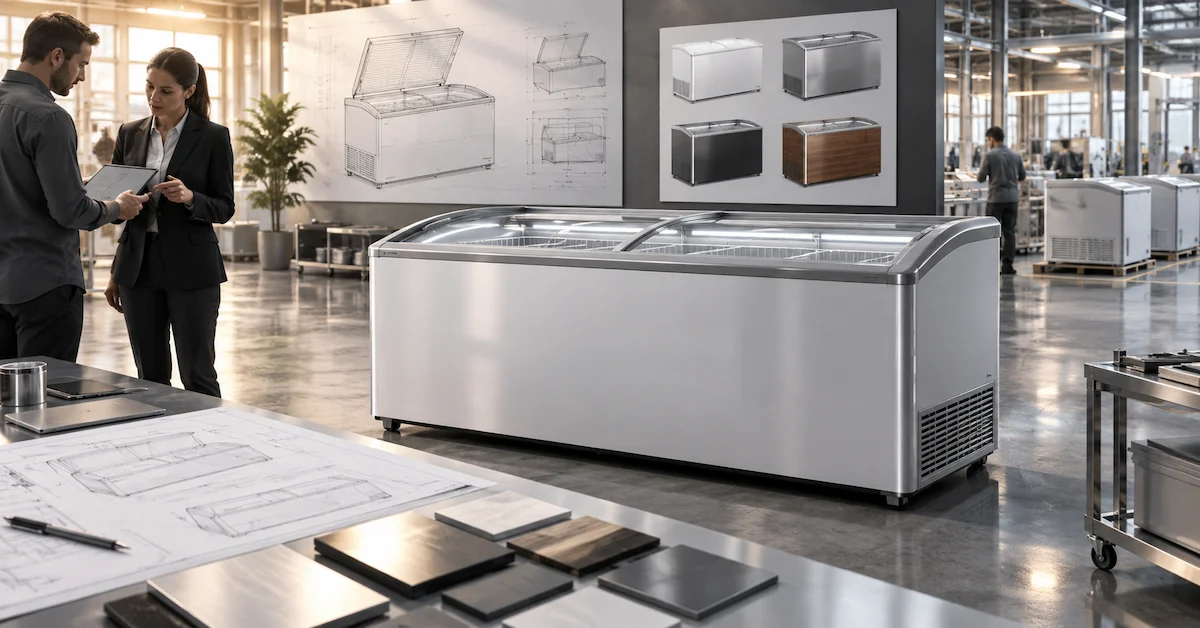
Who Needs a Custom Freezer OEM Project?
Custom OEM is particularly relevant to distributors building a regional product line, frozen-food and ice cream brands deploying branded cabinets into stores, supermarket-equipment suppliers standardizing equipment across locations, and private-label refrigeration companies that need differentiation from generic catalog products.
The project should nevertheless have a measurable business reason. A buyer may need a specific cabinet footprint because stores use standardized bays, a different basket arrangement because local ice cream packages have unusual dimensions, a destination-market electrical version, private-label controls or packaging, or a glass configuration better suited to a retail display.
Customization is less valuable when the existing freezer already satisfies the customer’s application and the proposed change adds no clear commercial or operating advantage. SNOWSEA’s existing custom commercial freezer guide follows the same principle: begin with the problem the standard product cannot solve, then determine the smallest justified modification.
Use Three Levels of Customization Before You Approve the Project
Not all custom freezer requirements create the same risk. Buyers can divide them into three practical levels.
| Customization Level | Typical Examples | Buyer Risk | Recommended Approach |
|---|---|---|---|
| Brand & market localization | Logo, model name, manual, carton, plug, language | Lower | Control artwork and market version |
| Functional configuration | Baskets, locks, lighting, controller options, selected accessories | Medium | Confirm compatibility and sample |
| Engineering customization | Cabinet dimensions, glass structure, refrigeration system, insulation, compressor, control logic | Higher | Engineering review, prototype and validation |
This structure prevents a salesperson, purchasing team and engineering team from using the word “custom” to describe completely different work.
For example, printing a private-label carton should not be managed with the same engineering process as changing cabinet width. Likewise, changing a compressor should not be approved like a different cabinet color.
Start With the Closest Standard Freezer Platform
A strong custom freezer OEM project usually starts with the existing model that already solves the largest part of the application.
SNOWSEA’s published platforms illustrate how different base cabinets can serve different starting roles.
| SNOWSEA Model | Published Starting Point | Possible Custom OEM Direction | First Question to Ask |
|---|---|---|---|
| BD-500 | 500L double-lid chest freezer | Larger frozen-storage program | Which requirement does the standard cabinet not satisfy? |
| BD/BC-227WA | 227L air-cooled no-frost freezer | No-frost or electronic-control project | Does the required change affect airflow, defrost or controls? |
| SD/SC-268PM | 268L flat sliding-glass ice cream freezer | Retail ice cream/private-label display | Does real package loading require another glass or basket layout? |
SNOWSEA’s BD-500 information identifies a 500L double-lid format and R290 refrigerant, while its no-frost and ice cream platforms serve different functions. This is precisely why buyers should not start a custom project by saying, “We need a 300L customized freezer.” Start with application and platform first.
What Should Usually Stay Standard?
A useful custom OEM program deliberately preserves standard elements where modification provides little customer value. Proven structural parts, established manufacturing processes, refrigeration components already matched to the platform, existing production tools and common service parts can reduce development work and make repeat orders easier.
Keeping selected parts standard can also improve serviceability. A distributor may prefer a proven gasket, controller or basket available across several models rather than a unique component that later requires a special MOQ and separate inventory.
The correct decision is not “never modify standard parts.” It is to ask what measurable benefit the change provides.
If an existing component meets the product requirement, replacing it solely to make the specification appear more customized can add sourcing risk without strengthening the product.
What Should Be Customized When It Creates Real Value?
Customization is justified when the buyer can define a specific requirement and later verify whether the change solved it. A cabinet width may need to fit an existing fixture. A basket layout may need to accommodate the customer’s packages. A controller may need market-specific functionality. A branded ice cream freezer may need a specific display or graphic treatment.
The project specification should therefore connect every custom item to its purpose.
| Requirement | Reason for Customization | Approval Evidence |
|---|---|---|
| Cabinet dimension | Fit a defined installation | Drawing + physical fit |
| Internal layout | Accommodate actual packaging | Loading trial |
| Glass system | Improve defined access/display requirement | Sample inspection |
| Controller | Required operating/control functions | Functional test |
| Electrical version | Destination-market supply | Specification + label |
| Logo/graphics | Private-label identity | Artwork approval |
| Packaging | Branding/export handling | Sample carton/packing spec |
| Refrigeration modification | Meet defined performance requirement | Engineering validation |
This simple connection between requirement → modification → evidence prevents OEM programs from becoming uncontrolled collections of options.
Custom Cabinet Size Is an Engineering Decision
Changing width, depth or height can appear straightforward, but a freezer cabinet is a thermal enclosure as well as a metal structure.
SNOWSEA’s OEM freezer custom cabinet size guide notes that dimensional changes can influence refrigeration load, heat-transfer area, insulation requirements, internal airflow, shelf or storage layout and other parts of the system.
Before requesting a new size, first provide actual package dimensions and the installation constraint. Engineering can then determine whether changing the basket arrangement or using another existing platform could solve the problem with less development.
If the cabinet dimensions must change, request updated drawings, usable internal dimensions, refrigeration review, packed dimensions and validation requirements before approving the project.
Custom Glass Should Be Evaluated as Part of the Thermal Enclosure
For ice cream and retail display equipment, glass customization can improve merchandising or access, but the glass system is not merely decorative.
SNOWSEA’s custom glass door guidance explains that changes to glass dimensions, construction, sliding or hinged operation, frame, gasket or anti-condensation strategy can influence heat transfer, sealing, refrigeration workload and packaging.
A buyer should therefore define what the new glass needs to accomplish. Does it improve customer access? Does it provide enough visible assortment? Does it fit the store fixture? Is condensation control relevant to the intended environment?
Then approve the complete glass-and-cabinet configuration rather than only the appearance.
Custom Controller Projects Need Functional Requirements
A digital controller is one of the easiest features to over-customize.
Instead of requesting a “better” controller or another display style, define the functions required by the application. SNOWSEA’s OEM custom controller guide identifies functions that can include temperature regulation, compressor operation, restart delay, sensor inputs, fans, defrost, alarms and display behavior.
A custom controller project may therefore affect refrigeration behavior and should not be treated only as industrial design.
If a brand needs custom buttons or a private-label display, preserve the validated control logic wherever practical. If operating logic changes, include it in prototype and performance validation.
A Preferred Compressor Brand Is Not the Same as a Better Freezer
Some OEM buyers specify a preferred compressor brand because it is familiar to their dealers or market. That request can be evaluated, but the compressor must match the refrigeration system.
SNOWSEA’s OEM freezer compressor guide notes that compressor selection needs to be considered together with refrigerant, cooling capacity, target temperature, ambient conditions, cabinet size, electrical configuration and refrigeration circuit.
For purchasing, this means a famous compressor brand should not automatically receive approval if the exact compressor model has not been matched to the freezer.
The useful requirement is refrigeration performance and serviceability. Brand preference can then be evaluated within that engineering requirement.
Custom Temperature Range Must Be Defined as Performance
A buyer asking for a custom temperature range should not simply ask the manufacturer to change the thermostat settings.
SNOWSEA’s OEM freezer custom temperature range guide distinguishes controller setpoint from actual cabinet operating range and identifies ambient condition, loading, recovery and defrost strategy as relevant factors.
A useful requirement might define target cabinet conditions, expected ambient environment, stored products, loading and recovery after replenishment.
Engineering can then determine whether the existing refrigeration system is suitable or whether deeper modification is needed.
Build One Custom Freezer OEM Specification
Before sample production, convert the customization list into one controlled specification.
The document should distinguish between the original standard platform and the approved customized version.
Important items can include the base model, cabinet dimensions, cooling architecture, refrigerant configuration, controller, electrical version, glass or lid, baskets, accessories, branding, labels, manuals and packaging.
Give the document a revision number.
If Sample Revision 01 contains a different controller from Sample Revision 02, the bulk purchase order should identify which revision represents the approved production unit.
That is much safer than telling the supplier to “follow the final sample.”
Use the Prototype to Test the Reason for Customization
A custom freezer prototype should prove that the customization solved the original problem.
If the project changed dimensions, test the actual site fit. If baskets were redesigned, load the real packages. If glass changed, evaluate access and merchandising. If refrigeration components changed, verify the relevant performance. If the controller changed, test the functions that justified the change.
A prototype should therefore be more than a product-photo sample.
Record the tested configuration, application conditions, results, corrections and unresolved issues. Where possible, keep technical approval separate from branding approval.
This creates evidence that purchasing can use when deciding whether to release mass production.
Do Not Turn Sample Approval Into Mass-Production Approval Too Early
A hand-built or carefully prepared prototype can perform well while still exposing production difficulties later.
Before mass production, ask whether the new parts and processes are practical on the normal production line. Unique components may have different tolerances or MOQ. A revised structure may require additional assembly instructions. New packaging may fit the sample but create inefficiency in regular packing.
SNOWSEA’s OEM/ODM manufacturing process covers material processing, structural assembly, insulation, refrigeration installation, assembly, testing and packing. A custom OEM project needs to identify where its changes enter this process.
When customization is significant, a pilot or first-production verification can help connect prototype success with manufacturing repeatability.
MOQ Can Change Because of One Small Custom Item
Buyers often associate MOQ only with the complete freezer. In practice, one custom component can create its own minimum.
Examples can include private-label cartons, special colors, unique baskets, custom glass, molded handles, controllers or other dedicated parts.
Before finalizing a design, request MOQ implications for each unique element.
If a custom handle creates a high component minimum while providing little customer value, retaining the standard handle may strengthen the commercial case.
This is exactly why the “what to customize vs. what to keep standard” decision should happen before the specification is locked.
Compare the Cost of the Standard and Custom Version
Do not ask only for the price of the customized freezer.
Request a comparable quotation for the closest suitable standard platform and the proposed custom version.
| Cost Area | Standard Version | Custom Version |
|---|---|---|
| Base cabinet | Benchmark | Recurring cost |
| Customized components | None/limited | Additional recurring cost |
| Engineering | Normally limited | Possible development cost |
| Sample | Standard evaluation | Custom prototype |
| Tooling | Usually existing | Possible new tooling |
| Additional validation | Standard scope | Depends on modification |
| Packaging | Standard | Custom artwork/size |
| Spare parts | Existing system | Unique parts may be needed |
| MOQ | Standard model | May change by custom item |
| Freight | Known package | Recalculate if size changes |
Then judge whether the additional investment solves a sufficiently valuable problem.
A $20 modification that creates a difficult spare part can be less attractive than a $50 change that solves a major installation problem. Cost should be connected to commercial value, not judged in isolation.
Customization Can Increase Spare-Parts Complexity
Every unique technical component has a service consequence.
If a custom controller, gasket, glass panel or handle is approved, determine how the part will be identified and supplied later. Ask whether it has a separate MOQ, whether the distributor should hold local stock and whether an approved alternative exists.
This matters most for private-label brands because customers will contact the brand or distributor rather than the factory when a replacement part is needed.
A well-designed custom freezer OEM program should therefore consider product differentiation and long-term serviceability at the same time.
Destination-Market Requirements Should Be Reviewed Before Artwork Is Finalized
Electrical, labeling and documentation requirements vary by market and product configuration.
Do not wait until the final carton is printed to determine whether a custom technical change affects the supporting product documentation.
The project should identify the destination country and exact electrical configuration from the beginning. If cabinet structure, refrigeration components or controls change, confirm whether relevant product documentation requires another review.
Keep technical data sourced from the approved specification separate from artwork design so marketing cannot accidentally introduce unsupported claims.
Packaging Should Be Revalidated When the Product Changes
A custom freezer can require different packaging even when the outer cabinet changes only slightly.
A new glass structure may require additional protection. Another cabinet dimension can alter carton size. Custom accessories may require separate fixation. Private-label artwork creates another controlled revision.
Before shipment planning, confirm final packed width, depth, height and the proposed protection method.
Do not calculate container quantity using the packaging dimensions of the original standard model after the customized freezer has been changed.
Create a Customization Decision Matrix Before Final Approval
Before releasing the design, ask three questions about each custom item:
| Question | If the Answer Is “No” |
|---|---|
| Does this change solve a measurable customer or market requirement? | Keep the standard design |
| Can the change be validated objectively? | Clarify the requirement first |
| Can the change be manufactured, serviced and reordered practically? | Redesign or remove it |
This framework keeps the project commercially disciplined.
It also helps product managers resist the temptation to add features only because they are available.
A custom freezer OEM project is stronger when every modification has a reason to exist.
Lock the Production Revision Before the Bulk Order
Once the sample, technical tests, artwork and packaging are approved, release one controlled version for mass production.
The production release should identify the base model, approved drawings, components, controller settings where relevant, electrical version, branding, labels, documents, accessories and packaging.
For repeat orders, reference that same revision.
If a change is proposed later, record the affected requirement and decide whether new validation is needed.
SNOWSEA’s OEM commercial freezer manufacturer guide similarly emphasizes tying repeat orders to an approved cabinet configuration rather than restarting the specification discussion every time.
What Should You Send SNOWSEA for a Custom Freezer OEM Project?
A useful request should explain what the standard product cannot do. That is more valuable to engineering than a long list of custom options without context.
Provide the target market, customer type, freezer application, closest standard model if known, product/package dimensions, required loading, installation limits, temperature requirement, ambient environment, electrical version, requested customization, branding, sample quantity, expected production volume and project timing.
For significant modifications, also explain the acceptance method: how will you decide whether the custom design works?
Submit this information through SNOWSEA Contact Us and ask for a proposal that separates the standard platform, required customization, engineering-review items, sample validation, MOQ impact and production-release requirements.
Frequently Asked Questions
1. What does custom freezer OEM mean?
Custom freezer OEM means adapting an established freezer platform to a buyer-specific commercial or technical configuration. Customization can include branding, electrical versions, accessories, controls, cabinet features or deeper engineering changes depending on project requirements.
2. How is custom freezer OEM different from ODM?
OEM usually begins from an existing product platform and modifies defined areas. ODM involves deeper product development when existing products cannot satisfy the requirement without significant engineering work.
3. What freezer parts can be customized?
Depending on the base model and technical feasibility, projects can evaluate cabinet dimensions, baskets, glass, controller functions, electrical configuration, branding, packaging and other model-specific requirements. Engineering changes require separate review.
4. Should every part of an OEM freezer be customized?
No. Retaining proven standard components where customization adds no customer value can reduce development time, MOQ, service complexity and repeat-order risk.
5. Can SNOWSEA customize freezer cabinet dimensions?
SNOWSEA publishes guidance for OEM freezer custom cabinet size. Dimension changes need evaluation because they can affect refrigeration load, insulation, internal layout and packaging.
6. Can a custom freezer use a preferred compressor brand?
A preferred brand can be evaluated, but the exact compressor must match the freezer’s refrigerant, cooling requirement, cabinet size, ambient conditions and electrical system. Review SNOWSEA’s custom compressor guide for this approach.
7. Do custom freezer projects require a prototype?
A representative prototype is valuable when customization affects fit, loading, appearance, controls or technical performance because it allows buyers to verify that the proposed change solves the original requirement before mass production.
8. Does customization increase MOQ?
It can. Unique artwork, packaging, components, glass, colors or other dedicated materials can create separate minimum quantities, so MOQ should be reviewed after the actual custom scope is defined.
9. How can I keep custom freezer repeat orders consistent?
Release a controlled specification revision after sample and technical approval. Reference that revision on later orders and require proposed component, technical, artwork or packaging changes to be approved before production.
10. How do I request a custom freezer OEM quote from SNOWSEA?
Send your application, target market, closest standard platform, required modifications, loading requirements, electrical version, quantity and project schedule through SNOWSEA Contact Us. Ask for a proposal separating standard features from customization and engineering work.
Conclusion
A successful custom freezer OEM project does not maximize customization; it uses customization selectively to solve real market and operating problems. Begin with the closest proven freezer platform, preserve standard components where they already satisfy the application, and place deeper engineering control around changes to cabinet dimensions, glass, refrigeration components, controls and temperature performance. Connect every modification to a measurable requirement, validate it on a controlled sample, understand its MOQ, cost, packaging and spare-parts consequences, and lock the final production revision before mass manufacturing. SNOWSEA offers commercial freezer platforms and OEM/ODM customization support for distributors, brands and project buyers. If your current freezer cannot meet a store layout, loading, display, control or market requirement, send SNOWSEA the constraint you need to solve and request a custom OEM proposal showing what should change, what can remain standard, how the modified version will be validated and what the customization means for MOQ and repeat production.