What Is Commercial Freezer Tropical Climate Design?
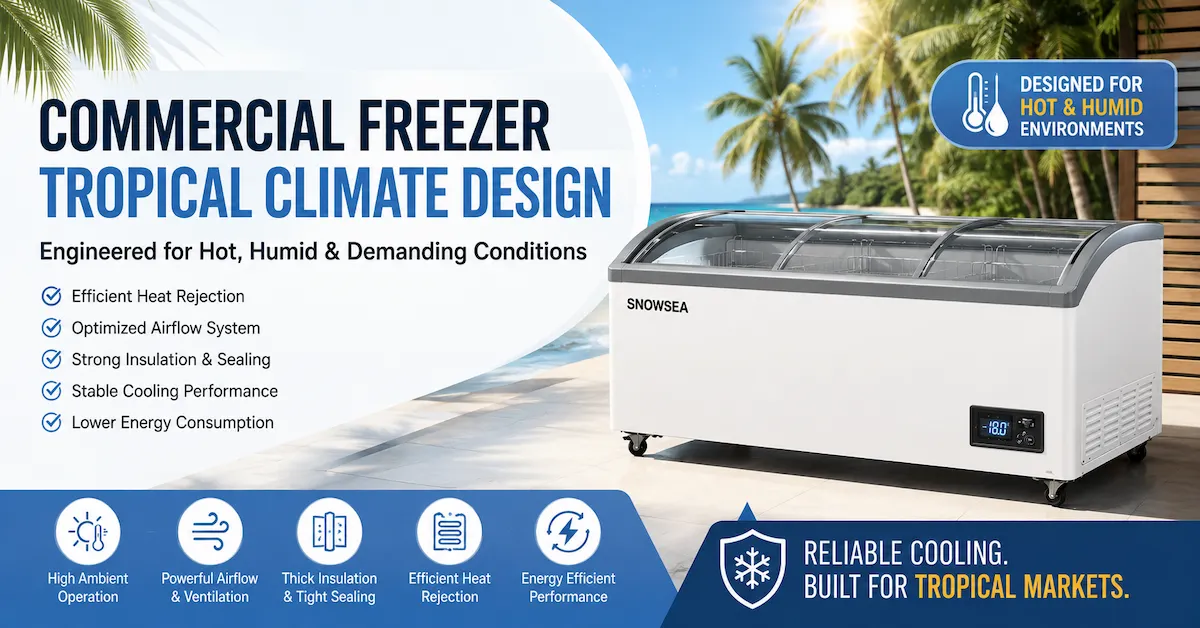
Commercial freezer tropical climate design is the engineering process of configuring a freezer around demanding operating conditions such as sustained heat, humidity, frequent access, heavy product loads, and limited installation ventilation.
It is not simply a standard freezer fitted with a larger compressor.
A tropical-climate project may require the manufacturer to review the complete thermal system:
- Compressor and refrigeration capacity
- Condenser heat rejection
- Evaporator performance
- Condenser and cabinet airflow
- Insulation
- Door and gasket design
- Glass-door configuration where used
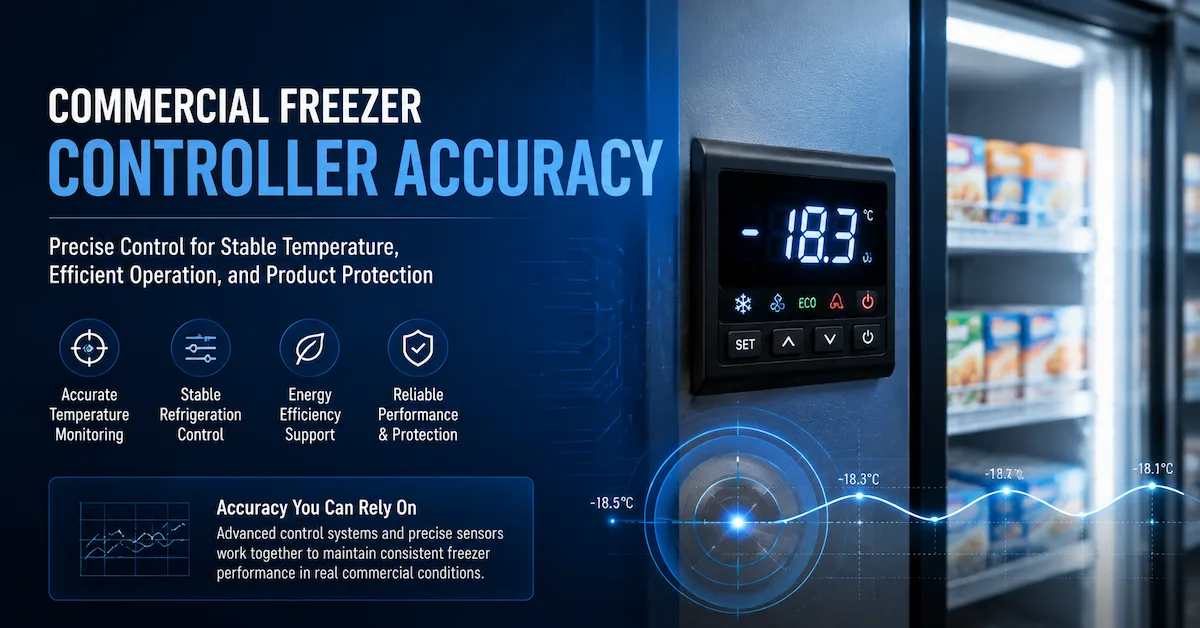
- Controller operation
- Product loading
- Installation clearance
- Humidity and condensation conditions
The specification should start with the actual application rather than a vague request for “a tropical freezer.”
A tropical-climate freezer is a system-design problem, not a single-component upgrade.
Tropical Climate Design vs High Ambient Performance
These two topics are closely related, but they answer different questions.
| Topic | Main Question |
|---|---|
| Tropical climate design | How should the freezer be configured for the intended environment? |
| High ambient performance | Does the completed freezer perform as required in that environment? |
Design comes first. Performance testing checks whether that design delivers the expected result.
For the verification side of the process, see Snowsea's commercial freezer high ambient performance guide.
A good OEM project needs both.
Start With the Real Operating Environment
A buyer may tell a manufacturer:
“This freezer is for a tropical country.”
That is useful background, but it is not enough for engineering.
An air-conditioned supermarket, a busy commercial kitchen and a non-air-conditioned warehouse can exist in the same market while exposing equipment to very different conditions.
More useful information includes:
- Expected ambient temperature
- Humidity conditions, if known
- Installation location
- Ventilation around the freezer
- Nearby cooking or heat-producing equipment
- Product load
- Door-opening frequency
- Required storage temperature
Country name alone does not define the thermal load.
For technical sourcing, describing how and where the freezer will actually operate is far more useful.
Why Condenser Heat Rejection Matters
A refrigeration system removes heat from the cabinet, but that heat does not disappear. It must be released into the surrounding environment through the condenser.
This becomes more demanding when the surrounding air is already hot.
A tropical freezer project therefore needs to consider:
- Condenser capacity
- Condenser airflow
- Fan operation where applicable
- Refrigeration-system matching
- Ventilation around the machine compartment
- Installation clearance
Poor heat rejection can undermine an otherwise capable refrigeration system.
However, choosing the largest possible condenser is not automatically the best solution. Space, airflow, component matching, cabinet architecture and project cost still matter.
The better question is whether the condenser is properly matched to the intended system and environment.
For more background, see commercial freezer condenser design.
A Larger Compressor Is Not a Complete Tropical Solution
Compressor selection attracts a lot of attention during sourcing because it is easy to compare model names and capacities.
Real refrigeration performance is more complicated.
A larger compressor cannot automatically compensate for:
- Weak condenser heat rejection
- Restricted airflow
- Inadequate evaporator performance
- Excessive cabinet heat gain
- Poor door sealing
- Incorrect control logic
- Unsuitable installation conditions
Oversimplifying the project to compressor size may also lead to poor system matching.
Snowsea's commercial freezer compressor sizing guide explains why compressor selection needs to be considered as part of the complete refrigeration system.
For tropical applications, that system-level view becomes even more important.
Evaporator and Cold-Air Distribution Matter Inside the Cabinet
Heat rejection happens outside the refrigerated space. Cooling still needs to be delivered effectively inside it.
That brings the evaporator and internal airflow into the design discussion.
A freezer may have adequate theoretical refrigeration capacity while still developing uneven storage conditions if cold air does not reach the usable cabinet effectively.
Shelf position, baskets and product loading can influence:
- Supply airflow
- Return airflow
- Warm zones
- Cold zones
- Cooling speed
- Temperature uniformity
For forced-air equipment, cabinet airflow is especially relevant.
See Snowsea's commercial freezer airflow design guide and commercial freezer temperature uniformity guide.
A useful design goal is not merely to create cold air. It is to deliver cooling where the stored products actually are.
Insulation Helps Control the Heat Load
Heat entering through cabinet walls becomes an additional load on the refrigeration system.
That makes insulation important in demanding climates.
Yet procurement teams should avoid reducing insulation design to one number.
Thickness matters, but so do:
- Insulation quality
- Cabinet geometry
- Door area
- Structural thermal paths
- Panel construction
- Usable internal space
An extremely thick wall may reduce usable volume without necessarily solving every thermal-design problem.
The complete cabinet needs to balance storage capacity and heat-load control.
Snowsea covers related considerations in its commercial freezer insulation thickness guide.
Door Design Becomes More Important in Hot and Humid Conditions
Every time a freezer door opens, the inside is exposed to the surrounding environment.
For retail and foodservice equipment, access frequency can be a major part of the operating load.
The manufacturer may need to consider:
- Door type
- Door opening area
- Gasket sealing
- Closing behavior
- Glass construction where relevant
- Customer access frequency
A small difference in door behavior can become more meaningful when the surrounding air is hot and humid.
This is also why gasket performance deserves attention. A door that appears closed may still introduce unnecessary heat if sealing is inconsistent.
See freezer door gasket sealing performance.
What Changes With a Glass-Door Freezer?
Display freezers are often selected because customers need to see products before opening the cabinet.
That commercial function changes the design priorities.
Glass-door equipment may require simultaneous consideration of:
- Visibility
- Thermal performance
- Condensation behavior
- Door sealing
- Lighting
- Refrigeration capacity
- Merchandising needs
A solid-door storage freezer and a glass-door merchandising freezer should not be judged as though they serve identical purposes.
For OEM projects involving glass configurations, Snowsea's OEM freezer custom glass door guide provides additional specification considerations.
Humidity Adds Another Layer to Tropical Applications
Hot climates are not always humid, and humid conditions are not always extremely hot. An OEM specification should therefore avoid treating “tropical” as one universal environment.
Humidity can make buyers pay closer attention to issues such as:
- Condensation on cold surfaces
- Glass visibility
- Moisture around door areas
- Frost behavior
- Surface durability
- Cleaning and maintenance
The exact effect depends on the freezer design, operation and installation.
This is why humidity should be included in the RFQ when the buyer has a defined requirement rather than being assumed from the destination country.
The next engineering question is often frost management around the evaporator, which should be evaluated separately according to the refrigeration platform.
Installation Ventilation Is Easy to Miss
A technically capable freezer can still perform poorly if its installation prevents heat from leaving the refrigeration compartment.
Real sites may place equipment:
- Close to walls
- Between other appliances
- Near cooking equipment
- Inside compact counters
- In poorly ventilated service spaces
Those details can matter as much as the geographic market.
When possible, provide the manufacturer with:
- Required wall clearance limitations
- Available ventilation
- Cabinet installation drawings
- Nearby equipment
- Heat sources
- Whether units will be installed side by side
Designing around an unrealistic open test environment can produce a freezer that looks good during development but struggles after installation.
Tropical Design Does Not Automatically Mean Outdoor Use
A freezer engineered for demanding indoor heat should not automatically be described as outdoor equipment.
Outdoor installation can introduce separate issues:
- Direct sunlight
- Rain
- Dust
- Wind
- Weather exposure
- Corrosion
- Electrical protection
These require their own product assessment.
If the final application is outdoors, say so during the project discussion.
“High-temperature indoor use” and “outdoor use” are not interchangeable specifications.
How Tropical Design Affects Pull Down and Recovery
A freezer used in a demanding climate still has to cool effectively.
Two useful performance checks are pull-down and recovery.
Pull down asks how the freezer moves from a defined starting condition toward the target temperature.
Recovery asks what happens after a disturbance such as door opening.
The ambient environment should be documented in both cases.
A cooling time measured under mild laboratory conditions cannot automatically prove identical behavior in a much more demanding installation.
For further technical comparison, review Snowsea's commercial freezer pull down time guide and commercial freezer temperature recovery guide.
Energy Consumption Must Be Read Beside Cooling Performance
Hotter operating conditions can change refrigeration-system demand.
That makes energy data useful—but only if the freezer is also maintaining the required product-storage condition.
A low energy figure has little commercial value if cabinet performance is inadequate.
Likewise, a freezer using more electricity is not automatically poorly designed if it was tested under a substantially heavier load.
Compare like with like:
Freezer configuration + ambient condition + target temperature + loading + usage pattern + energy data
For detailed interpretation, see commercial freezer energy consumption test.
What Should Be Tested Before a Tropical Freezer Is Approved?
There is no useful universal “tropical test” result without defined test conditions.
A B2B buyer should understand what was actually tested.
| Test Area | What to Confirm |
|---|---|
| Ambient condition | Environment used during testing |
| Target temperature | Required cabinet condition |
| Product configuration | Exact model/BOM tested |
| Loading | Empty,loaded or simulated |
| Pull down | Cooling behavior from startup |
| Temperature mapping | Performance in different storage zones |
| Door recovery | Response after access where relevant |
| Condenser ventilation | Installation airflow during test |
| Energy consumption | Electricity use under the same scenario |
| Test duration | How long operation was observed |
The key is repeatable context.
A photograph showing a cold controller display cannot replace a defined test method.
Common Procurement Risks
Several specifications sound reasonable but create weak buying decisions.
| Weak Requirement | Better Procurement Question |
|---|---|
| “Suitable for tropical countries” | Under what ambient and installation conditions? |
| “Use a bigger compressor” | Is the entire refrigeration system matched? |
| “Very thick insulation” | What is the complete thermal design? |
| “Works in high temperature” | What performance data supports the claim? |
| “Low energy consumption” | Was target temperature maintained during the test? |
| “Same model for every market” | Do the actual operating environments match? |
One more risk deserves attention: sample-to-production changes.
If the approved sample later receives a different compressor, condenser, fan, controller, insulation structure or door configuration, earlier performance evidence may no longer describe the final production unit in exactly the same way.
Configuration control is part of performance control.
How to Compare Tropical Commercial Freezer Suppliers
A capable supplier should ask questions before suggesting a configuration.
During sourcing, check whether the supplier discusses:
- Actual ambient environment
- Target storage temperature
- Installation ventilation
- Compressor-system matching
- Condenser heat rejection
- Evaporator and airflow
- Insulation
- Door and gasket conditions
- Humidity where relevant
- Loading pattern
- Test method
- Sample validation
- Production configuration control
A generic claim such as “we make tropical freezers” tells procurement teams very little.
The engineering discussion behind the claim is much more valuable.
What Should Buyers Send Snowsea for an OEM Evaluation?
For a commercial freezer tropical climate design project, prepare:
- Freezer type or reference model
- Cabinet dimensions or capacity requirement
- Required storage temperature
- Expected ambient operating condition
- Humidity requirement,if defined
- Installation location
- Available ventilation
- Nearby heat sources
- Product being stored
- Product/package dimensions
- Typical product loading
- Solid or glass-door requirement
- Expected door-opening frequency
- Pull-down requirement, if defined
- Temperature-uniformity requirement, if defined
- Energy target or benchmark, if available
- Customer test method,if available
- Destination market
- Sample/testing requirement
- Initial order quantity
- Annual forecast
- Project schedule
If you already have a benchmark freezer or internal test report, include it.
Snowsea can then evaluate the project through its OEM/ODM service rather than trying to design around the words “hot climate” alone.
FAQ
What is commercial freezer tropical climate design?
It is the process of configuring the refrigeration system, cabinet thermal design, airflow, controls and other relevant features around demanding hot or humid operating conditions.
What makes a commercial freezer suitable for tropical conditions?
Suitability depends on the complete system, including refrigeration capacity, condenser heat rejection, airflow, insulation, door design, controls, installation environment and actual application.
Is a larger compressor enough for a tropical freezer?
No. Compressor capacity must be matched with the condenser, evaporator, airflow, cabinet load and control system.
Why is condenser design important in hot climates?
The condenser must reject refrigeration-system heat into the surrounding environment. More demanding ambient conditions can make this process harder.
Does high humidity affect commercial freezer operation?
It can influence issues such as condensation, frost behavior and moisture around cold surfaces. The actual impact depends on the freezer and operating conditions.
Does a tropical freezer always need thicker insulation?
Not necessarily. Insulation should be evaluated as part of the complete cabinet thermal design rather than by thickness alone.
Are glass-door freezers suitable for hot and humid environments?
They can be evaluated for those applications, but glass performance, condensation, door sealing, refrigeration capacity and usage patterns should be considered together.
Is a tropical freezer automatically suitable for outdoor use?
No. Outdoor applications introduce additional environmental and protection requirements that should be evaluated separately.
How should buyers test a freezer for tropical applications?
Define the ambient condition, target temperature, loading, cabinet configuration, ventilation, test duration and relevant performance measurements before comparing results.
What information should I send a freezer manufacturer?
Provide the actual ambient and installation conditions, target temperature, cabinet requirement, product load, door configuration, usage pattern, test targets, destination market and purchasing quantity.
Conclusion
Good commercial freezer tropical climate design begins with the real application, not with a larger compressor or a generic “tropical” label.
For technical procurement, the major questions are interconnected:
- How much heat enters the cabinet?
- Can the condenser reject heat effectively?
- Is the refrigeration system properly matched?
- Does cold air reach the usable storage area?
- Are insulation and door sealing appropriate?
- How will humidity affect the application?
- Is installation ventilation realistic?
- Can the completed freezer prove its performance under defined conditions?
That approach reduces the risk of buying a freezer that performs well in a showroom but struggles at the actual installation.
Send Snowsea your freezer type, cabinet size, target storage temperature, expected ambient and humidity conditions, installation ventilation, product load, door configuration, access frequency, performance target or test method, destination market, sample requirement, and estimated order quantity through the Snowsea contact page.
Snowsea can evaluate the refrigeration configuration, condenser heat rejection, evaporator and airflow requirements, insulation, cabinet design, testing scope, OEM feasibility, and commercial project requirements before preparing a technical proposal and quotation.