What Is a Commercial Freezer Troubleshooting Guide?
A commercial freezer troubleshooting guide is a structured method for identifying equipment problems, analyzing possible causes, and selecting suitable solutions to restore normal operation.
For commercial refrigeration equipment, troubleshooting is not only about replacing failed components.
A reliable troubleshooting process should include:
- Identifying the operating symptom
- Checking possible causes
- Evaluating system conditions
- Confirming component performance
- Selecting suitable corrective actions
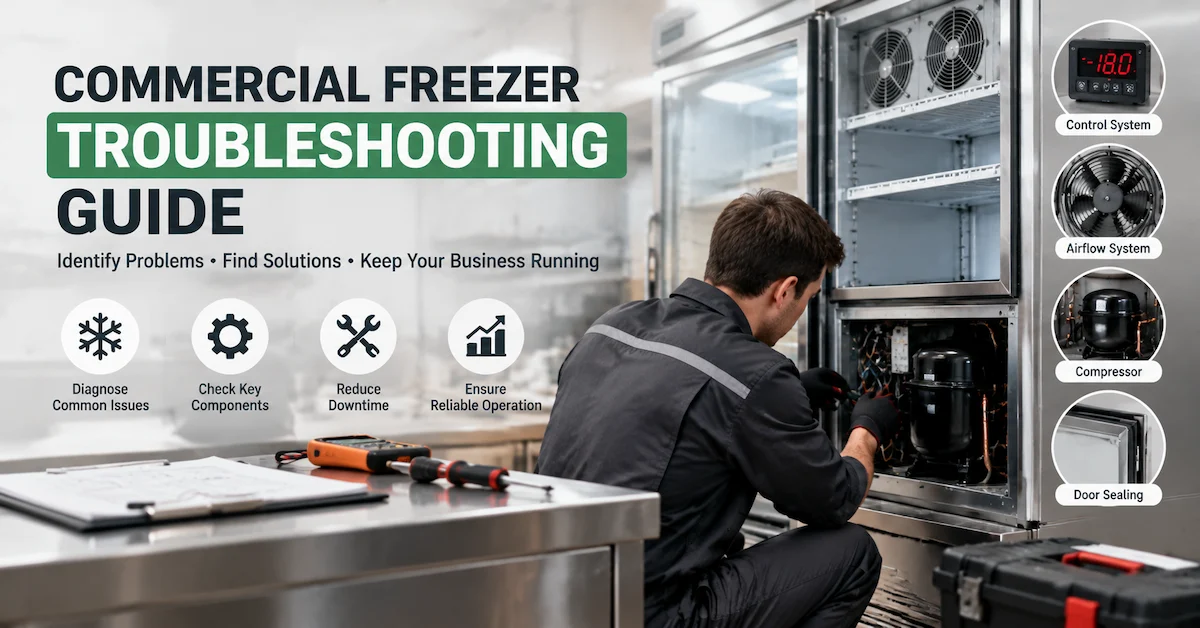
Commercial freezers are complete systems that combine multiple functions:
- Refrigeration system
- Temperature control system
- Air circulation system
- Door structure
- Electrical components
- Moisture management system
When a problem occurs, the cause may come from one component or from the interaction between several systems.
For B2B buyers, distributors, and service teams, understanding troubleshooting logic helps reduce unnecessary replacement costs and improve long-term equipment reliability.
Why Commercial Freezer Troubleshooting Matters for B2B Buyers
Commercial freezers are usually installed in environments where continuous operation is important.
Applications include:
- Supermarkets
- Convenience stores
- Restaurants
- Foodservice facilities
- Cold storage areas
Unexpected freezer problems may affect:
- Product protection
- Business operation
- Maintenance costs
- Customer experience
A practical troubleshooting approach helps businesses respond faster when issues appear.
Reduce Equipment Downtime
When a commercial freezer stops working properly, the priority is identifying the real cause.
Without proper diagnosis, companies may:
- Replace unnecessary parts
- Spend more time repairing equipment
- Delay normal operation
A structured troubleshooting process helps maintenance teams focus on the actual problem.
Improve Maintenance Efficiency
Many freezer problems have similar symptoms but different causes.
For example:
A temperature problem may be caused by:
- Sensor location
- Controller settings
- Airflow problems
- Door sealing issues
- Refrigeration performance
Checking the complete system is more effective than replacing components immediately.
Support Long-Term Equipment Reliability
Professional troubleshooting is also part of preventive maintenance.
By understanding recurring problems, buyers can improve:
- Spare parts planning
- Service preparation
- Equipment operation
- Supplier communication
Related guide:
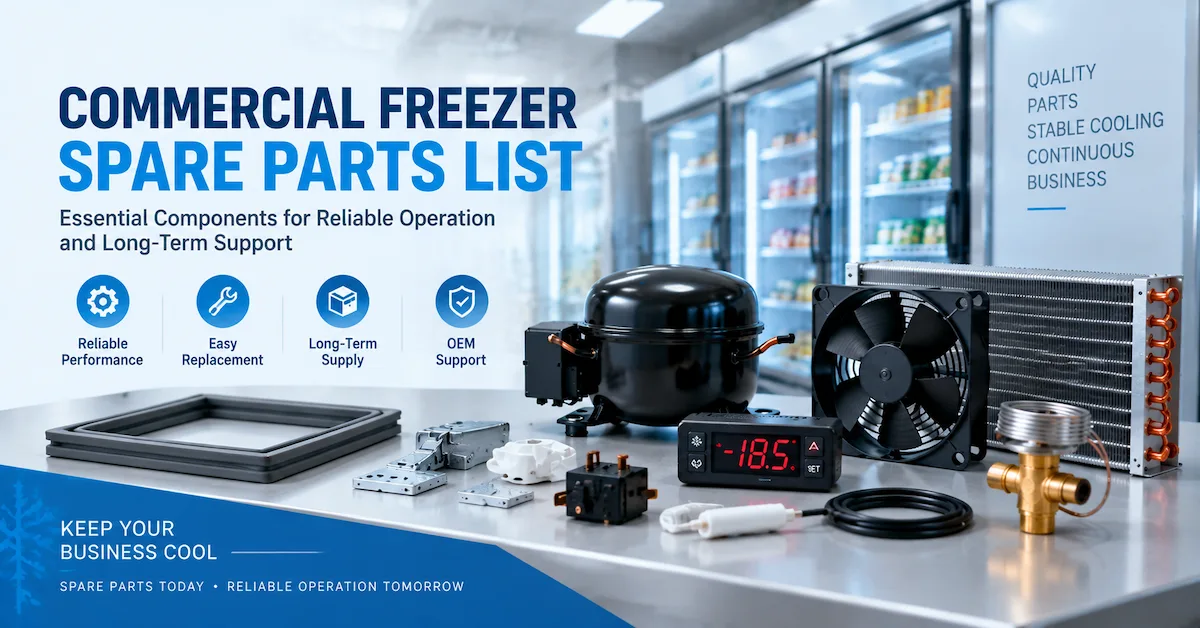
Commercial Freezer Spare Parts List
Common Commercial Freezer Problems and Troubleshooting Methods
Commercial Freezer Is Not Cooling
A freezer that does not cool properly is one of the most common service concerns.
Possible causes may include:
- Power supply problems
- Compressor operation issues
- Refrigeration system problems
- Controller problems
- Sensor-related issues
- Airflow restrictions
A basic troubleshooting process may include:
- Confirm power supply
- Check controller display and alarms
- Verify compressor operation
- Check airflow conditions
- Review temperature feedback
The purpose is not to immediately replace parts, but to identify which system requires further evaluation.
Commercial Freezer Temperature Is Too High
When freezer temperature is higher than expected, buyers should review several possible factors.
Potential causes include:
- Frequent door opening
- Poor door sealing
- Blocked airflow
- Product overloading
- Refrigeration system performance
- Incorrect control settings
Temperature problems should be evaluated together with:
- Cabinet design
- Air circulation
- Control system
- Operating environment
Related guide:
Commercial Freezer Cold Air Distribution
Commercial Freezer Temperature Fluctuation
Temperature fluctuation may indicate that the control system is not receiving or responding to information correctly.
Possible factors include:
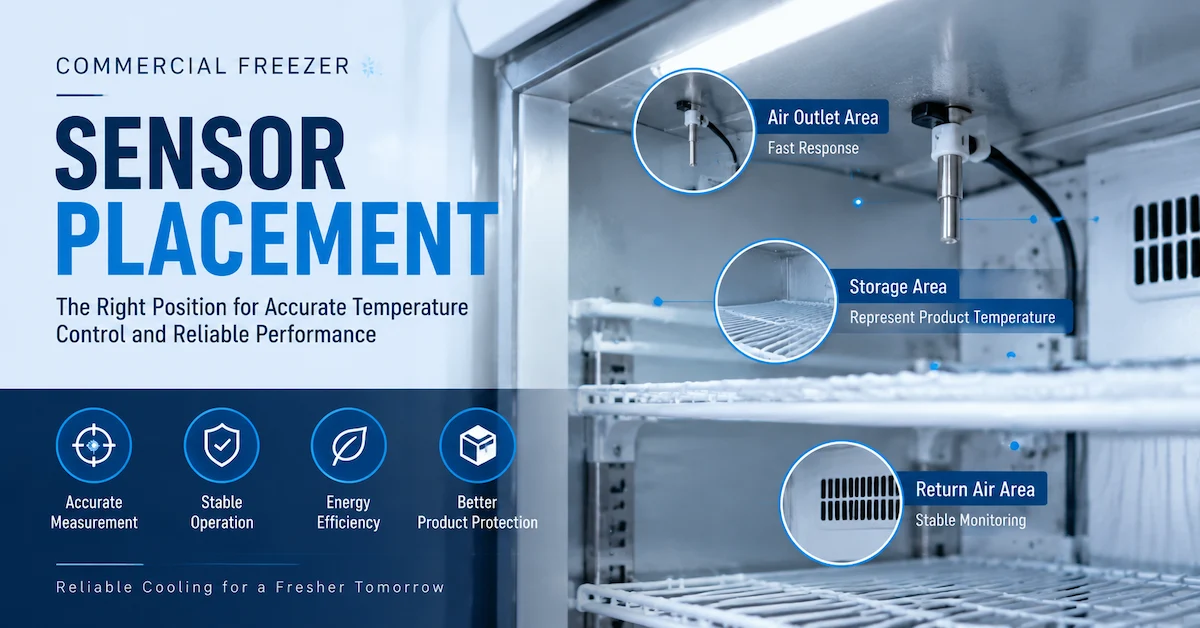
- Sensor placement
- Controller accuracy
- Compressor cycling
- Airflow conditions
A complete evaluation should check:
- Where temperature is measured
- How the controller responds
- Whether cold air is distributed evenly
Related articles:
Commercial Freezer Sensor Placement
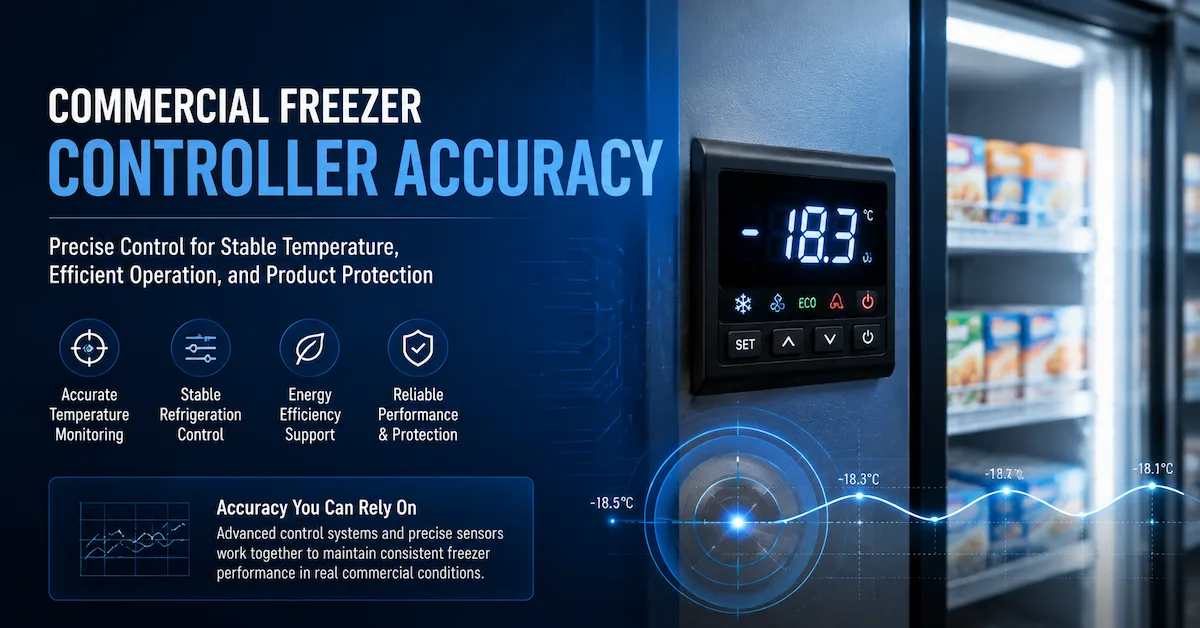
Commercial Freezer Controller Accuracy
Excessive Frost Formation
Frost accumulation can influence freezer performance and maintenance requirements.
Possible causes include:
- Frequent warm air entry
- Door sealing problems
- Defrost system issues
- Moisture management problems
Buyers should review:
- Door condition
- Condensation control
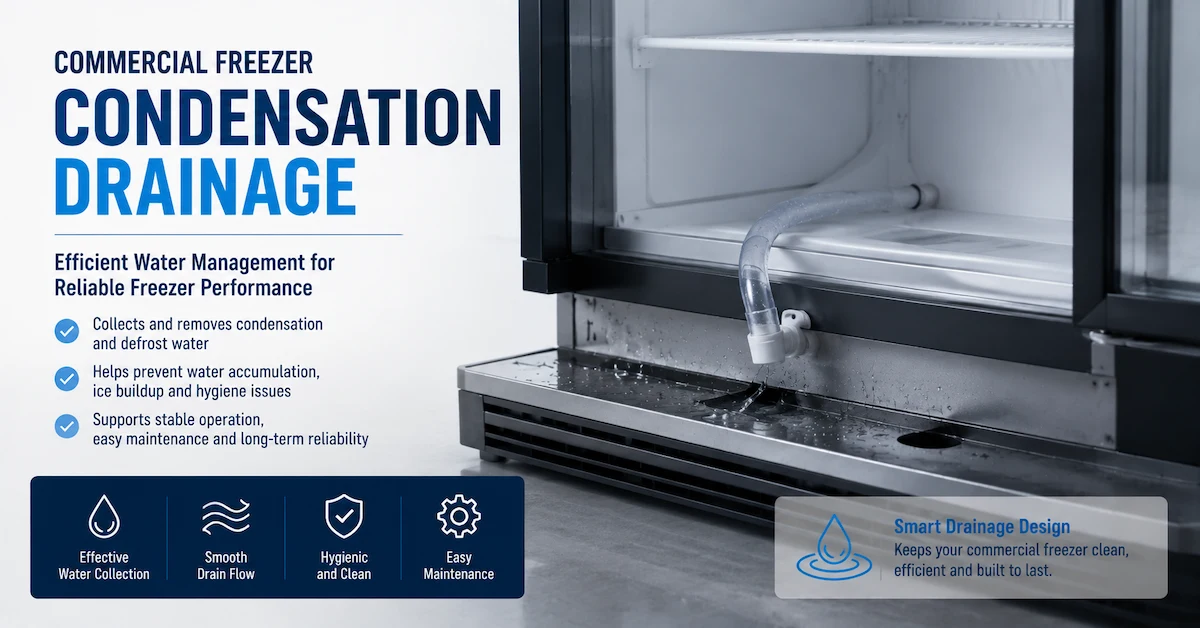
- Drainage performance
- Operating environment
Related guide:
Commercial Freezer Condensation Drainage
Water Leakage Problems
Water leakage may occur when moisture is not properly managed.
Possible causes include:
- Drainage blockage
- Poor water collection
- Defrost water management issues
- Improper installation
A complete inspection should include:
- Drain path
- Condensation collection areas
- Defrost operation
Compressor Frequently Starts and Stops
Frequent compressor cycling may affect operating stability.
Possible reasons include:
- Temperature control issues
- Sensor feedback problems
- Refrigeration load changes
- Ambient temperature changes
However, compressor cycling should not be evaluated separately.
Other factors include:
- Compressor capacity
- Cabinet insulation
- Product loading
- Refrigeration system design
Related guide:
Commercial Freezer Compressor Cycling
Troubleshooting by Commercial Freezer Component Category
Refrigeration System Troubleshooting
The refrigeration system is responsible for removing heat from the cabinet.
Inspection areas may include:
- Compressor operation
- Cooling performance
- Refrigeration circuit condition
- Condensing performance
A cooling problem does not always mean the compressor has failed.
The complete refrigeration system should be evaluated.
Control System Troubleshooting
Modern commercial freezers rely on electronic controls.
Possible inspection points include:
- Temperature controller
- Sensor connection
- Display information
- Alarm functions
- Control settings
The controller depends on accurate temperature information.
Related guide:
Commercial Freezer Controller Accuracy
Airflow System Troubleshooting
Air circulation affects temperature distribution.
Possible issues include:
- Fan failure
- Blocked airflow path
- Improper product placement
- Uneven cooling
Airflow problems may create temperature differences even when refrigeration components are working.
Related guide:
Commercial Freezer Temperature Uniformity
Door System Troubleshooting
The door system influences:
- Heat transfer
- Condensation
- Energy performance
Inspection points include:
- Door gasket condition
- Door closing performance
- Glass condition
- Heater operation
Poor door performance can increase cooling demand.
Related articles:
Commercial Freezer Door Heater Design
Commercial Freezer Anti Fog Glass
Troubleshooting Checklist for Commercial Freezer Problems
| Problem | Possible Causes | Recommended Check |
|---|---|---|
| Freezer not cooling | Power, compressor, control issues | Check system operation |
| High temperature | Airflow, sealing,loading | Review operating conditions |
| Temperature fluctuation | Sensor or control issues | Check measurement and response |
| Frost buildup | Moisture or defrost problems | Inspect door and drainage |
| Water leakage | Drainage issue | Check water path |
| Frequent cycling | Control or load changes | Review system conditions |
Why Professional Supplier Support Matters
Many freezer problems cannot be solved by checking one component.
For example:
A temperature issue may involve:
- Sensor placement
- Controller settings
- Airflow design
- Refrigeration capacity
- Ambient conditions
A professional supplier can help analyze:
- Symptoms
- Operating environment
- Component compatibility
- Replacement requirements
This reduces incorrect repairs and improves maintenance efficiency.
Relationship Between Troubleshooting and Spare Parts Planning
Troubleshooting and spare parts management are closely connected.
The process is:
Identify problem → Confirm cause → Select replacement part → Restore operation
Without proper diagnosis, companies may stock unnecessary parts or replace components that are still functional.
A complete spare parts strategy should be based on:
- Equipment model
- Failure risk
- Replacement frequency
- Supplier availability
Related guide:
Commercial Freezer Spare Parts List
How OEM Suppliers Support Commercial Freezer Troubleshooting
For OEM projects, supplier support is an important factor.
A capable manufacturer can provide:
- Technical documentation
- Troubleshooting guidance
- Spare parts identification
- Engineering communication
- Long-term service support
This is especially valuable for:
- Distributors
- Importers
- Private label brands
- Multi-location operators
OEM support helps customers solve problems faster and maintain consistent equipment performance.
How Should B2B Buyers Evaluate Freezer Suppliers?
Before selecting a supplier, buyers should consider more than equipment specifications.
| Evaluation Area | Buyer Should Verify |
|---|---|
| Technical support | Can supplier provide troubleshooting assistance? |
| Documentation | Are manuals and technical information available? |
| Spare parts | Are replacement components supported? |
| OEM capability | Can supplier analyze technical issues? |
| Response time | Is after-sales communication reliable? |
A supplier with strong technical support can provide more value throughout the equipment lifecycle.
Common Troubleshooting Mistakes
| Mistake | Why It Creates Risk |
|---|---|
| Replacing parts without diagnosis | Higher maintenance cost |
| Checking only one component | Misses system-level causes |
| Ignoring operating environment | Incorrect problem analysis |
| No spare parts planning | Longer downtime |
| Lack of supplier communication | Difficult troubleshooting |
OEM Troubleshooting Support Requirements
For OEM commercial freezer projects, buyers should provide detailed information when requesting technical support.
Useful information includes:
- Freezer model
- Problem description
- Operating environment
- Temperature condition
- Error symptoms
- Photos or videos if available
- Previous maintenance records
- Replacement requirements
- Destination market
- Service expectations
Based on this information,suppliers can better evaluate:
- Possible causes
- Component requirements
- Technical solutions
- Maintenance recommendations
What Should Buyers Send Snowsea for Troubleshooting Support?
For commercial freezer troubleshooting projects, buyers can provide:
- Freezer model
- Application environment
- Problem description
- Temperature symptoms
- Operating conditions
- Maintenance history
- Replacement expectations
Snowsea can help evaluate troubleshooting requirements, component compatibility, spare parts needs, technical documentation, and OEM support solutions according to project conditions.
FAQ
What are the most common commercial freezer problems?
Common issues include poor cooling performance, temperature fluctuation, frost buildup, water leakage, and control system problems.
Why is my commercial freezer not cooling?
Possible causes include refrigeration issues, controller problems, sensor issues, airflow restrictions, or operating condition changes.
How do sensors affect freezer troubleshooting?
Sensors provide temperature information for the controller, so incorrect placement or signal problems may affect system response.
How does airflow affect commercial freezer performance?
Poor airflow can create uneven temperatures and reduce cooling effectiveness.
When should freezer parts be replaced?
Parts should be replaced after confirming the actual cause of the problem and verifying compatibility.
Why is OEM technical support important?
OEM support helps buyers identify problems accurately and obtain suitable replacement solutions.
How can businesses reduce commercial freezer downtime?
Businesses can reduce downtime through preventive maintenance, spare parts planning, and reliable supplier support.
What information should buyers provide for troubleshooting?
Buyers should provide freezer model, operating conditions, symptoms, and maintenance information.
Can troubleshooting reduce maintenance costs?
Yes. Proper diagnosis helps avoid unnecessary replacement and improves repair efficiency.
Can Snowsea support commercial freezer troubleshooting?
Snowsea can provide technical evaluation, spare parts guidance, and OEM support according to project requirements.
Conclusion
A reliable commercial freezer troubleshooting guide helps B2B buyers, distributors, and service teams identify equipment issues faster, reduce unnecessary maintenance costs, and improve long-term operational reliability.
Commercial freezer problems are rarely caused by a single component. Effective troubleshooting requires understanding how different systems work together, including:
- Refrigeration performance
- Temperature control
- Sensor placement
- Airflow design
- Door system performance
- Spare parts availability
A complete maintenance strategy should combine accurate problem diagnosis with proper component planning.Buyers can also improve service efficiency by preparing suitable replacement parts through a structured Commercial Freezer Spare Parts List and selecting suppliers that provide reliable OEM support.
Before choosing a freezer manufacturer, B2B buyers should evaluate not only product quality but also technical support capability, troubleshooting guidance, documentation, and long-term supply reliability.
For distributors, OEM brands, and refrigeration partners, share your freezer model, application environment, problem description, operating conditions, spare parts requirements, and service expectations through the Snowsea Contact Us page.
Snowsea can evaluate commercial freezer troubleshooting requirements, refrigeration system conditions, spare parts planning, OEM support needs, and technical solutions to provide a suitable long-term supply solution for your market.