What Does OEM Freezer Custom Handle Design Mean?
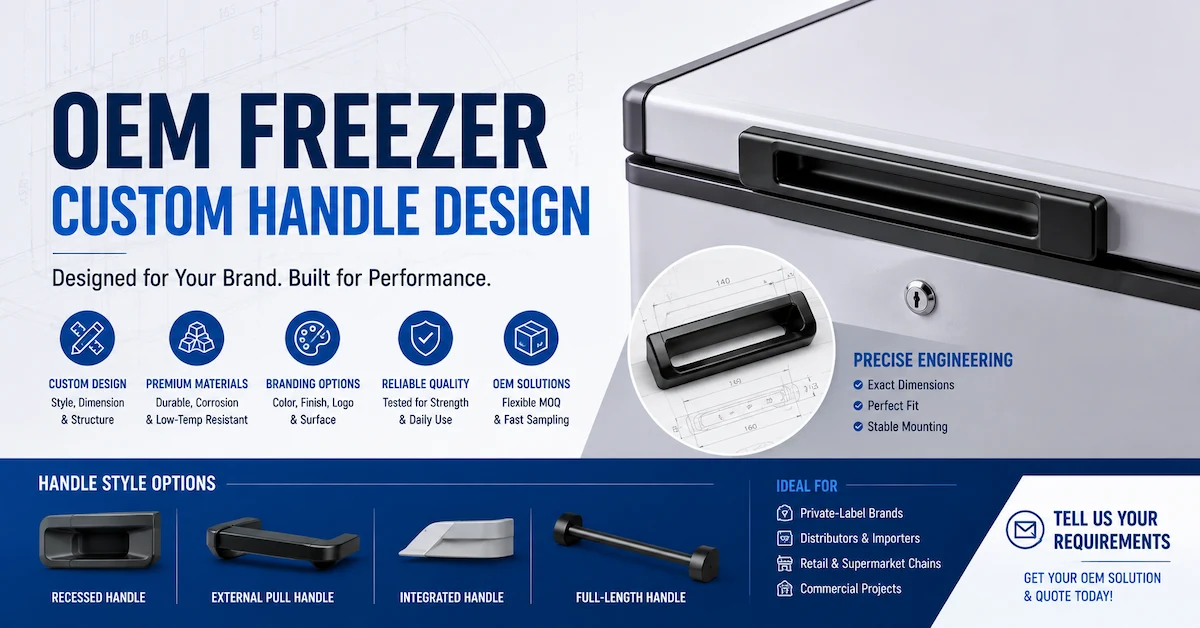
An OEM freezer custom handle design project means selecting, modifying, or developing a freezer door handle around the actual door structure, dimensions, material, mounting method, ergonomics, appearance, durability, packaging, and private-label requirements of a commercial refrigeration product.
A handle is easy to treat as a cosmetic detail, but for an OEM project it can affect:
- Door-opening experience
- Structural load
- User grip
- Cabinet appearance
- Packaging dimensions
- Shipping protection
- Assembly
- Replacement and spare parts
- Branding
- Project cost
The key procurement principle is:
A freezer handle is a structural and ergonomic component, not only a cosmetic accessory.
Snowsea can evaluate handle requirements together with the freezer configuration through its OEM/ODM solutions.
What Handle Specifications Should B2B Buyers Define?
A useful RFQ should include more than a reference photo.
| Specification | Buyer Should Confirm | Why It Matters |
|---|---|---|
| Handle type | Recessed, external, integrated, etc. | Determines basic structure |
| Overall length | Required dimension | Affects grip and appearance |
| Grip clearance | Hand space behind handle | Influences ergonomics |
| Material | Preferred material or performance need | Affects durability and cost |
| Color | Required visual specification | Supports product identity |
| Surface finish | Required appearance | Influences durability and branding |
| Mounting | Hole spacing and fixing method | Must match door structure |
| Position | Required mounting location | Affects usability |
| Door type | Solid, glass, hinged, etc. | Determines compatibility |
| Branding | Logo or private-label requirement | May affect tooling/process |
| Quantity | Initial and annual volume | Influences customization feasibility |
The more accurately these items are defined before sampling, the easier it is to compare supplier quotations.
Which Freezer Handle Styles Can Be Considered?
The available solution depends on the selected freezer platform and engineering feasibility. Common commercial refrigeration design directions include the following.
Recessed Handles
A recessed handle is built into or close to the door surface.
Potential advantages include:
- Low external projection
- Cleaner cabinet profile
- Less interference with packaging
- Reduced risk of external impact
Buyers should still review:
- Finger clearance
- Grip comfort
- Door-panel structure
- Cleaning access
- Tooling requirements
External Pull Handles
An external handle projects from the door and provides a clearly defined grip.
It can offer:
- Easy access
- Strong visual presence
- Greater grip clearance
However, buyers should evaluate:
- Handle projection
- Fixing strength
- Shipping protection
- Carton dimensions
- Impact risk
Integrated Handles
An integrated handle forms part of the door, frame, or decorative structure.
It can create a cleaner appearance, but may require closer coordination with the door design and tooling.
Long or Full-Length Handles
Long handles may suit some upright freezer and display-cabinet configurations.
Important considerations include:
- Door height
- Handle stiffness
- Mounting points
- Opening leverage
- Visual proportion
There is no single best handle style for every commercial freezer.
The correct handle should follow the freezer architecture and application rather than appearance alone.
Handle Design Must Match the Freezer Door
Handle design should not be finalized independently from the door.
The manufacturer may need to consider:
- Solid or glass door
- Door thickness
- Door frame
- Hinge position
- Opening direction
- Internal reinforcement
- Mounting access
For example, a handle mounting method suitable for a solid insulated door may not be appropriate for a glass-door structure.
This is why an OEM freezer custom handle design should be reviewed together with the approved door configuration.
See Snowsea's OEM freezer custom door type guide for related door-selection considerations.
How Handle Dimensions Affect Ergonomics
A visually attractive handle can still create a poor user experience if its dimensions are unsuitable.
B2B buyers may need to define or approve:
- Overall length
- Grip width
- Grip depth
- Finger clearance
- Distance from the door
- Corner shape
- Installation height
- Handle position
The suitable dimensions depend on the cabinet, door size, intended user, and operating environment.
Instead of assuming a universal “best” dimension, buyers should evaluate the handle on an actual sample door whenever possible.
How Should Handle Material Be Selected?
Material should be selected according to the project rather than appearance alone.
Plastic-Based Handle Designs
These may offer advantages such as:
- Flexible shapes
- Lower weight
- Molded colors
- Integration with customized styling
Potential considerations include:
- Material performance
- Surface wear
- Low-temperature operation
- Tooling
- Color consistency
Metal Handle Designs
Metal can provide a different appearance and structural feel.
Buyers should consider:
- Corrosion resistance
- Surface finish
- Weight
- Mounting
- Manufacturing process
- Cost
Mixed-Material Designs
Some projects may combine materials to balance appearance, structural performance, cost, and assembly.
The important principle is:
Handle material should follow strength, appearance, cleaning, operating environment, manufacturing process, and purchasing-volume requirements.
Specific material options should be confirmed for the selected Snowsea freezer platform.
Why Surface Finish and Color Matter
For private-label equipment, the handle often forms part of the visible product identity.
OEM requirements may include:
- Black or white appearance
- Metallic appearance
- Cabinet-matching color
- Brushed or polished appearance
- Coated finish
- Molded color
- Decorative elements
The feasible finish depends on material and manufacturing process.
Color and finish should therefore be defined early enough for sampling and mass-production approval.
Can Branding Be Added to the Handle?
A buyer may submit requirements for:
- Logo placement
- Embossed or debossed elements
- Printed branding
- Decorative inserts
- Brand-specific color
However, branding can affect:
- Tooling
- Production process
- MOQ
- Unit cost
- Sample development
- Lead time
Therefore:
Branding should be confirmed together with the manufacturing process, rather than added after the handle structure has already been approved.
Why Mounting Design Is Critical
The mounting interface is one of the most important parts of a custom freezer handle.
Buyers and engineers may need to confirm:
- Mounting-hole spacing
- Fastener type
- Door reinforcement
- Door-panel thickness
- Fixing points
- Assembly access
- Replacement method
A handle can look strong while still creating problems if the fixing structure is unsuitable for repeated use.
A visually attractive handle can still fail if the mounting structure is not designed for repeated door-opening loads.
For OEM procurement, mounting should therefore be treated as part of the handle specification.
Handle Design and Door-Opening Experience
Door-opening feel is not determined by the handle alone.
It can also be influenced by:
- Door weight
- Gasket sealing
- Hinge behavior
- Handle position
- Handle leverage
- Cabinet alignment
A longer or differently positioned handle may change leverage, but it cannot compensate for every door-system problem.
The more accurate principle is:
Opening feel is the combined result of handle geometry, door weight, hinge behavior, gasket sealing, and mounting position.
For related sealing considerations, see Freezer Door Gasket Sealing Performance.
Can Buyers Provide Their Own Handle Drawing or Sample?
Yes.OEM buyers can provide a reference for evaluation, such as:
- Physical sample
- Technical drawing
- CAD reference
- Dimensioned sketch
- Product photo
- Existing supplier specification
The manufacturer can then review factors such as:
- Size
- Mounting
- Material
- Door compatibility
- Manufacturing feasibility
- Tooling
- Testing
- MOQ
- Cost
Providing dimensions or drawings is usually more useful than sending only a visual reference.
Existing Handle vs Fully Custom Handle
Different customization levels create different commercial implications.
| Customization Route | Typical Scope | Development Impact | Best For |
|---|---|---|---|
| Existing handle | Existing structure | Lowest | Fast OEM projects |
| Existing handle + appearance changes | Color, finish,branding | Low–Medium | Private-label differentiation |
| Modified dimensions | Length or mounting changes | Medium | Project-specific cabinets |
| Fully custom design | New structure/tooling | Highest | Dedicated product programs |
Selecting the highest customization level is not always necessary.
If an existing solution already meets the buyer's operational requirements, it may reduce engineering risk and simplify repeat production.
Three Levels of OEM Handle Customization
Level 1: Existing Handle Selection
This uses an already established handle configuration for the selected freezer platform.
Potential benefits include:
- Lower development complexity
- Faster sampling
- Lower tooling risk
Level 2: Appearance or Dimension Modification
Depending on feasibility, this may involve:
- Color
- Finish
- Branding
- Length
- Mounting adjustment
Additional sample approval may be required.
Level 3: Fully Custom Handle Development
A new design may involve:
- New geometry
- New tooling or mold
- New mounting
- Door reinforcement
- New material
- New manufacturing process
This may affect:
- Development cost
- MOQ
- Sample lead time
- Validation
- Production preparation
OEM buyers should therefore define the commercial value of a fully custom handle before committing to new tooling.
How Does Custom Handle Design Affect Cost?
The handle unit price is only one cost factor.
An OEM freezer custom handle design may also affect:
- Tooling
- Material
- Surface treatment
- Branding
- Fasteners
- Door reinforcement
- Assembly
- Packaging
- Spare parts
- Purchasing volume
The lowest-cost handle component is not always the lowest-cost OEM solution if it requires additional door changes, tooling, packaging, or assembly.
For quotations, buyers should separate:
Component cost + customization cost + tooling + testing + packaging impact
rather than comparing only the handle price.
Does Handle Customization Affect MOQ?
It can.
MOQ may be influenced by:
- New tooling
- Custom colors
- Special finishes
- Dedicated material purchasing
- Branding
- Customized hardware
- Supplier purchasing quantities
Providing both an initial order quantity and an annual forecast allows the OEM supplier to evaluate whether the selected customization route is commercially practical.
How Can Handle Design Affect Export Packaging?
This is particularly important for projecting external handles.
A handle may influence:
- Carton dimensions
- Foam or protective structure
- Shipping-damage exposure
- Cabinet stacking
- Container utilization
- Final assembly method
Depending on handle projection and packaging design, the manufacturer should evaluate whether the handle is best shipped installed or separately.
For related export-risk considerations, see Snowsea's freezer export packaging protection guide.
Replacement and After-Sales Requirements
Distributors and private-label brands should also consider the handle after the product reaches the market.
Useful questions include:
- Can the handle be replaced separately?
- What tools are required?
- Are the mounting points easy to access?
- Can spare handles be included in bulk orders?
- Is the handle specification consistent across repeat orders?
A design that simplifies replacement can reduce future service complexity.
What Should Be Tested Before Mass Production?
A custom handle should be tested as part of the assembled freezer door.
Useful validation checks may include:
- Handle dimensions
- Mounting-hole position
- Installation fit
- Door compatibility
- Grip comfort
- Opening behavior
- Fastener security
- Repeated opening behavior
- Deformation or looseness
- Surface quality
- Low-temperature operation where relevant
- Packaging protection
- Replacement and assembly process
For broader freezer validation, see Snowsea's commercial freezer quality testing procedure.
OEM Handle Production QC Checklist
After the approved sample enters mass production, QC should verify consistency in:
- Handle model
- Dimensions
- Material
- Color
- Surface finish
- Mounting spacing
- Fasteners
- Installation tightness
- Surface defects
- Door alignment
- Branding
- Packaging
This is more useful to a B2B buyer than a generic claim of “strict quality control,” because it defines what should actually be checked.
How to Compare OEM Freezer Handle Suppliers
| Evaluation Area | What the Buyer Should Verify |
|---|---|
| Design flexibility | Existing, modified,or new design? |
| Door compatibility | Is mounting reviewed with the door? |
| Material | Is material selected for actual use? |
| Tooling | Is new tooling necessary? |
| Ergonomics | Is grip and opening behavior evaluated? |
| Durability | Is the assembled handle validated? |
| Branding | Can appearance be controlled consistently? |
| QC | Are dimensions and finish inspected? |
| MOQ | Does customization suit order volume? |
| Packaging | Is handle projection considered? |
| Spare parts | Can replacement handles be planned? |
The right supplier should explain both the technical and commercial consequences of the requested design rather than automatically recommending a new mold.
What Should Buyers Send Snowsea for a Quote?
To receive a more accurate technical evaluation and quotation,provide:
- Freezer type
- Reference freezer model
- Door type
- Preferred handle style
- Handle drawing or photo
- Required handle length
- Grip dimensions
- Mounting-hole spacing
- Preferred material
- Color
- Surface finish
- Logo or branding requirement
- Cabinet and door color
- Destination market
- Initial order quantity
- Annual purchasing forecast
- Packaging requirement
- Spare-parts requirement
- CAD drawing or physical reference, if available
- Target project schedule
Browse Snowsea commercial refrigeration products or submit these specifications through the Snowsea contact page.
FAQ
Can I customize the handle on an OEM freezer?
Yes. Buyers can submit handle style, dimensions, material, color, mounting, branding, and other requirements for technical and commercial evaluation.
Can I provide my own freezer handle drawing?
Yes. A drawing, CAD reference, physical sample, photo, or dimensioned sketch can help the manufacturer evaluate feasibility more accurately.
Can freezer handle color be customized?
Color requirements can be discussed, but feasibility depends on the handle material, manufacturing process, quantity, and selected product platform.
Can I add my logo to a custom freezer handle?
Branding may be possible depending on the design and production process. Logo requirements can affect tooling, MOQ, cost, and lead time.
What materials can be considered for freezer handles?
Plastic-based, metal, and mixed-material designs are common directions. The appropriate option depends on strength, appearance, environment, cost, manufacturing method, and freezer design.
Does a custom handle require new tooling?
Not always. Existing handles may require little or no new tooling, while a fully new shape or mounting structure can require dedicated tooling.
Does custom handle design affect MOQ?
It may. New molds, custom colors, special finishes, branding, or dedicated components can increase purchasing or production minimums.
Can handle design affect freezer packaging?
Yes. External projection can affect protective foam, carton dimensions, shipping risk, and whether the handle should be installed before shipment.
How should a custom freezer handle be tested?
The assembled handle should be checked for dimensions, mounting, grip, opening behavior, fastener security, surface quality, repeated use, and packaging protection.
What information is needed for a handle quotation?
Provide the freezer and door type, handle style, dimensions, material, mounting, finish, branding, reference drawing, destination market, order quantity, and packaging requirements.
Conclusion
An OEM freezer custom handle design project should not begin with appearance alone.
Private-label brands, distributors, and OEM buyers should define:
- Handle style
- Dimensions
- Grip requirements
- Material
- Surface finish
- Color
- Mounting
- Door compatibility
- Branding
- Packaging
- Spare-parts needs
- Order volume
The manufacturer can then evaluate structural feasibility, ergonomics, tooling, production process, testing, MOQ, cost, packaging, and mass-production consistency.
A detailed specification reduces sample revisions and makes competing OEM quotations much easier to compare.
Send Snowsea your freezer type, door configuration, preferred handle style, dimensions, mounting-hole spacing, material, finish, color, branding requirements, reference drawing or sample, destination market, and estimated order quantity through the contact page to request an OEM technical evaluation and commercial quotation.