What Does OEM Freezer Custom Cabinet Size Mean?
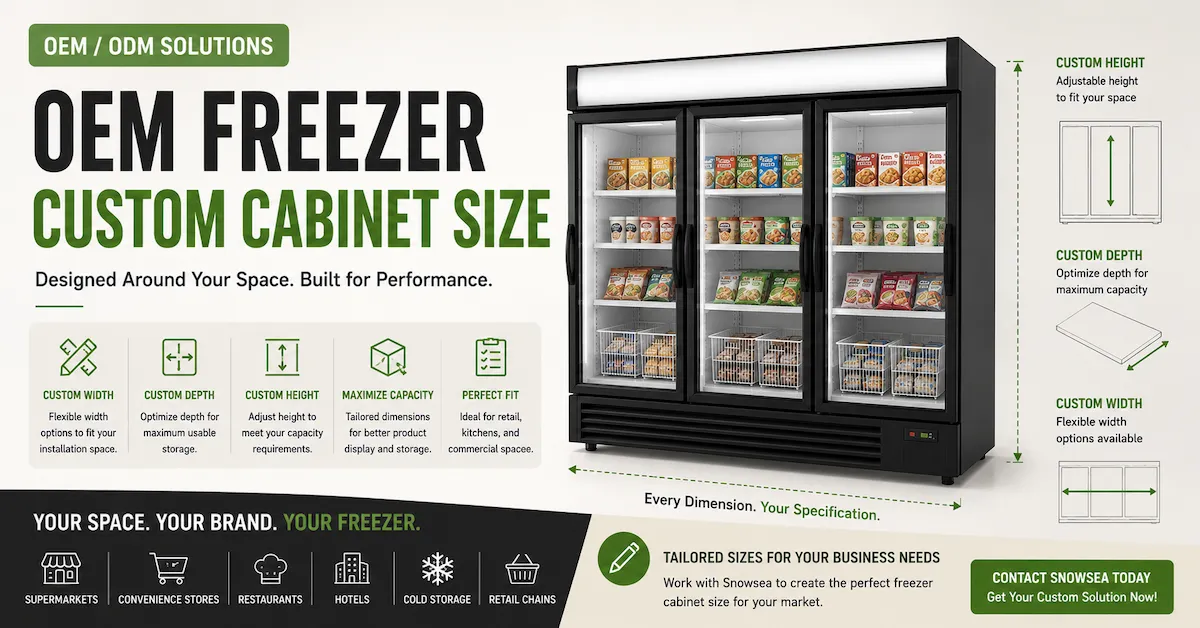
An OEM freezer custom cabinet size project means modifying the external or internal dimensions of a commercial freezer to match a buyer's installation space, stored products, merchandising layout, usable-capacity target, or private-label specification.
Possible requirements include:
- Overall width
- Overall depth
- Overall height
- Internal storage dimensions
- Door opening dimensions
- Shelf dimensions
- Compressor compartment
- Evaporator space
- Caster height
- Ventilation clearance
For B2B buyers, the most important point is that cabinet size cannot be treated as a sheet-metal dimension only.
Changing width, height, or depth may also change:
- Refrigeration load
- Heat-transfer area
- Insulation requirements
- Internal airflow
- Shelf layout
- Door dimensions
- Structural strength
- Refrigeration component placement
- Packaging dimensions
- Container loading efficiency
Snowsea can evaluate project-specific freezer dimensions together with the complete commercial refrigeration configuration through its OEM/ODM solutions.
External Cabinet Size vs Usable Internal Size
One of the most common OEM specification mistakes is providing only external dimensions.
External dimensions and usable internal dimensions are not the same.
| Dimension | Buyer Should Specify | Why It Matters |
|---|---|---|
| Overall width | Maximum allowable width | Installation and line-up planning |
| Overall depth | Maximum allowable depth | Aisle and wall clearance |
| Overall height | Height restriction | Fixtures and installation |
| Internal width | Required usable width | Product and shelf fit |
| Internal depth | Required usable depth | Storage capacity |
| Internal height | Required vertical space | Shelf levels |
| Door opening | Loading/access requirement | Daily operation |
| Caster/base height | Installation requirement | Working height |
Internal space can be reduced by:
- Insulation
- Evaporator or air channels
- Compressor compartment
- Door structure
- Cabinet liner
- Internal supports
Therefore, an RFQ such as “We need a 1200 mm freezer” is incomplete.
A better specification explains whether 1200 mm refers to overall width, internal width, shelf width, or available installation space.
Which Freezer Dimensions Can Be Customized?
Depending on the selected platform and engineering feasibility, an OEM project may evaluate changes to:
- Width
- Depth
- Height
- Internal compartment dimensions
- Door opening
- Shelf layout
- Base or caster height
However, buyers should not assume that any standard model can simply be resized to any requested dimension.
A major dimensional change may require changes to:
- Cabinet panels
- Internal liner
- Door frame
- Insulation tooling
- Refrigeration system
- Shelving
- Packaging
For this reason, Snowsea should first evaluate the required dimensions against the selected freezer platform.
Why Cabinet Size Changes Refrigeration Load
A larger cabinet normally creates a different refrigeration requirement than a smaller cabinet.
Changes can result from:
- Greater internal volume
- Larger external surface area
- More stored product
- Greater heat transfer
- Different airflow paths
- Different door size
The refrigeration system may therefore need to be reviewed.
Important components include:
- Compressor
- Condenser
- Evaporator
- Refrigerant circuit
- Expansion device
- Fan and airflow system
A larger freezer should not automatically use the same refrigeration configuration as a smaller model without performance verification.
For related technical information, see Snowsea's commercial freezer compressor sizing, commercial freezer condenser design, and commercial freezer evaporator design.
How Insulation Affects Custom Cabinet Dimensions
Insulation creates an important relationship between external size and internal usable space.
For example, if the external cabinet depth remains fixed while insulation thickness increases, usable internal depth may decrease.
OEM buyers should therefore specify both:
- Required external dimensions
- Required usable internal dimensions
They should also provide:
- Target temperature range
- Intended ambient conditions
- Stored product
- Expected application
This allows the cabinet and insulation requirements to be evaluated together.
For additional guidance, see Snowsea's commercial freezer insulation thickness guide.
Cabinet Size, Shelf Layout, and Product Dimensions
The cabinet should be designed around what will actually be stored inside.
Relevant product information includes:
- Package width
- Package depth
- Package height
- Product weight
- Number of SKUs
- Required shelf levels
A wider cabinet does not automatically create a better storage layout if the shelf spacing or product dimensions are poorly matched.
For example, an importer requesting a customized retail freezer may need to confirm:
- Shelf width
- Shelf depth
- Vertical spacing
- Number of shelves
- Airflow clearance
Snowsea's OEM freezer custom shelf system provides a useful related specification guide.
How Cabinet Size Affects Door Configuration
Changing cabinet width or height can affect the door structure.
Possible consequences include:
- Larger hinged doors
- Changing from one door to two doors
- Different sliding-door dimensions
- Larger glass panels
- Higher hinge load
- New door-frame dimensions
- Different handle positioning
For very wide cabinets, multiple smaller doors may sometimes be more practical than one large opening, depending on the product platform and application.
Door configuration should therefore be confirmed together with cabinet dimensions.
Related OEM guides include OEM freezer custom door type and OEM freezer custom glass door.
Three Levels of OEM Cabinet Size Customization
Level 1: Select an Existing Size
The buyer chooses the closest existing freezer size that fits the application.
Benefits can include:
- Lower development complexity
- Faster sample availability
- Reduced engineering risk
- Easier MOQ planning
This should often be evaluated before creating a completely new cabinet.
Level 2: Dimensional Adjustment
The existing product platform is retained while selected dimensions or internal layouts are adjusted.
Possible changes include:
- Width
- Height
- Depth
- Shelf layout
- Door dimensions
This can provide a balance between customization and development cost.
Level 3: New Cabinet Structure Development
A major size change may require broader structural development.
This can involve:
- New sheet-metal panels
- New internal liner
- New door frame
- New shelves
- Different insulation tooling
- Refrigeration system changes
- New packaging dimensions
Projects at this level can have a greater impact on engineering effort, tooling, sample cost, MOQ, and lead time.
Custom Cabinet Size vs Custom Storage Capacity
A larger cabinet does not always create a proportional increase in usable storage capacity.
The difference comes from:
- Insulation thickness
- Compressor compartment
- Evaporator area
- Air channels
- Shelf supports
- Door geometry
For this reason, OEM buyers should ideally provide both:
Required external dimensions + required usable storage target
This gives the supplier a much clearer engineering objective.
How Cabinet Size Can Affect Temperature Performance
Changing dimensions can influence:
- Internal air volume
- Air circulation distance
- Product loading
- Heat gain
- Door-opening load
A custom-size freezer should therefore be tested as a complete system.
If the buyer also requires a non-standard operating temperature, the cabinet size and temperature requirement should be evaluated together.
See Snowsea's OEM freezer custom temperature range guide for related considerations.
How Custom Cabinet Size Affects Energy Consumption
Cabinet size can influence long-term energy demand.
A dimensional change can alter:
- Cabinet surface area
- Heat transfer
- Product load
- Compressor runtime
- Fan operation
- Door size
The purchasing question should therefore not be limited to:
“Can you make this freezer larger?”
A stronger question is:
“Can the refrigeration system and insulation be optimized for the new cabinet dimensions and operating conditions?”
This shifts the project from cosmetic customization to performance-based OEM engineering.
How Custom Cabinet Size Affects OEM Cost
Custom cabinet cost should not be calculated by simply adding a price per centimeter.
Potential cost drivers include:
- Sheet metal
- Internal liner
- Insulation
- Cabinet structure
- Door system
- Shelves and baskets
- Refrigeration components
- Tooling
- Sample development
- Testing
- Packaging
- Order quantity
A quotation based on exact dimensions and technical requirements will be more meaningful than one based only on estimated capacity.
Does Custom Cabinet Size Affect MOQ?
It can.
A project based largely on existing:
- Cabinet structure
- Panels
- Tooling
- Doors
- Shelves
may be commercially easier to implement.
MOQ can become more important when the project requires:
- New cabinet tooling
- New sheet-metal components
- New internal liners
- New door dimensions
- New packaging
- New refrigeration configuration
Buyers should provide both expected first-order volume and repeat purchasing expectations where available.
How Cabinet Size Affects Shipping and Container Loading
This is especially important for importers and distributors.
Even a relatively small change in cabinet dimensions can change:
- Carton dimensions
- CBM per unit
- Pallet configuration
- Container loading quantity
- Shipping cost per freezer
For example, a cabinet that is slightly narrower may allow more units to fit across a container or more units per loading plan.
That can reduce landed cost even if the product itself is only slightly smaller.
For B2B projects, cabinet optimization should therefore consider both end-user requirements and logistics economics.
Snowsea's freezer export packaging protection guide provides related export considerations.
What Should Be Tested Before Mass Production?
For an OEM freezer custom cabinet size project, buyers should not approve a sample based only on appearance and dimensions.
Useful verification points include:
- Overall width, depth, and height
- Internal usable dimensions
- Cabinet squareness
- Door alignment
- Shelf fit
- Product accessibility
- Caster/base position
- Structural stability
- Airflow
- Temperature stability
- Temperature recovery
- Loaded operation
- Packaging fit
For broader testing procedures, see Snowsea's commercial freezer quality testing guide.
OEM Cabinet Size Production QC Checklist
Once the sample specification is approved, production should reproduce the dimensions consistently.
A practical QC checklist can include:
- Overall width
- Overall depth
- Overall height
- Internal dimensions
- Cabinet squareness
- Door opening dimensions
- Shelf mounting positions
- Compressor compartment dimensions
- Caster placement
- Surface finish
- Insulation consistency
- Final functional test
Approved drawings and dimensional tolerances should be documented before mass production.
How to Compare Custom Freezer Manufacturers
| Evaluation Area | What Buyers Should Verify |
|---|---|
| Dimensional capability | Can the required size be engineered? |
| Internal capacity | Does usable space meet the target? |
| Refrigeration design | Is cooling capacity reviewed? |
| Insulation | Is thermal performance considered? |
| Door/shelf integration | Do components fit the new structure? |
| Sample testing | Is the new cabinet validated? |
| QC | Are dimensions controlled in production? |
| MOQ | Does it fit the project volume? |
| Logistics | Are packaging and container loading optimized? |
| Documentation | Are drawings/specifications controlled? |
A reliable OEM supplier should explain the trade-offs between dimensions, performance, tooling, cost, and logistics instead of simply agreeing to any requested size.
What Should Buyers Send Snowsea for a Cabinet Size Quote?
For a faster technical evaluation,send Snowsea:
- Freezer type or reference model
- Required overall width
- Required overall depth
- Required overall height
- Required internal dimensions
- Required usable capacity
- Stored product
- Door configuration
- Shelf requirements
- Target operating temperature
- Expected ambient condition
- Voltage and frequency
- Destination country
- Estimated order quantity
- Certification requirements
- Installation drawing
- Reference product or image
- Target delivery schedule
A detailed specification helps Snowsea evaluate cabinet structure, refrigeration load, internal layout, packaging, and commercial feasibility together.
Browse Snowsea commercial refrigeration products, review OEM/ODM solutions, or contact Snowsea with your project dimensions.
FAQ
What is OEM freezer custom cabinet size?
It means modifying a commercial freezer's dimensions or internal structure to meet a private-label or project-specific requirement.
Can freezer width, depth, and height all be customized?
Requested dimensions can be evaluated depending on the selected freezer platform, cabinet structure, tooling, refrigeration system, quantity, and project requirements.
Can external dimensions change without changing internal capacity?
Not necessarily. Insulation, refrigeration components, door design, and internal structure all influence usable capacity.
Does a larger freezer need a different compressor?
It may. A larger cabinet can increase refrigeration load, so compressor and system capacity should be technically evaluated rather than assumed.
Does cabinet size affect shelf dimensions?
Yes. Shelf width, depth, spacing, and support structure are directly related to internal cabinet dimensions.
Can cabinet size affect door configuration?
Yes. Wider or taller cabinets may require different door dimensions, hinges, frames, or door quantities.
Does a custom cabinet size affect energy consumption?
It can. Surface area, internal volume, product load, insulation, and refrigeration-system design all influence energy use.
Does custom cabinet size increase MOQ?
It may, particularly when new tooling, panels, liners, doors, packaging, or structural components are required.
Why should buyers consider container loading when customizing dimensions?
Cabinet and packaging dimensions determine CBM and loading quantity, which can significantly affect landed cost for international orders.
What information does Snowsea need for a custom-size freezer quote?
Provide required external and internal dimensions, capacity, stored products, door and shelf requirements, temperature, destination, quantity, and reference drawings where available.
Conclusion
An OEM freezer custom cabinet size project should be treated as a complete structural, refrigeration, storage, and logistics decision—not simply a request to change width, depth, or height.
B2B buyers should define:
- External dimensions
- Internal usable dimensions
- Required capacity
- Stored products
- Door configuration
- Shelf requirements
- Target temperature
- Installation environment
- Quantity
- Shipping constraints
The manufacturer should then evaluate how the new dimensions affect cabinet structure, insulation, refrigeration load, airflow, doors, shelves, testing, MOQ, packaging, and container loading.
For private-label brands, distributors, and OEM buyers, confirming these requirements before sampling helps reduce design revisions, protects performance, and makes competing quotations easier to compare.
Send Snowsea your required freezer width, depth, height, usable capacity, stored product, temperature range, door configuration, destination market, reference drawing, and estimated order quantity through the contact page to request an OEM technical proposal and commercial quotation.