What Does OEM Freezer Custom Compressor Brand Mean?
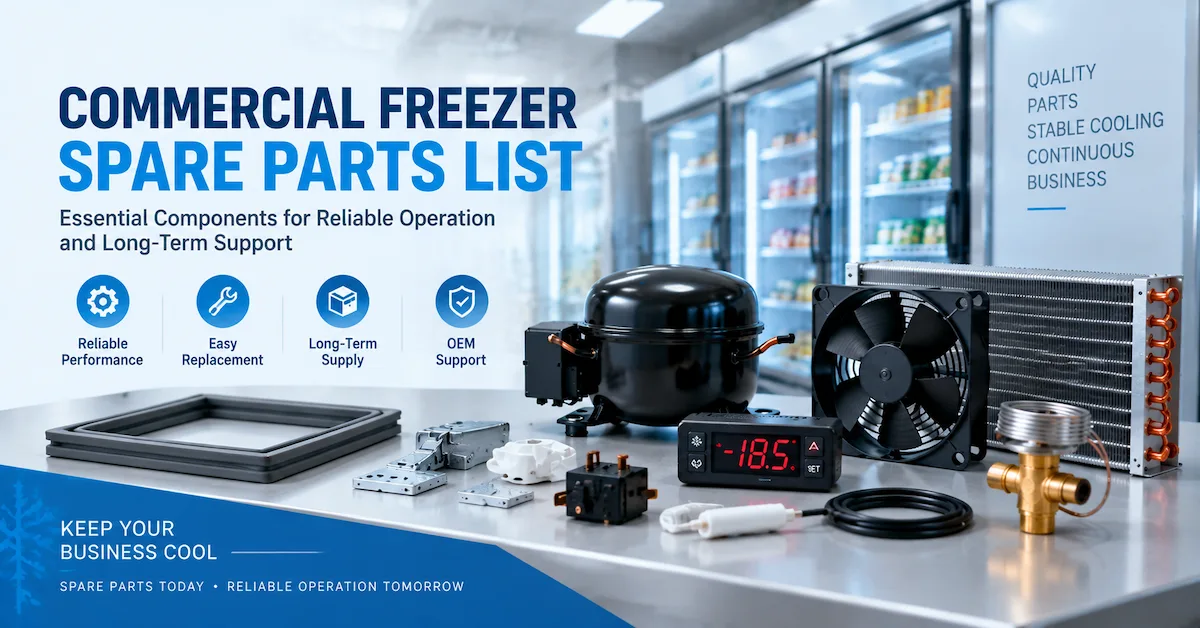
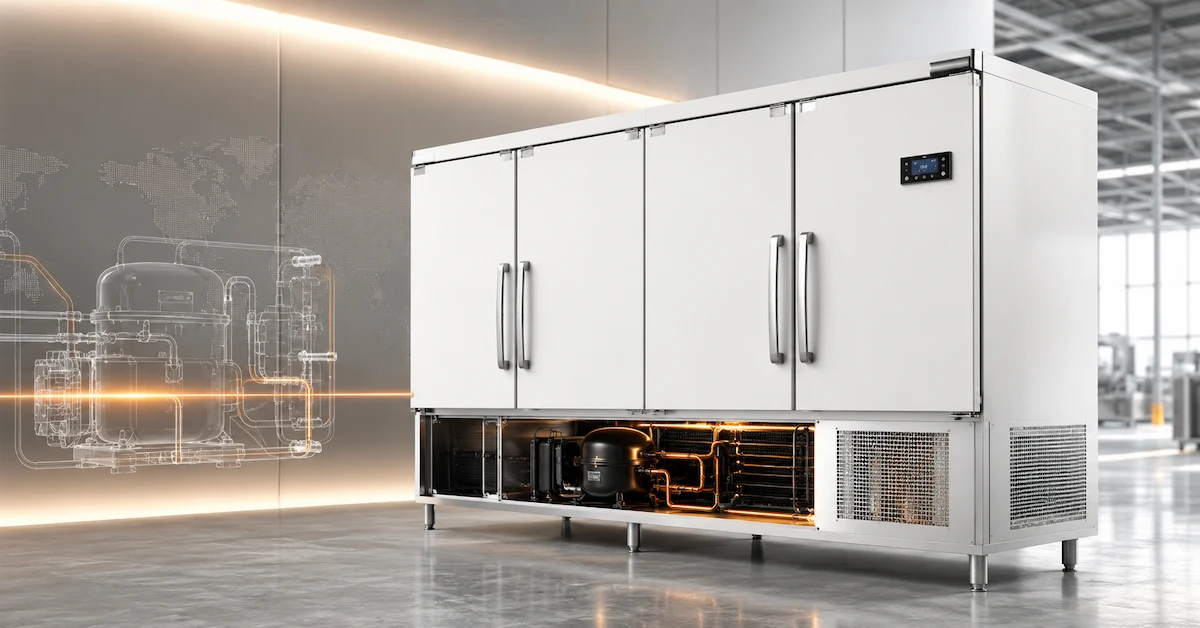
An OEM freezer custom compressor brand project means evaluating a buyer's preferred compressor manufacturer, series, or exact model for use in a commercial freezer while confirming that it matches the complete refrigeration system.
For OEM buyers, the most important principle is:
A preferred compressor brand is only useful when the selected compressor model matches the freezer's actual refrigeration requirements.
A compressor must be evaluated together with:
- Refrigerant
- Cooling capacity
- Target cabinet temperature
- Evaporating condition
- Condensing condition
- Ambient temperature
- Cabinet size
- Voltage and frequency
- Refrigeration circuit
- Intended application
This means compressor customization should be treated as a refrigeration-system decision rather than only a purchasing preference.
Snowsea can evaluate component requirements together with the complete freezer specification through its OEM/ODM solutions.
Can Buyers Specify a Compressor Brand for an OEM Freezer?
A preferred compressor brand can be submitted as part of an OEM project for technical and commercial evaluation.
However, specifying only a brand name is usually not enough.
Available brands and models should be confirmed according to:
- Freezer platform
- Refrigerant
- Required cooling performance
- Electrical specification
- Destination market
- Component availability
- Order quantity
A compressor that works well in one freezer does not automatically fit another freezer with a different cabinet size, temperature requirement, refrigerant, or operating environment.
Compressor Brand vs Compressor Model
B2B buyers should clearly distinguish between a brand preference and an exact model requirement.
Preferred Brand
The buyer prefers a particular compressor manufacturer but allows Snowsea to evaluate the most suitable model.
A useful RFQ format is:
Preferred compressor brand: ______
Equivalent brand acceptable: Yes / No
Exact Brand and Model
Some projects require an exact compressor model because of:
- Existing distributor specifications
- Spare-parts standardization
- Customer contracts
- Service requirements
- Product-line consistency
In that case, provide:
Compressor brand: ______
Compressor model: ______
Snowsea can then review whether the requested model matches the freezer platform and operating conditions.
What Compressor Specifications Should OEM Buyers Confirm?
| Specification | Buyer Should Provide | Why It Matters |
|---|---|---|
| Preferred brand | Brand or approved alternatives | Procurement requirement |
| Exact model | If mandatory | Maintains specification consistency |
| Refrigerant | Required refrigerant | Compressor compatibility |
| Temperature range | Required cabinet temperature | Defines operating condition |
| Cabinet size | Dimensions or capacity | Influences refrigeration load |
| Ambient condition | Expected operating environment | Changes cooling demand |
| Voltage | Required voltage | Electrical compatibility |
| Frequency | 50/60 Hz requirement | Affects model selection |
| Quantity | Initial and annual volume | Sourcing feasibility |
Providing these specifications reduces unnecessary quotation revisions.
Compressor Brand Is Not the Same as Cooling Capacity
A recognized compressor brand does not guarantee correct freezer performance if the compressor is incorrectly sized.
Compressor selection should consider:
- Cooling capacity
- Displacement
- Evaporating temperature
- Condensing temperature
- Refrigerant
- Cabinet heat load
- Product load
- Operating conditions
The important procurement principle is:
A well-known compressor brand does not compensate for incorrect compressor sizing.
For more detail, see Snowsea's commercial freezer compressor sizing guide.
Compressor and Refrigerant Must Be Matched
The compressor cannot be evaluated separately from the refrigerant.
Compatibility may involve:
- Refrigerant type
- Lubricant
- Operating pressure
- Compressor application range
- Refrigeration circuit
- Expansion device
If a buyer requests both a custom compressor brand and custom refrigerant, the two specifications should be reviewed together.
See Snowsea's OEM freezer custom refrigerant guide for related considerations.
How Cabinet Size Affects Compressor Selection
Cabinet dimensions can directly affect refrigeration load.
A larger cabinet may involve:
- Greater internal volume
- Larger heat-transfer area
- More stored product
- Larger doors
- Different airflow requirements
For this reason, changing the cabinet size can require the compressor specification to be re-evaluated.
This is especially important for projects combining component customization with structural changes.
See OEM freezer custom cabinet size for the related cabinet engineering process.
How Temperature Range Affects Compressor Selection
The required operating temperature is another major selection factor.
A freezer designed for one temperature range should not automatically use the same compressor configuration for a significantly different target temperature.
System performance depends on:
- Target cabinet temperature
- Ambient temperature
- Refrigerant
- Compressor
- Evaporator
- Condenser
- Insulation
- Airflow
Therefore:
Compressor selection should follow the required operating condition, not only the nominal freezer volume.
See Snowsea's OEM freezer custom temperature range guide.
Why Voltage and Frequency Matter for Export Orders
Export buyers should specify voltage and frequency early in the project.
A preferred compressor may not be available in every combination of:
- Voltage
- Frequency
- Refrigerant
- Cooling capacity
This can affect component selection and sourcing.
Instead of sending only a compressor brand, buyers should provide:
Destination country + required voltage + frequency + refrigerant + freezer operating condition.
This gives the engineering team a much clearer specification.
Exact Compressor vs Approved Equivalent
Different purchasing strategies create different benefits and risks.
| Requirement | Main Advantage | Buyer Should Consider |
|---|---|---|
| Exact brand + model | Maximum specification consistency | Availability and lead time |
| Preferred brand | Maintains brand preference | Correct model still required |
| Approved equivalents | More sourcing flexibility | Sample approval needed |
| Validated factory selection | Easier system matching | Less buyer brand control |
When an Exact Brand May Be Important
An exact compressor may make sense when:
- Customer contracts specify it
- Local service networks depend on it
- Spare parts are standardized
- A distributor wants consistent components
- Existing product lines use the same compressor
When Approved Alternatives May Help
Approved equivalents can be useful when:
- Supply continuity is critical
- Project lead time is important
- Multiple export markets are involved
- Buyers want sourcing flexibility
The preferred strategy should be defined before sample approval.
Does Compressor Brand Determine Reliability?
Brand is only one part of reliability.
Long-term compressor performance can also depend on:
- Correct sizing
- Refrigerant compatibility
- Refrigeration circuit workmanship
- Refrigerant charge
- Condenser performance
- Operating environment
- Voltage conditions
- System testing
The better procurement question is not simply:
“Which compressor brand is most reliable?”
It is:
“Is this compressor correctly matched and validated in this freezer configuration?”
See Snowsea's commercial freezer compressor reliability test.
Does Compressor Brand Affect Energy Consumption?
It can influence system performance, but freezer energy consumption is not determined by compressor brand alone.
Other important factors include:
- Compressor efficiency
- Cabinet insulation
- Door sealing
- Condenser and evaporator design
- Temperature setting
- Ambient conditions
- Product loading
- Usage pattern
OEM buyers should therefore compare complete freezer performance instead of assuming that a particular brand automatically guarantees lower energy use.
Three Levels of OEM Compressor Customization
Level 1: Existing Validated Compressor
The project uses an existing compressor configuration already matched to the freezer platform.
Potential advantages include:
- Lower engineering risk
- Faster evaluation
- Easier sourcing
- Shorter validation process
Level 2: Alternative Validated Compressor
Another compressor option already evaluated for the platform may be considered where available.
Snowsea would still need to confirm:
- Refrigerant
- Voltage/frequency
- Cooling performance
- Component availability
Level 3: Buyer-Specified New Compressor
The buyer requests a brand or model not previously validated for the selected configuration.
This may require:
- Capacity review
- Refrigerant compatibility review
- Mounting evaluation
- Piping changes
- Electrical changes
- Performance testing
- Sample validation
As a result, development cost, MOQ, sampling time, and production lead time may change.
How Does a Custom Compressor Brand Affect OEM Cost?
Compressor customization should not be evaluated from component price alone.
Cost factors can include:
- Compressor purchase cost
- Component sourcing quantity
- Refrigeration-system modifications
- Mounting changes
- Electrical changes
- Engineering work
- Testing
- Certification implications
- Spare-parts requirements
- Order quantity
A slightly cheaper compressor can create a higher overall project cost if it requires extensive engineering changes or creates sourcing risk.
Does Compressor Customization Affect MOQ?
It may.
MOQ can be influenced by:
- Compressor supplier purchasing requirements
- Special model availability
- New mounting components
- Electrical changes
- Refrigeration-system validation
- Production preparation
For serious OEM projects, buyers should provide:
- Initial order quantity
- Estimated annual purchase volume
This allows Snowsea to evaluate both technical suitability and sourcing feasibility.
Why Compressor Availability Matters
A compressor can be technically suitable but commercially inconvenient if long-term supply is unstable.
OEM buyers should ask:
- Is the requested model regularly available?
- Is it locally sourced or imported?
- What is the expected procurement lead time?
- Is an approved equivalent available?
- What happens if the model is discontinued?
- Is replacement supply important in the destination market?
For distributors and private-label brands, supply continuity can be as important as initial component cost.
Spare Parts and After-Sales Considerations
Compressor selection can also affect the long-term service strategy.
Buyers may need to consider:
- Replacement availability
- Local technician familiarity
- Spare-parts stocking
- Product-line standardization
- Long-term model continuity
For a distributor, a compressor specification that supports easier after-sales service may create more value than simply choosing the lowest-priced component.
What Should Be Tested Before Mass Production?
When an OEM freezer custom compressor brand project changes the existing refrigeration configuration, sample testing should confirm system performance before mass production.
Useful checks include:
- Compressor brand and model verification
- Refrigerant compatibility
- Compressor starting operation
- Pull-down performance
- Temperature stability
- Temperature recovery
- Compressor operating behavior
- Condenser performance
- Evaporator performance
- Electrical operation
- High-ambient performance where required
- Loaded performance where applicable
For broader validation, see Snowsea's commercial freezer quality testing procedure.
OEM Compressor Production QC Checklist
After the sample configuration is approved, mass-production QC should verify:
- Correct compressor brand
- Correct compressor model
- Correct refrigerant
- Correct voltage and frequency
- Compressor mounting
- Refrigeration piping
- Electrical wiring
- System evacuation
- Refrigerant charging
- Leak inspection
- Cooling performance
- Nameplate consistency
Documenting the approved component specification reduces the risk of unintended changes during repeat orders.
How to Compare OEM Freezer Suppliers for Compressor Projects
| Evaluation Area | What Buyers Should Verify |
|---|---|
| Brand flexibility | Can preferred brands be evaluated? |
| Model selection | Is compressor sizing reviewed? |
| Refrigerant matching | Is compatibility confirmed? |
| Electrical matching | Are voltage and frequency checked? |
| Supply stability | Is long-term sourcing considered? |
| Testing | Is a new configuration validated? |
| QC | Is the exact model controlled in production? |
| Spare parts | Is replacement strategy considered? |
| MOQ | Does sourcing fit the order volume? |
| Lead time | Are procurement and testing stages clear? |
A capable OEM supplier should be willing to explain why a requested compressor is or is not suitable rather than accepting every brand request without technical review.
What Should Buyers Send Snowsea for a Compressor Quote?
For a more accurate technical proposal and commercial quotation,provide:
- Freezer type or reference model
- Preferred compressor brand
- Exact model if mandatory
- Whether equivalent brands are acceptable
- Required refrigerant
- Target temperature range
- Cabinet dimensions or capacity
- Stored product
- Expected ambient conditions
- Voltage
- Frequency
- Destination country
- Certification requirements
- Initial order quantity
- Estimated annual volume
- Reference technical specification
- Target delivery schedule
Browse Snowsea commercial refrigeration products, review OEM/ODM solutions, or contact Snowsea with your project requirements.
FAQ
Can I specify a compressor brand for my OEM freezer?
Yes. A preferred brand can be submitted for evaluation, but the actual compressor model must still match the refrigerant, cooling requirement, voltage, freezer platform, and operating conditions.
Can I require an exact compressor model?
Yes, an exact model can be specified for evaluation when component consistency or customer requirements make it necessary.
Can Snowsea use an equivalent compressor?
An equivalent option may be evaluated if the buyer allows alternatives and the compressor meets the required refrigeration and electrical conditions.
Does a more famous compressor brand guarantee better freezer performance?
No. Correct sizing, refrigerant compatibility, system design, installation, charging, and operating conditions also affect performance and reliability.
Does changing compressor brand require changing the refrigeration system?
It may. Mounting, piping, electrical components, refrigerant compatibility, and system parameters may need to be reviewed.
Does compressor selection depend on the refrigerant?
Yes. The compressor must be compatible with the refrigerant and intended operating conditions.
Can cabinet size affect compressor selection?
Yes. Cabinet dimensions, internal volume, door area, insulation, and product load can change the required cooling capacity.
Does custom compressor selection affect MOQ?
It can, especially when special models, supplier purchasing quantities, or additional system validation are required.
Can compressor availability affect lead time?
Yes.Component availability and sourcing lead time can influence sample development and mass-production scheduling.
What information does Snowsea need for a compressor quotation?
Provide the preferred brand/model, freezer type, refrigerant, temperature range, capacity, voltage, frequency, destination market, order quantity, and reference specification where available.
Conclusion
An OEM freezer custom compressor brand project should not be treated as a simple request to install a preferred component name.
B2B buyers should define:
- Preferred compressor brand
- Exact model or acceptable equivalents
- Refrigerant
- Temperature range
- Cabinet capacity
- Ambient conditions
- Voltage and frequency
- Destination market
- Order volume
- After-sales requirements
The manufacturer should then evaluate compressor sizing, refrigerant compatibility, refrigeration-system integration, sourcing stability, reliability, testing, MOQ, and lead time.
For private-label brands, distributors, and OEM buyers, confirming these requirements before sampling reduces technical risk and makes competing quotations easier to compare.
Send Snowsea your freezer type, preferred compressor brand or model, refrigerant, target temperature, cabinet capacity, voltage, frequency, destination market, reference specification, and estimated order quantity through the contact page to request an OEM technical evaluation and commercial quotation.