What Does OEM Freezer Custom Thermostat Mean?
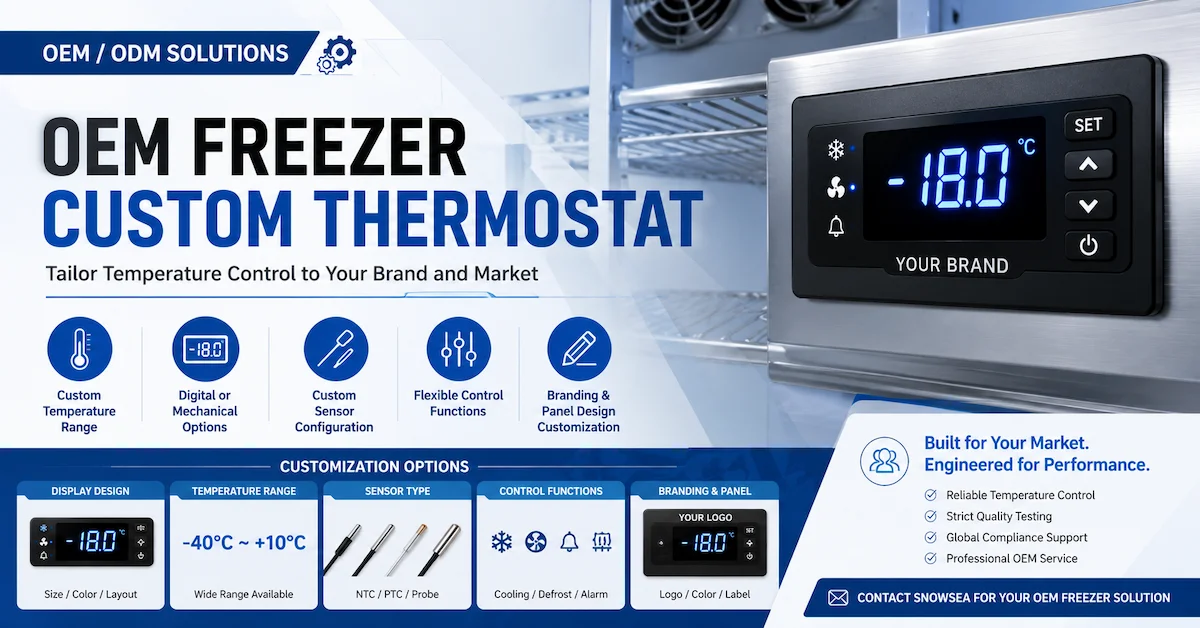
An OEM freezer custom thermostat project allows a commercial freezer buyer to define or modify part of the temperature-control configuration for a private-label or project-specific freezer.
Depending on the model and technical feasibility, customization may involve:
- Mechanical or digital temperature controller
- Temperature set-point range
- Temperature differential
- Sensor type and position
- Celsius or Fahrenheit display
- Display panel layout
- Compressor delay settings
- Defrost parameters
- Alarm functions
- Wiring and electrical compatibility
For B2B buyers, the important point is that thermostat customization should be evaluated as part of the complete refrigeration system—not as an isolated component change.
A controller may allow a certain set point, but the freezer must still have enough refrigeration capacity, insulation performance, airflow, and component compatibility to reach and maintain the required cabinet temperature.
Snowsea supports commercial freezer OEM/ODM projects and can evaluate project-specific requirements through its OEM/ODM solutions.
Who Usually Needs a Custom Freezer Thermostat?
OEM thermostat customization is most relevant to buyers who already have defined market or product requirements.
Typical buyers include:
- Private-label commercial freezer brands
- Refrigeration equipment distributors
- Supermarket equipment suppliers
- Importers
- OEM procurement teams
- Retail refrigeration project companies
For example, a distributor may want one temperature-control interface across an entire product line, while a private-label brand may require its own panel layout, operating range, or controller functions.
This is why a useful RFQ should specify both the freezer application and the required thermostat behavior.
Mechanical vs Digital Thermostat for OEM Freezers
The first decision is usually the controller type.
| Requirement | Mechanical Thermostat | Digital Thermostat |
|---|---|---|
| Basic temperature adjustment | Yes | Yes |
| Digital temperature display | No in typical designs | Yes |
| Parameter flexibility | Limited | Higher |
| Alarm functions | Limited | Possible depending on controller |
| Compressor delay setting | Limited | Often configurable |
| Defrost logic integration | Limited | More flexible |
| Interface customization | Limited | Better suited to customized panels |
| Typical use | Standard freezer models | OEM/private-label projects |
A mechanical thermostat may be appropriate when buyers want a simple and familiar operating system.
A digital thermostat is usually more suitable when the project requires additional parameter control or a customer-facing display.
The correct choice depends on application, cost target, destination market, and required functions.
What Specifications Should Buyers Confirm?
Before requesting an OEM freezer custom thermostat, buyers should define the control requirements as clearly as possible.
Required Temperature Range
Specify the intended operating range rather than simply saying “commercial freezer.”
Different applications may require different temperature settings.
The buyer should provide:
- Target cabinet temperature
- Acceptable operating range
- Minimum required setting
- Maximum required setting
Temperature Differential
Temperature differential determines how the controller responds around the set point.
A buyer with specific performance requirements should confirm how the control logic is expected to operate rather than assuming that all thermostats behave identically.
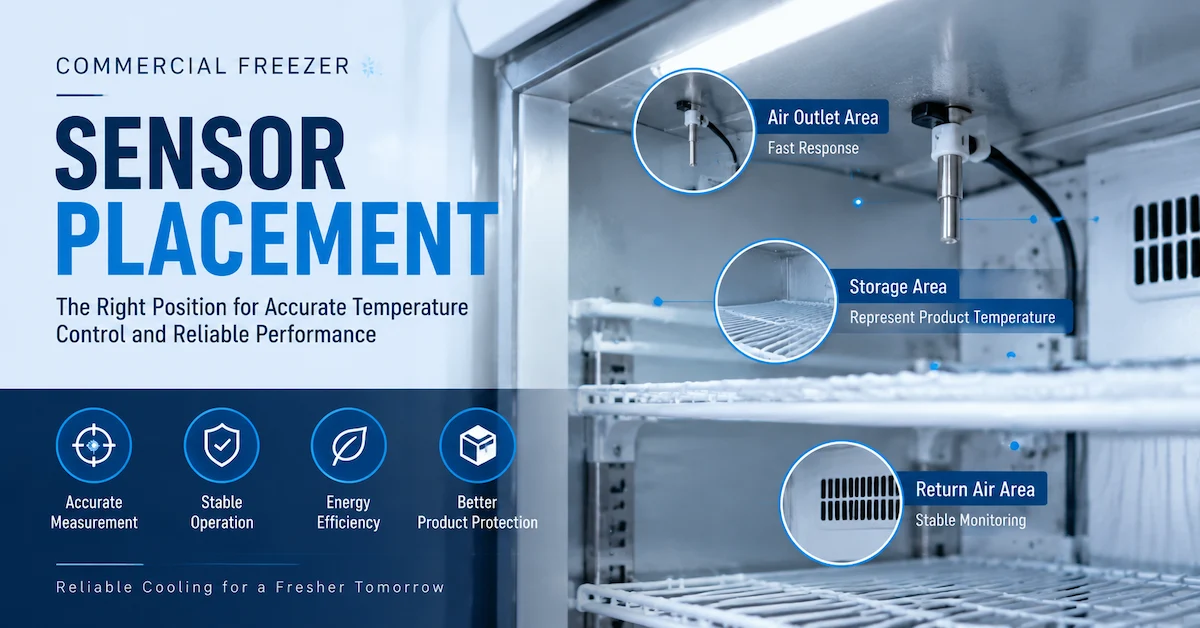
Sensor Configuration
The sensor can affect how the controller interprets cabinet conditions.
Important questions include:
- What type of sensor is required?
- Where will the sensor be installed?
- Does the project require one or multiple sensors?
- Is the sensor configuration compatible with the selected controller?
Display Requirements
For digital controllers, buyers may also specify:
- Celsius or Fahrenheit
- Display size
- Button layout
- Display position
- Panel appearance
- Required operating indicators
These details are particularly relevant to private-label products where user experience needs to remain consistent across multiple models.
Why Thermostat Settings Cannot Be Customized Independently
One of the most important procurement points is:
A lower thermostat setting does not automatically make a freezer capable of operating at a lower temperature.
Actual cabinet performance depends on the complete refrigeration system.
Key factors include:
- Compressor capacity
- Condenser design
- Evaporator capacity
- Refrigerant configuration
- Cabinet insulation
- Door sealing
- Ambient temperature
- Product loading
- Air circulation
For example, changing the controller from a standard operating range to a much lower target range may require the refrigeration system itself to be reviewed.
Buyers evaluating temperature-control customization can also review Snowsea's guides on commercial freezer compressor sizing, commercial freezer condenser design, and commercial freezer evaporator design.
Three Levels of OEM Thermostat Customization
It is useful to separate thermostat projects into three practical levels.
Level 1: Standard Controller Selection
The buyer chooses from controller configurations already suitable for the freezer platform.
This typically has:
- Lower development complexity
- Faster sample preparation
- Lower customization risk
It is often suitable for distributors who mainly need a different controller option rather than a new control system.
Level 2: Parameter Customization
The hardware may remain similar, while selected parameters are adjusted.
Possible requirements can include:
- Temperature range
- Temperature differential
- Compressor delay
- Defrost parameters
- Display units
- Alarm settings
Feasibility must be confirmed against the freezer's refrigeration system.
Level 3: Interface or Functional Customization
More advanced projects may involve:
- Customized panel layout
- Brand-specific interface
- Different display position
- Additional status indicators
- Modified wiring
- New control functions
These changes may require additional engineering verification, samples, testing, and potentially different MOQ or development costs.
How Does a Custom Thermostat Affect OEM Cost?
The thermostat itself is only one part of the quotation.
OEM cost may change because of:
- Different controller specification
- Sensor changes
- Wiring harness modification
- New panel or mounting structure
- Label or interface customization
- Additional sample development
- Testing requirements
- Order quantity
For this reason, two freezer quotations with the same cabinet size may not be directly comparable if their temperature-control specifications are different.
Buyers should request a quotation based on a defined technical specification rather than comparing only unit price.
Does Thermostat Customization Affect MOQ?
It can.
A standard controller selected from an existing configuration may involve less customization than a project requiring a new panel, wiring arrangement, or control function.
MOQ may therefore depend on:
- Controller availability
- Custom component quantity
- Packaging quantity
- Production complexity
- Required development work
For serious OEM projects, buyers should state the expected annual or initial order quantity early in the discussion.
This helps the manufacturer recommend a commercially realistic customization route.
What Should Be Verified on the Sample?
For an OEM freezer custom thermostat project, sample approval should go beyond checking whether the display turns on.
The sample should be evaluated under representative operating conditions.
Important checks include:
- Controller set point
- Actual cabinet temperature
- Temperature stability
- Cooling recovery
- Compressor cycling
- Sensor response
- Defrost operation where applicable
- Alarm functions where applicable
- Display accuracy
- Button operation
- Door-opening recovery
- Loaded cabinet performance
The objective is to confirm that the controller and refrigeration system work together as intended.
Snowsea's commercial freezer quality testing procedure provides related guidance for evaluating commercial freezer performance.
How Should Thermostat QC Be Managed Before Shipment?
For batch production, buyers should ask how thermostat-related functions are checked during QC.
A practical inspection process may include:
- Controller model verification
- Parameter verification
- Sensor installation check
- Wiring inspection
- Power-on functional test
- Temperature operation test
- Display and button inspection
- Final product inspection
For private-label orders, the approved specification should be clearly documented so that production units follow the same configuration as the confirmed sample.
Will a Custom Thermostat Affect Certification?
Potentially, depending on the type and extent of the change.
Electrical components, wiring, control systems, and final product configuration can be relevant to compliance requirements in the destination market.
Buyers should therefore provide:
- Destination country
- Required certification
- Voltage
- Frequency
- Plug requirements
- Required controller functions
Snowsea should then confirm the applicable configuration for the specific project.
Certification requirements should never be assumed solely because a similar freezer model has previously been supplied to another market.
Other OEM Features Buyers Can Coordinate With Thermostat Customization
Temperature-control customization is often only one part of a private-label freezer project.
Depending on the selected platform, buyers may also need to discuss:
- Freezer capacity
- Cabinet dimensions
- Door configuration
- Shelf layout
- Voltage and frequency
- Refrigeration system
- Cabinet color
- Logo placement
- Nameplate
- Packaging
- User manual
- Spare parts
This is why thermostat requirements should ideally be confirmed together with the complete product specification.
Explore Snowsea's commercial refrigeration products to define the base freezer type before starting customization.
What Should Be Included in an OEM Thermostat RFQ?
A high-quality inquiry helps reduce quotation revisions and sample delays.
Send the supplier:
- Freezer type or model
- Application
- Required temperature range
- Mechanical or digital controller preference
- Celsius or Fahrenheit requirement
- Required controller functions
- Sensor requirements if specified
- Voltage and frequency
- Destination market
- Certification requirements
- Estimated order quantity
- Annual purchasing volume if available
- Branding or panel requirements
- Sample requirement
- Target delivery schedule
Instead of asking:
“Can you customize the thermostat?”
A stronger inquiry is:
“Please quote a commercial freezer for our private-label project with a digital controller, required operating range, destination voltage, order quantity, and specified control functions.”
That gives the manufacturer enough information to evaluate technical feasibility and commercial cost.
How to Compare Two OEM Freezer Thermostat Suppliers
Do not compare suppliers only by controller price.
Evaluate:
| Area | What Buyers Should Check |
|---|---|
| Technical feasibility | Can the complete freezer meet the target range? |
| Controller configuration | Does it support required parameters? |
| System compatibility | Compressor, sensor,defrost and wiring |
| Sample validation | Is performance tested before mass production? |
| QC | Are controller settings verified in production? |
| OEM capability | Can panel, branding and related features be coordinated? |
| Documentation | Are approved specifications recorded clearly? |
| Commercial terms | MOQ, sample cost, lead time and unit price |
| Support | Spare parts and technical communication |
The strongest supplier is not necessarily the one offering the cheapest thermostat.It is the supplier that can integrate the required control system into a reliable freezer configuration and reproduce it consistently in mass production.
How Snowsea Supports OEM Freezer Projects
For an OEM freezer custom thermostat inquiry, Snowsea can start by evaluating the complete commercial freezer requirement rather than treating the thermostat as a standalone accessory.
To make the discussion more efficient, send:
- Freezer type
- Required temperature range
- Controller preference
- Voltage/frequency
- Destination country
- Required functions
- Estimated quantity
- Branding requirements
Snowsea can then review the project and discuss a suitable OEM configuration.
For a technical and commercial evaluation, visit Snowsea OEM/ODM Solutions or contact Snowsea.
FAQ
Can the thermostat be customized on an OEM commercial freezer?
Depending on the freezer platform and technical requirements, controller type, parameters, display, sensor configuration, and related functions may be evaluated for customization.
Can I use my preferred thermostat brand?
This depends on compatibility with the freezer's electrical and refrigeration design. Buyers should provide the controller specification for technical evaluation.
Can Snowsea customize the freezer temperature range?
Temperature requirements can be evaluated, but the refrigeration system must be capable of supporting the requested range. Changing only the thermostat setting may not be sufficient.
Is a digital thermostat better for an OEM freezer?
Not always. Digital controllers provide more parameter flexibility, while mechanical thermostats can suit simpler applications.The correct option depends on project requirements.
Can Celsius and Fahrenheit displays be customized?
This depends on the selected digital controller. Buyers should specify the required display format in the RFQ.
Does a custom thermostat increase MOQ?
It may. MOQ depends on whether the project uses an existing controller configuration or requires customized hardware, panels, wiring, or functions.
Should buyers test the thermostat before mass production?
Yes. Sample validation should confirm temperature control, recovery, controller behavior, sensor response, and relevant functions before batch production.
Does thermostat customization change the freezer price?
It can. Controller cost, wiring changes, panel development, sensors, testing, and order quantity may affect the final quotation.
What information is required for a thermostat customization quote?
Provide freezer type, temperature range, controller type, voltage, destination market, functions, order quantity, certifications, and branding requirements.
Can Snowsea support private-label freezer thermostat projects?
Snowsea supports commercial refrigeration OEM/ODM projects and can evaluate thermostat requirements together with the complete freezer specification.
Conclusion
An OEM freezer custom thermostat project should be treated as a complete temperature-control engineering and procurement decision, not simply a request to replace one component.
B2B buyers should define:
- Required temperature range
- Controller type
- Sensor configuration
- Display requirements
- Control functions
- Electrical specifications
- Destination market
- Order quantity
The manufacturer should then verify whether the controller, compressor, evaporator, condenser, insulation, airflow, and electrical system can work together to achieve the required performance.
For private-label brands, distributors, and OEM buyers, this approach reduces specification misunderstandings, unnecessary sample revisions, and mass-production risks.
Send Snowsea your freezer type, required temperature range, thermostat preference, voltage, destination market, expected quantity, and required functions through the contact page to request an OEM configuration review and commercial quotation.