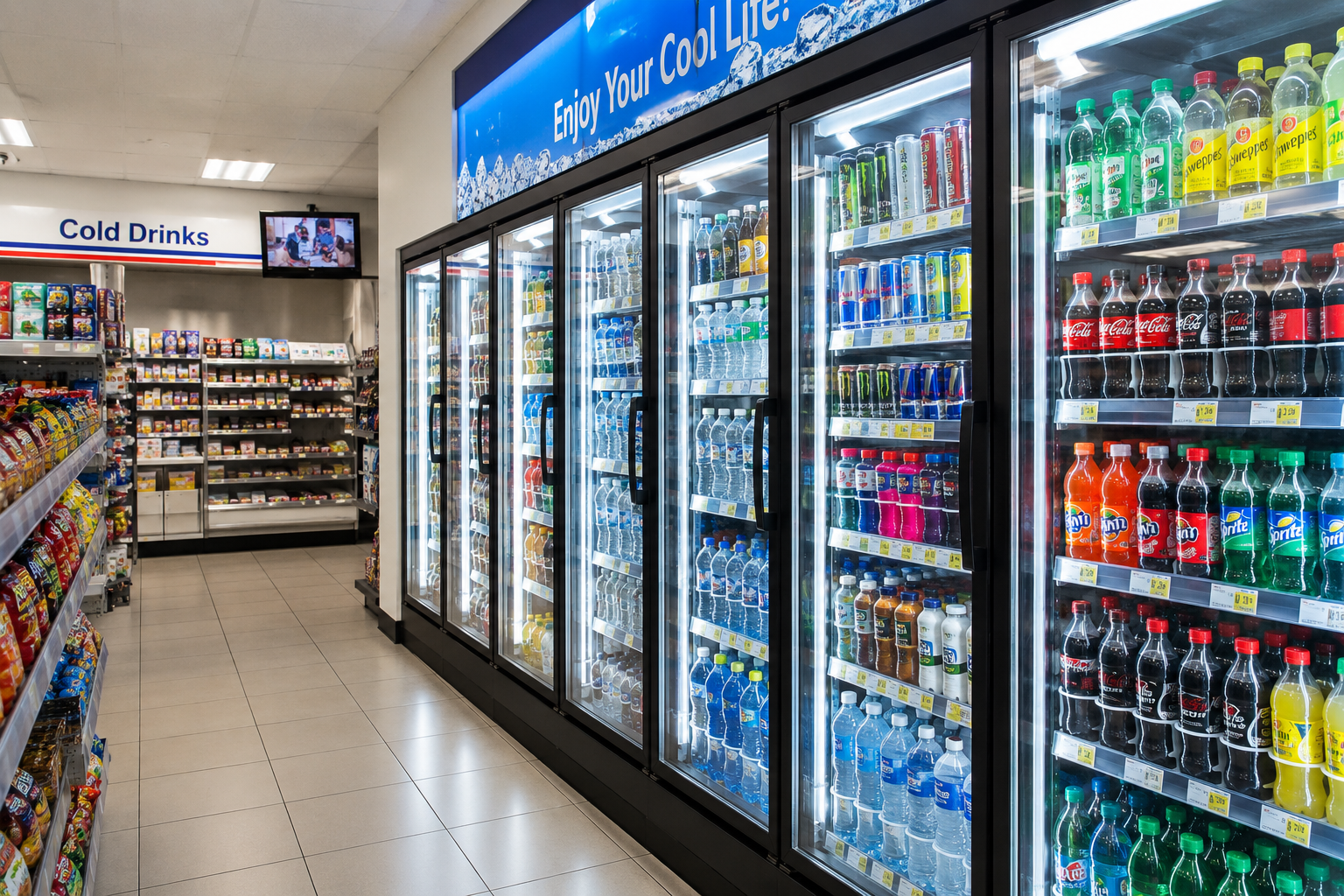
In beverage retail environments, refrigeration equipment must do more than maintain cold temperatures. Customers expect clear product visibility, easy selection, and attractive displays that encourage purchases.
Unfortunately, many traditional beverage coolers experience recurring issues such as glass fogging, temperature fluctuations, excessive energy consumption, and poor insulation performance. These challenges can affect both product presentation and operating costs.
Modern beverage cooler glass door technology helps solve these problems through advanced insulated glass structures, anti-condensation systems, and optimized refrigeration integration.
As a result, retailers can improve both customer experience and refrigeration performance.
Why Traditional Beverage Cooler Doors Create Problems
Many older beverage refrigerators were designed primarily for cooling rather than merchandising.
Common issues include:
- Glass condensation
- Limited product visibility
- Heat transfer through glass surfaces
- Increased compressor workload
- Higher energy consumption
- Inconsistent cabinet temperatures
These problems become even more noticeable in convenience stores, supermarkets, gas stations, and high-traffic retail environments.
A properly designed beverage cooler glass door technology solution helps reduce these operational challenges while improving display quality.
How Modern Glass Door Technology Works
Today's refrigeration manufacturers use multiple technologies to improve both cooling efficiency and visibility.
Multi-Layer Insulated Glass
Double-pane or triple-pane glass reduces thermal transfer and improves temperature stability.
Low-E Glass Coatings
Special coatings reflect heat while maintaining visibility.
Anti-Fog Systems
Heated glass surfaces and airflow management help prevent condensation buildup.
Improved Door Sealing
High-performance gaskets reduce cold air leakage.
Integrated Refrigeration Controls
Temperature and airflow systems work together to maximize cooling efficiency.
Because of these innovations, beverage cooler glass door technology can significantly improve both refrigeration performance and product presentation.
Traditional Glass Doors vs Advanced Glass Technology
| Feature | Standard Glass Door | Advanced Glass Door Technology |
|---|---|---|
| Product Visibility | Moderate | Excellent |
| Condensation Resistance | Limited | Improved |
| Energy Efficiency | Standard | Higher |
| Temperature Stability | Average | Better |
| Cold Air Retention | Moderate | Enhanced |
| Merchandising Impact | Standard | Stronger |
The difference often becomes most visible during peak business hours when refrigeration systems face higher workloads.
Solving Real Beverage Display Challenges
Retailers often encounter several practical refrigeration issues.
Customers Cannot Clearly See Products
Fogged glass reduces product visibility and customer engagement.
Energy Costs Continue to Increase
Poor insulation forces refrigeration systems to work harder.
Temperature Fluctuation Affects Beverage Quality
Inconsistent cooling can reduce product freshness and customer satisfaction.
A modern beverage cooler glass door technology solution addresses these challenges simultaneously by improving insulation, visibility, and refrigeration efficiency.
Key Advantages for Commercial Beverage Displays
Improved Product Visibility
Customers can quickly identify products without opening doors unnecessarily.
Better Energy Efficiency
Insulated glass reduces refrigeration losses.
Reduced Condensation
Anti-fog systems maintain clear visibility throughout operating hours.
More Stable Refrigeration Performance
Improved thermal insulation supports consistent cabinet temperatures.
Enhanced Product Merchandising
Attractive displays help improve customer engagement and purchasing behavior.
For many retailers, beverage cooler glass door technology provides benefits that extend beyond refrigeration itself.
Best Applications for Advanced Glass Door Beverage Coolers
Common commercial applications include:
- Supermarkets
- Convenience stores
- Beverage retailers
- Gas station stores
- Hotels
- Restaurants
- Airport retail outlets
- Café beverage displays
These environments rely heavily on both product visibility and refrigeration efficiency.
How to Choose the Right Beverage Cooler
Evaluate Glass Construction
Double-pane or triple-pane glass generally offers better insulation performance.
Consider Anti-Fog Features
Clear visibility improves merchandising effectiveness.
Assess Energy Consumption
Long-term operating costs are often more important than initial purchase price.
Review Refrigeration Performance
Stable temperatures remain critical for beverage quality.
Match Capacity to Retail Demand
Cabinet size should reflect sales volume and available floor space.
Selecting the right beverage cooler glass door technology helps retailers optimize display performance, customer experience, and operating efficiency.
FAQ
Q1: Why is insulated glass important in beverage coolers?
Insulated glass reduces heat transfer and helps maintain more stable refrigeration temperatures.
Q2: Does anti-fog technology improve beverage sales?
Clear product visibility can improve customer engagement and product selection.
Q3: Can advanced glass door technology reduce energy costs?
Yes. Better insulation reduces compressor workload and refrigeration losses.
Q4: Is glass door technology suitable for high-traffic retail stores?
Absolutely. Modern systems are specifically designed to maintain visibility and cooling performance in busy environments.
Improving Beverage Merchandising Through Better Refrigeration Design
Modern beverage cooler glass door technology combines refrigeration efficiency, thermal insulation, and product visibility into a single solution. By improving cooling stability and display performance, retailers can create a more effective beverage merchandising strategy while reducing operating costs.
Learn more about our refrigeration expertise: https://www.snowseax.com/about-us
Explore our commercial refrigeration products: https://www.snowseax.com/
Visit our FAQ center for additional refrigeration guidance: https://www.snowseax.com/faqs
For customized beverage refrigeration solutions, contact our team: https://www.snowseax.com/contact-us