What Is Commercial Freezer Distributor Pricing?
Commercial Freezer Distributor Pricing refers to the complete purchasing cost structure offered to businesses that resell commercial refrigeration equipment through local, regional, or national sales channels.
It should not be evaluated as a simple factory discount.
A distributor's real cost can include:
- Factory unit price
- OEM branding
- Packaging
- Spare parts
- Freight
- Import duties
- Customs clearance
- Warehousing
- Local delivery
- Warranty service
- Sales support
- Inventory carrying cost
For this reason, two suppliers offering similar ex-factory prices can create very different distributor economics.
Snowsea provides commercial refrigeration products for distributors, importers, private-label brands, and commercial refrigeration projects serving different market segments.
Distributor Pricing vs Wholesale Pricing
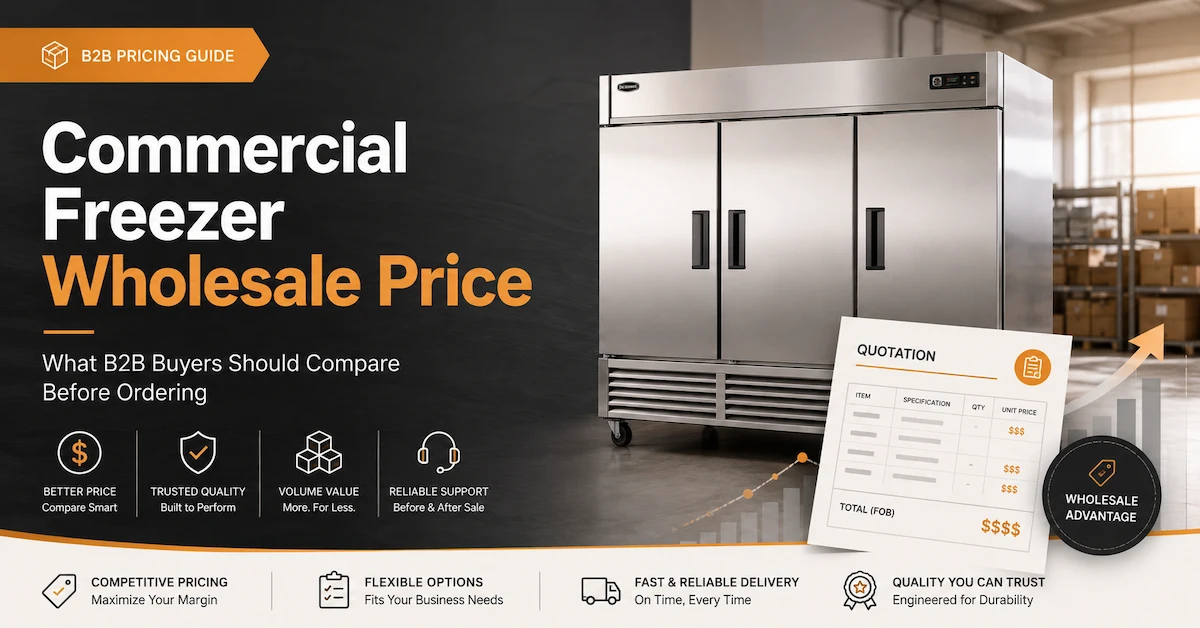
Wholesale pricing usually focuses on the business-to-business purchase price of the freezer itself.
Distributor pricing goes further by considering the economics of reselling and supporting the equipment in a target market.
For a broader explanation of product-level cost drivers, buyers can review Snowsea's commercial freezer wholesale price guide.
A distributor should ask:
Can this product generate sustainable channel value after freight, service, inventory, and market costs are included?
That is a different question from simply asking which factory offers the lowest quotation.
What Determines Commercial Freezer Distributor Pricing?
Several factors can influence the final purchasing structure.
Purchase Volume
Order quantity can influence:
- Component purchasing
- Production scheduling
- Packaging preparation
- Branding cost allocation
- Factory setup efficiency
However, distributors should not assume that every increase in volume produces the same percentage reduction.
For quantity-specific purchasing analysis, see Snowsea's commercial freezer bulk order price guide.
Product Mix
A distributor may sell:
- Chest freezers
- Upright freezers
- Display freezers
- Ice cream freezers
- Refrigerators
A mixed order can support a broader product portfolio, but it may also involve:
- Different components
- Different cartons
- Separate production runs
- Multiple SKUs
- Different spare parts
Therefore, model mix should be discussed together with total order quantity.
Annual Purchase Volume
A distributor planning repeat purchases should provide realistic annual estimates.
Annual demand can help both sides plan:
- Production
- Components
- Packaging
- Forecasts
- Inventory
- Repeat orders
Forecast volume should not be confused with a guaranteed order unless the commercial agreement clearly defines it.
How Distributor Margin Should Be Evaluated
Distributor margin should not be calculated from factory unit price alone.
A more useful approach is to first estimate the landed and supported cost of each freezer.
This may include:
- Product purchase cost
- International logistics
- Duties and clearance
- Local warehousing
- Dealer delivery
- Warranty reserve
- Spare parts
- Sales and service cost
Only then can the distributor compare the expected resale price with the actual cost structure.
Snowsea does not recommend using a universal margin percentage because distributor economics vary by market, product segment, service level, and channel model.
Factory Price vs Landed Distributor Cost
| Cost Area | Factory Quotation | Distributor Cost |
|---|---|---|
| Freezer unit | Yes | Yes |
| OEM branding | Sometimes | Yes if required |
| Export packaging | Usually included or specified | Yes |
| Ocean/air freight | Depends on trade term | Yes |
| Import duty | No | Usually buyer responsibility |
| Customs clearance | No | Usually buyer responsibility |
| Warehousing | No | Yes |
| Local transport | No | Yes |
| Spare parts | Optional | Should be planned |
| Warranty service | Not fully reflected | Distributor may carry cost |
| Inventory financing | No | Distributor cost |
This is why the lowest factory price does not automatically produce the strongest distributor margin.
Trial Order vs Repeat Distributor Pricing
Distributor relationships usually develop in stages.
Initial Sample
The purpose is product verification.
Buyers may evaluate:
- Appearance
- Dimensions
- Temperature performance
- Packaging
- Components
- Branding
Trial Order
The distributor tests:
- Market acceptance
- Customer feedback
- Dealer response
- Service requirements
- Sell-through speed
Repeat Order
Once product performance and market demand are clearer, repeat orders can become more standardized.
Repeat purchasing may improve planning efficiency, but specifications should still be controlled so that approved components and product performance do not change without agreement.
Regional Distributor vs National Distributor
Different distribution models require different supplier support.
Regional Distributors
Regional buyers may focus on:
- Smaller inventory
- Faster model turnover
- Local dealer relationships
- Flexible SKU selection
National Distributors
Larger distributors may require:
- Higher volume
- Consistent national specifications
- Spare-parts planning
- Multiple warehouses
- Stronger documentation
- Stable repeat-order supply
Supplier selection should therefore match the distributor's actual channel structure.
How OEM and Private Label Affect Distributor Cost
Private-label programs can help distributors differentiate their product range.
Common OEM requirements include:
- Logo
- Rating label
- Cabinet color
- User manual
- Carton artwork
- Product stickers
Deeper customization may involve:
- Compressor
- Refrigerant
- Controller
- Door configuration
- Cabinet material
- Shelving
- Defrost system
These changes can affect both unit cost and MOQ.
Distributors considering branded product programs can review Snowsea's OEM and ODM commercial refrigeration solutions.
Why Quality Control Matters to Distributor Pricing
A quotation should be evaluated together with the supplier's quality-control process.
A lower product price can lose its advantage if the distributor experiences:
- High warranty claims
- Temperature complaints
- Door alignment issues
- Compressor failures
- Packaging damage
- Excessive replacement costs
Quality-related costs often appear after the shipment arrives.
Snowsea's commercial freezer quality testing procedure explains important factory checks including temperature performance, airflow, sealing, refrigeration-system operation, electrical inspection, and final QC.
Spare Parts Are Part of Distributor Economics
Distributors should discuss spare parts before placing large orders.
Possible service parts include:
- Controllers
- Fan motors
- Door gaskets
- Hinges
- Handles
- Lights
- Electrical components
A distributor should ask:
- Which parts are recommended?
- Which parts are commonly serviceable?
- Can they ship with the freezer order?
- Are they available for repeat purchase?
- How are part numbers identified?
A slightly higher sourcing cost may be commercially justified if it reduces service delays in the destination market.
Warranty Terms Should Be Compared Carefully
Warranty language can strongly affect distributor risk.
Buyers should clarify:
- Warranty period
- Covered components
- Exclusions
- Claim procedure
- Required evidence
- Replacement-part process
- Technical support
- Freight responsibility
A written warranty should be reviewed as part of the commercial quotation.
Do not assume two suppliers offering the same warranty duration provide the same support structure.
How Packaging Affects Distributor Cost
Shipping damage creates direct channel costs.
Potential consequences include:
- Discounted resale
- Local repair
- Replacement
- Claims
- Customer dissatisfaction
- Lost dealer confidence
Export packaging should therefore be evaluated as part of distributor pricing.
Snowsea's freezer export packaging drop protection guide explains carton reinforcement, corner protection, product fixation, glass protection, and transport-risk considerations.
How Commercial Freezer Distributor Pricing Changes With Product Mix
A practical Commercial Freezer Distributor Pricing strategy should consider the role of each model in the portfolio.
| Product Role | Distributor Objective | Pricing Priority |
| Entry model | Win price-sensitive buyers | Competitive landed cost |
| Core model | Generate consistent volume | Balance cost and reliability |
| Premium model | Higher-value applications | Features and durability |
| Display model | Retail merchandising | Appearance and visibility |
| Custom OEM model | Channel differentiation | Brand value and exclusivity |
A distributor does not need every model to deliver the same margin or serve the same customer.
Portfolio economics should be evaluated at the channel level.
How Distributors Should Compare Supplier Quotations
Before comparing price, normalize the specification.
| Comparison Item | Supplier A | Supplier B | Supplier C |
| Freezer model | Confirm | Confirm | Confirm |
| Capacity | Confirm | Confirm | Confirm |
| Compressor | Confirm | Confirm | Confirm |
| Refrigerant | Confirm | Confirm | Confirm |
| Cabinet material | Confirm | Confirm | Confirm |
| Defrost system | Confirm | Confirm | Confirm |
| Controller | Confirm | Confirm | Confirm |
| OEM branding | Confirm | Confirm | Confirm |
| QC scope | Confirm | Confirm | Confirm |
| Packaging | Confirm | Confirm | Confirm |
| Spare parts | Confirm | Confirm | Confirm |
| Warranty | Confirm | Confirm | Confirm |
| MOQ | Confirm | Confirm | Confirm |
| Lead time | Confirm | Confirm | Confirm |
| Trade term | Confirm | Confirm | Confirm |
Only compare final prices after these factors are aligned.
How Repeat Orders Can Improve Distributor Planning
Repeat orders can create value beyond unit-price negotiation.
Benefits may include:
- More predictable inventory
- Standardized specifications
- Easier spare-parts planning
- Consistent branding
- More efficient forecasting
Distributors should maintain a controlled specification for repeat orders so that unauthorized component changes do not create inconsistent products in the market.
What Should Distributors Include in an RFQ?
A distributor RFQ should include:
- Product types
- Required models
- Quantity per model
- Target market
- Voltage and frequency
- Temperature range
- Refrigerant
- Cabinet requirements
- Door configuration
- Branding
- Packaging
- Spare-parts requirements
- Certification requirements
- Initial order quantity
- Estimated annual demand
- Requested trade term
- Target launch schedule
A clear RFQ makes supplier quotations easier to compare.
Common Distributor Pricing Mistakes
Comparing Unit Price Only
The unit price excludes many channel costs.
Ignoring After-Sales Cost
Warranty and spare parts can materially affect profitability.
Ordering Too Many SKUs
Too many models can increase inventory pressure.
Assuming Forecast Volume Guarantees Discounts
Factories need clear order commitments and production planning.
Ignoring Packaging
Shipping damage can destroy the advantage of a cheaper quotation.
Changing Specifications Too Frequently
Frequent changes increase purchasing, QC, inventory, and spare-parts complexity.
FAQ
What is commercial freezer distributor pricing?
It is the purchasing and cost structure used by distributors sourcing commercial freezers for resale, including product price and other channel-related cost considerations.
How is distributor pricing different from wholesale pricing?
Wholesale pricing focuses more on product purchase cost, while distributor pricing should also consider logistics, inventory, service, warranty, spare parts, and resale economics.
Does higher annual volume reduce distributor price?
It can improve purchasing and production efficiency, but pricing depends on actual orders, specifications, product mix, and supplier conditions.
Can distributors mix several freezer models in one order?
Often yes, but buyers should confirm MOQ per model, production requirements, packaging, and container-loading conditions.
Does private labeling increase distributor cost?
It can. Logo, labels, cartons, manuals, colors, and technical customization can all influence pricing.
Should distributors calculate landed cost?
Yes. Landed cost gives a more realistic view of sourcing cost than factory unit price alone.
Should spare parts be included with distributor orders?
For many commercial refrigeration programs, spare-parts planning can improve local service and reduce future downtime.
How should distributors compare warranty offers?
Compare coverage, exclusions, claim procedures, spare-parts support, technical assistance, and responsibilities rather than warranty duration alone.
What should a distributor ask a commercial freezer supplier?
Ask about specifications, MOQ, tiered pricing, QC, packaging, spare parts, warranty, lead time, OEM options, and repeat-order support.
Can Snowsea support commercial freezer distributors?
Snowsea provides commercial refrigeration products and OEM/ODM support for distributors, importers, and private-label buyers. Project requirements can be evaluated based on models, quantities, market needs, and customization.
Conclusion
Commercial Freezer Distributor Pricing should be evaluated as a complete channel cost structure, not simply as a discounted factory price.
For commercial refrigeration distributors, sustainable profitability depends on purchase cost, product mix, landed cost, inventory, quality, packaging, spare parts, warranty support, and repeat-order reliability working together.
The strongest sourcing decision is therefore not necessarily the supplier with the lowest initial quotation. It is the supplier whose product specification, cost structure, quality control, and service model support the distributor's target market and long-term channel strategy.
Snowsea supports commercial refrigeration distributors and B2B buyers with standard products and OEM/ODM projects. Explore Snowsea's commercial refrigeration products, review OEM/ODM solutions, or contact Snowsea with your product mix, market, expected volume, and distributor requirements.