Why Choosing the Right Commercial Freezer Private Label Factory Matters
A reliable Commercial Freezer Private Label Factory does more than place a customer's logo on an existing cabinet.
For importers, distributors, supermarket-equipment companies, and refrigeration brands, a private-label project must turn an approved product into a consistent commercial product line that customers can recognize and purchase repeatedly.
The factory may need to control:
- Product specifications
- Cabinet appearance
- Logo placement
- Model numbers
- Rating labels
- Packaging artwork
- Manuals
- Barcodes
- Accessories
- Quality standards
- Repeat-order consistency
If these elements change between production batches, the buyer can face problems with brand presentation, inventory management, spare parts, warranties, and channel confidence.
Snowsea supports OEM and ODM commercial refrigeration solutions for B2B buyers developing private-label freezer and refrigeration programs.
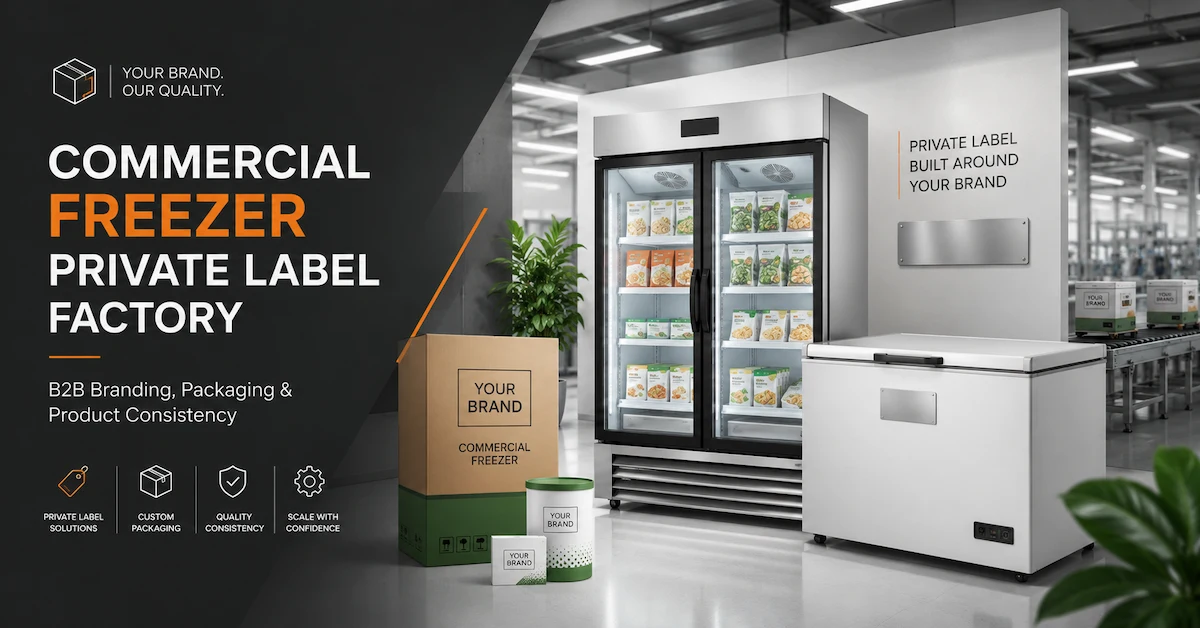
What Is a Commercial Freezer Private Label Factory?
A private-label freezer factory manufactures commercial refrigeration equipment that is sold under the buyer's own brand.
Depending on the project, customization may range from simple visual changes to a more complete branded product specification.
Typical private-label requirements include:
- Brand logo
- Product model number
- Cabinet color
- Nameplate
- Rating label
- Carton artwork
- User manual
- Barcode
- Product stickers
- Warranty card
More advanced programs may also specify components, materials, controls, packaging, or market-specific configurations.
Private Label vs OEM vs ODM
These terms are related but should not be treated as identical.
| Project Type | Main Focus | Typical Buyer Requirement |
|---|---|---|
| Private Label | Brand ownership | Sell an existing or modified product under buyer's brand |
| OEM | Manufacturing to agreed specification | Buyer defines more product requirements |
| ODM | Product development + manufacturing | Supplier contributes more engineering and development |
A private-label project may also include OEM or ODM work.
For example, a distributor may begin with a standard freezer and customize the logo and carton. Later, the buyer may request a different controller, cabinet design, or refrigeration configuration.
Buyers evaluating deeper manufacturing cooperation can also review Snowsea's guide to choosing a commercial freezer OEM factory.
What Can Be Customized for a Private Label Freezer?
Logo and Brand Identity
Common branding locations include:
- Cabinet front
- Header panel
- Door
- Rating label
- Control panel area
- Packaging
Logo size, color, placement, and printing method should be approved before mass production.
Do not rely only on verbal descriptions such as “put our logo on the freezer.”
Use approved artwork and placement references.
Cabinet Color and Appearance
Private-label brands may request:
- White
- Black
- Stainless finish
- Custom painted color
- Different handles
- Branded display panels
Appearance changes can influence production processes and MOQ, particularly when custom materials or colors must be purchased specifically for the project.
Model Number and Product Labels
A distributor should create a clear model-number system.
Model numbers help manage:
- Product catalogs
- Spare parts
- Warranty claims
- Inventory
- Technical documentation
- Repeat orders
A private-label model number should remain linked to a controlled factory specification.
Rating Labels
Rating labels may include technical information such as:
- Model
- Voltage
- Frequency
- Refrigerant
- Electrical data
- Product identification
The label format and required information should match the destination market and actual product specification.
Packaging and Manuals
Private-label packaging may include:
- Brand logo
- Model number
- Product image
- Handling marks
- Barcode
- Shipping information
User manuals may also need:
- Buyer branding
- Local language
- Safety instructions
- Installation guidance
- Cleaning information
How to Build a Consistent Private Label Product Line
A private-label brand often includes more than one freezer.
For example:
- Chest freezer
- Upright freezer
- Display freezer
- Ice cream freezer
- Commercial refrigerator
The challenge is making these products look and feel like one coherent brand.
Buyers should standardize:
- Logo position
- Cabinet colors
- Label design
- Model naming
- Carton style
- Manual format
- Warranty information
This improves brand recognition and simplifies channel management.
Why Sample Approval Matters
Before mass production, the buyer should approve a representative sample.
A private-label sample should be evaluated for both technical performance and brand execution.
Check:
- Product dimensions
- Temperature performance
- Door operation
- Cabinet appearance
- Logo position
- Label accuracy
- Model number
- Manual
- Carton artwork
- Accessories
The approved sample should become a clear reference for production.
Photos are useful, but a written approved specification is even more important.
MOQ for Private Label Projects
MOQ depends on the level of customization.
Basic branding may involve:
- Logo printing
- Labels
- Cartons
- Manuals
These items can have their own supplier MOQs.
More complex projects may require:
- Custom cabinet colors
- Special glass
- Unique components
- Custom packaging
- New tooling
Buyers should therefore ask for MOQ by customization item, not only one overall MOQ.
For example:
| Customization | Possible Cost/MOQ Driver |
| Logo | Printing setup |
| Carton | Packaging supplier MOQ |
| Manual | Printing quantity |
| Cabinet color | Material purchasing |
| Custom controller | Component MOQ |
| New structure | Tooling or engineering |
Quality Control for Private Label Commercial Freezers
A strong Commercial Freezer Private Label Factory should maintain the approved product specification across every production batch.
Quality control should cover more than branding.
Refrigeration Performance
Depending on the product, testing may include:
- Pull-down performance
- Temperature stability
- Airflow
- Compressor operation
- Defrost performance
Cabinet Quality
Inspect:
- Door alignment
- Gasket sealing
- Cabinet panels
- Handles
- Shelves
- Surface finish
Branding Quality
Check:
- Logo position
- Printing quality
- Label accuracy
- Model number
- Carton artwork
- Manual version
Snowsea's commercial freezer quality testing procedure provides a broader framework for factory performance and pre-shipment inspection.
How to Control Product Consistency Across Repeat Orders
Repeat-order consistency is one of the most important private-label issues.
A factory may need to change a component because of:
- Supplier availability
- Cost changes
- Model updates
- Regulatory changes
- Component discontinuation
The buyer should define which components cannot be changed without approval.
These may include:
- Compressor
- Controller
- Refrigerant
- Fan motor
- Cabinet material
- Glass
- Door gasket
A controlled change process helps prevent unexpected differences between earlier and later shipments.
Packaging Is Part of the Brand Experience
Packaging is not only transportation protection.
For private-label distributors, packaging also communicates brand quality.
A damaged or poorly printed carton can create a negative impression before the customer even sees the freezer.
Packaging should balance:
- Brand appearance
- Product protection
- Shipping efficiency
- Handling requirements
For export projects, Snowsea's freezer export packaging drop protection explains how cushioning, corner protection, bases, and product fixation affect transportation risk.
Private Label Freezers for Different Markets
A private-label product cannot always use one global specification.
Buyers may need different versions for:
- Voltage
- Frequency
- Plug type
- Refrigerant
- Labels
- Manuals
- Compliance requirements
If one brand sells into multiple countries, each version should be clearly identified.
Model-number extensions or market codes can help prevent warehouse and shipping errors.
Spare Parts and After-Sales Support
Private-label buyers usually become the customer-facing brand.
That means end users may contact the distributor rather than the factory when problems occur.
Before launch, buyers should plan spare parts such as:
- Controllers
- Fan motors
- Door gaskets
- Hinges
- Handles
- Lights
- Electrical parts
Ask the factory to provide clear part identification so service teams can match replacements to the correct model.
Warranty Responsibility Should Be Defined Before Launch
Private-label programs require clear warranty responsibilities.
Confirm:
- Warranty period
- Covered parts
- Exclusions
- Claim procedure
- Required evidence
- Replacement-part process
- Freight responsibility
- Technical support
The warranty offered to the final customer should be compatible with the support the factory provides to the distributor.
How to Evaluate a Commercial Freezer Private Label Factory
A practical supplier evaluation can include:
| Evaluation Area | What Buyers Should Verify |
| Product range | Suitable freezer platforms |
| Branding capability | Logo, labels and packaging |
| Engineering support | Ability to manage modifications |
| Sample process | Clear approval procedure |
| QC | Product and branding inspection |
| Specification control | Repeat-order consistency |
| Packaging | Export-ready protection |
| Spare parts | Long-term availability |
| OEM/ODM | Support for future expansion |
| Documentation | Model and specification records |
The best private-label supplier is not necessarily the one offering the most customization.
A stronger partner is usually the one that can control approved specifications reliably over time.
What Should Buyers Include in a Private Label RFQ?
Send the factory:
- Product type
- Reference model
- Required capacity
- Temperature range
- Voltage and frequency
- Refrigerant
- Destination market
- Brand logo
- Cabinet color
- Model-number requirements
- Label artwork
- Carton requirements
- Manual language
- Quantity per model
- Estimated annual volume
- Certification requirements
- Target launch date
Also identify which requirements are mandatory and which can use the factory's standard solution.
Common Private Label Sourcing Mistakes
Treating Private Label as Logo Printing Only
The project also needs specification and quality consistency.
No Approved Artwork
Uncontrolled logo and label files can create production errors.
No Model-Number System
This creates difficulties in inventory, warranty, and spare-parts management.
Approving Appearance but Not Performance
A branded sample must still meet refrigeration requirements.
No Change-Control Process
Unapproved component substitutions can create inconsistent batches.
Ignoring Packaging
Packaging influences both transport risk and brand presentation.
No Spare-Parts Plan
The distributor may struggle to support customers after launch.
FAQ
What is a commercial freezer private label factory?
It is a manufacturer that produces commercial freezers that distributors, importers, or other businesses sell under their own brand.
Can I put my logo on a commercial freezer?
Yes. Private-label programs commonly customize logos, labels, cartons, manuals, and other branding elements.
What is the difference between private label and OEM?
Private label focuses primarily on selling under the buyer's brand, while OEM can involve broader manufacturing according to buyer-defined specifications.
Can private-label freezers use custom model numbers?
Yes. Buyers can establish their own model-number system, but each model should remain linked to a controlled technical specification.
What is the MOQ for private-label freezers?
MOQ depends on the product and customization requirements. Logo printing, cartons, colors, components, and tooling can each create different quantity requirements.
Should I approve a sample before mass production?
Yes. The sample should verify technical performance, branding, labels, packaging, accessories, and other agreed specifications.
Can cabinet colors be customized?
Depending on the product and order quantity, different cabinet colors or surface finishes may be possible.
How do I keep repeat orders consistent?
Use approved specifications, BOM control, sample references, version control, and written approval requirements for important component changes.
Should private-label buyers order spare parts?
For distributors and brands providing local after-sales service, spare-parts planning is highly recommended.
Can Snowsea manufacture private-label commercial freezers?
Snowsea supports OEM/ODM commercial refrigeration projects. Buyers can submit branding, product specifications, quantity, destination market, and packaging requirements for project evaluation.
Conclusion
Choosing a Commercial Freezer Private Label Factory should be based on much more than logo-printing capability.
For distributors, importers, refrigeration brands, and commercial equipment companies, a successful private-label program requires consistent product specifications, controlled branding, sample approval, quality testing, packaging, spare-parts planning, and repeat-order management.
The strongest private-label supplier is one that can reproduce the approved product reliably while helping the buyer maintain consistent branding and technical specifications across different orders and markets.
Snowsea supports private-label and OEM/ODM commercial refrigeration projects for global B2B buyers. Explore Snowsea's commercial refrigeration products, review its OEM/ODM solutions, or contact Snowsea with your branding, product specifications, expected quantity, and target market.