Why Franchise Brands Need a Specialized Commercial Freezer Supplier
Franchise refrigeration procurement is different from purchasing equipment for one independently operated store.
A reliable Commercial Freezer Supplier for Franchise needs to help brand headquarters create equipment standards that can be repeated across dozens or hundreds of franchise locations while still accommodating different store sizes, layouts, and regional requirements.
Typical franchise applications include:
- Convenience stores
- Frozen-food retailers
- Ice cream shops
- Dessert chains
- Restaurant franchises
- Specialty food stores
- Supermarket franchises
Without standardized sourcing, franchise networks can gradually accumulate different freezer models, dimensions, controllers, components, and service procedures.
This creates higher operating complexity for both headquarters and franchisees.
Snowsea provides commercial refrigeration products for distributors, retail networks, franchise brands, and other global B2B buyers.
What Is a Commercial Freezer Supplier for Franchise?
A Commercial Freezer Supplier for Franchise is a manufacturer or supply partner capable of supporting repeatable refrigeration equipment programs across multiple independently operated franchise locations.
The supplier may help headquarters define:
- Approved freezer models
- Technical specifications
- Store-format equipment packages
- Brand appearance
- Pricing structure
- Quality requirements
- Packaging standards
- Spare-parts systems
- Delivery procedures
The objective is to make it easier for each new franchise location to purchase equipment that matches the brand's approved standard.
Headquarters Purchasing vs Individual Franchise Store Purchasing
Franchise systems generally use one of several procurement approaches.
| Purchasing Model | Main Advantage | Main Risk |
|---|---|---|
| Each franchisee buys independently | High local flexibility | Inconsistent equipment |
| Headquarters purchases centrally | Strongest standardization | Requires logistics coordination |
| Approved supplier program | Balance of control and flexibility | Needs clear supplier rules |
| Regional distributor model | Easier local delivery | Requires specification control |
For many franchise brands, an approved-supplier model works well.
Headquarters defines the freezer standard, while franchisees purchase approved equipment according to store needs.
This can preserve consistency without requiring the headquarters to physically manage every shipment.
How to Standardize Freezers Across Franchise Locations
Standardization should begin with technical requirements rather than appearance alone.
Approved Freezer Models
The brand can define an approved equipment list for different applications.
For example:
- Glass door freezer
- Upright freezer
- Chest freezer
- Ice cream freezer
- Display freezer
Each approved model should have a controlled specification.
Dimensions and Store Layout
Freezer dimensions should coordinate with:
- Store furniture
- Aisle widths
- Wall modules
- Electrical points
- Customer circulation
A standardized footprint makes future store design easier.
If equipment dimensions change unexpectedly, the new freezer may not fit the original store plan.
Technical Specifications
Important specifications may include:
- Capacity
- Temperature range
- Voltage
- Frequency
- Refrigerant
- Defrost method
- Controller
- Compressor configuration
These specifications should be documented for repeat orders.
Branding and Appearance
Franchise equipment can also support consistent visual identity through:
- Cabinet colors
- Logo placement
- Header panels
- Model labels
- Product stickers
Snowsea supports OEM and ODM commercial refrigeration solutions for buyers requiring controlled branding and product customization.
Spare Parts Standards
Whenever possible, franchise networks should reduce unnecessary variation in:
- Controllers
- Gaskets
- Fan motors
- Handles
- Hinges
- Lighting components
Common components simplify service and inventory management.
What Freezer Equipment Do Franchise Stores Need?
Equipment requirements depend on the business model.
Glass Door Freezers
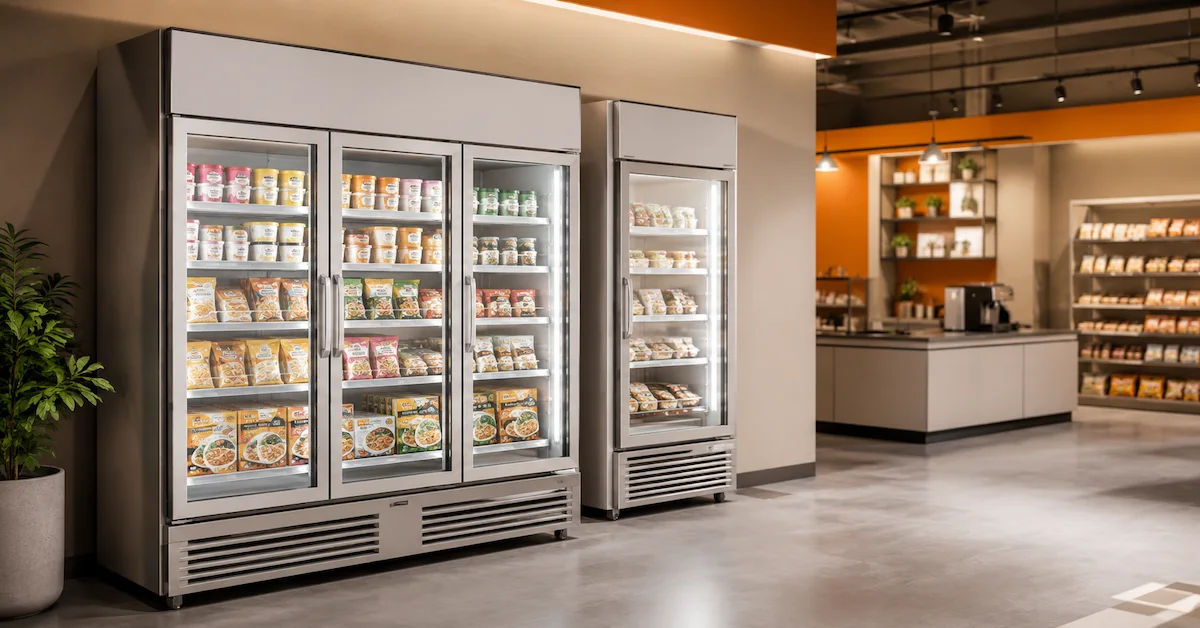
Glass-door freezers are suitable for stores where frozen products need to remain visible to customers.
They are commonly used for:
- Frozen food
- Packaged meals
- Ice cream
- Retail merchandising
Important factors include glass construction, LED lighting, sealing, and temperature stability.
Snowsea's glass door freezer wholesale supplier guide covers these considerations in more detail.
Upright Freezers
Upright freezers use vertical storage space efficiently and can help franchise locations organize products by shelf.
They are useful where floor space is limited.
See Snowsea's upright freezer wholesale supplier guide for additional sourcing guidance.
Chest Freezers
Chest freezers are suitable for applications requiring large frozen-storage capacity.
They may be used for:
- Back-of-house inventory
- Bulk frozen products
- Promotional frozen-food displays
Snowsea's chest freezer wholesale manufacturer guide explains important factors such as insulation, sealing, and temperature recovery.
Ice Cream Freezers
Ice cream and dessert franchises often require freezers that combine product protection with attractive merchandising.
Important considerations include:
- Display visibility
- Stable temperature
- Customer access
- Cabinet capacity
Buyers can review Snowsea's ice cream freezer wholesale supplier guide.
How to Build Freezer Packages for Different Store Formats
Not every franchise location needs exactly the same quantity of equipment.
A better approach is to create standardized freezer packages.
For example:
| Store Format | Example Equipment Package |
|---|---|
| Small Store | 1 upright freezer + 1 compact display freezer |
| Standard Store | 2 upright/display units + 1 chest freezer |
| Large Store | Multiple display, upright and storage freezers |
| Flagship Store | Full branded refrigeration package |
This allows headquarters to maintain approved specifications while adjusting equipment quantity to store size.
How Suppliers Support New Franchise Store Openings
Franchise expansion can create frequent but relatively predictable refrigeration demand.
A supplier should be able to support a process such as:
- Franchise location confirmed
- Store format selected
- Approved freezer package chosen
- Order placed
- Production or inventory allocated
- Delivery coordinated
- Installation and service documentation provided
A standardized process reduces repeated technical discussions for every new location.
Centralized Pricing and Repeat-Order Cost Control
Franchise brands should avoid allowing every franchisee to negotiate completely different equipment prices.
A more structured pricing model can include:
- Approved model pricing
- Quantity tiers
- Annual-volume discounts
- Regional shipping terms
- Replacement-unit pricing
- Spare-parts pricing
This provides franchisees with greater purchasing transparency.
Volume pricing should still be based on controlled specifications.
Snowsea's commercial freezer bulk order price guide explains how quantity, model mix, and production planning influence B2B freezer pricing.
OEM and Private Label Freezers for Franchise Brands
Franchise businesses often want refrigeration equipment to feel like part of the store rather than unrelated third-party equipment.
OEM customization may include:
- Logo
- Cabinet color
- Header graphics
- Model number
- Product labels
- Carton
- Manual
A strong private-label program should also control artwork versions.
Headquarters should provide approved:
- Logo files
- Color references
- Label layouts
- Position drawings
This reduces branding inconsistencies between production batches.
Quality Consistency Across Franchise Expansion
One of the most important requirements for a Commercial Freezer Supplier for Franchise is maintaining the same approved standard over time.
Franchise expansion may take several years.
During this period:
- Component suppliers may change
- Materials may change
- Regulations may change
- Production processes may improve
These changes should not happen without appropriate control.
Buyers should establish rules for critical components such as:
- Compressor
- Controller
- Refrigerant
- Fan motor
- Glass
- Door gasket
If a change becomes necessary, the supplier should document the reason and obtain approval when required.
Snowsea's commercial freezer quality testing procedure provides a broader framework for production and pre-shipment QC.
Delivery Planning for Multiple Franchise Locations
Franchise brands frequently open stores at different times.
This means one large shipment may not always be practical.
Possible delivery models include:
- Shipment directly to franchise location
- Central warehouse delivery
- Regional warehouse delivery
- Distributor fulfillment
- Phased export shipments
The correct model depends on geography, order volume, and logistics infrastructure.
Buyers should discuss:
- Production lead time
- Minimum shipment quantities
- Warehouse requirements
- Delivery frequency
- Emergency replenishment
Emergency Replacement and Replenishment
Equipment failures or unexpected store openings can create urgent demand.
Franchise headquarters should ask:
- Are standard models kept in stock?
- What is the lead time for replacement units?
- Can urgent orders be prioritized?
- Are major spare parts available?
A small number of standardized freezer models makes emergency replacement much easier.
Spare Parts and Warranty Management
A franchise network may operate hundreds or thousands of refrigeration units.
Without standardization, after-sales management can become complicated.
Headquarters should establish:
- Part-number systems
- Recommended spare-parts lists
- Warranty procedures
- Claim documentation
- Service responsibilities
Useful spare parts may include:
- Controllers
- Fan motors
- Door gaskets
- Hinges
- Handles
- LED components
Standardized service documentation can also help regional technicians identify the correct components.
How Franchise Procurement Differs From Chain Procurement
Franchise networks and corporate-owned chains have similar standardization goals, but ownership and purchasing responsibility differ.
| Area | Franchise Network | Corporate Chain |
|---|---|---|
| Store ownership | Independent franchisees | Parent company |
| Equipment purchasing | May be decentralized | Usually centralized |
| Standards | Controlled by headquarters | Controlled internally |
| Payment | Often individual franchisee | Usually corporate procurement |
| Delivery | Many individual destinations | Often centralized |
This means franchise suppliers need to support both headquarters-level standards and store-level ordering.
For corporate multi-store procurement, Snowsea's commercial freezer vendor for chains guide provides a related sourcing framework.
How to Evaluate a Commercial Freezer Supplier for Franchise
Franchise headquarters should use a repeatable supplier evaluation process.
| Evaluation Area | What Buyers Should Verify |
|---|---|
| Product range | Supports different store formats |
| Standardization | Maintains approved specifications |
| OEM capability | Supports brand consistency |
| Quality control | Reliable testing system |
| Production capacity | Supports network expansion |
| Pricing | Transparent repeat-order structure |
| Delivery | Supports multiple destinations |
| Spare parts | Standardized and available |
| Warranty | Clear process for franchisees |
| Documentation | Easy model and part identification |
| Change control | Approval for critical changes |
| Communication | Supports headquarters and store buyers |
The strongest supplier should make expansion easier, not create additional procurement complexity.
What Should Franchise Headquarters Include in an RFQ?
A franchise freezer RFQ should include:
- Franchise business type
- Current number of stores
- Planned expansion
- Store formats
- Required freezer categories
- Capacity requirements
- Temperature requirements
- Voltage and frequency
- Refrigerant requirements
- Brand customization
- Quantity per store format
- Estimated annual volume
- Destination regions
- Delivery model
- Quality requirements
- Spare-parts requirements
- Warranty expectations
- Replacement-unit requirements
This gives suppliers enough information to design a scalable procurement program.
FAQ
What is a commercial freezer supplier for franchise?
It is a supplier or manufacturer that supports standardized refrigeration equipment programs for franchise brands and their independently operated locations.
Why should franchise brands standardize freezer equipment?
Standardization simplifies store design, purchasing, maintenance, spare parts, warranty management, and future expansion.
Can different franchise store sizes use different freezer packages?
Yes. Headquarters can create approved equipment packages for small, standard, large, and flagship store formats.
Should franchisees buy freezers directly from the approved supplier?
They can. Some franchise systems allow approved direct purchasing, while others use headquarters or regional distributors.
Can commercial freezers carry franchise branding?
Yes. OEM programs can include cabinet colors, logos, labels, header panels, manuals, and packaging.
How can a franchise brand keep freezer quality consistent?
Use approved specifications, controlled components, reference samples, QC procedures, and formal approval for significant specification changes.
How should freezer warranties work across franchise stores?
Headquarters and the supplier should define claim procedures, service responsibility, required documentation, and spare-parts support before rollout.
Can suppliers deliver to multiple franchise locations?
Depending on logistics arrangements, suppliers may support central warehouses, regional distributors, or phased deliveries to multiple locations.
What happens when a franchise location needs an urgent replacement freezer?
The supplier and headquarters should establish replacement stock, standard models, emergency lead times, or regional inventory before large-scale rollout.
Can Snowsea support franchise refrigeration programs?
Snowsea supports commercial refrigeration and OEM/ODM projects for B2B buyers. Franchise brands can provide store formats, equipment requirements, rollout plans, annual volume, branding, and destination markets for evaluation.
Conclusion
Choosing the right Commercial Freezer Supplier for Franchise requires more than finding a supplier capable of shipping commercial freezers.
Franchise brands need a partner that can translate headquarters standards into repeatable equipment packages for independently operated locations.
Standardized models, controlled specifications, OEM branding, predictable pricing, phased delivery, spare-parts management, quality consistency, and reliable replacement support all contribute to a scalable refrigeration program.
For expanding franchise networks, the strongest supplier is one that can support both brand-level control and store-level purchasing as the number of locations grows.
Snowsea supports commercial refrigeration programs for global franchise and multi-store B2B buyers. Explore Snowsea's commercial refrigeration products, review its OEM/ODM solutions, or contact Snowsea with your franchise store formats, equipment requirements, rollout plan, annual volume, and target markets.