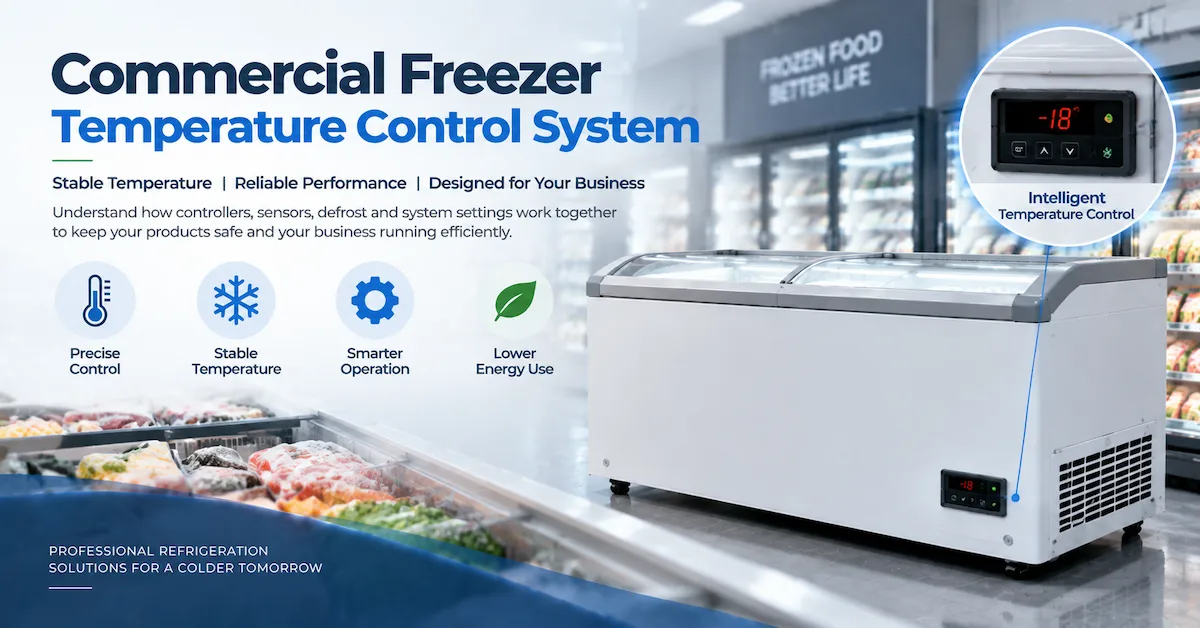
A commercial freezer temperature control system should be evaluated as part of the refrigeration system rather than as a digital display on the front of the cabinet. The controller reads one or more sensors, decides when refrigeration should operate, may coordinate fan or defrost functions, and determines how the freezer responds after loading, opening, power interruption or changing ambient conditions. For distributors, supermarket groups, restaurant-equipment suppliers and private-label brands, the important purchasing question is not simply whether the freezer has an electronic controller. It is whether the complete control strategy matches the intended products, cabinet structure, operating environment and refrigeration configuration. SNOWSEA offers multiple commercial freezer platforms, while buyers requiring model-specific control functions can discuss them through its OEM/ODM service.
What Is a Commercial Freezer Temperature Control System?
At its simplest, a freezer control system compares a measured temperature with a target and determines when cooling equipment should operate. In commercial refrigeration, however, the real system can involve several functions working together.
Depending on the freezer architecture, these may include the temperature controller, cabinet sensor, evaporator or defrost sensor, compressor relay or control output, fan control, defrost logic, restart delay, alarm functions, display parameters and fault handling.
That is why the controller should not be evaluated independently from the freezer.
A control system that works well on one cabinet may not produce identical performance on another cabinet with different insulation, evaporator arrangement, airflow, product load or refrigeration capacity.
SNOWSEA’s existing OEM freezer controller guide discusses controller configuration as an engineering issue involving sensors, compressor operation, defrost and temperature recovery rather than a cosmetic control-panel change.
Setpoint Temperature Is Not the Same as Product Temperature
One of the most important concepts for B2B buyers is the difference between:
Controller setpoint — the value the control system is trying to regulate around.
Sensor temperature — what the installed sensor measures at its location.
Cabinet-air temperature — which can vary across different parts of the freezer.
Product temperature — the actual temperature of the stored food or simulated product load.
These four values should not automatically be treated as identical.
A controller may display one temperature while another area inside the cabinet is warmer or colder. Likewise, frozen products have thermal mass, so their temperatures normally respond differently from rapidly changing cabinet air.
For this reason, buyers concerned about actual storage performance should combine controller review with appropriate temperature measurement rather than approving a freezer because its front display shows the desired number.
SNOWSEA’s commercial freezer temperature uniformity guide is a useful related reference when evaluating how measured temperatures differ across a cabinet.
Start With the Storage Requirement Before Selecting Controller Settings
A control specification should begin with the commercial application.
A restaurant reserve freezer, packaged ice cream display and no-frost storage cabinet can require different control behavior. Buyers should first define what the freezer needs to accomplish, then determine how the controller helps deliver that result.
| Requirement Area | Buyer Should Define | Supplier Should Confirm |
|---|---|---|
| Application | Frozen food,ice cream or defined commercial use | Suitable freezer platform |
| Required temperature | Product-storage requirement | Supported control range/configuration |
| Product load | Typical and maximum load | Test/loading conditions |
| Opening routine | Customer or staff access frequency | Recovery assumptions |
| Ambient environment | Expected operating temperature | Applicable operating conditions |
| Controller type | Mechanical or electronic requirement where relevant | Actual supplied controller |
| Sensor arrangement | Required measurement/control approach | Sensor quantity and position |
| Compressor control | Required operating behavior | Differential and restart logic |
| Defrost | Manual/no-frost system requirement | Control strategy |
| Fans | Where applicable | Fan operating logic |
| Alarm | If required | Functions and limits |
| Electrical version | Voltage/frequency | Correct controller/product version |
This gives purchasing a defined system to evaluate rather than asking for a generic “digital thermostat.”
Sensor Placement Can Change How the Controller Behaves
A controller only knows what its sensor tells it.
If a sensor is positioned near a particularly cold surface, its reading may not represent the warmest part of the useful storage space. If it is strongly influenced by door opening or warm incoming air, the control system may respond differently.
Sensor position should therefore be part of the freezer design.
For a forced-air or no-frost product, the relationship between sensor placement and airflow can also become important. For a chest freezer, stratification and cabinet geometry may affect how temperature varies vertically or horizontally.
The practical buyer question is not:
“Which sensor brand do you use?”
It is:
“Where does the control sensor measure temperature, why was that location selected, and how does the complete cabinet perform with that sensor position?”
That question connects the component with measured freezer behavior.
Temperature Differential Affects Stability and Compressor Operation
Many controllers do not switch the compressor on and off at exactly one temperature. They use a control differential or hysteresis so the refrigeration system is not commanded to switch continuously around a single value.
If the differential is extremely narrow, compressor cycling behavior may become undesirable depending on the system. If it is too wide, cabinet temperature swing may become greater than the application requires.
The correct setting depends on the freezer design, refrigeration system, sensor arrangement and target storage conditions.
Buyers should therefore avoid specifying an arbitrary differential without engineering review.
Instead, define the temperature-performance requirement and ask the manufacturer to confirm the controller parameters used to achieve it.
For more context on operating behavior, SNOWSEA’s commercial freezer compressor cycling guide explains why cycling should be evaluated at system level rather than judged from compressor operation alone.
Compressor Restart Delay Helps Protect the Control Strategy
Electronic controllers may incorporate a compressor restart delay after shutdown or power interruption.
The purpose of such logic is not simply to make the controller more sophisticated. Compressor and refrigeration-system operating conditions can require controlled restart behavior.
For a B2B project, ask whether the quoted freezer has a restart-delay function and whether that parameter is fixed, configurable or linked to the selected controller.
This is especially relevant when buyers request a different third-party controller or private-label user interface.Replacing the controller without reviewing its operating logic can change more than the appearance of the control panel.
Any OEM controller change should therefore be treated as a technical change requiring model-specific validation.
Temperature Recovery Is an Important Control-System Test
Commercial freezers experience disturbances: a lid opens, customers access products, new stock is loaded or a restaurant employee repeatedly removes ingredients.
The control system should respond to those changes as part of the complete refrigeration design.
Temperature recovery does not mean the controller immediately forces maximum cooling whenever the lid is opened. A useful recovery test evaluates how the cabinet returns toward its intended operating condition under defined conditions.
SNOWSEA’s temperature recovery guide discusses recovery as a system-level result involving refrigeration capacity, insulation, airflow, sealing, loading and control logic.
For procurement, record:
- Ambient condition
- Initial cabinet condition
- Product or simulated load
- Door/lid opening duration
- Measurement locations
- Recovery time or acceptance requirement
- Compressor/control behavior
- Final temperature condition
This gives the controller specification a real commercial purpose.
No-Frost Freezers Require More Than Simple Compressor Control
A no-frost freezer can add fan and defrost functions to the temperature-control strategy.
SNOWSEA’s BD/BC-227WA no-frost freezer is positioned as an air-cooled no-frost chest-freezer platform with electronic temperature control. That architecture creates additional control considerations compared with a simpler storage chest freezer.
These can include:
- Compressor control
- Fan operation
- Defrost initiation
- Defrost termination
- Sensor response
- Post-defrost recovery
- Fan delay where applicable
- Temperature display behavior during defrost
- Fault handling
The buyer should not assume that “electronic control” or “no frost” proves appropriate temperature stability.
Request the configuration and performance evidence for the actual freezer being ordered.
Mechanical Control vs. Electronic Control: Which Is Better?
Neither control type should automatically be described as universally better.
A simple mechanical control can be appropriate for products where straightforward operation is the priority. Electronic control can provide more configurable parameters, display functions, alarms or coordination with additional refrigeration functions.
| Comparison Area | Mechanical Control | Electronic Control |
|---|---|---|
| User interface | Usually simple | Digital/display-based |
| Parameter flexibility | More limited | Typically greater |
| Temperature display | May require separate indication | Often integrated |
| Defrost/fan coordination | Limited depending on design | Can support more functions |
| Alarm functions | Usually limited | Can be available |
| Service complexity | Often simpler | Requires controller/sensor diagnosis |
| OEM interface options | More limited | Potentially more flexible |
| Best choice | Depends on product design | Depends on product design |
The decision should follow application, refrigeration architecture, service capability and market expectation.
A distributor should not select electronic control simply because it appears more premium.
Compare Control Requirements Across Different Freezer Platforms
Different cabinet structures create different control priorities.
| SNOWSEA Platform | Published Starting Point | Main Temperature-Control Focus |
|---|---|---|
| BD-500 Chest Freezer | Larger chest-freezer storage platform | Stable storage control, compressor cycling and real loading |
| BD/BC-227WA No-Frost Freezer | Air-cooled no-frost electronic-control platform | Temperature, fan and defrost coordination |
| SD/SC-268PM Ice Cream Freezer | Flat sliding-glass frozen-display platform | Product holding, customer access and recovery |
These products serve different applications, so buyers should not compare their controllers without considering the cabinet and refrigeration function.
A display cabinet that experiences frequent customer access can need a different operational evaluation from a reserve-storage chest freezer opened infrequently.
How Should Temperature Control Be Tested?
A useful commercial freezer temperature-control test should reproduce enough of the intended application to make the result meaningful.
Record:
| Test Item | What to Document |
|---|---|
| Exact model | Production configuration tested |
| Controller | Model/version and settings |
| Sensor | Position and configuration |
| Ambient | Surrounding test condition |
| Load | Empty,actual or simulated product |
| Setpoint | Controller target |
| Measured temperatures | Cabinet/product measurement positions |
| Stabilization | When stable operation is considered reached |
| Cycling | Compressor operating behavior |
| Opening | Door/lid disturbance where required |
| Recovery | Response after disturbance |
| Defrost | Where applicable |
| Duration | Observation period |
| Pass criteria | Agreed acceptance requirement |
This approach is more useful than a photograph showing a controller at −18°C or another target value.
Temperature Uniformity and Control Accuracy Are Different
A controller can accurately measure and regulate its own sensor while the overall cabinet still has meaningful temperature variation.
That is why B2B buyers should distinguish:
Controller accuracy — how accurately the controller/sensor measures or responds.
Temperature stability — how much the measured condition changes over time.
Temperature uniformity — how much temperatures differ across the usable cabinet.
These are related but different performance characteristics.
A high-quality procurement specification should avoid writing one vague line such as:
“Temperature accuracy: ±X.”
unless it clearly defines what temperature is being measured, where and under which test conditions.
Calibration Should Be Controlled, Not Used to Hide a Design Problem
Electronic controllers may support calibration or sensor-offset parameters.
Calibration can be useful where a measurement system legitimately requires adjustment. It should not be used simply to make the display match a desired number while the cabinet itself remains poorly controlled.
If an offset is applied during production, ask whether the parameter is documented and whether the same method is used consistently.
For OEM products, control parameters should be part of the approved production specification where they materially affect operation.
That prevents one production batch from using different settings from the sample without disclosure.
Alarm Functions Can Add Value for Some B2B Applications
Not every chest freezer needs a sophisticated alarm package, but some commercial buyers may require functions such as:
- High-temperature alarm
- Low-temperature alarm
- Sensor-fault indication
- Door-open alarm where applicable
- Power-related alarm or restart behavior
- Visual or audible alert
Whether these features are necessary depends on the application.
For a basic wholesale storage freezer, excessive controller complexity can increase cost and service burden without delivering useful customer value.
For a branded commercial product serving professional operators, selected alarm functions may improve usability.
OEM buyers should specify which alarms are mandatory rather than requesting “all possible functions.”
High Ambient Conditions Can Affect Control-System Behavior
A controller does not create refrigeration capacity.
When ambient temperature becomes high, the refrigeration system may need to operate for longer periods to remove the increased heat load. Control settings that appear satisfactory under mild conditions should therefore be validated in the target operating environment.
SNOWSEA’s high ambient performance guide explains why temperature stability, recovery, condenser heat rejection and energy consumption should be reviewed together under demanding ambient conditions.
For hot-market OEM projects, do not simply lower the setpoint in an attempt to compensate for inadequate thermal performance.
The cabinet and refrigeration system must first be capable of meeting the requirement.
Control Logic Can Affect Energy Consumption, but Avoid Simple Savings Claims
Temperature control influences when compressors, fans or defrost systems operate, so the control strategy can affect electricity consumption.
However, energy consumption remains a whole-system result.
A tighter control differential does not automatically reduce electricity use. A longer compressor run is not automatically inefficient. More frequent defrost is not automatically better or worse.
Compare the complete freezer under equivalent conditions.
SNOWSEA’s commercial freezer energy efficiency guide explains that meaningful energy comparison requires aligned cabinet, temperature, ambient, loading and operating conditions.
For an OEM controller project, energy should be treated as a measured validation output rather than promised from one parameter change.
Common Temperature-Control Sourcing Mistakes
Mistake 1: Buying by Controller Brand Alone
A well-known controller cannot compensate for an incorrectly matched refrigeration system or poor sensor placement.
Mistake 2: Treating Display Temperature as Product Temperature
The displayed value reflects a defined sensor/control strategy and may not represent every package inside the freezer.
Mistake 3: Using the Same Settings for Every Cabinet
Different cabinet structures and refrigeration systems may require different parameters.
Mistake 4: Changing the Controller After Sample Approval
A different controller can alter sensing, compressor logic, defrost, alarm and interface behavior.
Mistake 5: Setting a Colder Target to Fix Weak Cooling
Lowering the controller setpoint does not create additional refrigeration capacity.
Mistake 6: Ignoring Field Service
A highly customized controller can become a service problem if distributors cannot identify replacement parts or parameters.
OEM Controller Customization Should Begin With Required Functions
A private-label buyer may want a custom controller for brand identity or market requirements.
Possible requests can include:
- Customized display appearance
- Button arrangement
- Temperature-unit display
- Setpoint limits
- Alarm limits
- Compressor delay
- Fan control
- Defrost parameters
- Sensor type
- Parameter locking
- Fault codes
- Private-label interface
SNOWSEA’s OEM controller customization guide provides a useful starting point for these discussions.
The correct workflow is:
application requirement → required controller functions → engineering evaluation → prototype → performance validation → parameter freeze → production release.
Not:
choose a controller first → force the refrigeration system to use it afterward.
How Should OEM Buyers Lock Controller Parameters for Mass Production?
After the sample has been validated, important controller settings should become part of the controlled product configuration.
Depending on the system, this may include:
- Setpoint range
- Control differential
- Compressor restart delay
- Sensor configuration
- Fan logic
- Defrost logic
- Alarm settings
- Calibration/offset
- Temperature units
- Parameter lock
The factory should know which version is approved.
If firmware, controller hardware or important parameter values change, request an engineering review to determine whether previous validation still applies.
This links controller quality to the same specification-control process used for the rest of an OEM freezer.
Controller Cost Should Be Evaluated Against Commercial Value
A more sophisticated controller can increase features, but every feature has to create value for the intended buyer.
Additional complexity may influence:
- Component cost
- Sample development
- Programming
- Validation
- Spare-parts inventory
- Service training
- Warranty diagnosis
The right controller is therefore not the one with the largest feature list.
It is the simplest control system that reliably meets the application and commercial requirements.
For distributors, serviceability can matter as much as the original hardware cost.
Spare Parts and Controller Replacement Need Version Control
If a controller fails in the field, the service team needs to know which replacement belongs to that freezer.
Maintain a cross-reference such as:
Private-label model → factory model → production revision → controller version → parameter configuration
SNOWSEA’s About Us information describes technical and spare-parts support for commercial refrigeration products. Buyers should still confirm controller-specific replacement arrangements for the exact model and market.
Do not assume two controllers with similar displays are interchangeable.
A replacement controller with different sensor input or parameter logic can change freezer behavior.
What Should You Send SNOWSEA for a Temperature-Control Project?
For a model-specific technical discussion,provide:
- Target country
- Freezer application
- Stored product
- Required temperature condition
- Capacity
- Cabinet type
- Ambient operating condition
- Product load
- Opening frequency
- Defrost requirement
- No-frost/manual system preference
- Current controller if replacing one
- Required display
- Required alarms
- Sensor requirements
- Compressor-control requirement
- Fan-control requirement where applicable
- OEM interface requirements
- Electrical version
- Sample quantity
- Bulk-order quantity
- Annual forecast where available
Submit the project through SNOWSEA Contact Us and request a model-specific controller and temperature-performance proposal rather than asking only for a “digital thermostat.”
Frequently Asked Questions
1. What is a commercial freezer temperature control system?
A commercial freezer temperature control system monitors temperature through sensors and controls refrigeration functions such as compressor operation; depending on freezer design, it may also coordinate fans, defrost, alarms and other functions.
2. Is the controller display the actual food temperature?
Not necessarily. The display normally reflects the control sensor or programmed display logic, while temperatures can differ elsewhere in the cabinet and inside stored products.
3.What is the difference between a thermostat and an electronic freezer controller?
A thermostat provides basic temperature-based switching, while an electronic controller can provide additional configurable functions such as digital display, delays, alarms, sensor settings, fan control or defrost control depending on design.
4. How does sensor placement affect freezer control?
The sensor measures conditions at its own location. Poor placement can cause the control system to respond to a temperature that does not adequately represent the intended storage area.
5. What is temperature differential or hysteresis?
It is the control range used between switching conditions rather than continuously switching at one exact temperature. The suitable differential depends on the refrigeration and application design.
6. Why does a freezer controller need compressor restart delay?
A restart delay can form part of the refrigeration control strategy after compressor shutdown or power interruption. The appropriate parameter should be defined for the actual freezer system.
7. How does temperature control work in a no-frost freezer?
A no-frost system can coordinate compressor, fan and defrost functions in addition to basic temperature sensing. The exact control strategy should be verified for the selected model, such as SNOWSEA’s BD/BC-227WA.
8. Can SNOWSEA customize freezer controllers for OEM projects?
SNOWSEA provides OEM/ODM support, and controller-related requirements can be evaluated as part of a model-specific project. Functions and feasibility should be confirmed before sample development.
9. Can controller settings improve freezer energy efficiency?
Control logic can influence system operation, but energy consumption depends on the complete freezer, including refrigeration design, cabinet insulation, loading and environment. Any improvement should be verified through comparable testing.
10.What should I verify before approving a freezer controller for mass production?
Verify the controller hardware/version, sensor arrangement, setpoint range, differential, compressor delay, fan and defrost logic where relevant, alarms, calibration settings, electrical configuration and performance of the complete freezer under agreed test conditions.
Conclusion
A commercial freezer temperature control system should be treated as part of the complete refrigeration design, not merely as a thermostat or front-panel display. B2B buyers should define the product-storage requirement first, then evaluate sensor placement, controller logic, compressor cycling, restart delay, temperature stability, uniformity, recovery, fan and defrost functions where applicable, alarms and serviceability under real operating conditions. For OEM and private-label projects, the approved controller version and key parameters should be tied to the same controlled specification used for mass production so later changes do not invalidate sample performance. SNOWSEA provides multiple commercial freezer platforms together with OEM/ODM development support for distributors, brands and project buyers. If you are developing a freezer around a specific temperature range, control interface or operating environment, send SNOWSEA your application, target temperature, ambient condition, controller requirements and expected quantity and request a model-specific temperature-control and performance evaluation.