Commercial refrigeration equipment often operates 24 hours a day, making electricity one of the largest ongoing expenses for supermarkets, restaurants, convenience stores, hotels, and cold storage facilities.
Many businesses focus on refrigeration capacity when selecting equipment, but long-term energy consumption can have a much greater impact on total ownership costs. An inefficient system may maintain acceptable temperatures while consuming significantly more electricity over its lifetime.
A properly engineered freezer energy consumption control strategy helps optimize cooling performance while reducing unnecessary power usage.
For businesses seeking to improve profitability, energy-efficient refrigeration is becoming increasingly important.
Common Causes of High Energy Consumption
Several factors can increase freezer power usage.
Common issues include:
- Poor insulation performance
- Inefficient airflow circulation
- Frequent compressor cycling
- Inadequate heat dissipation
- Door seal leakage
- Improper temperature settings
These problems can increase operating costs while reducing refrigeration efficiency.
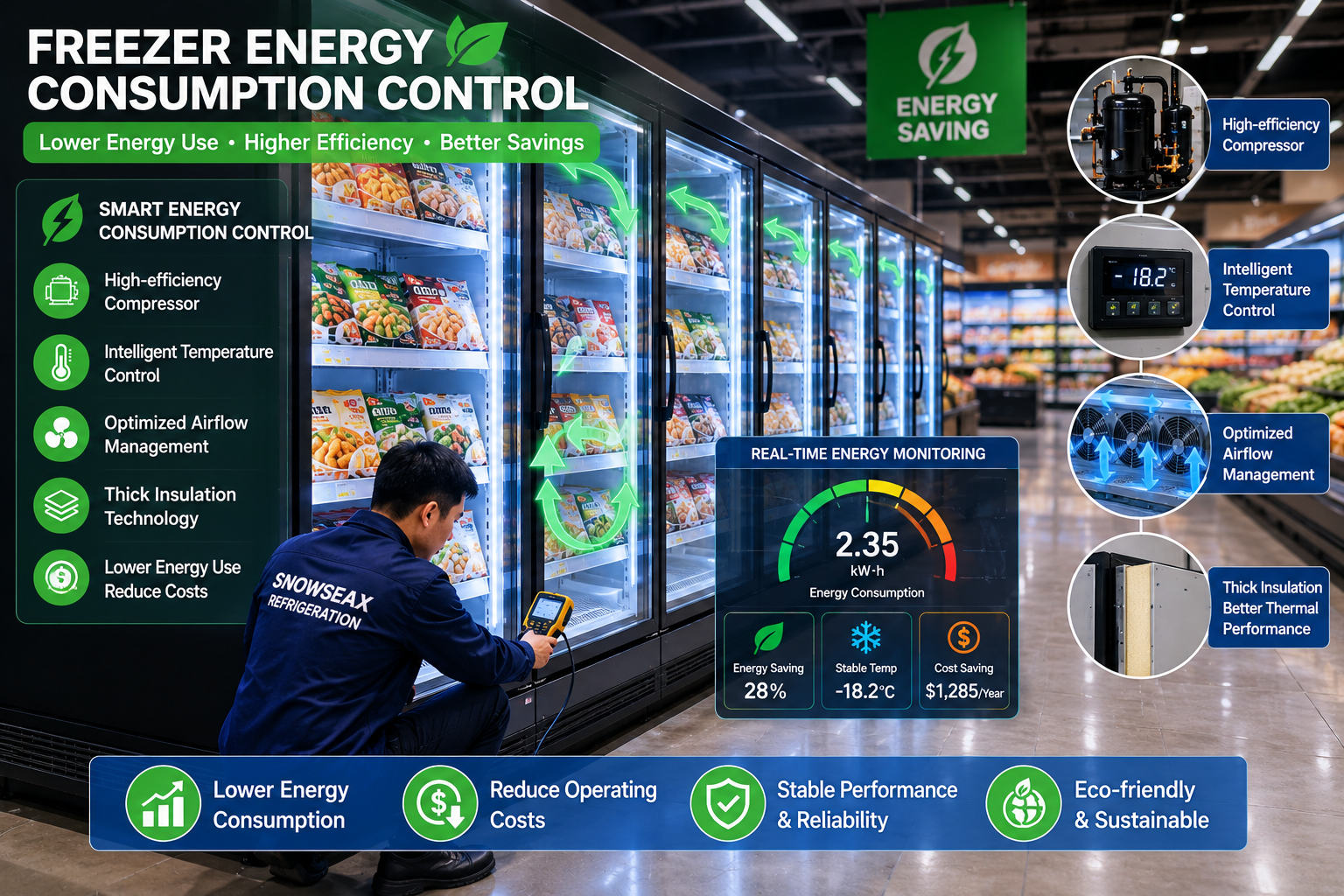
A modern freezer energy consumption control system helps minimize these inefficiencies through optimized refrigeration engineering.
How Energy Consumption Control Works
Commercial freezers use several technologies to improve energy performance.
High-Density Insulation Systems
Improved insulation reduces thermal transfer and compressor workload.
Intelligent Temperature Control
Digital control systems optimize cooling cycles based on operating conditions.
Efficient Airflow Management
Uniform airflow reduces cooling demand and improves temperature stability.
Advanced Compressor Technology
Modern compressors deliver higher cooling efficiency with lower power consumption.
Because of these features, a properly designed freezer energy consumption control solution can significantly reduce operating expenses.
Standard Freezer vs Energy-Optimized Freezer
| Feature | Standard Freezer | Freezer Energy Consumption Control |
|---|---|---|
| Electricity Usage | Higher | Lower |
| Compressor Efficiency | Standard | Optimized |
| Temperature Stability | Average | Improved |
| Cooling Recovery | Standard | Faster |
| Operating Cost | Higher | Reduced |
| Long-Term ROI | Moderate | Better |
The difference becomes increasingly significant in facilities operating multiple refrigeration units.
Solving Real Commercial Refrigeration Challenges
Rising Utility Costs
Energy expenses continue to increase for many commercial facilities.
Continuous Equipment Operation
Commercial freezers typically operate year-round without interruption.
Sustainability Goals
Businesses are increasingly focused on reducing energy consumption and environmental impact.
Temperature Stability Requirements
Efficient systems must still maintain reliable refrigeration performance.
A properly engineered freezer energy consumption control strategy helps address these challenges while supporting consistent cooling operation.
Key Advantages of Energy Consumption Control
Lower Electricity Costs
Reduced power consumption helps improve operational profitability.
Better Temperature Stability
Efficient cooling systems maintain more consistent storage conditions.
Reduced Compressor Workload
Optimized operation decreases component stress.
Improved Equipment Lifespan
Lower operating stress contributes to longer service life.
Enhanced Sustainability
Reduced energy usage supports environmental objectives.
For many businesses, freezer energy consumption control delivers both financial and operational benefits.
Common Commercial Applications
Energy-efficient refrigeration systems are widely used in:
- Supermarkets
- Convenience stores
- Restaurants
- Hotels
- Food processing facilities
- Cold storage warehouses
- Distribution centers
Businesses evaluating refrigeration suppliers should also consider engineering expertise and energy-saving technologies. Learn more about our refrigeration experience:
https://www.snowseax.com/about-us
How to Choose an Energy-Efficient Freezer
Evaluate Insulation Quality
Better insulation reduces refrigeration demand.
Review Compressor Specifications
High-efficiency compressors improve overall performance.
Assess Airflow Design
Proper airflow reduces temperature fluctuations.
Examine Control Systems
Intelligent controls help optimize cooling cycles.
Consider Total Ownership Cost
Long-term energy savings often outweigh initial purchase price differences.
Our commercial refrigeration product range includes solutions designed for retail, food service, and cold storage applications:
Choosing equipment with advanced freezer energy consumption control capabilities helps maximize refrigeration efficiency while minimizing long-term operating costs.
FAQ
Many businesses researching refrigeration equipment have questions about energy efficiency and operating expenses. Additional technical information can be found in our FAQ center:
Q1: Why is energy consumption important in commercial refrigeration?
Energy costs often represent one of the largest long-term operating expenses for refrigeration equipment.
Q2: Can energy-efficient freezers reduce operating costs?
Yes. Improved insulation, airflow management, and compressor efficiency can significantly lower electricity consumption.
Q3: Does energy efficiency affect cooling performance?
Modern refrigeration systems can improve both energy efficiency and cooling reliability simultaneously.
Q4: Which industries benefit most from energy-efficient refrigeration?
Supermarkets, restaurants, cold storage facilities, food processors, and distribution centers all benefit from lower energy costs.
Reducing Refrigeration Costs Through Smarter Energy Management
A modern freezer energy consumption control system helps businesses reduce electricity expenses, improve cooling efficiency, and maintain reliable refrigeration performance. By optimizing energy use throughout the refrigeration cycle, businesses can achieve lower operating costs while protecting valuable refrigerated products.
If you are planning a supermarket, restaurant, hotel, food processing, or cold storage project, our refrigeration specialists can help identify the most suitable solution for your application: