Every commercial freezer relies on a refrigeration cycle to remove heat from stored products and transfer it outside the cabinet. The efficiency of this process determines how effectively the system maintains target temperatures while minimizing energy consumption.
When refrigeration cycles operate inefficiently, compressors work harder, cooling recovery slows down, and operating costs increase. A properly optimized refrigeration cycle efficiency strategy helps improve cooling performance while reducing equipment stress.
For supermarkets, restaurants, convenience stores, cold storage warehouses, and food processing facilities, refrigeration cycle performance directly affects profitability and operational reliability.
Common Problems Caused by Inefficient Refrigeration Cycles
Poor system efficiency can create several operational challenges.
Common issues include:
- High electricity consumption
- Compressor overload
- Slow cooling recovery
- Uneven temperature distribution
- Increased maintenance requirements
- Reduced equipment lifespan
These problems often become more noticeable in high-volume refrigeration environments.
A modern system designed around refrigeration cycle efficiency helps solve these challenges while maintaining reliable cooling performance.
How the Refrigeration Cycle Works
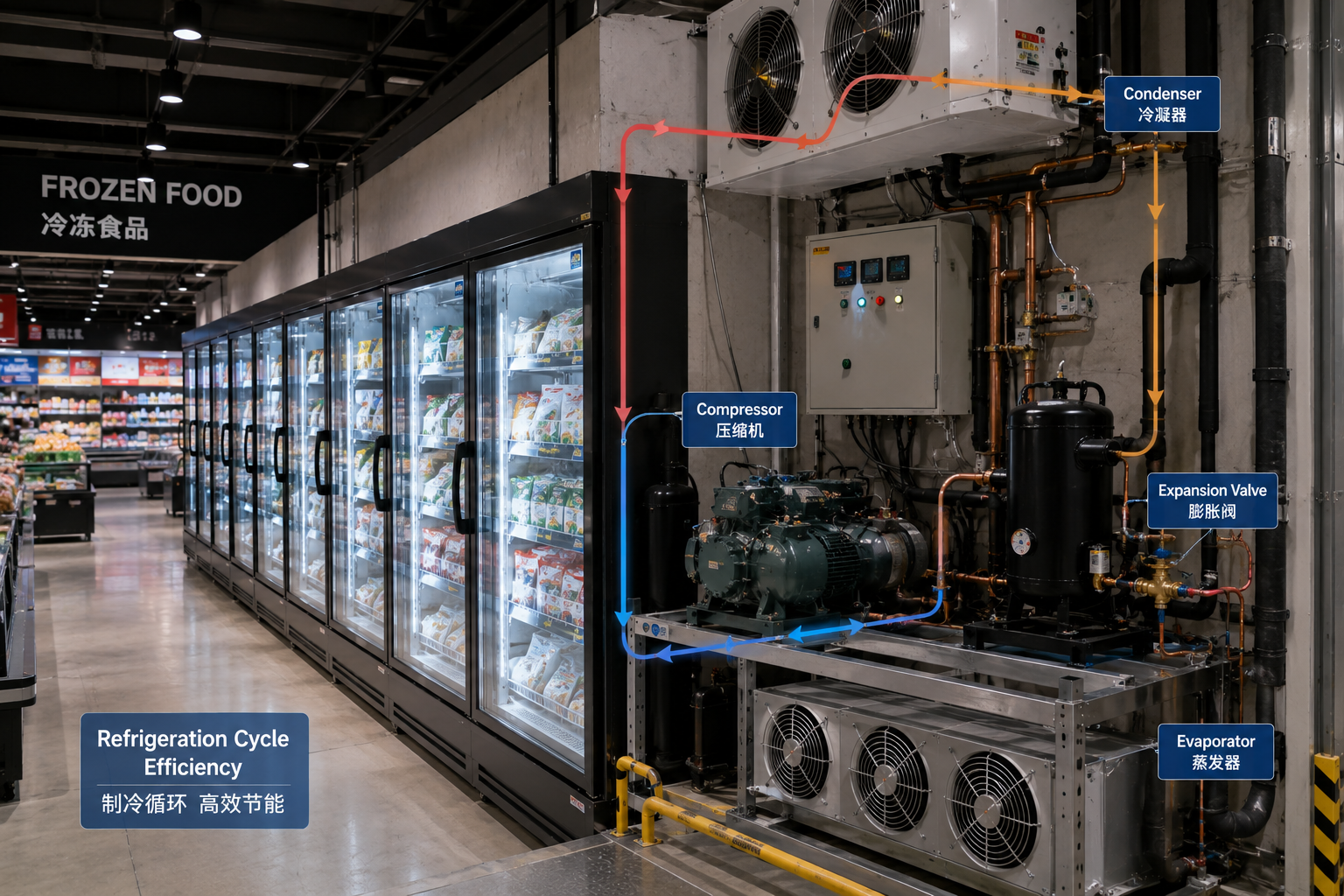
The refrigeration cycle continuously removes heat through four primary stages.
Compression
The compressor increases refrigerant pressure and temperature.
Condensation
The condenser releases heat into the surrounding environment.
Expansion
The expansion device reduces refrigerant pressure before cooling begins.
Evaporation
The evaporator absorbs heat from inside the freezer cabinet.
Because these components work together, improvements in refrigeration cycle efficiency can significantly impact overall refrigeration performance.
Standard Refrigeration System vs Optimized Cycle Efficiency
| Feature | Standard Refrigeration System | Optimized Refrigeration Cycle Efficiency |
|---|---|---|
| Energy Consumption | Higher | Lower |
| Cooling Recovery Speed | Moderate | Faster |
| Compressor Workload | Higher | Reduced |
| Temperature Stability | Average | Improved |
| Equipment Lifespan | Standard | Extended |
| Operating Cost | Higher | Lower |
The performance difference becomes increasingly important in commercial refrigeration applications.
Solving Real Commercial Refrigeration Challenges
Rising Energy Costs
Electricity consumption is often one of the largest operating expenses for refrigeration facilities.
Continuous Equipment Operation
Commercial freezers frequently operate 24 hours a day.
Heavy Product Loads
Large inventories require efficient heat removal.
Temperature Stability Requirements
Many products require precise storage temperatures.
A properly engineered refrigeration cycle efficiency solution helps address these challenges while improving refrigeration reliability.
Key Advantages of High Refrigeration Cycle Efficiency
Lower Energy Consumption
Efficient heat transfer reduces overall power demand.
Faster Temperature Recovery
Cooling systems return to target temperatures more quickly after door openings.
Better Product Protection
Stable temperatures help preserve product quality.
Reduced Maintenance Costs
Lower equipment stress decreases wear on refrigeration components.
Longer Equipment Lifespan
Optimized operation improves long-term reliability.
For many businesses, improved refrigeration cycle efficiency provides measurable financial and operational benefits.
Common Commercial Applications
Efficient refrigeration systems are widely used in:
- Supermarkets
- Convenience stores
- Restaurants
- Hotels
- Food processing facilities
- Cold storage warehouses
- Distribution centers
Businesses evaluating refrigeration suppliers should also consider engineering expertise and manufacturing capabilities. Learn more about our refrigeration experience:
https://www.snowseax.com/about-us
How to Improve Refrigeration Cycle Efficiency
Optimize Condenser Performance
Effective heat dissipation improves overall system efficiency.
Improve Evaporator Heat Transfer
Better heat absorption enhances cooling performance.
Upgrade Insulation Systems
Reduced thermal loss lowers refrigeration demand.
Maintain Proper Airflow
Uniform airflow improves cooling consistency.
Select High-Efficiency Components
Modern compressors and control systems improve energy performance.
Our commercial refrigeration product range includes solutions designed for retail, food service, and cold storage applications:
Selecting equipment focused on refrigeration cycle efficiency helps maximize cooling performance while reducing long-term operating costs.
FAQ
Many businesses researching refrigeration equipment have questions about cooling efficiency and energy performance. Additional technical information can be found in our FAQ center:
Q1: Why is refrigeration cycle efficiency important?
It affects cooling performance, energy consumption, operating costs, and equipment reliability.
Q2: Can refrigeration cycle efficiency reduce electricity costs?
Yes. Efficient heat transfer reduces compressor workload and overall power consumption.
Q3: Which component has the greatest impact on cycle efficiency?
The compressor, condenser, evaporator, and expansion device all contribute to overall efficiency.
Q4: Which industries benefit most from efficient refrigeration cycles?
Supermarkets, restaurants, food processors, cold storage facilities, and logistics centers all benefit from improved refrigeration efficiency.
Improving Cooling Performance Through System Efficiency
A modern refrigeration system designed around refrigeration cycle efficiency helps businesses reduce energy consumption, improve temperature stability, and support long-term refrigeration reliability. By optimizing heat transfer throughout the cooling cycle, businesses can improve operational performance while lowering ownership costs.
If you are planning a supermarket, restaurant, hotel, food processing, or cold storage project, our refrigeration specialists can help identify the most suitable solution for your application: