Understanding how to choose supermarket display freezer size is essential for supermarket operators, refrigeration distributors, convenience-store chains, food retailers, and commercial refrigeration project contractors.
The correct freezer size must provide enough storage and display capacity without occupying excessive floor space, restricting customer movement, or increasing electricity costs unnecessarily.
A freezer that is too small may cause:
- Frequent product replenishment
- Limited product selection
- Overloaded storage compartments
- Poor air circulation
- Reduced product visibility
- Lost sales during peak periods
A freezer that is too large may create:
- Higher purchasing costs
- Unnecessary energy consumption
- Wasted store space
- Lower product turnover
- Difficult installation
- Increased refrigeration load
The best decision should balance external dimensions, internal capacity, display area, product turnover, store layout, customer traffic, and future demand.
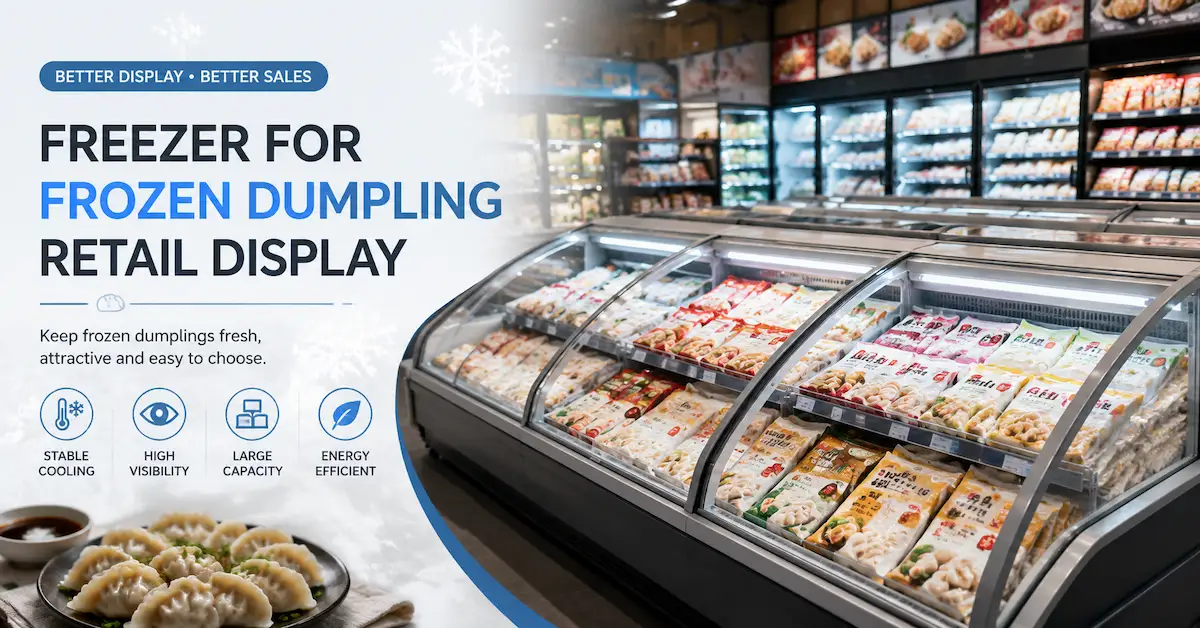
Snowsea supplies supermarket display freezers, island freezers, chest freezers, upright glass-door freezers, ice cream freezers, and customized commercial refrigeration equipment for different retail environments.
Why Freezer Size Matters in Supermarket Retail
A supermarket display freezer is both a storage unit and a merchandising tool.
It must keep products at a stable temperature while allowing customers to:
- See products clearly
- Compare different brands
- Reach products easily
- Move comfortably through the aisle
- Complete purchases efficiently
Freezer size directly affects:
| Area | Impact |
|---|---|
| Product capacity | Determines how much inventory can be displayed |
| Product visibility | Influences customer attention and sales |
| Floor-space use | Affects aisle width and store layout |
| Energy consumption | Larger units generally require more energy |
| Replenishment frequency | Smaller cabinets may need more frequent restocking |
| Installation | Dimensions affect doorways, corners, and access routes |
| Future expansion | Additional capacity may support business growth |
Buyers should not select a freezer only by its stated volume in liters. Two freezers with a similar volume may provide different usable display areas, shelf arrangements, basket configurations, and external dimensions.
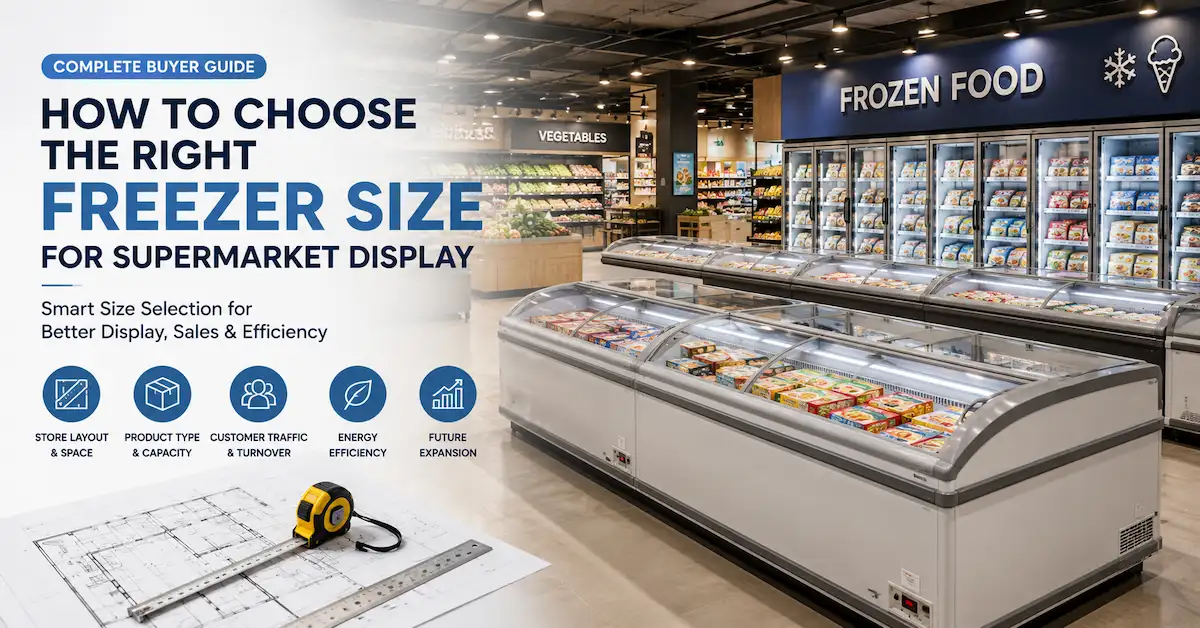
Step 1: Measure the Available Installation Space
The first step in learning how to choose supermarket display freezer size is measuring the actual installation area.
Record the available:
- Width
- Depth
- Height
- Aisle clearance
- Door-opening space
- Ventilation clearance
- Distance from walls
- Distance from heat sources
Measurements should be taken at the exact location where the freezer will be installed.
Buyers should also check:
- Store entrance dimensions
- Loading-door dimensions
- Elevator capacity
- Corridor width
- Turning radius
- Floor load capacity
A freezer may fit the sales area but still be impossible to move through the building entrance or delivery corridor.
Allow Space for Ventilation
Commercial freezers require sufficient airflow around the refrigeration system.
Insufficient ventilation can lead to:
- Higher compressor workload
- Increased power consumption
- Poor cooling performance
- Shorter component life
- Higher maintenance costs
The required clearance depends on the freezer design and condenser location. Buyers should confirm installation clearance with the manufacturer before finalizing the store layout.
Step 2: Identify the Products to Be Displayed
Different frozen products require different display formats and storage capacities.
Common supermarket categories include:
- Ice cream
- Frozen vegetables
- Frozen meat
- Seafood
- Frozen meals
- Pizza
- Desserts
- Packaged snacks
- Bulk frozen food
Product dimensions influence the usable freezer capacity.
For example, small ice cream packages can be arranged differently from large frozen meat cartons or family-size pizza boxes.
The buyer should provide the manufacturer with:
- Product category
- Package dimensions
- Number of SKUs
- Average package weight
- Desired display quantity
- Expected daily sales
This information helps determine whether an island freezer, chest freezer, or upright display freezer is more suitable.
Step 3: Calculate the Required Display Capacity
The required capacity should be based on actual inventory demand rather than an estimated freezer volume.
A simple planning method is:
Required display capacity = average daily sales × replenishment period × safety stock allowance
For example, a store selling 150 packages per day and replenishing every two days may need space for:
- 300 packages for normal sales
- Additional stock for peak demand
- Extra capacity to avoid overloading
Buyers should avoid filling a freezer beyond its recommended loading line.
Overloading can block airflow and cause:
- Uneven temperature distribution
- Slow temperature recovery
- Increased compressor operation
- Poor product visibility
- Potential product-quality risks
A practical freezer should provide enough capacity while leaving room for proper cold-air circulation.
Step 4: Compare External Dimensions and Usable Capacity
External size and internal capacity are not the same.
The external dimensions include:
- Cabinet walls
- Insulation
- Compressor compartment
- Condenser space
- Door frames
- Glass structures
- Control systems
Usable capacity refers to the practical space available for displaying products.
When comparing models, buyers should review:
| Specification | Why It Matters |
|---|---|
| External width | Determines required floor space |
| External depth | Affects aisle clearance |
| External height | Influences visibility and accessibility |
| Gross volume | General cabinet-capacity reference |
| Net volume | More accurate usable-space reference |
| Display area | Determines visible product quantity |
| Shelf or basket count | Affects product organization |
| Loading line | Shows maximum recommended fill level |
A larger gross volume does not always mean a better display solution.
Step 5: Choose the Appropriate Freezer Type
The correct size also depends on the freezer configuration.
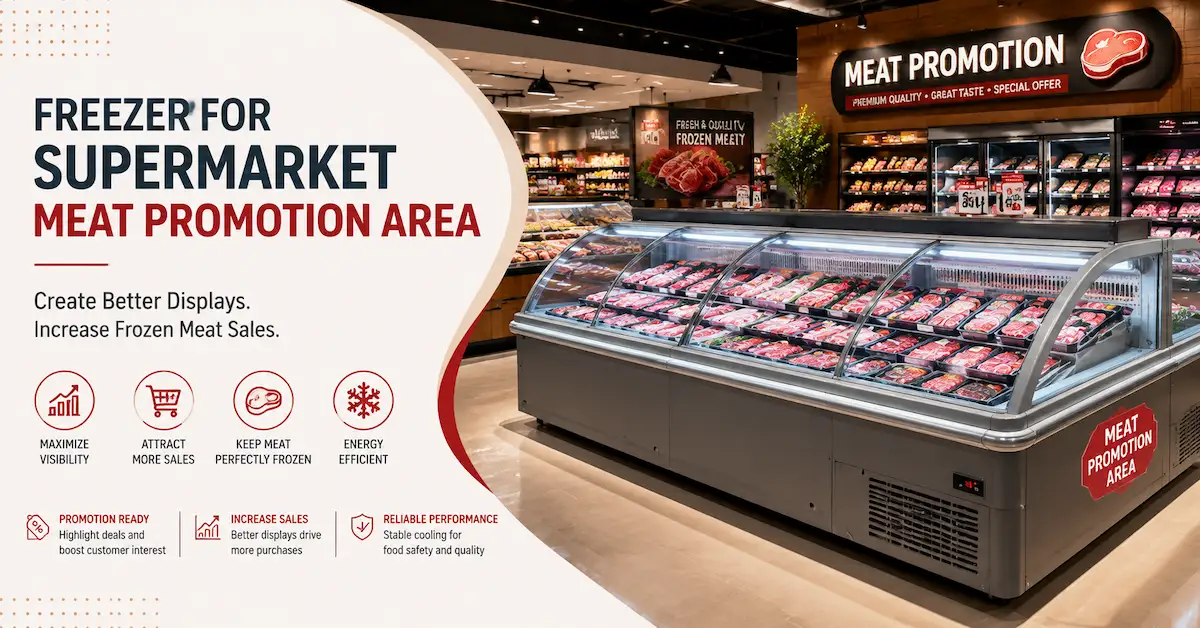
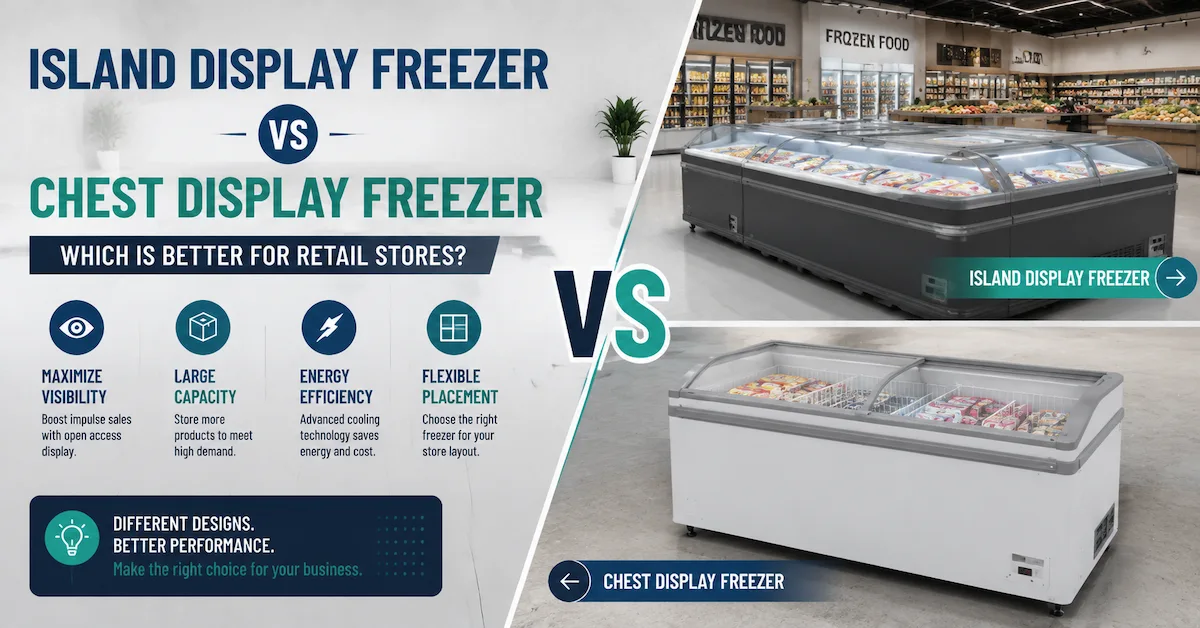
Island Display Freezers
Island freezers are commonly installed in central supermarket aisles.
They are suitable for:
- Frozen food promotions
- Meat and seafood
- Ice cream
- High-volume retail
- Self-service shopping
Advantages include:
- Wide display area
- Easy customer access
- Strong promotional visibility
- Flexible store placement
However, island freezers require significant floor space and sufficient aisle clearance around the unit.
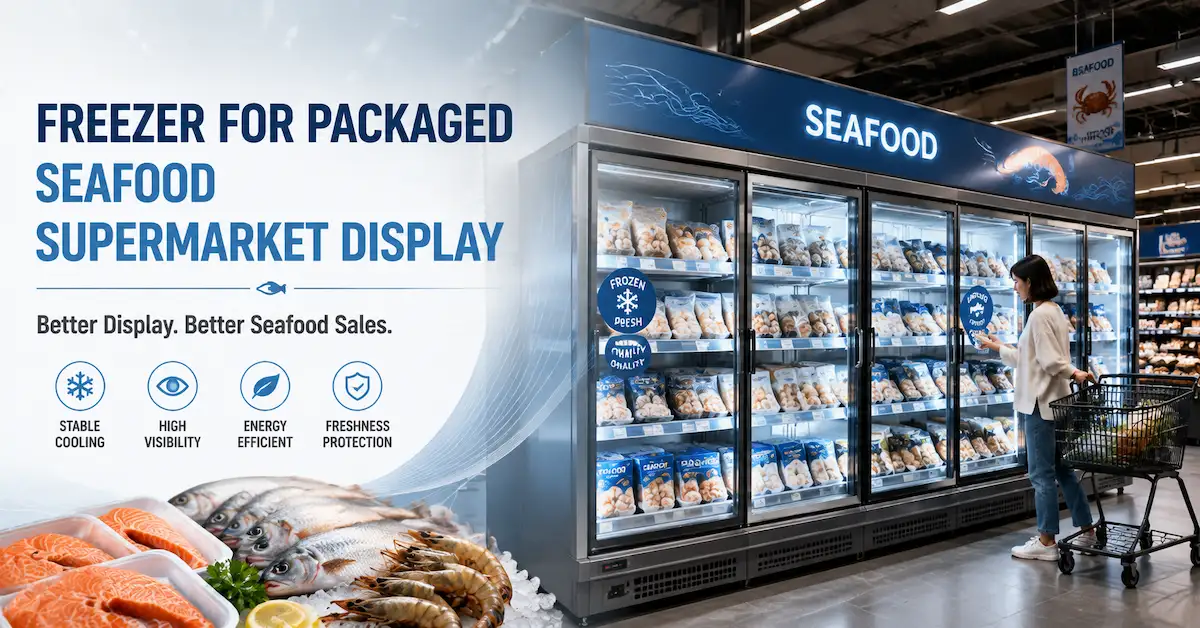
Upright Glass-Door Freezers
Upright freezers use vertical space efficiently.
They are suitable for:
- Packaged frozen meals
- Pizza
- Frozen vegetables
- Premium frozen products
- Organized multi-SKU displays
Advantages include:
- Smaller floor footprint
- Clear product organization
- Good customer visibility
- Easy category separation
The number of doors should be selected according to product volume and available wall space.
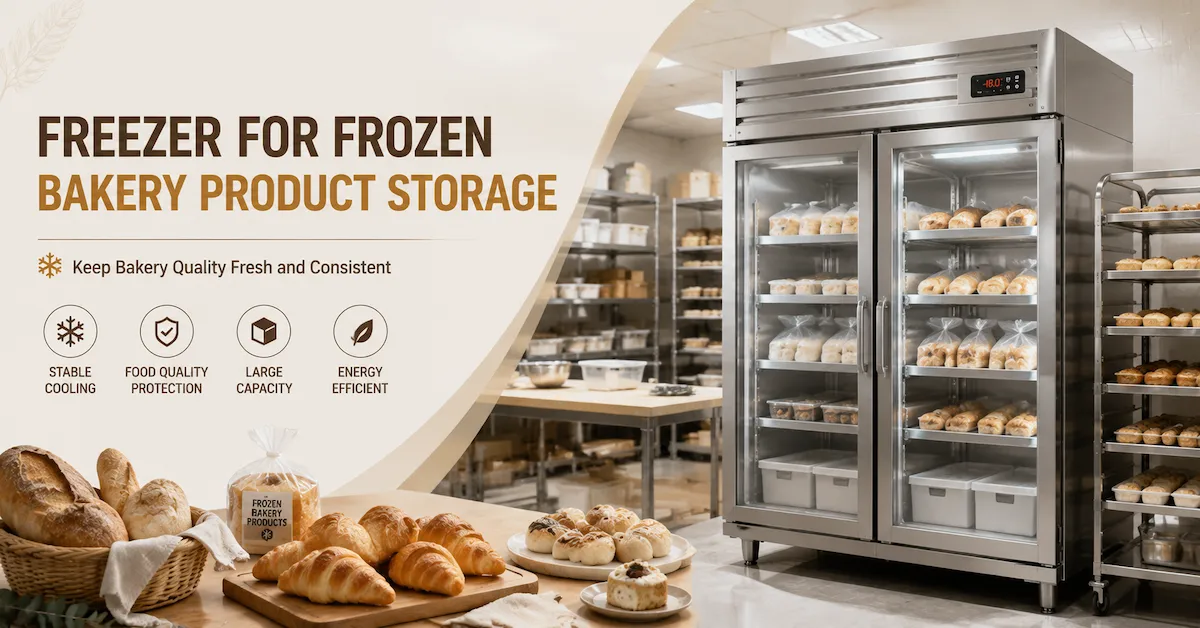
Chest Freezers
Chest freezers are suitable for bulk storage and value-focused retail.
They typically provide:
- Large storage capacity
- Simple construction
- Good cold retention
- Flexible basket arrangements
However, products stored at the bottom may be less visible or harder for customers to reach.
Ice Cream Display Freezers
Ice cream freezers often use sliding glass lids and internal baskets.
The correct size depends on:
- Number of flavors or brands
- Package dimensions
- Seasonal sales
- Promotional requirements
- Branding space
Buyers can review different options on Snowsea’s commercial refrigeration product page.
Step 6: Evaluate Store Traffic and Product Turnover
A high-traffic supermarket usually requires more display capacity than a small neighborhood store.
Important indicators include:
- Average daily customer count
- Weekend traffic
- Holiday demand
- Promotion frequency
- Product turnover
- Replenishment schedule
A busy store with fast-moving frozen products may benefit from:
- Larger display capacity
- Wider customer access
- More doors
- Multiple freezer zones
- Faster replenishment access
A low-traffic store may achieve better efficiency with a smaller freezer and carefully selected products.
Oversized freezers can appear empty when product turnover is low, which may reduce visual appeal and increase unnecessary energy use.
Step 7: Consider the Number of SKUs
The number of product varieties affects both freezer size and internal configuration.
A supermarket displaying many SKUs needs sufficient separation to prevent products from becoming mixed or difficult to find.
Buyers should calculate:
- Number of product categories
- Number of brands
- Number of package sizes
- Required facings per SKU
- Promotional stock requirements
An upright freezer with adjustable shelves may be better for organized SKU presentation.
An island freezer with dividers and baskets may be more suitable for high-volume packaged products.
The internal layout should allow customers to identify products quickly without moving other packages.
Step 8: Maintain Adequate Aisle Space
The freezer must not interfere with customer movement.
Buyers should consider:
- Shopping-cart width
- Two-way customer traffic
- Shelf access opposite the freezer
- Emergency access
- Cleaning access
- Restocking activities
A wide island freezer installed in a narrow aisle may create congestion, especially during busy periods.
The store layout should provide enough space for customers to stop, open freezer doors or lids, compare products, and continue moving through the aisle.
Door swing must also be considered for upright freezers with hinged glass doors.
Step 9: Compare Door and Lid Configurations
The number and type of doors affect the overall dimensions and customer access.
Common options include:
- Sliding glass lids
- Curved glass lids
- Hinged glass lids
- Single glass doors
- Double glass doors
- Three-door upright cabinets
- Multi-door freezer lines
Sliding lids are useful where aisle space is limited because they do not project outward.
Hinged doors may provide wider access but require additional clearance.
For upright freezers, more doors generally provide:
- Greater capacity
- More product categories
- Wider display area
However, they also increase external width and may require more installation space.
Step 10: Consider Energy Consumption
A larger freezer generally has a higher refrigeration load, but energy performance also depends on:
- Compressor efficiency
- Insulation thickness
- Door design
- Glass quality
- Defrost system
- Lighting
- Ambient temperature
- Door-opening frequency
- Product loading
The correct freezer size should match the actual inventory requirement.
An oversized, partially empty freezer may waste energy, while an overloaded small freezer may operate continuously to maintain temperature.
Buyers should compare energy performance under realistic operating conditions rather than relying only on cabinet dimensions.
Step 11: Evaluate Ambient Conditions
The store environment affects freezer performance.
Important factors include:
- Indoor temperature
- Relative humidity
- Air-conditioning
- Direct sunlight
- Nearby cooking equipment
- Store entrance airflow
- Customer traffic
A freezer installed near a sunny window, entrance, oven, or heating source may need more refrigeration capacity.
Buyers operating in hot or humid markets should inform the manufacturer of the expected ambient conditions.
This helps the manufacturer recommend an appropriate compressor, condenser, glass structure, and refrigeration configuration.
Step 12: Plan for Seasonal Demand
Frozen-product demand can change significantly during:
- Summer
- Holidays
- Promotional events
- Tourist seasons
- New product launches
Ice cream retailers may experience strong summer demand, while frozen meat and prepared-food sales may increase before holidays.
Buyers should estimate peak demand rather than selecting a freezer based only on average monthly sales.
However, purchasing a permanently oversized unit for a short seasonal period may not be economical.
Alternative solutions include:
- Temporary promotional freezers
- Modular freezer arrangements
- Additional small units
- Flexible product allocation
- Seasonal rental programs
Step 13: Consider Future Store Growth
A new supermarket may begin with limited product volume but expand its frozen-food category later.
Future planning should consider:
- Additional SKUs
- Higher customer traffic
- New store locations
- Seasonal promotions
- Private-label products
- Expanded frozen-food categories
A slightly larger cabinet may provide useful growth capacity, but excessive unused volume should still be avoided.
Modular freezer systems can allow stores to add more units as demand increases.
Recommended Freezer Types by Store Format
| Store Format | Recommended Direction |
|---|---|
| Small convenience store | Compact upright or chest freezer |
| Neighborhood supermarket | Medium upright and chest freezer combination |
| Large supermarket | Multi-door upright and island freezer zones |
| Hypermarket | Multiple large island and wall-mounted freezer lines |
| Specialty frozen-food store | High-capacity display freezer system |
| Ice cream shop | Branded sliding-glass display freezer |
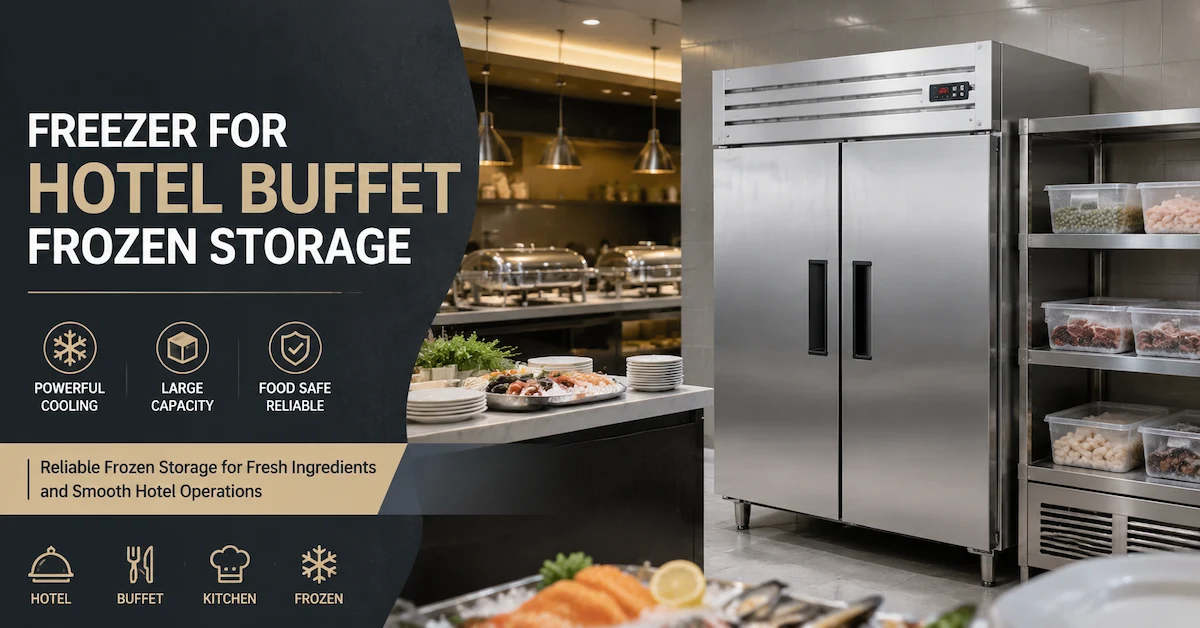
| Meat and seafood retailer | Chest, island, or heavy-duty storage freezer |
The final selection should be based on actual measurements and product requirements.
Supermarket Display Freezer Measurement Checklist
Before requesting a quotation, buyers should provide:
| Information | Details to Confirm |
|---|---|
| Installation width | Maximum available width |
| Installation depth | Maximum cabinet depth |
| Installation height | Ceiling and signage clearance |
| Aisle width | Customer and cart movement |
| Access route | Door, corridor, and elevator dimensions |
| Product category | Ice cream, meat, frozen meals, seafood |
| Package dimensions | Width, depth, and height |
| Number of SKUs | Product varieties to display |
| Daily sales | Expected product turnover |
| Replenishment cycle | Daily, every two days, or weekly |
| Voltage | Destination-market standard |
| Ambient temperature | Expected store environment |
| Future growth | Planned product expansion |
Providing these details helps the manufacturer recommend the correct model and configuration.
Common Freezer Sizing Mistakes
Choosing Only by Liter Capacity
Volume does not show the actual display area or product organization.
Ignoring External Dimensions
A freezer may offer sufficient capacity but occupy too much aisle space.
Forgetting Ventilation Clearance
Insufficient airflow can reduce cooling efficiency and component life.
Not Measuring the Delivery Route
Large units may not pass through entrances, elevators, or corridors.
Overlooking Door-Swing Space
Hinged doors require enough room for customers to open them safely.
Ignoring Product Turnover
A large freezer may not be necessary when products are replenished frequently.
Selecting a Freezer That Is Too Small
Overloading can obstruct airflow and reduce product visibility.
Failing to Consider Future Demand
A store may outgrow the freezer shortly after installation.
How Snowsea Supports Supermarket Freezer Selection
Snowsea provides commercial refrigeration solutions for supermarkets, frozen-food retailers, distributors, convenience stores, and retail-project contractors.
Support may include:
- Freezer model recommendations
- Dimension and capacity selection
- Store-layout consultation
- Product-display planning
- OEM logo and cabinet customization
- Shelf and basket configuration
- Voltage and plug customization
- Quality inspection
- Export packaging
- Bulk-order production
For supermarket projects with special dimensions, colors, branding, or internal layouts, buyers can review Snowsea’s OEM and ODM refrigeration solutions.
FAQ
How do I choose the right freezer size for a supermarket?
Measure the available installation space, calculate product volume, identify the number of SKUs, estimate product turnover, and allow sufficient ventilation and aisle clearance.
Is freezer capacity measured by external size or internal volume?
External dimensions determine floor-space requirements, while net internal volume and display area determine practical product capacity.
What freezer type uses supermarket space most efficiently?
Upright glass-door freezers use vertical space efficiently, while island freezers provide larger horizontal displays and strong promotional visibility.
Should I choose a larger freezer for future growth?
Allow some additional capacity for future demand, but avoid purchasing a significantly oversized unit that increases energy use and occupies unnecessary space.
How much space should be left around a commercial freezer?
The required ventilation clearance depends on the product design and condenser location. Buyers should follow the manufacturer’s installation instructions.
What information should I send to a freezer manufacturer?
Provide installation dimensions, product type, package size, quantity, daily turnover, temperature requirements, voltage, ambient conditions, destination, and customization requirements.
Conclusion
Understanding how to choose supermarket display freezer size helps retailers balance product capacity, customer access, merchandising performance, energy consumption, and store-space efficiency.
The correct selection should be based on available installation space, product dimensions, number of SKUs, daily sales, replenishment frequency, store traffic, ventilation requirements, and future growth.
Snowsea supplies commercial display freezers, island freezers, chest freezers, upright freezers, and customized supermarket refrigeration solutions.
Explore Snowsea’s commercial refrigeration products or submit your store dimensions and product requirements through the OEM and ODM service page for a suitable freezer recommendation.