For importers, distributors, supermarket equipment buyers, restaurant suppliers, frozen food brands, and private label refrigeration companies, comparing no frost vs manual defrost freezer options is an important step before placing bulk orders.
Both freezer types are used in commercial refrigeration, but they are designed for different business needs. A no frost freezer helps reduce ice buildup and maintenance work. A manual defrost freezer is often valued for simpler structure, stable storage performance, and cost efficiency in certain applications.
Choosing the wrong defrost system may lead to higher maintenance cost, poor user experience, reduced storage efficiency, or customer complaints. This guide explains how B2B buyers should compare no frost and manual defrost freezers before sourcing from a commercial freezer manufacturer.
Snowsea provides commercial refrigeration products including chest freezers, no frost freezers, display freezers, ice cream freezers, refrigerators, beverage coolers, and showcase cabinets. For buyers who need OEM/ODM freezer solutions, Snowsea supports product customization, private label branding, quality inspection, and export-ready packaging.
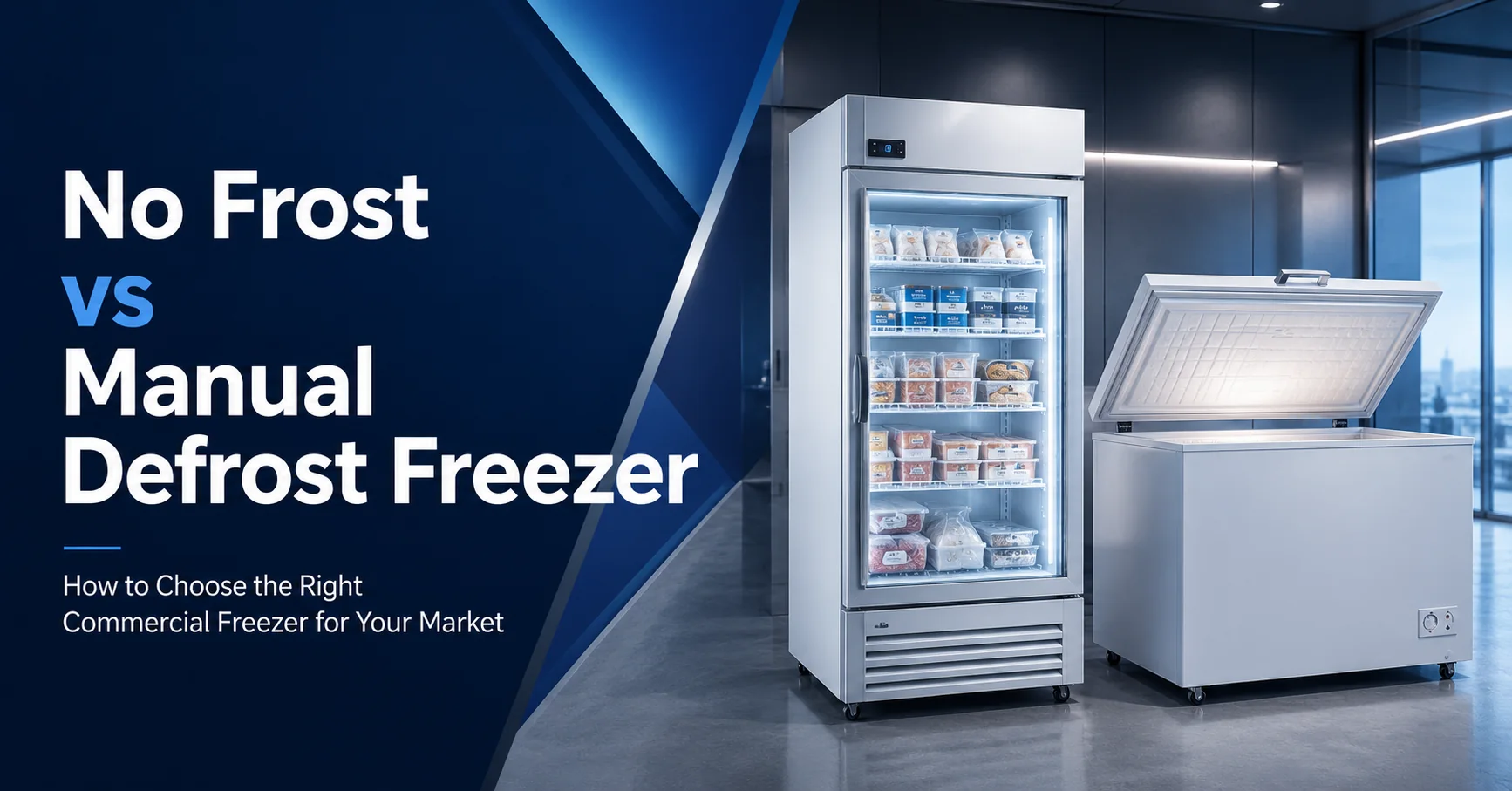
No Frost vs Manual Defrost Freezer: Quick Comparison
| Comparison Point | No Frost Freezer | Manual Defrost Freezer |
|---|---|---|
| Defrost Method | Automatic frost control | Requires manual ice removal |
| Maintenance | Lower daily maintenance | Needs scheduled defrosting |
| Best Use | Retail, supermarkets, frequent access | Storage, warehouses, lower access frequency |
| User Convenience | Higher | Lower |
| Structure | More complex system | Simpler system |
| Cost | Usually higher | Usually more cost-effective |
| Temperature Stability | Good with proper airflow design | Strong for long-term storage when managed well |
| Storage Space | Less ice buildup helps preserve usable space | Ice buildup may reduce usable space over time |
| Suitable Buyers | Supermarkets, retailers, convenience stores | Distributors, frozen food storage, backup storage |
The better choice depends on your application, maintenance expectations, budget, product type, and target customer group.
What Is a No Frost Freezer?
A no frost freezer uses an automatic defrost system to reduce frost buildup inside the cabinet. It usually relies on airflow circulation and defrost control to keep the internal environment cleaner and easier to maintain.
No frost freezer models are suitable for commercial buyers who want convenience, cleaner storage, and reduced manual maintenance.
Common applications include:
- Supermarkets
- Convenience stores
- Frozen food retail
- Beverage and chilled/frozen display zones
- Restaurants with frequent access
- Private label freezer product lines
- Retail equipment distribution
For buyers selling to retail customers, no frost freezers can provide a better daily user experience because users do not need to stop operation frequently for manual defrosting.
What Is a Manual Defrost Freezer?
A manual defrost freezer requires users to remove accumulated frost manually after a period of operation. This type of freezer has a simpler structure and is widely used in commercial frozen storage.
Manual defrost freezer models are suitable for buyers who prioritize cost efficiency, storage capacity, and simple operation.
Common applications include:
- Frozen food storage
- Meat and seafood storage
- Restaurant backup storage
- Distributor warehouses
- Bulk frozen inventory
- Chest freezer projects
- Price-sensitive commercial channels
Manual defrost freezers can be practical when products are not accessed too frequently and users can follow regular maintenance schedules.
When Should Buyers Choose a No Frost Freezer?
1. When Maintenance Convenience Matters
No frost freezers are suitable for buyers whose customers prefer lower maintenance. In retail environments, staff may not have time to stop the freezer, remove products, defrost ice, clean water, and restart operation.
A no frost system helps reduce this maintenance burden.
2. When the Freezer Is Opened Frequently
Supermarkets, convenience stores, and food service areas often open freezer doors many times per day. Frequent opening can increase moisture entry and frost buildup.
A no frost freezer is usually more suitable for these high-access environments.
3. When Clean Appearance Matters
For customer-facing display or retail equipment, frost buildup may reduce product visibility and make the freezer look poorly maintained.
No frost models help keep the cabinet cleaner and more professional.
4. When Buyers Sell to Higher-End Retail Channels
Retailers, chain stores, and branded frozen food companies may prefer no frost freezers because they improve user convenience and reduce daily service work.
When Should Buyers Choose a Manual Defrost Freezer?
1. When Cost Efficiency Matters
Manual defrost freezers are often more cost-effective because their structure is simpler. For bulk buyers, this can be important when targeting price-sensitive markets.
2. When Products Are Stored Long-Term
If the freezer is mainly used for bulk storage and is not opened frequently, manual defrost models can be practical and reliable.
This is common for:
- Meat storage
- Seafood storage
- Frozen vegetable storage
- Frozen meal inventory
- Restaurant backup storage
- Distributor warehouses
3. When Buyers Need Simple Operation
Some customers prefer simpler equipment with fewer system components. Manual defrost freezers may be easier to understand and maintain in certain markets.
4. When Chest Freezer Projects Are the Main Focus
Many chest freezer projects use manual defrost systems because they are practical for frozen storage and bulk commercial use.
No Frost vs Manual Defrost Freezer for Different Applications
| Application | Better Choice | Reason |
| Supermarket display | No Frost Freezer | Cleaner cabinet and lower maintenance |
| Convenience store | No Frost Freezer | Frequent access and better user convenience |
| Frozen food warehouse | Manual Defrost Freezer | Bulk storage and cost efficiency |
| Restaurant backup storage | Manual Defrost or No Frost | Depends on access frequency |
| Meat and seafood storage | Manual Defrost Freezer | Stable storage and bulk capacity |
| Frozen food brand retail display | No Frost Freezer | Better appearance and customer-facing value |
| Distributor product catalog | Both | Covers different customer needs |
| Private label freezer line | Both | Supports different price and market segments |
For importers and distributors, offering both no frost and manual defrost freezer options can help cover more customer groups.
Key Technical Factors Buyers Should Compare
1. Temperature Stability
Both freezer types must maintain stable low temperature. Buyers should check:
- Temperature range
- Cooling recovery speed
- Door sealing performance
- Compressor configuration
- Insulation structure
- Digital temperature control
- Ambient environment adaptability
Stable freezing is essential for frozen food, seafood, meat, ice cream, and frozen desserts.
2. Defrost System Design
For no frost models, buyers should confirm how the automatic defrost system works and whether it is suitable for commercial use.
For manual defrost models, buyers should understand defrost frequency and maintenance requirements.
3. Energy Use
No frost systems may include additional airflow and defrost components. Manual defrost systems may be simpler, but heavy frost buildup can reduce efficiency if not maintained properly.
Buyers should compare energy performance based on real use, not only catalog data.
4. Storage Layout
No frost freezers are often used in upright or display-style cabinets. Manual defrost freezers are common in chest freezer and bulk storage models.
Storage layout should match product packaging, restocking habits, and customer access needs.
5. Maintenance Requirements
No frost freezers reduce manual defrost work, while manual defrost freezers require scheduled cleaning and ice removal.
Buyers should choose based on their customers’ maintenance capability.
OEM/ODM Customization Options
For importers, distributors, and private label buyers, freezer customization is often necessary.
Snowsea can support OEM/ODM options such as:
- No frost or manual defrost configuration
- Logo customization
- Cabinet color
- Product labels
- User manuals
- Carton design
- Glass door or solid door options
- Basket and divider layout
- Shelf layout
- Voltage and plug adaptation
- Private label packaging
- Export packaging support
For OEM/ODM freezer projects, buyers can visit:
https://www.snowseax.com/oem-odm
Buying Checklist: No Frost vs Manual Defrost Freezer
Before requesting a quotation, buyers should prepare:
| Information to Prepare | Why It Matters |
| Target market | Confirms voltage, plug, labels, and packaging |
| Defrost preference | No frost, manual defrost, or both |
| Application | Retail display, storage, restaurant, distributor, supermarket |
| Product category | Meat, seafood, frozen food, ice cream, frozen meals |
| Size or capacity | Matches storage volume and floor space |
| Temperature range | Ensures correct freezing performance |
| Branding needs | Logo, color, labels, carton design |
| Order quantity | Affects quotation and production planning |
| Export packaging | Reduces shipping damage risk |
| Delivery schedule | Supports production and shipment planning |
Clear information helps Snowsea recommend suitable freezer models faster.
Common Mistakes When Choosing Defrost Type
Mistake 1: Only Comparing Price
Manual defrost may have a lower initial cost, but if users cannot maintain it properly, frost buildup may create problems. No frost may cost more, but can reduce daily maintenance.
Mistake 2: Ignoring Access Frequency
A freezer opened many times per day usually needs better frost control. For low-access storage, manual defrost may be enough.
Mistake 3: Choosing the Wrong Model for Retail Display
For customer-facing display, frost buildup can reduce product visibility. No frost or better display-oriented freezer design may be more suitable.
Mistake 4: Forgetting OEM Details
Logo, cabinet color, labels, packaging, voltage, plug type, and user manual should be confirmed before production.
Mistake 5: Not Checking Export Packaging
Commercial freezers may include glass, compressors, wheels, baskets, shelves, and controllers. Strong packaging is important for international shipment.
Why Snowsea Can Support Freezer Buyers
Snowsea focuses on commercial refrigeration equipment for frozen food storage, supermarket refrigeration, convenience store cooling, ice cream display, restaurant storage, and food service applications.
For no frost and manual defrost freezer projects, Snowsea can support:
- No frost freezer options
- Manual defrost freezer options
- Chest freezer solutions
- Upright freezer options
- Display freezer customization
- Ice cream freezer solutions
- OEM/ODM customization
- Private label branding
- Cabinet size and structure customization
- Basket and shelf layout options
- Temperature control configuration
- Export packaging support
- Quality inspection before shipment
Buyers can learn more about Snowsea here:
https://www.snowseax.com/about-us
FAQ
1. Which is better, no frost or manual defrost freezer?
A no frost freezer is better for lower maintenance and frequent access. A manual defrost freezer is often better for cost-effective bulk storage and lower access frequency.
2. Is no frost suitable for commercial freezers?
Yes. No frost freezers are suitable for retail, supermarkets, convenience stores, and applications where reduced maintenance is important.
3. Is manual defrost suitable for bulk storage?
Yes. Manual defrost freezers are commonly used for frozen food, seafood, meat, and warehouse storage when maintenance schedules are manageable.
4. Can I customize both no frost and manual defrost freezers?
Yes. Snowsea supports logo, cabinet color, labels, basket layout, shelf layout, packaging, voltage, and plug customization.
5. What information should I prepare for a quotation?
Prepare target market, defrost type, freezer type, application, size, temperature range, branding needs, quantity, voltage, plug type, and packaging requirements.
Conclusion
The choice between no frost vs manual defrost freezer depends on maintenance needs, access frequency, product type, storage environment, budget, and target customer group.
No frost freezers are suitable for retail environments, frequent access, and lower maintenance requirements. Manual defrost freezers are practical for bulk storage, cost-sensitive channels, and applications where scheduled defrosting is acceptable.
Snowsea provides no frost freezers, manual defrost freezers, chest freezers, upright freezers, display freezers, ice cream freezers, refrigerators, beverage coolers, and showcase cabinets for different commercial applications.
To explore freezer models, visit:
https://www.snowseax.com/products
For OEM/ODM freezer projects, visit:
https://www.snowseax.com/oem-odm