What Is the Best Commercial Freezer Strategy for Food Retail?
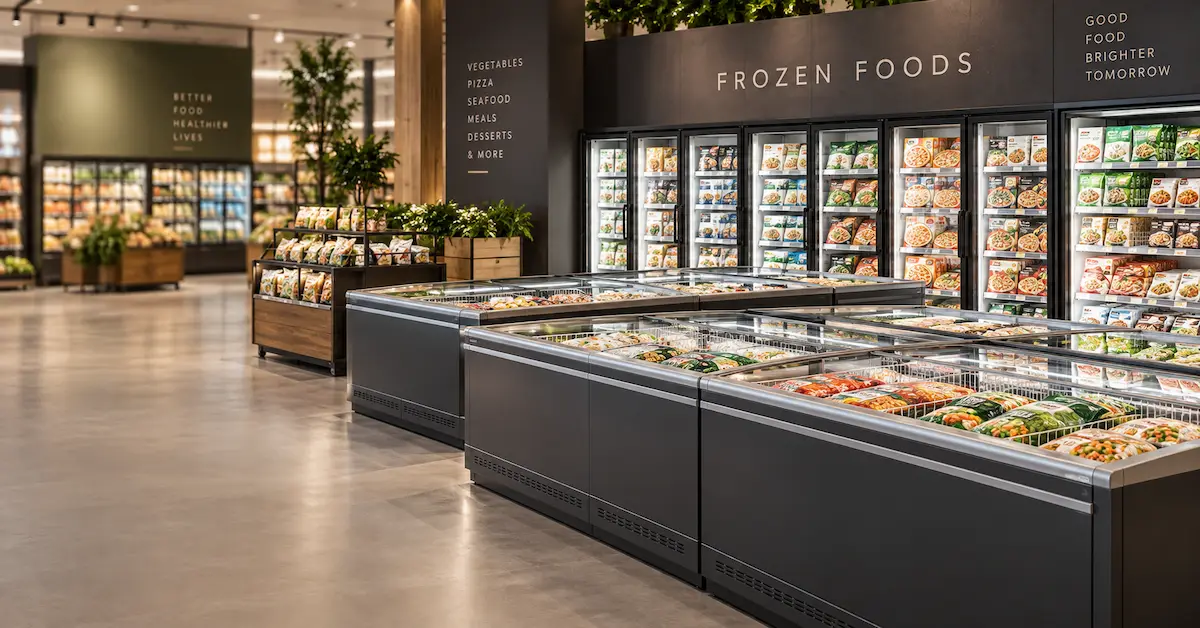
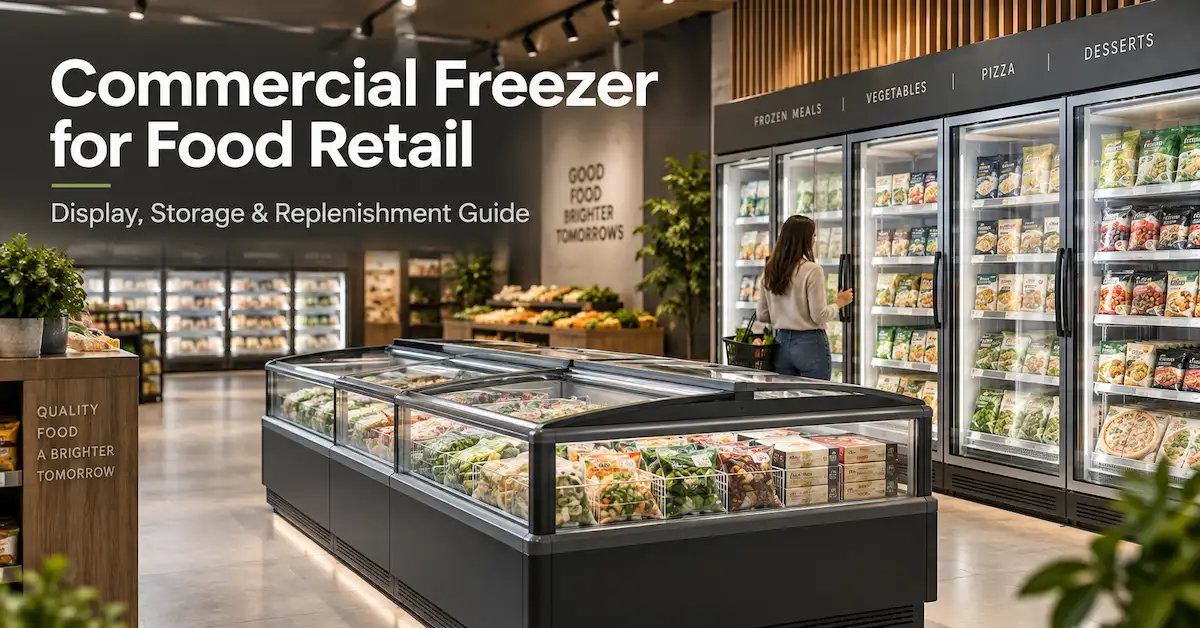
The best commercial freezer for food retail is not necessarily one cabinet type. Food retail covers supermarkets, neighborhood grocery stores, convenience stores, frozen-food shops, specialty retailers and multi-location chains, and each format uses frozen space differently.
A supermarket may have enough floor area to separate frozen aisles, promotional islands and backroom reserve storage. A compact convenience store may need one customer-facing cabinet to provide both visibility and enough working inventory. A frozen-food specialty store may devote a large percentage of its selling area to freezers and therefore care intensely about product facing, category organization and replenishment efficiency.
The correct purchasing question is therefore not simply:
“Which freezer has the best capacity?”
It is:
“Which freezer role does this store need, and how should several freezer roles work together?”
A useful starting point is to separate equipment into three functions: customer-facing display, working inventory and reserve storage. Buyers can then evaluate SNOWSEA’s commercial freezer range, chest freezer range and ice cream freezer range according to those functions rather than treating every freezer as interchangeable.
Start With the Retail Format Before Choosing the Cabinet
Different retail formats create different freezer priorities.
| Retail Format | Main Frozen-Food Requirement | Main Purchasing Priority |
|---|---|---|
| Supermarket | Broad assortment and multiple frozen zones | Standardization and capacity |
| Grocery store | Balanced display and reserve stock | Floor-space efficiency |
| Convenience store | Compact, high-turnover frozen range | Visibility and easy access |
| Frozen-food specialty store | Large frozen assortment | Merchandising and category organization |
| Ice cream retailer | Strong customer-facing presentation | Glass visibility and package access |
| Multi-store chain | Repeatable layouts and supply | Standardized product family |
| Food brand retail program | Product-focused display | Branding and merchandising |
This distinction matters because a freezer that performs well in one format can be inefficient in another.
A large chest freezer may provide excellent reserve capacity for a supermarket backroom but consume too much selling space in a convenience store. A glass display freezer can improve customer interaction but may add unnecessary cost when used only for warehouse-style reserve storage.
SNOWSEA’s existing frozen retail freezer program guide also emphasizes building a structured equipment portfolio instead of purchasing many similar freezer models without clear store roles.
Map the Frozen Category Before You Map the Equipment
Equipment selection should follow the merchandise.
Food retail buyers may handle:
- Frozen vegetables
- Frozen meat
- Seafood
- Pizza
- Ready meals
- Dumplings
- Fries
- Frozen snacks
- Desserts
- Ice cream
- Frozen bakery products
These categories differ in package dimensions, turnover and merchandising value.
For each important SKU, record package size, typical facing quantity, daily or weekly sales, reserve quantity and replenishment frequency.
A store selling large pizza boxes has a different space requirement from one selling compact frozen vegetable bags even when the total product weight is similar.
The purpose of this exercise is to translate “we need a 500L freezer” into a more useful requirement:
“We need enough usable space for this exact assortment, with this quantity visible and this quantity held in reserve.”
Separate Display Inventory From Reserve Inventory
A strong food-retail freezer plan usually separates what the customer sees from what the store keeps behind the scenes.
Display inventory supports sales.
Reserve inventory supports replenishment.
If too much inventory is kept in the display freezer, staff may struggle to organize products and customers may have difficulty finding items. If display stock is too shallow, employees spend too much time replenishing.
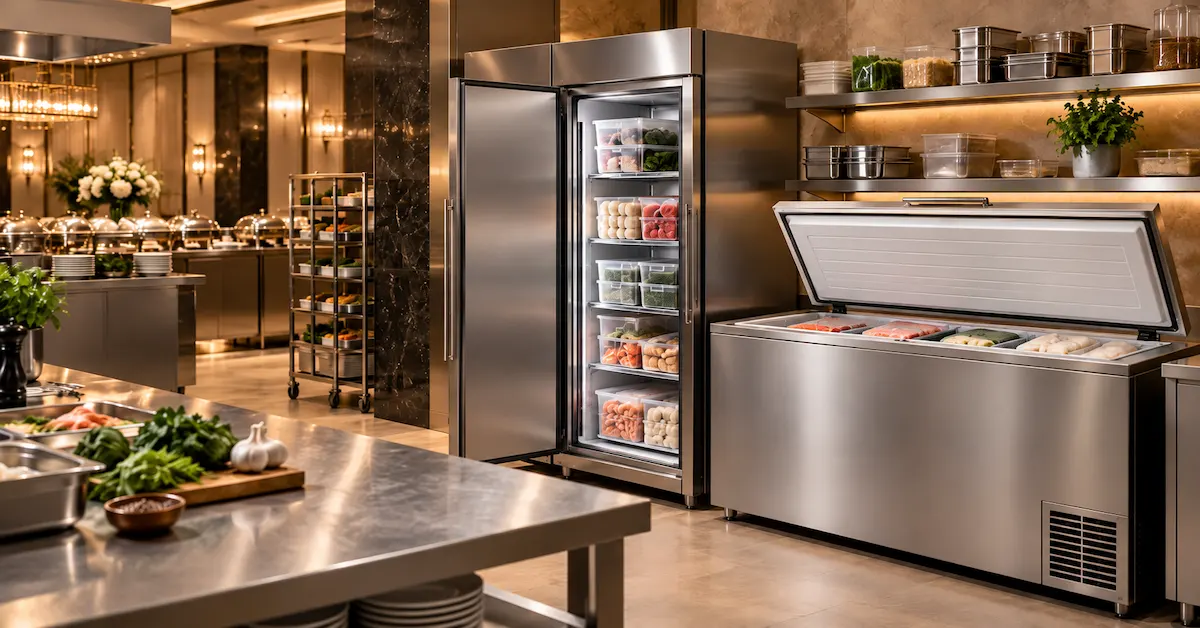
Reserve inventory can be held in a storage-focused cabinet such as a commercial chest freezer, while customer-facing products can use display-oriented equipment where visibility has real commercial value.
The optimal balance depends on turnover.
Fast-moving products may justify deeper working inventory in the display cabinet. Slow-moving SKUs may need only a few visible units.
Use Product Turnover to Determine Freezer Capacity
Retail freezer capacity should be calculated from sales and replenishment—not from catalog preference.
A practical sequence is:
Average sales between replenishments + safety stock + promotional/seasonal buffer = required inventory
Then translate the result into real packages.
For example, a retail buyer may know that 300 units of frozen meals must be available during a sales cycle. The next step is to determine the actual space occupied by those packages and how they fit inside the proposed cabinet.
This is more reliable than selecting a freezer by liters alone.
The buyer should also distinguish normal sales from peak periods. Holiday promotions, hot-weather ice cream demand or seasonal frozen-food campaigns can temporarily increase stock requirements.
Nominal Capacity Is Not the Same as Retail Capacity
Nominal capacity is an equipment specification. Retail capacity is a business measurement.
A freezer can theoretically hold a large volume but still be inefficient if product packages stack badly or lower items become difficult to reach.
For storage-focused applications, buyers can review products such as the BD-500 commercial chest freezer, then test whether the internal arrangement works for the actual merchandise.
For smaller storage needs, the BD-308 chest freezer provides another platform for comparison.
The correct evaluation should consider:
| Capacity Question | What Buyers Should Measure |
|---|---|
| Nominal volume | Published cabinet capacity |
| Usable volume | Space available after real organization |
| SKU capacity | Number of different products |
| Facing capacity | Number visible to the shopper |
| Reserve capacity | Additional units available for replenishment |
| Access efficiency | How easily staff/customers retrieve products |
Retailers should optimize the entire table rather than one number.
When Should Food Retailers Use Chest Freezers?
Chest freezers are useful when storage efficiency, bulk inventory and simple frozen holding are more important than vertical merchandising.
Typical applications include backroom reserve stock, bulk meat or seafood, high-volume frozen-food storage and selected self-service layouts.
They can also be attractive for retailers that need large storage capacity without an elaborate display structure.
However, chest freezers need internal organization.
Large cartons placed above smaller products can reduce retrieval efficiency. Baskets and product zones can help, but buyers should test the layout with actual packaging.
A chest freezer also requires horizontal floor area and sufficient lid-opening space.
That makes it important to evaluate its operating footprint, not just cabinet dimensions.
When Should Food Retailers Use Display Freezers?
Display-oriented freezers make sense where visibility helps sell the product.
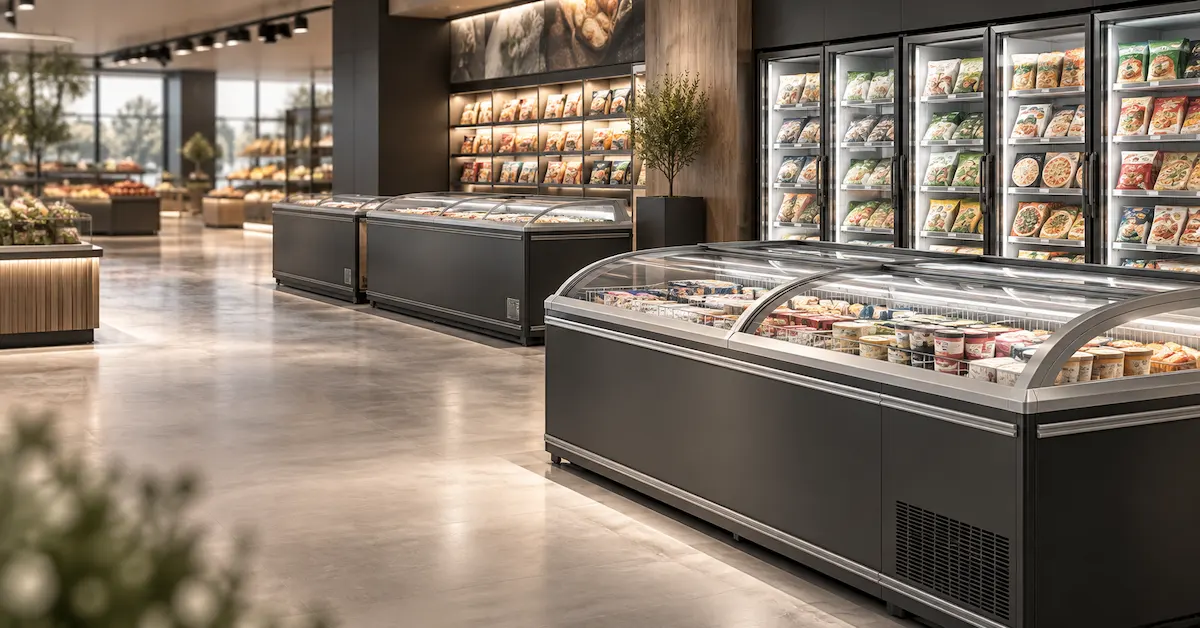
Packaged ice cream, frozen desserts, frozen snacks and other consumer-facing frozen products can benefit from transparent access.
The SD/SC-268PM ice cream freezer is one SNOWSEA platform designed around sliding transparent glass and commercial frozen display.
For retail buyers, glass should not be treated as decoration.
It should help answer commercial questions:
Can customers see enough products without opening the freezer? Are packages easy to identify? Can staff replenish efficiently? Does the lid arrangement fit the aisle? Can the store maintain a clean, organized presentation during peak traffic?
The most attractive freezer is not necessarily the highest-performing retail asset if merchandise becomes disorganized after several hours of customer use.
Do Not Confuse Frozen Display With Chilled Display
Food retailers commonly use both frozen and chilled refrigeration.
Glass doors and bright internal displays can make the products look similar, but their temperature applications are different.
A beverage cooler or refrigerated showcase should not automatically be selected for frozen food simply because the cabinet design looks appropriate.
Retailers that also need chilled merchandising can separately review the Showcase range.
For frozen products, always begin with the required storage condition.
This distinction helps prevent one of the most expensive specification errors in retail refrigeration: buying the correct cabinet shape for the wrong temperature application.
Floor Space Should Generate Retail Value
Every freezer occupies space that could otherwise be used for another product category.
The correct freezer therefore needs to justify its footprint.
Retailers should evaluate:
Frozen sales potential / equipment footprint / usable storage / replenishment workload
A larger freezer can reduce replenishment labor but take away shelf space. A smaller display can improve circulation but require frequent stock movement.
For multi-store chains, these tradeoffs become even more important because the same decision may be repeated across many locations.
A useful approach is to create standard freezer modules rather than designing every store independently.
Convenience Stores Need a Different Freezer Strategy
Convenience stores often operate with limited floor area and a focused frozen assortment.
The freezer program should therefore prioritize:
- High-value frozen categories
- Fast product recognition
- Easy customer access
- Compact footprint
- Enough working stock to avoid constant replenishment
Reserve storage may be limited or located in a small backroom.
That means one customer-facing freezer may carry a larger proportion of total frozen inventory than it would in a full-size supermarket.
A convenience-store buyer should therefore test both merchandising and storage depth before choosing the cabinet.
Frozen-Food Specialty Stores Need Strong Category Organization
A specialty frozen-food retailer has a different problem: freezer space is a large percentage of the business.
Customers may expect to browse dozens or hundreds of frozen SKUs.
The freezer plan should make category navigation intuitive.
Possible sections include seafood, vegetables, ready meals, desserts, meat and snacks.
The store should avoid creating a large freezer bank where every cabinet looks identical and customers have difficulty finding products.
Equipment selection, signage and product zoning should work together.
SNOWSEA’s existing freezer for frozen food shop guide provides additional context for balancing frozen storage and product presentation in specialty frozen-food retail.
Product Visibility Should Be Measured With Real Merchandise
Retail visibility is often discussed vaguely.
A better method is to load the actual packages into the proposed freezer.
Then assess:
- Number of visible SKUs
- Product facing
- Customer viewing angle
- Package labels visible through glass
- Customer reach
- Lid or door obstruction
- Restocking access
An empty freezer almost always looks spacious and clear.
The real test is how it performs when fully merchandised.
For display-oriented projects, buyers can also review SNOWSEA’s display freezer selection guide when comparing frozen merchandising formats.
Condensation Can Affect Retail Display Quality
Condensation is especially important for customer-facing transparent refrigeration because fogged glass directly reduces product visibility.
Its behavior can be affected by environmental temperature, humidity, opening frequency, glass construction and cabinet design.
Retail buyers should define realistic operating conditions before comparing claims.
SNOWSEA’s commercial freezer condensation control design guide discusses condensation as both a technical and merchandising issue in supermarket, convenience-store and other food-retail environments.
The purchasing goal should be commercially acceptable visibility under the intended operating conditions—not a generic “anti-fog” label without a defined test environment.
Temperature Recovery Matters in High-Traffic Retail
Customer-facing cabinets can experience repeated openings.
That can temporarily introduce warmer air and increase refrigeration demand.
High-turnover stores should therefore consider temperature recovery as part of freezer selection.
A useful evaluation defines an opening scenario, ambient condition, load and recovery criterion.
SNOWSEA’s commercial freezer temperature recovery guide can help buyers structure this discussion.
The phrase “fast cooling” is not enough by itself. A buyer needs to know what disturbance occurred, what was measured and how the freezer returned to the required operating condition.
Temperature Uniformity Matters When a Cabinet Holds Many SKUs
One controller reading does not prove that every product experiences the same temperature condition.
Cabinet geometry, loading and airflow can influence temperature distribution.
This becomes especially relevant in larger food-retail freezers carrying several categories or densely packed merchandise.
Buyers can use SNOWSEA’s commercial freezer temperature uniformity guide when developing testing questions.
The objective is not necessarily identical temperature at every location. It is to understand the cabinet’s distribution and confirm that the intended storage requirement is maintained across the usable product area.
No-Frost Can Reduce Maintenance, but It Is Not the Only Selection Criterion
Retail operators often value reduced defrost labor.
SNOWSEA’s No Frost Series provides one equipment direction for buyers considering this requirement.
However, a no-frost specification should still be compared alongside usable capacity, cabinet footprint, airflow, energy, temperature behavior, operating cost and product fit.
A feature should solve a real retail problem.
Do not automatically reject a different freezer architecture if manual defrost can be scheduled easily in a backroom application where display uptime is less critical.
Energy Efficiency Must Be Compared Against Retail Function
Food retailers can operate multiple freezers continuously, making electricity a meaningful operating expense.
But energy comparison needs a common basis.
| Comparison Item | Align Before Comparing |
|---|---|
| Cabinet role | Storage vs display |
| Capacity | Comparable usable inventory |
| Temperature requirement | Same frozen application |
| Ambient conditions | Equivalent environment |
| Loading | Comparable product load |
| Openings | Similar access frequency |
| Defrost system | Comparable strategy |
| Test duration | Same basis |
SNOWSEA’s commercial freezer energy efficiency guide provides additional purchasing context.
A display freezer with more glass may consume energy differently from a storage-focused solid-lid cabinet while creating additional merchandising value.
Operating efficiency therefore needs to be evaluated together with the cabinet’s commercial role.
Replenishment Workflow Can Determine the Better Cabinet
Two freezers may store the same amount of product but require very different labor to replenish.
Retailers should map how frozen products move:
Receiving → reserve storage → working stock → display → customer
For each step, measure travel distance, carton handling, opening access and peak replenishment timing.
A freezer positioned conveniently for customers may be difficult for staff to refill.
A large backroom cabinet may reduce deliveries to the sales floor but create slow carton retrieval.
The optimal system minimizes total handling rather than maximizing cabinet capacity.
Multi-Store Retailers Should Standardize Equipment Roles
A growing retail chain should avoid creating a unique freezer list for every branch.
A more scalable equipment family can include:
Storage freezer: reserve stock and bulk inventory.
Core display freezer: standard frozen-food merchandising.
Ice cream/freezer display: impulse and dessert categories.
Special format: only where a measurable business requirement exists.
Different store sizes can then change quantities rather than the entire equipment architecture.
SNOWSEA’s retail freezer manufacturer guide and frozen retail freezer program guide provide related guidance for buyers building repeatable multi-store programs.
A Standard Freezer Family Can Reduce Service Complexity
Every additional model can introduce new controllers, baskets, locks, gaskets, glass parts or other service components.
Multi-site food retailers should therefore ask whether selected products share service parts where technically applicable.
Do not assume interchangeability simply because cabinets look similar.
Maintain a clear relationship between the store’s equipment code and the manufacturer’s actual model.
That way, maintenance teams can identify the correct replacement part later without relying on photographs or old purchase emails.
Quality Control Should Follow the Retail Role
A storage freezer and customer-facing glass freezer do not need identical inspection priorities.
For a storage cabinet, buyers may focus on cabinet workmanship, lid operation, controller function, refrigeration performance and accessories.
For a display freezer, glass movement, visibility, frame alignment and presentation-related elements become more important.
SNOWSEA’s commercial freezer quality standards guide provides a useful framework for building model-specific quality checks.
Inspection should always reference the approved product specification rather than a generic “factory QC” statement.
When Does OEM or Customization Make Sense in Food Retail?
Standard equipment should remain the first option when it already fits the store.
Customization becomes valuable when a measurable commercial requirement cannot be met by the standard platform.
Examples can include:
- Store-specific dimensions
- Market-specific electrical configuration
- Brand graphics
- Basket or layout requirements
- Standardized private-label model family
- Project-specific packaging
For deeper commercial programs, SNOWSEA provides OEM/ODM support.
The strongest customization strategy is usually:
Start from the closest proven platform → identify the remaining problem → customize only what creates meaningful retail value.
This limits unnecessary tooling, engineering, MOQ and service complexity.
Compare Freezers by Their Retail Role, Not Only Price
A professional comparison should combine business and technical criteria.
| Evaluation Area | Food-Retail Buyer Question |
|---|---|
| Store format | Where will the cabinet operate? |
| Product category | What frozen goods go inside? |
| Display requirement | Does visibility influence sales? |
| Package fit | How efficiently do products load? |
| Turnover | How fast is inventory sold? |
| Replenishment | How often must stock be moved? |
| Reserve capacity | Is separate backroom stock available? |
| Floor space | How much retail area can be allocated? |
| Temperature | Does the cabinet suit the product requirement? |
| Recovery | How does it handle frequent openings? |
| Condensation | Is visibility maintained in the store environment? |
| Energy | Is performance compared fairly? |
| Cleaning | Can staff maintain the cabinet easily? |
| Service | Can parts be identified and supplied? |
| Standardization | Can the platform support future stores? |
This produces a more reliable purchasing decision than comparing capacity and price alone.
Calculate Total Retail Cost Instead of Unit Cost
The freezer invoice represents only part of the business cost.
A food-retail buyer should also consider:
Floor-space cost + energy + replenishment labor + maintenance + cleaning + spare parts + inventory complexity + replacement logistics
A cheaper cabinet can become more expensive if it requires excessive replenishment or uses valuable selling space inefficiently.
Likewise, an expensive display feature does not create value if the product category does not depend on visibility.
The purchasing objective is to maximize the commercial return of the frozen category—not simply minimize equipment cost.
What Should Be Included in a Food Retail Freezer RFQ?
A strong RFQ should describe the retail program clearly.
Provide:
- Store format
- Number of locations
- Frozen product categories
- Package dimensions
- SKU count
- Sales turnover
- Replenishment schedule
- Required display inventory
- Required reserve stock
- Available selling-space dimensions
- Backroom availability
- Expected store environment
- Electrical requirements
- Required branding
- Initial equipment quantity
- Expansion plan
Buyers can first review the SNOWSEA product range, then compare commercial freezers, chest freezers and ice cream freezers.
Once the application has been defined, submit the project through SNOWSEA Contact Us for model-specific evaluation.
A Practical Food Retail Freezer Planning Workflow
A buyer evaluating a commercial freezer for food retail can use this sequence:
Define the store format → map frozen categories → measure real packages → analyze sales turnover → calculate working inventory → calculate reserve inventory → identify which products need display → measure available floor space → assign freezer roles → evaluate temperature, recovery, condensation and energy requirements → verify cleaning and service → test representative loading → standardize core models → approve the specification → scale the equipment program across additional stores.
This approach turns commercial freezer selection into a retail-system decision rather than an isolated equipment purchase.
Frequently Asked Questions
1. What is the best commercial freezer for food retail?
There is no single best model for every retail business. The correct freezer depends on store format, merchandise, package size, sales turnover, display requirements, reserve-storage availability and floor space.
2. Should food retailers use chest freezers or display freezers?
Use storage-focused chest freezers where bulk capacity is the main goal and display freezers where customer visibility and direct access support sales. Many retailers benefit from using both for different roles.
3. How do I calculate freezer capacity for a retail store?
Calculate the number of products required between replenishments, add a practical inventory buffer and translate that quantity into actual package dimensions. Then validate usable cabinet space with real merchandise.
4. What freezer is suitable for frozen-food display?
Select equipment designed for the required frozen application and evaluate product visibility, customer access, package layout, temperature performance and store footprint together.
5. Can a chilled showcase be used as a freezer?
Do not assume so. Chilled and frozen cabinets serve different temperature requirements. Always confirm the intended application and model-specific operating range.
6. Is no-frost important for food retail?
It can reduce manual defrost work in suitable applications, but buyers should also evaluate capacity, temperature behavior, energy, cost and the complete operating requirements.
7. How does customer traffic affect freezer selection?
High customer traffic can increase opening frequency and refrigeration load. Retailers should consider door or lid access, recovery behavior, product organization and replenishment during peak periods.
8. Should retail chains standardize freezer models?
Where practical, yes. A small standardized equipment family can simplify store layouts, procurement, spare parts, staff training, maintenance and future expansion.
9. Can commercial freezers for food retail be customized?
Technically feasible branding, configuration and project requirements can be evaluated. Customization should address a real store, merchandising or market requirement rather than create complexity without commercial value.
10. How can I request a food-retail freezer proposal from SNOWSEA?
Prepare your store formats, frozen categories, package sizes, turnover, display requirements, reserve-stock plan, store dimensions, electrical requirements and expected quantities, then submit the information through SNOWSEA Contact Us for project-specific evaluation.
Conclusion
Choosing a commercial freezer for food retail should begin with the retail business model rather than cabinet capacity or purchase price. Supermarkets, grocery stores, convenience stores, frozen-food shops and multi-location retail chains may sell similar products, but their requirements for customer visibility, working inventory, reserve stock, replenishment frequency and floor-space efficiency can be very different. Buyers should first map the frozen assortment, measure real package sizes and sales turnover, then divide equipment into clear roles such as customer-facing display, working stock and reserve storage. From there, factors including usable capacity, temperature recovery, uniformity, condensation control, energy efficiency, cleaning, spare parts and multi-store standardization can be evaluated against the actual retail job. SNOWSEA offers commercial freezer, chest freezer and ice cream freezer platforms together with OEM/ODM support for retail, distributor and project requirements. Food retailers planning a new frozen category, store rollout or equipment standardization program can submit store formats, merchandise data, package dimensions, replenishment plans and expected quantities through SNOWSEA Contact Us to evaluate an appropriate freezer mix before bulk purchasing.