How Should You Choose a Commercial Freezer for Restaurant Use?
The right commercial freezer for restaurant use should be selected from the restaurant’s menu, delivery cycle, daily frozen-food consumption, kitchen layout and staff workflow. Capacity alone is not enough. A freezer can be large on paper but still create operational problems if chefs cannot reach ingredients quickly, products are difficult to organize, the lid conflicts with the prep area or the cabinet cannot reject heat effectively in a warm kitchen.
Restaurant buyers should therefore begin with three questions: What frozen products must be stored? How much stock must be available between deliveries? Where and how often will staff access the freezer?
A restaurant using frozen meat and seafood for bulk preparation has different requirements from a café storing desserts or a chain restaurant receiving standardized frozen ingredients from a central kitchen. The purchasing objective is to match equipment to the kitchen operation rather than forcing kitchen operations around whichever freezer happens to offer the largest advertised capacity.
SNOWSEA currently lists commercial freezer and chest freezer platforms that buyers can use as starting points when defining restaurant storage requirements. Its OEM/ODM page also identifies food service as one of its commercial refrigeration application areas.
Map the Restaurant Kitchen Before Selecting a Freezer
The same restaurant may need frozen storage in more than one operating zone. Treating every zone as the same application can lead to oversized cabinets, slow ingredient access or unnecessary floor-space use.
| Restaurant Zone | Main Freezer Requirement | Purchasing Priority |
|---|---|---|
| Main back-of-house storage | Bulk frozen inventory | Capacity and organization |
| Prep area | Frequently used ingredients | Fast staff access |
| Central kitchen | Larger reserve quantities | High-volume storage |
| Dessert station | Frozen desserts and ingredients | Organization and access |
| Seafood/meat preparation | Dedicated frozen ingredients | Controlled product separation |
| Branch restaurant | Standardized daily stock | Repeatable model and footprint |
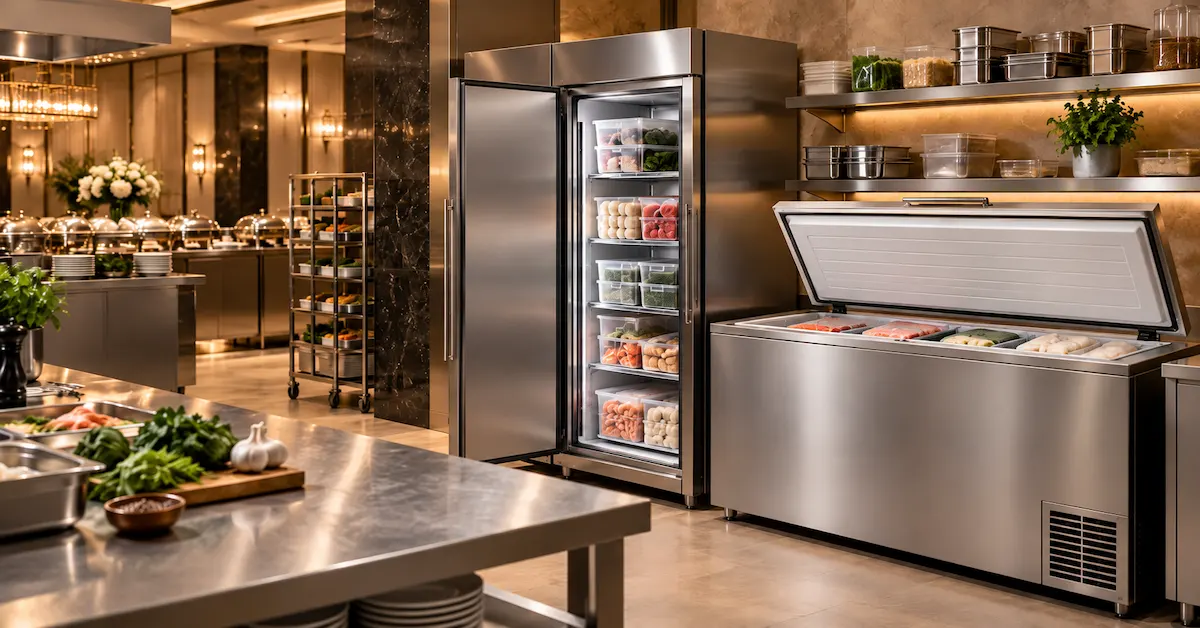
A large chest freezer can work well as reserve storage, but it may be inconvenient if kitchen staff repeatedly need products stored at the bottom during peak service.
Conversely, choosing several small freezers simply to improve access can increase equipment count, cleaning work, spare-parts requirements and total floor-space consumption.
The best configuration often combines bulk storage with workflow-based access.
Start With the Menu, Not With the Freezer Catalog
A commercial kitchen freezer should be selected after the restaurant identifies which menu items depend on frozen ingredients.
Typical restaurant frozen inventory can include meat, poultry, seafood, vegetables, fries, prepared products, dough, desserts, sauces or other ingredients depending on the operation.
Create an ingredient map before requesting quotations.
| Inventory Question | Why It Matters |
|---|---|
| Which products arrive frozen? | Defines actual freezer demand |
| What are the carton/package dimensions? | Determines usable loading |
| How much is consumed daily? | Supports capacity planning |
| How often are deliveries received? | Determines reserve stock |
| Which products have high turnover? | Influences access layout |
| Which ingredients are rarely used? | Can be placed deeper in storage |
| Are there seasonal peaks? | Prevents undersizing |
| Will several menu concepts share one freezer? | Affects organization |
This exercise prevents a common purchasing mistake: selecting a cabinet based on nominal liters and discovering later that the actual cartons do not fit efficiently.
Calculate Restaurant Freezer Capacity From Inventory Turnover
A useful capacity estimate begins with food inventory rather than a catalog specification.
A practical planning sequence is:
Average frozen-food usage × days between deliveries + operating buffer = required frozen stock
Then translate the stock into actual packages and determine how much cabinet space those packages occupy.
Do not treat this as a precise engineering formula. Restaurants also need room for organization and practical access. A cabinet filled so tightly that staff must remove several cartons to reach one ingredient may technically hold enough stock but still be operationally undersized.
The correct question is not:
“How many liters does this restaurant need?”
It is:
“How much usable frozen inventory must staff access between deliveries without creating workflow problems?”
Nominal Capacity and Usable Capacity Are Not the Same
Published capacity is useful for initial comparison, but it does not describe how efficiently a restaurant can organize real food packages.
Usable capacity can be affected by cabinet geometry, baskets, insulation, refrigeration components and package shape.
SNOWSEA currently publishes the BD-500 chest freezer as a 500L double-lid platform intended for bulk frozen-food storage, with removable basket, drain, lock and adjustable temperature control. Its product page specifically positions the cabinet for commercial food storage.
For a restaurant buyer, however, the published 500L figure should still be followed by a loading check using the actual meat cartons, frozen vegetable bags, seafood boxes or other inventory that will be stored.
Should a Restaurant Choose a Chest Freezer or an Upright Format?
There is no universal winner. The cabinet should match the workflow.
| Requirement | Chest Freezer Direction | Upright/Vertical Direction |
|---|---|---|
| Bulk reserve stock | Strong fit | Depends on layout |
| Large packages | Often practical | Shelf dimensions matter |
| Limited floor width | Can be challenging | Vertical format may help |
| Frequent access to many SKUs | Organization requires planning | Shelves may improve visibility |
| Large-volume backroom storage | Strong use case | Model dependent |
| Staff reaching lower products | Requires careful organization | Easier front-level access |
| Top clearance | Lid opening must be considered | Door clearance must be considered |
SNOWSEA’s current range is especially useful for buyers evaluating chest-freezer-based storage. For example, the BD-800 is published as a large commercial double-lid freezer for meat, seafood and frozen-food storage.
The correct choice depends on the restaurant layout rather than on a generic “best freezer” recommendation.
Use More Than One Storage Zone When Ingredient Turnover Is Very Different
A busy restaurant may gain more operational value from dividing stock into reserve inventory and working inventory.
The reserve freezer can hold unopened cartons and lower-turnover stock. A smaller or more accessible freezer can hold ingredients needed during daily preparation.
This approach can reduce repeated searching through bulk stock during service.
However, additional equipment also means additional electrical connections, cleaning, maintenance and spare-parts requirements. The buyer should therefore justify each freezer according to workflow rather than adding units simply for convenience.
For restaurant chains, this operating model can be tested in a representative store before being standardized.
Access Frequency Should Influence Freezer Selection
A freezer opened a few times each morning has a different operating pattern from one accessed repeatedly through lunch and dinner service.
Frequent opening introduces warmer air and changes the operating load. It can also make lid or door ergonomics more important.
Before approving a commercial freezer for restaurant use, describe the likely access pattern to the supplier:
Low frequency: reserve inventory accessed occasionally.
Medium frequency: ingredients accessed throughout preparation periods.
High frequency: products accessed repeatedly during active service.
If temperature recovery after access is important to your operation, SNOWSEA’s commercial freezer temperature recovery guide provides a useful framework for defining and comparing recovery conditions.
Avoid asking only whether a freezer “recovers quickly.” Define the opening or loading scenario first.
Kitchen Temperature Matters More Than Many Buyers Expect
Restaurant kitchens can be considerably more demanding than climate-controlled retail spaces.
Cooking appliances, limited ventilation, crowded equipment layouts and peak service activity can increase the thermal load around refrigeration equipment.
That makes installation environment an important part of the RFQ.
Provide the supplier with the expected operating environment rather than assuming the freezer will always operate under moderate room conditions.
Where restaurants operate in consistently warm markets or demanding environments, SNOWSEA’s high ambient performance guide and tropical climate design guide can help buyers structure the technical discussion.
The model-specific suitability should still be confirmed before purchasing.
Do Not Push a Freezer Into a Space With No Heat-Rejection Plan
A freezer removes heat from the cabinet and releases that heat into the surrounding room.
Restaurant planners sometimes focus so heavily on usable kitchen space that refrigeration equipment is installed tightly between walls, counters or other appliances.
The freezer may physically fit while the installation remains poor.
Before purchasing, confirm the model-specific ventilation and service-clearance requirements with the supplier.
The equipment footprint should therefore include:
Cabinet dimensions + opening space + ventilation space + service access
This becomes especially important for restaurant chains because an installation mistake in one standard kitchen drawing can be repeated across dozens of branches.
Defrost Strategy Can Affect Restaurant Labor
Frost accumulation can reduce usable space and create additional maintenance work depending on freezer architecture and operating conditions.
Restaurant buyers should therefore understand whether the proposed model requires manual defrosting or uses another frost-management approach.
The decision is operational as well as technical.
A manual-defrost cabinet may be suitable where the restaurant can schedule maintenance without disrupting operations. A no-frost solution can reduce manual defrost work in certain applications, but the complete system, capacity, energy requirements and operating behavior should still be evaluated.
SNOWSEA currently describes the BD/BC-227WA as a 227L no-frost chest freezer using air-cooled technology and specifically lists busy commercial kitchens among its intended applications.
That makes it a useful reference platform when restaurant buyers are comparing frost-management approaches rather than simply comparing cabinet size.
Organize the Freezer Around Ingredient Retrieval
A restaurant freezer should help staff find ingredients quickly.
This becomes harder as capacity increases.
Create an internal storage plan based on categories, package size and turnover. Higher-frequency products should remain easier to reach, while reserve cartons can occupy less accessible areas.
Removable baskets can help organize smaller packages in chest freezers, but the layout should be checked using actual products.
For larger operations, a simple location system can reduce searching:
Zone A — high-turnover proteins
Zone B — seafood
Zone C — vegetables and side ingredients
Zone D — prepared products
Zone E — desserts or lower-turnover stock
The actual categories will vary by menu, but the purchasing principle remains the same: buy the cabinet around the storage workflow, not the other way around.
Temperature Control Should Be Evaluated as a System
Restaurant buyers often focus on the controller because it is the most visible part of the temperature-control system.
The controller is only one component.
Cabinet insulation, sensors, compressor operation, evaporator design, condenser performance, loading and opening behavior can all influence temperature performance.
SNOWSEA’s commercial freezer temperature control system guide discusses the relationship between controls and the overall refrigeration system.
For purchasing purposes, define the required frozen-storage condition and operating scenario, then ask how the proposed model maintains that condition.
A more sophisticated display panel is not automatically evidence of better freezer performance.
Do Not Block Airflow With Poor Loading Practices
Even a properly selected freezer can perform poorly when staff load it incorrectly.
Boxes should not interfere with areas the manufacturer requires for airflow or cooling operation.
This issue becomes particularly important with heavily loaded restaurant freezers because staff naturally try to maximize every available space during busy periods.
When evaluating a sample, load it as the restaurant actually intends to use it.
Ask the supplier which areas must remain clear and include those instructions in staff training.
For restaurant chains, standardized loading guidance can be just as useful as standardized equipment.
Large Restaurants and Small Restaurants Need Different Procurement Logic
A single independent restaurant may need one primary freezer and possibly a second unit for specialized stock.
A high-volume restaurant may need bulk reserve storage plus more accessible working inventory.
A restaurant chain creates a third purchasing scenario: the equipment needs to be repeatable across multiple sites.
| Restaurant Type | Freezer Planning Priority |
|---|---|
| Small independent restaurant | Footprint and practical capacity |
| High-volume restaurant | Inventory turnover and access |
| Hotel/large foodservice kitchen | Multiple storage functions |
| Restaurant chain | Standardization and repeat orders |
| Central kitchen | Bulk storage and inventory organization |
| Delivery kitchen | High throughput in limited space |
A supplier recommendation should therefore begin with the operation, not simply the number of seats.
Central Kitchen and Branch Restaurant Storage Should Not Be Planned the Same Way
Central kitchens often hold larger reserve quantities and distribute prepared or frozen ingredients to multiple branches.
The local branch may hold only enough frozen stock for a defined operating period.
That distinction affects equipment capacity and quantity.
SNOWSEA’s central kitchen freezer guide discusses high-volume frozen storage for restaurant chains, catering companies and other centralized food preparation operations.
A chain can therefore build two equipment standards:
Central-kitchen storage standard for bulk inventory.
Branch-restaurant storage standard for daily operational inventory.
This is often more efficient than installing the same freezer specification everywhere.
Standardize Freezers Across Restaurant Chains Where Practical
Restaurant chains benefit from repeatable kitchen design.
Standardizing the freezer family can simplify:
- Purchasing
- Kitchen drawings
- Staff training
- Cleaning procedures
- Spare-parts inventory
- Replacement planning
- Repeat orders
That does not mean every restaurant must use the same quantity.
A compact branch may use one core freezer, while a high-volume branch may use two units of the same platform.
The objective is to reduce unnecessary technical variants.
SNOWSEA’s existing restaurant freezer manufacturer guide also discusses repeatable back-of-house frozen storage for restaurant chains.
Cleaning Features Should Be Evaluated Before Purchase
Restaurant equipment needs regular cleaning, so seemingly minor features can have significant operational value.
Buyers should check how easily staff can reach internal surfaces, remove baskets and deal with defrost water where applicable.
Drain configuration can become particularly relevant on chest freezers that require scheduled defrosting.
The BD-500, for example, is currently published with a defrost water drain and removable basket.
The purchasing team should still inspect these features in relation to the actual kitchen layout. A drain feature provides little operational benefit if the installation makes it difficult for staff to use.
Mobility Can Help, but Stability Comes First
Restaurant kitchens occasionally need equipment to move for cleaning or layout changes.
Casters or other mobility features can therefore be useful on appropriate models.
However, mobility should not compromise stability during normal use.
If the restaurant requires frequent relocation, include that requirement in the RFQ instead of assuming every commercial freezer is designed to be moved regularly.
For OEM or project orders, technically feasible mobility and accessory requirements can be discussed through SNOWSEA’s OEM/ODM service.
Energy Cost Should Be Compared With Equivalent Storage Work
Restaurant buyers should consider operating cost, particularly where several freezers run continuously.
However, one energy figure is meaningless without context.
Compare equipment with similar:
| Comparison Basis | Why It Matters |
|---|---|
| Usable storage | Larger equipment naturally performs more work |
| Temperature requirement | Different targets create different loads |
| Ambient condition | Kitchen heat can affect operation |
| Door/lid usage | Opening frequency changes load |
| Loading condition | Empty and loaded cabinets differ |
| Defrost system | Operating strategies differ |
| Test duration | Figures need equivalent basis |
SNOWSEA’s commercial freezer energy efficiency guide provides further context for comparing energy performance.
For restaurant procurement, efficiency should mean lowest practical operating cost while still meeting the required storage and workflow function, not simply the smallest published number.
Evaluate Total Kitchen Cost, Not Just the Freezer Price
The purchase price is only one part of the equipment decision.
A commercial freezer can create indirect costs through floor-space use, inefficient staff access, manual defrost labor, additional spare parts, difficult cleaning or unnecessary SKU variation.
Restaurant chains should therefore compare the broader cost of ownership.
A slightly higher-priced cabinet can create better commercial value if it fits the kitchen correctly, reduces equipment variety and can be serviced with the same spare-parts structure across many sites.
Conversely, paying more for features the restaurant never uses does not create value.
Quality Control Should Match the Approved Restaurant Configuration
Statements such as “100% QC” or “strict inspection” do not tell a restaurant buyer what is actually checked.
For bulk projects, define the required inspection points.
These can include cabinet finish, lid or door operation, controller function, electrical version, accessories, agreed functional testing, model identification and export packaging.
SNOWSEA’s current OEM/ODM page describes a manufacturing process that includes material processing, structural assembly, foaming and insulation, refrigeration-system installation, main assembly, performance and temperature testing, final inspection and packing before shipment.
For customized or chain-specific configurations, the buyer should still confirm exactly how the approved restaurant model is identified throughout those stages.
Build One Specification for Every Restaurant-Chain Model
Do not manage multi-store purchasing through old quotations or product screenshots.
Create a controlled equipment specification.
| Specification Area | What to Record |
|---|---|
| Chain model | Restaurant’s internal model code |
| Factory model | Supplier reference |
| Application | Branch, central kitchen or prep area |
| Frozen inventory | Main food categories |
| Capacity | Approved loading requirement |
| Cabinet | Dimensions and configuration |
| Lid/door | Approved arrangement |
| Controller | Approved configuration |
| Electrical | Voltage, frequency and plug |
| Accessories | Baskets, lock, mobility options |
| Packaging | Approved export protection |
| Testing | Agreed checks |
| Spare parts | Model-specific service items |
| Revision | Current approved version |
The same reference should be used for later expansion and replacement orders.
When Does Restaurant Freezer Customization Make Sense?
Customization is useful when a standard product cannot solve a measurable kitchen problem.
Examples may include an installation-width restriction, unusual package size, electrical-market requirement, specific basket arrangement or private-label requirement for a foodservice distributor.
Customization should not begin simply because the buyer wants a product to appear different.
SNOWSEA’s custom commercial freezer guide recommends beginning with the operating problem and then making the smallest justified change to an existing platform. That approach reduces unnecessary engineering and repeat-order complexity.
OEM Freezers for Foodservice Distributors and Restaurant Brands
A restaurant buying one freezer and a foodservice distributor building a product range have different purchasing requirements.
Distributors may require multiple capacities, private-label branding, market-specific electrical versions, packaging and repeat-order control.
Restaurant chains may instead need standardized equipment with consistent dimensions and service parts.
SNOWSEA’s OEM/ODM program is currently positioned for distributors, brand owners and project buyers and covers integrated manufacturing and in-house testing.
Where OEM is required, lock the approved specification before volume production instead of treating logo approval as the end of product development.
How Should Buyers Compare Restaurant Commercial Freezers?
A useful comparison should go beyond capacity and price.
| Evaluation Area | Restaurant Buyer Should Ask |
|---|---|
| Menu | What frozen ingredients will be stored? |
| Turnover | How quickly is stock consumed? |
| Delivery | How many days of inventory are required? |
| Packages | Do real cartons fit efficiently? |
| Access | How frequently will staff open it? |
| Kitchen zone | Where will the freezer be installed? |
| Environment | How warm is the operating area? |
| Ventilation | Is heat rejection practical? |
| Defrost | What maintenance does the system require? |
| Cleaning | Can staff access and clean it easily? |
| Temperature | Does performance match the application? |
| Energy | Is the comparison based on equivalent use? |
| Service | Are replacement parts identifiable? |
| Standardization | Can the same model support multiple branches? |
| OEM | Are modifications actually necessary? |
This comparison is more useful than choosing the largest freezer within a fixed budget.
What Should a Restaurant Include in a Freezer RFQ?
A useful RFQ should provide enough operational information for the supplier to recommend a suitable platform rather than simply quote the closest catalog model.
Include:
- Restaurant type
- Number of locations
- Main frozen ingredients
- Package/carton dimensions
- Average daily usage
- Delivery frequency
- Required reserve stock
- Installation dimensions
- Kitchen environment
- Expected opening frequency
- Required electrical version
- Defrost preference if already determined
- Cleaning/access requirements
- Required accessories
- First order quantity
- Future expansion plan
Buyers can first review SNOWSEA’s commercial freezer products, chest freezer range and existing restaurant freezer purchasing guide, then send the operating information through Contact Us.
A Practical Restaurant Freezer Selection Workflow
For restaurants evaluating a commercial freezer for restaurant operations, a practical procurement sequence is:
Map the menu → identify frozen ingredients → measure real packages → calculate inventory between deliveries → divide reserve and working stock → map kitchen installation zones → define access frequency → shortlist suitable freezer platforms → evaluate defrost and temperature requirements → confirm ventilation and cleaning access → test actual loading → approve specifications → standardize models for multiple branches where practical.
This process moves the decision from “Which freezer looks right?” to “Which freezer supports the kitchen operation?”
For B2B buyers, that difference can determine whether a freezer remains a useful operating asset or becomes another cabinet staff need to work around.
Frequently Asked Questions
1. What commercial freezer is best for a restaurant?
There is no single best freezer for every restaurant. The correct choice depends on frozen-food volume, delivery frequency, kitchen space, ingredient turnover, access frequency and the role of the freezer within the kitchen.
2. What size commercial freezer does a restaurant need?
Calculate the stock needed between deliveries, add the operating buffer required by your business and then validate that amount using real package dimensions. Nominal liters should be used as a shortlist tool rather than the only sizing criterion.
3. Is a chest freezer suitable for a restaurant kitchen?
Yes, chest freezers can work well for bulk frozen-food and reserve storage where floor space and access patterns are suitable. High-frequency kitchens should also consider how easily staff can retrieve specific ingredients.
4. Is a no-frost freezer better for restaurants?
It depends on the application. No-frost technology can reduce manual defrosting requirements, while other freezer architectures may suit different capacity, cost or operating priorities. Compare the complete cabinet rather than one feature.
5. How should restaurants organize a chest freezer?
Group ingredients by type and turnover, use baskets or clearly defined zones where practical, and keep high-frequency products easier to reach. Validate the layout using real cartons before selecting the final cabinet.
6. Does kitchen heat affect commercial freezer operation?
The surrounding environment can influence refrigeration load. Restaurants should provide realistic kitchen conditions to the supplier and maintain the model-specific ventilation and installation clearances.
7. Should a restaurant chain use the same freezer in every location?
Not necessarily the same quantity, but standardizing a small family of freezer models can simplify purchasing, kitchen planning, staff training, spare parts and replacement orders.
8. What should restaurants check before a bulk freezer order?
Confirm the model, usable loading, cabinet dimensions, electrical configuration, access, defrost method, installation requirements, agreed testing, cleaning considerations, packaging and spare-parts arrangements.
9. Can a commercial restaurant freezer be customized?
Technically feasible changes can be evaluated for project requirements, but customization should solve a clear operational or market problem. Standard platforms are usually preferable where they already meet the restaurant’s needs.
10. How can I request a restaurant freezer proposal from SNOWSEA?
Prepare your restaurant type, menu-based frozen inventory, package dimensions, delivery schedule, required stock, kitchen dimensions, environmental conditions, electrical requirements and expected quantities, then submit them through SNOWSEA Contact Us for model-specific evaluation.
Conclusion
Choosing a commercial freezer for restaurant operations should begin with the menu and kitchen workflow rather than cabinet capacity, appearance or unit price. Restaurants need to calculate how much frozen inventory is required between deliveries, test real package loading, separate reserve stock from frequently accessed ingredients and determine where the freezer can operate without disrupting preparation, cleaning or heat rejection. Cabinet type, usable capacity, defrost strategy, temperature control, access frequency, kitchen ambient conditions, energy use and service requirements should then be evaluated as one operating system. For multi-location restaurant groups, standardizing a manageable family of commercial freezer or chest freezer platforms can simplify kitchen design, staff training, spare parts and repeat purchasing. Where standard equipment cannot solve a measurable kitchen requirement, SNOWSEA also provides OEM/ODM support for B2B projects. Restaurant operators, foodservice distributors and chain buyers can send menu-based inventory data, package dimensions, kitchen constraints, target market and expected quantities through SNOWSEA Contact Us to evaluate the most suitable freezer platform and project configuration before bulk purchasing.