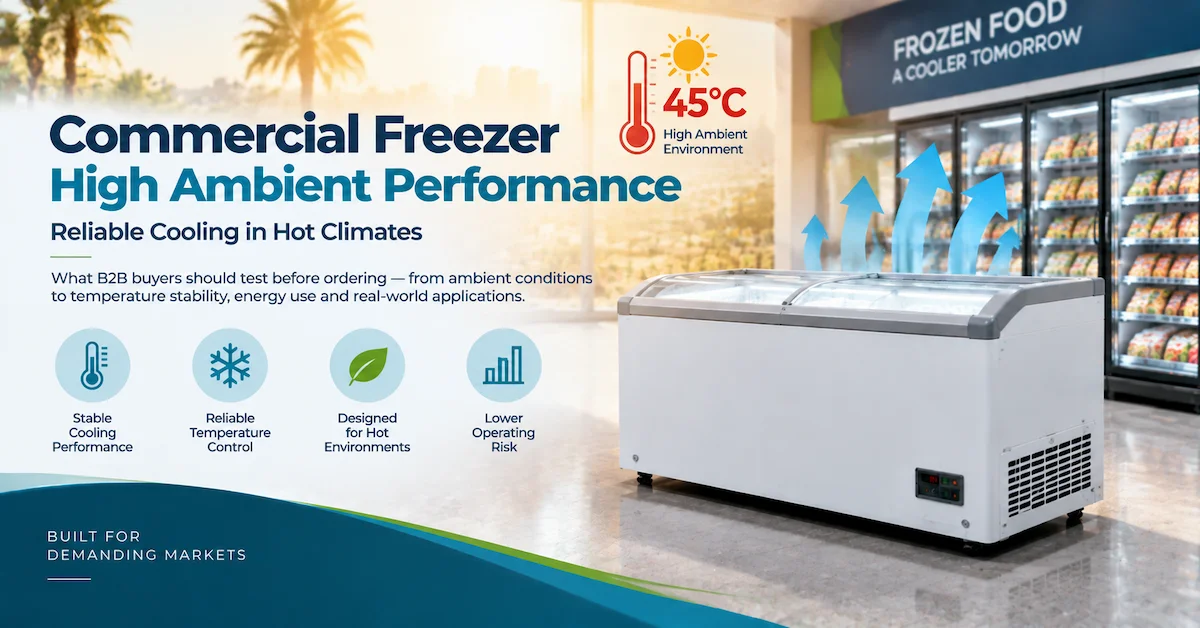
Commercial freezer high ambient performance describes whether a completed freezer can achieve and maintain its required storage conditions when the surrounding environment becomes demanding. It is not proven by a “tropical freezer” label, a large compressor or a controller photograph showing a low temperature. For distributors, supermarket groups, restaurant-equipment suppliers and OEM brands selling into hot markets, the important question is whether the exact production configuration can maintain the required cabinet condition under a defined ambient temperature, loading pattern, ventilation condition and usage cycle. SNOWSEA’s existing commercial freezer tropical climate design guide makes a useful distinction: tropical design addresses how the freezer should be configured, while high ambient performance asks whether the completed design actually works as required in that environment.
High Ambient Performance Is a Test Result, Not a Product Label
Buyers often ask whether a freezer is “suitable for hot countries.” That question is too broad for technical procurement. A freezer installed inside an air-conditioned supermarket can experience very different surrounding conditions from the same freezer installed in a busy restaurant kitchen, a warm warehouse or a retail store with poor ventilation, even when all locations are in the same country.
A useful high-ambient requirement therefore starts with numbers and operating conditions rather than geography. The buyer should define the expected surrounding temperature, required internal storage condition, product load, opening frequency, installation ventilation and relevant humidity conditions. SNOWSEA’s ambient temperature guide explains that higher ambient conditions can increase cooling demand, compressor workload and electricity consumption.
The procurement question should be:
At this defined ambient condition, can this exact freezer configuration maintain the required product-storage performance for the intended operating routine?
That question can be tested. “Suitable for tropical markets” by itself cannot.
High Ambient Performance vs.Climate Class
Climate class and high-ambient performance are related, but they should not be treated as identical concepts. SNOWSEA’s commercial freezer climate class guide describes climate class as the surrounding environmental temperature range for which equipment is designed, while freezer temperature range refers to the internal storage condition.
The same guide currently presents common reference categories such as SN, N, ST and T, while noting that actual classification requirements can vary by product standards, certifications and markets. For purchasing purposes, buyers should verify the climate-class information stated on the actual model specification instead of applying a generic category to the entire product range.
| Topic | What It Tells the Buyer | What It Does Not Prove by Itself |
|---|---|---|
| Climate class | Intended surrounding operating environment | Actual performance of your specific loaded cabinet |
| Internal temperature range | Intended storage temperature capability | Performance at every ambient temperature |
| High ambient test | How a defined configuration performs under a specified hot environment | Performance under different untested conditions |
| Tropical design | How the refrigeration/cabinet system is configured for demanding environments | That production units have already passed your acceptance requirement |
A B2B project is strongest when the intended climate specification and the relevant high-ambient validation support each other.
Start With the Real Installation Environment
Before asking the supplier to prove high ambient performance, describe the site where the freezer will operate. This is one of the most important inputs because the same outdoor temperature does not necessarily create the same equipment environment.
A restaurant freezer may sit near cooking equipment. A supermarket freezer may operate in conditioned indoor air. A warehouse may become hot during the afternoon and provide limited airflow around the condenser area. A glass-top ice cream freezer may experience repeated customer access and higher humidity.
A practical high-ambient specification should therefore include:
| Application Input | What the Buyer Should Provide |
|---|---|
| Expected ambient temperature | Normal and demanding operating conditions |
| Humidity | Where relevant to the application |
| Installation location | Supermarket, kitchen, warehouse, retail outlet, etc. |
| Ventilation | Available airflow around the equipment |
| Nearby heat sources | Cooking equipment,sunlight or other refrigeration units |
| Stored products | Product type and package format |
| Product loading | Typical and maximum intended loading |
| Door/lid opening | Expected frequency and duration |
| Internal target | Required storage temperature/operating range |
| Electrical version | Destination voltage and frequency |
| Test requirement | Buyer method or acceptance criteria, if available |
SNOWSEA’s tropical-climate design content makes the same point: country name alone does not define refrigeration load; actual installation temperature, ventilation,loading and use conditions are much more valuable engineering inputs.
Why High Ambient Temperature Makes Refrigeration More Difficult
A freezer removes heat from its cabinet and rejects that heat into the surrounding environment. When the surrounding environment becomes hotter, several parts of that process can become more demanding.
Higher ambient conditions can influence cabinet heat gain, condenser heat rejection, compressor runtime, pull-down behavior and energy consumption. SNOWSEA’s current compressor-cycling guidance specifically notes that high ambient conditions can increase thermal load and alter compressor operating behavior.
This is why high ambient performance should be evaluated as a complete refrigeration-system result. A buyer should not reduce the problem to a single component such as the compressor.
The system can involve:
- Compressor capacity and operating behavior
- Condenser heat rejection
- Evaporator performance
- Refrigerant-system matching
- Cabinet insulation
- Lid, door or glass sealing
- Airflow where applicable
- Controller logic
- Product loading
- Installation ventilation
Weak performance in one area can place additional demand on the rest of the system.
Condenser Heat Rejection Is Critical in Hot Environments
The condenser must release refrigeration-system heat into the surrounding air. When that air is already hot, heat rejection becomes more difficult.
SNOWSEA’s commercial freezer condenser heat rejection guide identifies restricted airflow, hot-air recirculation, high ambient temperature, dirty heat-exchange surfaces, poor system matching, tight installations and nearby heat sources as conditions that can reduce effective heat rejection.
For buyers, this creates several practical questions:
Where does condenser air enter?
Where does hot discharge air leave?
Can discharged hot air circulate back into the condenser?
How much installation space is required?
Can the condenser be accessed for cleaning?
Was the freezer tested with realistic installation ventilation?
A physically larger condenser is not automatically better. SNOWSEA’s current condenser guidance emphasizes that system matching, airflow, fan operation where relevant, ambient environment and installation space all influence the result.
High ambient performance should therefore be proven at system level.
Compressor Size Alone Cannot Prove High Ambient Capability
“Use a larger compressor” sounds like an easy solution, but a freezer refrigeration system is a matched system.
A compressor that is changed without reviewing the condenser, evaporator, refrigerant circuit, cabinet heat load, controls and airflow can create a different operating balance rather than a guaranteed improvement.
SNOWSEA’s tropical-climate design guide explicitly describes high-temperature configuration as a system-design problem rather than a single-component upgrade.
For B2B procurement, ask the supplier to explain why the proposed refrigeration configuration is appropriate for the intended ambient environment. The answer should connect the components to the actual thermal load, not rely only on component size or brand.
Cabinet Insulation Still Matters in High Ambient Conditions
Heat entering through cabinet walls becomes additional refrigeration load. As the temperature difference between the environment and the frozen cabinet increases, cabinet thermal design becomes increasingly relevant.
However, buyers should avoid reducing insulation quality to one simple statement such as “thicker foam is better.” Thickness can influence thermal performance, but cabinet construction, insulation consistency, usable volume, lid or door design and thermal bridges also matter.
A stronger procurement question is:
Does the approved cabinet construction, together with the refrigeration system, maintain the required internal condition under the specified high ambient environment?
If the project changes cabinet dimensions or insulation structure, earlier high-ambient test evidence may not represent the modified product in exactly the same way.
Door and Gasket Sealing Become More Important as the Temperature Difference Increases
Every opening or unwanted air leak introduces warmer air into the cabinet.
In hot environments, the difference between surrounding air and frozen storage conditions can be substantial. Poor gasket contact, misaligned lids or repeated customer access can therefore increase refrigeration demand.
For a chest freezer sample, inspect:
- Lid alignment
- Gasket contact
- Hinges
- Lock/handle operation
- Visible gaps
- Cabinet deformation
- Repeated opening and closing
For a glass-top display freezer, also evaluate sliding-glass movement, frame alignment and access.
High ambient testing on a carefully adjusted prototype will have limited commercial value if later production units do not maintain comparable sealing workmanship.
Product Loading Changes the Test
An empty freezer and a commercially loaded freezer do not represent identical thermal conditions.
Product quantity, package size, initial product temperature and placement can influence cooling and recovery. Loading can also affect airflow in products that rely on forced circulation.
SNOWSEA’s OEM freezer custom temperature range guide notes that product load, frequent access and cabinet loading arrangement should be considered when evaluating temperature performance.
Therefore, a buyer should ask whether the high ambient test was performed:
empty, partly loaded, fully loaded, or with a defined simulated load.
The supplier should not present those conditions as interchangeable.
High Ambient Pull-Down and Stable Operation Are Different Tests
Pull-down performance describes how the freezer moves from a defined starting condition toward the required operating temperature.
Stable operation describes what happens after the cabinet has already reached the operating condition.
A freezer might pull down successfully but require excessive compressor runtime afterward. Another may stabilize well after reaching temperature but take longer to handle a warm starting load.
SNOWSEA’s tropical-climate content recommends reviewing both pull-down and recovery behavior in demanding environments rather than relying on the lowest temperature reached.
A useful high-ambient performance report should therefore state what phase of operation was actually tested.
Temperature Recovery Is Important for Real Commercial Use
Commercial freezers experience disturbances.
Products are added. Lids are opened. Customers access display cabinets. Defrost events may occur. Ambient temperature can rise during the day.
Temperature recovery describes how the freezer responds after such a disturbance and returns toward its normal operating condition.
SNOWSEA’s commercial freezer temperature recovery guide emphasizes that a freezer reaching its target at initial startup is not automatically good at recovering from repeated disturbances. Recovery should be evaluated together with refrigeration capacity, insulation, airflow, sealing and loading.
For high ambient projects, recovery becomes particularly useful because the surrounding environment already creates a demanding thermal condition.
Temperature Uniformity Should Not Be Ignored
A controller may show the desired temperature while different areas of the cabinet experience different conditions.
High ambient performance testing should therefore consider whether the relevant storage area remains within the agreed requirement, not just whether one sensor reaches a low value.
For cabinet mapping, document:
- Ambient condition
- Product/loading condition
- Sensor positions
- Target setting
- Test duration
- Maximum reading
- Minimum reading
- Temperature spread
- Door/lid events
- Defrost events where applicable
A photograph of one controller display cannot replace a defined mapping exercise.
Energy Consumption Must Be Read Beside Cooling Performance
Higher ambient temperature can increase refrigeration demand and therefore electricity consumption.
This does not mean a freezer consuming more electricity under a hotter test is automatically inefficient.
The useful question is whether both products maintained the same required internal performance while facing comparable surrounding conditions.
SNOWSEA’s recent commercial freezer energy efficiency guide and energy-consumption content recommend comparing energy data together with cabinet configuration, ambient environment, target temperature, loading and usage pattern rather than reading a kWh number alone.
A low energy result has little commercial value if the cabinet is not maintaining the required product-storage condition.
What Should a High Ambient Test Specification Include?
A B2B buyer does not necessarily need to design the manufacturer’s laboratory method. However, the buyer should understand the context behind the result.
| High Ambient Test Item | What Should Be Recorded |
|---|---|
| Product identification | Exact model/configuration |
| Ambient condition | Defined surrounding temperature |
| Humidity | Where relevant |
| Internal target | Required cabinet condition |
| Starting condition | Cabinet/product starting temperature |
| Loading | Empty,real product or simulated load |
| Measurement positions | Sensor locations |
| Pull-down | Startup cooling behavior |
| Stable operation | Performance after stabilization |
| Recovery | Response after opening/loading where relevant |
| Uniformity | Different cabinet-zone temperatures |
| Compressor operation | Runtime/cycling where useful |
| Condenser ventilation | Test installation condition |
| Energy consumption | If part of project evaluation |
| Duration | Total observation period |
| Acceptance result | Pass/fail against agreed criteria |
The critical principle is repeatable context.
Two suppliers should not be compared if one performed a loaded test at a demanding ambient condition and the other supplied an unloaded result from a mild room.
High Ambient Performance vs. Normal Ambient Performance
The following comparison is useful when reviewing test reports.
| Evaluation Area | Normal Ambient Review | High Ambient Review |
|---|---|---|
| Cabinet heat gain | Lower thermal challenge | Increased thermal challenge |
| Condenser heat rejection | Less demanding | More demanding |
| Compressor runtime | Application dependent | Can increase |
| Pull-down | Baseline performance | Verify under hotter surroundings |
| Recovery | Normal commercial disturbance | Disturbance + demanding environment |
| Energy use | Baseline comparison | Interpret beside maintained performance |
| Ventilation | Important | More critical |
| Door sealing | Important | Greater heat difference can raise impact |
| Test evidence | Standard product validation | Application-specific verification may be required |
This does not imply that every freezer requires a unique hot-climate design. The appropriate level of validation should follow the destination market and installation conditions.
How Should Buyers Interpret Climate Class Ratings?
SNOWSEA’s climate class guide currently lists common reference classes such as SN, N, ST and T and explains that they represent different intended surrounding-temperature conditions. It also explicitly notes that actual classification requirements can vary by product standards, certifications and markets.
Therefore, do not take a generic climate-class table and automatically assign a class to a SNOWSEA model if the model specification has not established it.
For procurement, ask:
What climate class or ambient operating condition is specified for the exact version I am buying, and what evidence supports its performance?
That keeps generic technical education separate from product-specific claims.
Which SNOWSEA Models Can Be Used as Project Starting Points?
SNOWSEA offers several freezer platforms that can be discussed for different commercial applications, but their product pages do not by themselves establish universal high-ambient suitability.
| Model | Published Starting Point | Potential Project Role | High-Ambient Question |
|---|---|---|---|
| BD-500 | 500L chest freezer, R290 listed, 1650 × 720 × 830 mm | Larger frozen-storage requirement | What ambient/performance data applies to the quoted version? |
| BD/BC-227WA | 227L air-cooled no-frost platform | Projects prioritizing no-frost operation | How do airflow, defrost and controls behave under the intended ambient? |
| SD/SC-268PM | 268L flat sliding-glass ice cream freezer | Packaged ice cream display | How do glass, access,condensation and refrigeration load perform in the target environment? |
The BD-500 listing publishes features including R290 refrigerant, adjustable control and wide-voltage starting, but the product page should not be converted automatically into a high-ambient operating guarantee.
For hot-market sourcing, request model-specific evaluation rather than inferring suitability from capacity or refrigerant.
Glass-Top Freezers Need an Additional Humidity Discussion
High ambient temperature and high humidity frequently occur together in tropical markets, but they are different environmental variables.
For glass-top frozen displays, humidity can affect condensation and customer visibility. Door opening can also introduce moisture into the cabinet.
Therefore, a high-ambient project involving ice cream displays should discuss:
- Ambient temperature
- Humidity
- Glass construction
- Condensation behavior
- Opening frequency
- Gasket sealing
- Refrigeration capacity
- Defrost/frost behavior
- Product visibility
A cabinet that maintains temperature but develops unacceptable visibility problems may still be unsuitable for the intended retail application.
Installation Ventilation Can Make or Break the Field Result
Factory testing cannot compensate for an installation that blocks required heat rejection.
When equipment is installed, confirm the model-specific ventilation and clearance requirements rather than pushing the condenser area tightly against walls or other heat-producing equipment.
SNOWSEA’s condenser guidance identifies tight installations and hot-air recirculation as potential causes of reduced heat rejection.
For project buyers, record the installation layout before ordering large quantities. A freezer that performs properly in the factory test but is later placed in a poorly ventilated recess may not reproduce the same field behavior.
Maintenance Access Matters More in Demanding Environments
High-ambient performance is not only a sample-development issue.
Commercial freezers may operate in dusty warehouses, greasy kitchens or busy retail environments. Condenser surfaces can accumulate debris and airflow pathways may become restricted.
SNOWSEA’s current condenser-heat-rejection content highlights maintenance access as an important B2B consideration because deterioration in heat rejection can affect field performance, operating demand and service costs.
A procurement team should therefore consider:
Can the condenser be accessed for routine cleaning?
Can local service staff reach relevant components?
Are maintenance instructions available?
A technically capable freezer can still become expensive to operate if routine maintenance is difficult.
What Are the Biggest High Ambient Procurement Mistakes?
Several common statements sound useful but leave the buyer exposed.
| Weak Requirement | Better Requirement |
|---|---|
| “Suitable for hot countries” | Define the actual ambient operating condition |
| “Tropical freezer” | Confirm model configuration and test evidence |
| “Use a bigger compressor” | Review complete refrigeration-system matching |
| “Very thick insulation” | Evaluate complete cabinet thermal performance |
| “Low energy consumption” | Confirm energy while target temperature is maintained |
| “Fast cooling” | Define starting condition, load and ambient |
| “Works at high temperature” | Request model-specific test context |
| “Same freezer for every market” | Compare actual installation environments |
| “Passed testing” | Ask what was tested and under what conditions |
The strongest purchasing specifications replace adjectives with measurable conditions.
OEM High Ambient Projects Need Configuration Control
A freezer can pass a high ambient sample test and then become a different product before volume production if important components change.
Relevant changes may include:
- Compressor
- Condenser
- Fan
- Controller
- Sensor
- Cabinet construction
- Insulation
- Door or glass arrangement
- Refrigeration-system configuration
SNOWSEA’s tropical-climate guidance specifically warns that sample-to-production changes can make earlier performance evidence less representative of the final production unit.
For an OEM project, connect the high-ambient test report to an approved specification revision. If an important technical change is proposed later, ask whether the performance evaluation needs to be repeated.
Use the SNOWSEA OEM/ODM service to define the application and engineering requirement before sample development.
How Does High Ambient Performance Affect Cost?
Hot-climate performance can influence project economics in more than one direction.
A more demanding configuration may affect components, testing, cabinet design or energy use. At the same time, insufficient performance can lead to longer compressor operation, unstable cabinet temperature, field complaints, service costs or the need to replace equipment.
A useful B2B comparison therefore considers:
Purchase cost + energy consumption + installation flexibility + maintenance + after-sales risk + ability to maintain required storage performance
The lowest factory quotation is not necessarily the lowest lifecycle cost if the product is poorly matched to the intended environment.
Likewise, an expensive configuration is not automatically better. Ask what engineering or evidence justifies the additional cost.
How Should Buyers Compare Two High Ambient Freezers?
Compare like with like.
A useful comparison requires:
- Comparable cabinet application
- Similar usable capacity
- Same internal target
- Same ambient test condition
- Comparable loading
- Same opening or access scenario
- Comparable ventilation
- Comparable test duration
- Recorded temperature performance
- Energy result where relevant
- Same production configuration as the quoted unit
If those conditions differ, record the differences before ranking the products.
The right question is not:
“Which freezer reached the lower temperature?”
It is:
“Which freezer maintained our required storage condition most effectively and consistently under the operating environment we actually expect?”
What Should You Send SNOWSEA for a High Ambient Evaluation?
For a useful engineering discussion,provide:
- Freezer type or reference model
- Required capacity or dimensions
- Stored product type
- Product/package dimensions
- Normal product loading
- Required internal temperature
- Expected ambient temperature
- Humidity where relevant
- Installation location
- Available ventilation
- Nearby heat sources
- Door or lid configuration
- Opening frequency
- Pull-down requirement if defined
- Recovery requirement if defined
- Temperature-uniformity target if defined
- Energy benchmark if available
- Customer test method if available
- Destination market
- Electrical requirement
- Sample quantity
- Initial order volume
- Annual forecast
- Project schedule
These inputs are closely aligned with the information SNOWSEA currently recommends for tropical-climate project evaluation.
Send the requirements through SNOWSEA Contact Us and request a configuration-specific technical proposal rather than asking only whether the freezer is “tropical.”
Frequently Asked Questions
1. What is commercial freezer high ambient performance?
It describes how a defined commercial freezer configuration performs when the surrounding operating temperature is high. Buyers should evaluate whether the freezer maintains the required storage conditions under a specified ambient environment.
2. Is high ambient performance the same as climate class?
No. Climate class describes the intended surrounding operating environment, while high ambient performance testing evaluates how the completed product performs under defined conditions. The two should support each other but are not identical.
3. Is a tropical freezer automatically suitable for every hot location?
No. Actual suitability also depends on installation temperature, ventilation, loading, access frequency, humidity where relevant and the required internal storage condition.
4. Does a high ambient freezer need a bigger compressor?
Not necessarily. Compressor capacity must be matched with condenser heat rejection, evaporator performance, refrigeration load, cabinet design and controls. A single-component upgrade does not guarantee system performance.
5. Why is condenser performance important at high ambient temperature?
The condenser has to reject system heat into the surrounding environment. When that environment is hotter, effective heat rejection can become more demanding, especially if airflow or installation ventilation is restricted.
6. Does high ambient temperature increase freezer energy consumption?
It can increase refrigeration demand and compressor runtime.Energy should be compared together with maintained cabinet performance under equivalent test conditions.
7. How should a freezer be tested for high ambient performance?
Define the tested model, ambient condition, internal target, loading, sensor locations, ventilation, test duration and relevant pull-down, stability, recovery and energy measurements before interpreting the result.
8. Are glass-top ice cream freezers suitable for hot and humid markets?
They can be evaluated for those markets, but buyers should consider temperature performance, condensation, humidity, glass construction, sealing, access pattern and refrigeration capacity together.
9. Can SNOWSEA customize a freezer for a high ambient market?
SNOWSEA provides OEM/ODM services and currently advises buyers to provide the actual ambient environment, temperature target, loading and installation information for hot-climate engineering evaluation. Final feasibility depends on the selected freezer platform and project requirements.
10. What information should I request before accepting a “high ambient” claim?
Ask for the exact model and configuration, ambient test condition, target cabinet temperature, loading condition, ventilation setup, test duration, temperature results and other relevant performance data. Confirm that production units will match the tested configuration.
Conclusion
Commercial freezer high ambient performance should be verified through a defined operating scenario rather than assumed from a tropical label, compressor size or climate-market description. Start with the actual ambient temperature, humidity where relevant, target storage condition, product loading, access pattern and installation ventilation; then evaluate refrigeration-system matching, condenser heat rejection, cabinet insulation, sealing, pull-down, stable operation, recovery, temperature uniformity and energy consumption under comparable conditions. SNOWSEA’s existing tropical climate design, climate class and temperature recovery content can help buyers define those requirements before product approval. If you are sourcing commercial freezers for a hot market, commercial kitchen, warm warehouse or tropical retail project, send SNOWSEA your target ambient condition, required storage temperature, loading details, installation environment and expected quantity and request a model-specific high ambient evaluation tied to the actual production configuration.