How Should You Choose a Commercial Freezer for Hotel Operations?
The right commercial freezer for hotel operations should be selected around the hotel’s foodservice structure rather than one headline capacity figure. Unlike a small restaurant with one primary kitchen, a hotel may need to support breakfast service, all-day dining, banquets, room service, pastry production, staff dining and seasonal events from the same frozen-food inventory. The freezer plan therefore needs to account for where products are stored, when they are used, how frequently stock moves and how demand changes between normal days and high-occupancy or event periods.
SNOWSEA’s existing hotel-kitchen guidance identifies frozen meat, seafood, vegetables, desserts, prepared ingredients and frozen meals among common hotel storage requirements, while its hotel-buffet guide highlights the higher food volume and longer operating schedules that can occur in hospitality foodservice.
For hotel buyers, the practical sequence is:
Hotel foodservice map → frozen inventory → delivery cycle → peak demand → kitchen zones → usable storage requirement → freezer type → technical specification.
Starting with equipment before completing this process can create too much freezer capacity in one department and insufficient working stock in another.
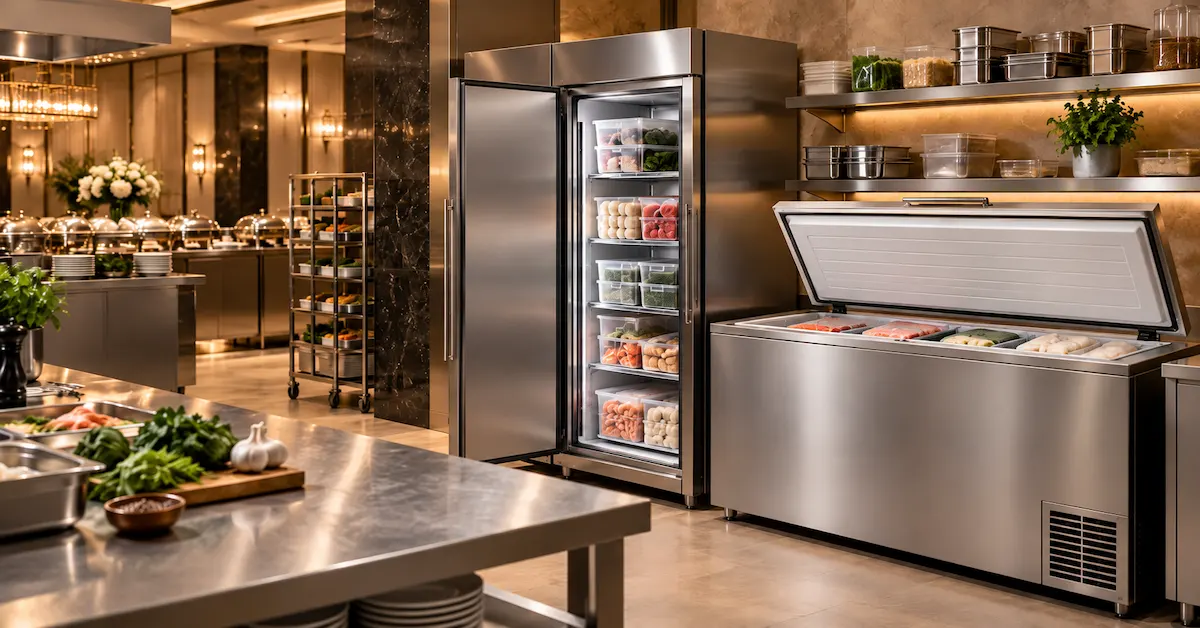
Map Every Hotel Foodservice Zone Before Selecting Equipment
A large hotel should not automatically treat all frozen food as one storage requirement.
| Hotel Zone | Typical Role | Main Freezer Priority |
|---|---|---|
| Main production kitchen | Core frozen ingredients | Capacity, organization and daily access |
| Banquet kitchen | Event-driven inventory | Peak-volume flexibility |
| Buffet preparation | Breakfast and meal-period support | Fast replenishment |
| Pastry/dessert area | Desserts and specialty ingredients | Product organization |
| Room-service kitchen | Smaller but extended-hour demand | Convenient working stock |
| Staff cafeteria | Separate foodservice inventory | Practical capacity and simplicity |
| Reserve/backroom storage | Bulk cartons and backup stock | High usable storage |
| Resort seasonal operation | Demand that changes by season | Flexible capacity planning |
The purchasing team should decide whether each area needs dedicated frozen storage or whether several functions can share centralized reserve inventory.
A banquet department serving large events, for example, may not need permanently oversized working freezers if bulk stock can remain in central storage and move into the banquet-preparation zone according to the event schedule.
Separate Reserve Inventory From Working Inventory
One of the most useful concepts in hotel freezer planning is separating reserve storage from working storage.
Reserve storage holds unopened cartons, lower-turnover items and inventory required between supplier deliveries. Working storage contains the ingredients kitchen staff need repeatedly during preparation and service.
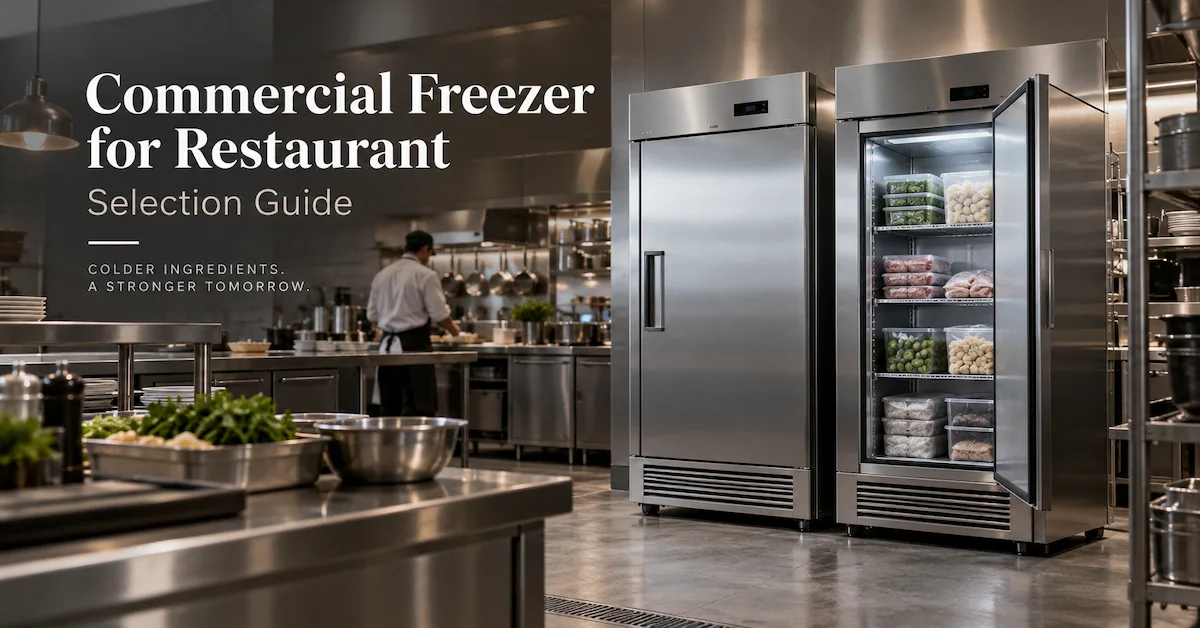
A large commercial chest freezer range can provide a starting point for bulk reserve-storage planning, while smaller or differently configured commercial freezer platforms can be evaluated for working areas depending on the hotel’s exact requirements.
The benefit of this separation is operational. Kitchen staff should not need to search through several days of bulk inventory every time they need one frequently used ingredient.
The downside is equipment proliferation. Every additional freezer requires floor space, electrical supply, cleaning, maintenance and spare-parts support.
The target is therefore not “more freezers.” It is the minimum number of storage zones needed to keep food movement efficient.
Calculate Capacity From Food Volume and Delivery Cycles
Hotel freezer capacity should be calculated from inventory rather than guest-room count alone.
Two 300-room hotels can have completely different frozen-storage requirements. One may operate only breakfast and a small restaurant, while another may support banquets, weddings, multiple restaurants and 24-hour room service.
A practical planning model is:
Daily frozen-food usage × required stock days + peak/event reserve = required inventory
Then convert that inventory into actual cartons, bags, trays and containers.
Important inputs include average occupancy, foodservice outlets, banquet frequency, delivery schedule, buffet volume, menu structure and seasonal peaks.
Do not use the formula as a precise engineering calculation. The goal is to establish a realistic product volume before choosing freezer capacity.
Use Real Packages to Measure Usable Capacity
Nominal liters do not automatically equal useful hotel storage.
A cabinet may appear large on a specification sheet but use space inefficiently for the hotel’s actual meat cartons, seafood boxes or frozen prepared-food containers.
For each high-volume item, record:
- Package dimensions
- Units per carton
- Typical cartons in stock
- Maximum event-period stock
- How frequently the item is retrieved
Load-test representative equipment whenever practical.
A well-organized medium-size freezer can sometimes provide more operational value than a larger cabinet that forces employees to repeatedly remove products to reach the required carton.
Plan Banquet Peaks Separately From Normal Hotel Demand
Banquet demand can create one of the largest differences between hotel refrigeration and normal restaurant refrigeration.
A hotel may operate comfortably with its regular frozen inventory most days, then host conferences, weddings or seasonal events that substantially change food volume.
The equipment plan should determine whether those peaks will be handled through permanent spare capacity, centralized reserve storage, scheduled deliveries or temporary changes in stock allocation.
Permanent oversizing has a cost. It occupies kitchen space throughout the year even when banquet demand is low.
Undersizing creates a different risk: the hotel may lack practical storage during important events.
A hotel procurement team should therefore provide both normal operating demand and realistic peak-event demand when requesting a freezer proposal.
Buffet Operations Need Replenishment Planning, Not Just Storage
Hotel buffets can involve several meal periods and wide menu variety. SNOWSEA’s hotel buffet frozen storage guide identifies seafood, meat, vegetables, desserts, ice cream and prepared frozen foods among typical buffet-related inventory and notes that hotel operations can involve higher food volumes and longer schedules than smaller foodservice businesses.
The freezer closest to buffet preparation should therefore be sized around replenishment workflow rather than the hotel’s entire frozen inventory.
Consider how often the buffet team replenishes ingredients, whether frozen products are moved to preparation areas before service and whether breakfast, lunch and dinner use the same inventory categories.
This can prevent the buffet-preparation area from becoming a second bulk warehouse.
Room Service Can Create a Different Access Pattern
Room service may require a narrower range of frozen ingredients than the main kitchen, but operating hours can be longer.
For hotels providing late-night or round-the-clock food service, staff access patterns may matter more than maximum cabinet size.
A freezer used for room-service working stock should prioritize logical product organization and convenient access. Reserve inventory can remain elsewhere if internal logistics allow quick replenishment.
This illustrates why one large freezer is not automatically the most efficient solution for every hotel department.
Hotel Pastry and Dessert Storage May Need Separate Organization
Desserts, bakery ingredients and ice cream can require different package formats from meat and seafood.
Even when the required storage condition is compatible, operational separation can make inventory control easier.
The hotel should decide whether these items belong in dedicated equipment or a clearly separated section of a larger freezer.
For businesses with substantial packaged ice cream requirements, SNOWSEA’s ice cream freezer range provides additional equipment formats for consideration. However, customer-facing display cabinets and back-of-house hotel storage should be treated as different purchasing applications.
Chest Freezer or Vertical Access: Which Works Better in a Hotel?
There is no universally superior cabinet arrangement.
| Requirement | Chest Freezer Direction | Vertical/Front-Access Direction |
|---|---|---|
| Bulk cartons | Often practical | Shelf dimensions must fit |
| High reserve volume | Strong application | Model dependent |
| Limited floor width | Requires more floor area | Uses vertical space |
| Frequent SKU access | Requires careful organization | Shelves may simplify retrieval |
| Large packages | Often convenient | Door/shelf geometry matters |
| Working inventory | Can work with good zoning | Often easier to scan |
| Top clearance | Lid clearance required | Door swing/access required |
Hotels with large reserve inventory can begin by reviewing SNOWSEA’s chest freezer category, then evaluate whether working-storage areas need a different access format.
The correct decision should come from package size, staff workflow and available kitchen space.
Defrost Strategy Should Be Included in Labor Planning
Defrosting is not only a refrigeration issue. It can affect hotel kitchen labor and equipment availability.
If a freezer requires scheduled manual defrosting, the hotel needs a procedure for moving products, cleaning the cabinet and returning it to service.
For operations where reducing manual defrost workload has significant value, buyers can evaluate SNOWSEA’s No Frost Series as one possible starting point.
However, “no-frost” should not be evaluated in isolation. Capacity, refrigeration architecture, energy use, cabinet layout and the intended application still matter.
The right question is:
Which frost-management approach creates the best balance of storage performance, maintenance workload and operating cost for this hotel zone?
Hotel Kitchen Heat Must Be Included in Equipment Selection
Hotel freezers can operate near cooking lines, ovens, dishwashing areas or other equipment that raises the surrounding temperature.
The ambient environment therefore belongs in the purchasing specification.
SNOWSEA’s commercial freezer high ambient performance guide distinguishes the freezer’s required internal storage condition from the surrounding ambient conditions under which it must achieve that performance.
Hotel procurement teams should provide realistic installation conditions rather than assume every freezer will operate in an air-conditioned room.
This is particularly important for resorts, tropical markets and large kitchens operating continuously through multiple meal periods.
Ventilation Is Part of the Required Installation Space
A freezer that physically fits into a kitchen drawing may still have insufficient operating space.
The cabinet needs to reject heat, and maintenance teams need access to relevant service areas.
The correct installation footprint is therefore:
Cabinet footprint + door/lid movement + required ventilation + service access
Hotel designers and purchasing teams should confirm model-specific installation requirements with the supplier before approving kitchen drawings.
This is especially valuable during new hotel construction because correcting the layout on paper is easier than modifying stainless-steel counters, walls or utility positions after equipment arrives.
Temperature Range and Temperature Stability Are Different Questions
The lowest temperature shown on a controller is not enough to evaluate hotel food storage.
Buyers should determine the required storage condition first, then evaluate whether the cabinet can maintain it under realistic loading and access conditions.
SNOWSEA’s commercial freezer temperature range guide highlights target temperature, operating range, stability, recovery and uniformity as separate purchasing considerations.
A freezer that can briefly reach a low temperature but struggles during normal kitchen use may not provide the required operational value.
Temperature Recovery Matters in High-Access Hotel Kitchens
Main kitchens and buffet-preparation areas may experience repeated freezer opening during busy periods.
The hotel should therefore consider how the freezer behaves after predictable disturbances.
Rather than asking whether the equipment has “fast recovery,” define a representative operating condition and discuss it with the supplier.
The commercial freezer temperature recovery guide can be used to structure this evaluation.
A meaningful comparison requires similar opening patterns, loads, ambient conditions and measurement methods.
Separate Hotel Procurement Requirements From Technical Requirements
Hotel freezer projects usually involve several stakeholders.
The executive chef may focus on ingredient access. Purchasing may focus on cost and supplier reliability. Engineering may focus on electrical supply, ventilation and maintenance. F&B management may focus on service continuity. Project teams may focus on dimensions and delivery dates.
A controlled specification keeps these requirements in one place.
| Specification Area | Hotel Should Define |
|---|---|
| Hotel zone | Main kitchen, banquet, buffet, room service, reserve |
| Stored products | Actual frozen-food categories |
| Package dimensions | Representative cartons and containers |
| Stock quantity | Normal and peak inventory |
| Delivery cycle | Replenishment frequency |
| Cabinet dimensions | Maximum installation envelope |
| Access pattern | Low, medium or high frequency |
| Temperature | Required storage condition |
| Ambient | Expected kitchen environment |
| Electrical | Voltage, frequency and plug |
| Defrost | Operational preference/requirement |
| Cleaning | Drain/access requirements |
| Packaging | Delivery/project requirements |
| Service | Spare-parts expectations |
This is considerably more useful than sending suppliers only a capacity target and requesting “best price.”
Hotel Projects Should Evaluate Cleaning and Maintenance Access
Hotel kitchens are high-use foodservice environments, so equipment needs to fit routine cleaning procedures.
Buyers should consider how easily staff can remove baskets or internal organizers, access surfaces and manage defrost water where applicable.
Engineering teams should also verify whether the equipment can be moved or serviced without dismantling surrounding kitchen fixtures.
A freezer that saves a small amount of installation space but becomes difficult to clean or maintain may create higher operating costs later.
Energy Efficiency Should Be Compared at Equivalent Workload
Hotels may operate refrigeration equipment continuously, making energy use relevant to total operating cost.
But energy comparisons need context.
A large reserve freezer cannot be compared fairly with a smaller working freezer if capacity, temperature conditions, ambient environment and access frequency are different.
A useful comparison should align cabinet type, usable storage, required internal condition, ambient conditions, loading, access pattern, defrost strategy and test duration.
SNOWSEA’s commercial freezer energy efficiency guide can provide an additional framework for B2B energy comparison.
Efficiency should mean lower operating input for the required hotel storage job, not simply the smallest isolated number in a quotation.
Hotel Chains Benefit From Standardizing a Small Freezer Family
A hotel group may operate properties of different sizes, but that does not necessarily require a unique freezer specification at every location.
A practical standard may include:
Small working-storage platform for limited-volume departments.
Core kitchen platform for typical hotel kitchen demand.
Large reserve-storage platform for high-volume properties.
Event/banquet capacity option where large functions justify additional storage.
Hotels can then vary equipment quantity while maintaining a manageable model family.
This can simplify spare-parts stock, staff familiarity, technical documentation and future replacement orders.
Resorts Need to Consider Seasonal Occupancy
Resorts can have larger swings between low and peak occupancy than some city hotels.
Freezer planning should therefore examine seasonal food volume rather than annual averages alone.
A cabinet sized only around the quiet season may become inadequate during holidays. A system designed exclusively around peak season may leave substantial unused capacity for much of the year.
The procurement team should compare several capacity scenarios and determine whether flexible equipment quantities or centralized reserve storage can absorb seasonal peaks more efficiently than oversized freezers in every department.
Hotel Renovations Require More Installation Checks Than New Builds
In an existing property, buyers may face fixed doors, elevators, corridors, counters and electrical infrastructure.
Confirm not only where the freezer will operate but also whether it can physically reach that location.
The project review should consider delivery route, doorway clearance, elevator dimensions where relevant, final installation footprint and service access.
This can prevent a commercially suitable freezer from becoming an installation problem after delivery.
For larger formal projects, SNOWSEA’s commercial freezer tender supplier guide also discusses technical proposals, documentation, delivery planning and service requirements for hotel, catering and other project procurement.
Use Pilot Equipment Before Standardizing a Large Hotel Group
For chain hotels or large resort groups, a representative pilot can identify operational issues before equipment is rolled out broadly.
The pilot should test real food packages and actual staff workflows.
Review ingredient retrieval, loading, lid or door movement, temperature behavior, cleaning routines, kitchen circulation and maintenance access.
Record the final configuration and any required corrections.
Once the equipment is approved, freeze the specification so later properties receive the same controlled version.
Quality Control Should Follow the Hotel Specification
Generic phrases such as “strict QC” provide limited purchasing value.
The buyer should know what will be inspected on the actual hotel freezer configuration.
Possible checkpoints include cabinet workmanship, lid or door function, controller operation, correct electrical version, accessories, agreed functional tests, model identification and packaging.
SNOWSEA’s commercial freezer quality standards guide can help buyers organize model-specific inspection requirements.
For hotel chains, every purchased unit should be checked against the same approved project specification.
Do Not Ignore Spare Parts and Service Planning
Hotel foodservice cannot easily stop because one freezer component is unavailable.
Before placing a multi-property order, ask how replacement parts are identified for each selected model.
The hotel group may benefit from standardizing controllers, baskets, handles, gaskets or other service items where the products genuinely share compatible parts.
Do not assume interchangeability without confirmation.
A private hotel model code should remain linked to the manufacturer’s production model and revision so future maintenance teams can identify the correct parts.
When Does Customization Make Sense for Hotels?
A standard freezer is preferable when it already solves the application reliably.
Customization becomes useful when a measurable hotel requirement cannot be met with the existing platform.
Examples can include fixed kitchen dimensions, an unusual package arrangement, market-specific electrical requirements, hotel-group branding or a project-specific accessory configuration.
SNOWSEA’s OEM/ODM service supports project-based commercial refrigeration development and manufacturing. Its broader customization guidance also emphasizes starting from the closest proven platform rather than changing components without a clear operating reason.
The goal is to customize what creates operating value while keeping unnecessary complexity out of the hotel supply chain.
How Should Hotel Buyers Compare Commercial Freezers?
| Evaluation Area | Hotel Procurement Question |
|---|---|
| Foodservice zone | Where will the freezer be used? |
| Inventory | What food and packages must it hold? |
| Normal demand | How much stock is routinely required? |
| Peak demand | What happens during events/high occupancy? |
| Delivery cycle | How many days of stock are needed? |
| Usable capacity | Do real cartons fit efficiently? |
| Access | How often will staff open the freezer? |
| Kitchen environment | What ambient conditions are expected? |
| Defrost | What maintenance workload is acceptable? |
| Temperature | Does the cabinet meet the storage requirement? |
| Cleaning | Can staff maintain it conveniently? |
| Installation | Are ventilation and service access adequate? |
| Energy | Is the comparison based on equivalent operation? |
| Spare parts | Can maintenance be supported long term? |
| Standardization | Can the model be reused across properties? |
This comparison is more valuable than ranking quotations according to capacity and unit price alone.
Evaluate Total Hotel Operating Cost, Not Only Purchase Price
The freezer purchase price is only one part of its commercial impact.
Hotel buyers should consider energy, floor-space consumption, staff access, cleaning labor, defrost requirements, spare parts, maintenance and the cost of stocking multiple equipment versions.
An inexpensive unit can become expensive if it complicates kitchen operations or creates unique service parts across many properties.
Likewise, premium features do not automatically create value if the hotel operation does not benefit from them.
The stronger purchasing question is:
Which freezer configuration provides the required storage function with the lowest practical operational complexity over its service life?
What Should a Hotel Include in a Commercial Freezer RFQ?
A useful RFQ for a commercial freezer for hotel project should include hotel type, number of rooms where relevant, foodservice outlets, main kitchen functions, banquet capacity, buffet schedule, frozen-food categories, package dimensions, normal stock, peak-event stock, delivery frequency, installation dimensions, expected kitchen conditions, electrical requirements, preferred defrost approach, cleaning requirements and quantity by hotel zone.
For a hotel group, also provide the number of properties and whether different hotel formats need the same equipment family.
Buyers can review the commercial freezer range, chest freezer range, hotel kitchen frozen-food guide and hotel buffet freezer guide before preparing the shortlist.
Once the operating requirements are defined, send the project through SNOWSEA Contact Us for model-specific evaluation.
A Practical Hotel Freezer Planning Workflow
For hotel operators evaluating a commercial freezer for hotel, a practical purchasing sequence is:
Map all foodservice outlets → identify frozen products → measure packages → calculate normal inventory → calculate banquet and occupancy peaks → separate working and reserve storage → map kitchen spaces → define environmental and electrical requirements → shortlist freezer platforms → verify loading and access → evaluate defrost, temperature and energy requirements → plan spare parts → pilot representative equipment → freeze the final specification → standardize across suitable hotel locations.
This process creates a hotel refrigeration plan rather than a collection of unrelated freezer purchases.
Frequently Asked Questions
1. What commercial freezer is best for a hotel?
There is no single best cabinet for every hotel. The right freezer depends on the foodservice zone, frozen-product volume, delivery schedule, banquet activity, kitchen space, staff-access pattern and operating environment.
2. How much freezer capacity does a hotel need?
Calculate normal frozen-food inventory between deliveries, then add realistic peak demand for occupancy, banquets and seasonal events. Validate the result using actual carton and package dimensions instead of relying only on nominal liters.
3. Does a hotel need more than one commercial freezer?
Large hotels often benefit from separating bulk reserve storage from working inventory used in the main kitchen, banquet area or other departments. The appropriate number depends on food volume and internal logistics.
4. Is a chest freezer suitable for hotel kitchens?
Chest freezers can be useful for bulk and reserve storage, particularly where large cartons and high frozen-food volumes are involved. Staff access, floor space and product organization should still be evaluated.
5. What freezer is suitable for hotel buffet operations?
The freezer should match buffet product categories, meal frequency, preparation workflow and replenishment volume. A buffet-preparation freezer does not necessarily need to hold all of the hotel’s reserve inventory.
6. How should hotels handle banquet freezer demand?
Plan normal and event-peak inventory separately. Hotels can evaluate permanent spare capacity, centralized reserve storage and delivery scheduling instead of automatically oversizing every kitchen freezer.
7. Does a hot hotel kitchen affect freezer selection?
Yes. The surrounding environment can influence refrigeration load. Buyers should provide realistic kitchen conditions and confirm model-specific operating suitability, ventilation and installation requirements.
8. Should hotel chains standardize freezer models?
Where practical, yes. Using a manageable family of approved models can simplify kitchen planning, spare parts, staff familiarity, maintenance and repeat purchasing across properties.
9. Can hotel commercial freezers be customized?
Technically feasible changes can be evaluated when standard products do not meet a measurable installation, electrical, operational or branding requirement. Customization should solve a defined problem rather than add complexity without operational value.
10. How can I request a hotel commercial freezer proposal from SNOWSEA?
Prepare your hotel foodservice zones, frozen-product list, package dimensions, normal and peak inventory, delivery frequency, kitchen dimensions, operating environment, electrical requirements and project quantities, then submit them through SNOWSEA Contact Us.
Conclusion
Selecting a commercial freezer for hotel operations requires planning the hotel’s entire frozen-food workflow rather than choosing one cabinet based on capacity or price. Main kitchens, banquet operations, buffets, room service, pastry areas and reserve storage can create different inventory and access requirements, while occupancy changes and event peaks make hotel demand less predictable than a simple daily average. Buyers should calculate real food volume, separate working stock from reserve stock, test package loading, account for kitchen ambient conditions, define temperature and defrost requirements, verify installation space and include cleaning, service and spare-parts planning before approving equipment. For hotel groups, a manageable family of standardized commercial freezer and chest freezer platforms can simplify future projects and replacement purchasing. When a standard product cannot solve a measurable hotel requirement, SNOWSEA also provides OEM/ODM support for project-based refrigeration configurations. Hotel operators, hospitality groups, foodservice distributors and project buyers can submit their kitchen zones, inventory profile, banquet requirements, installation constraints and expected quantities through SNOWSEA Contact Us to evaluate a practical freezer mix before bulk procurement.