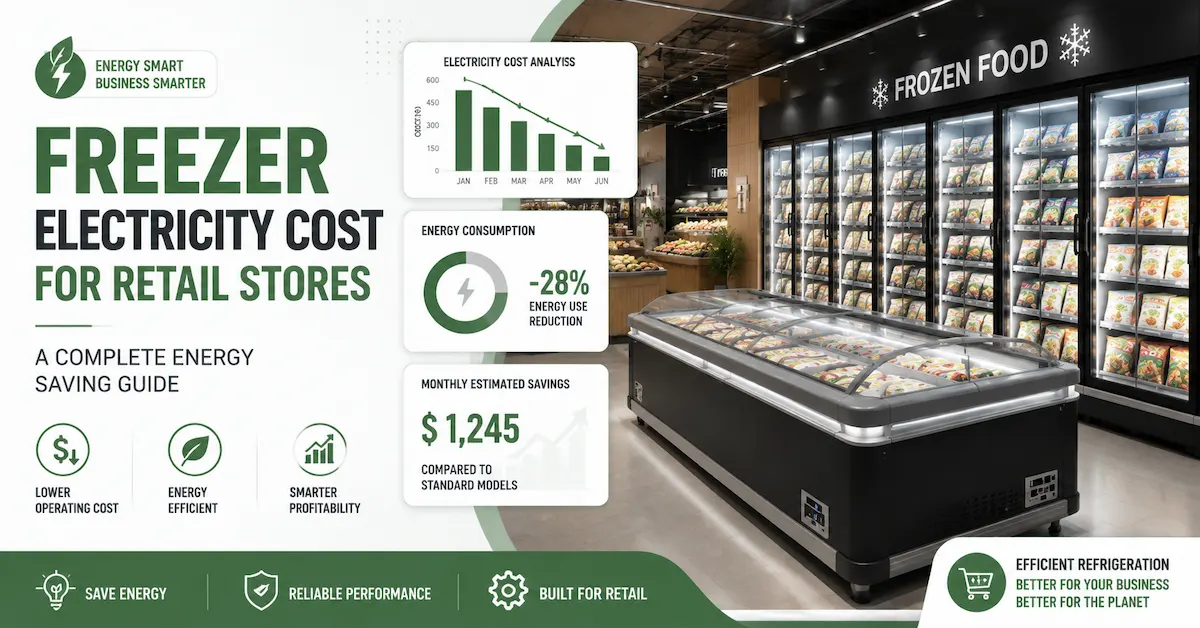
For supermarkets, convenience stores, frozen-food retailers, and commercial refrigeration operators, electricity expenses are one of the most important ongoing operating costs.
Unlike many other store equipment, freezers usually operate continuously throughout the day. A single freezer may consume a moderate amount of electricity, but when a store operates multiple units for years, the total energy expense becomes significant.
Understanding freezer electricity cost for retail stores helps business owners:
- Estimate monthly operating expenses
- Compare different freezer models
- Select energy-efficient equipment
- Reduce unnecessary electricity consumption
- Improve long-term profitability
The actual electricity cost of a retail freezer depends on many factors, including:
- Freezer type
- Compressor efficiency
- Cabinet insulation
- Temperature settings
- Store environment
- Door opening frequency
- Maintenance condition
- Operating hours
Choosing the right freezer is not only about purchase price. Energy consumption directly affects the total cost of ownership.
Why Freezer Electricity Cost Matters for Retail Businesses
Retail refrigeration equipment often represents a large portion of store energy usage.
Supermarkets may operate:
- Upright glass-door freezers
- Island display freezers
- Chest freezers
- Open display freezers
- Beverage coolers
- Refrigeration cabinets
Each unit contributes to monthly electricity expenses.
For example, a supermarket with dozens of freezer cabinets may spend thousands of dollars annually on refrigeration electricity.
Reducing energy consumption can help businesses:
- Increase profit margins
- Lower operating expenses
- Improve equipment efficiency
- Support sustainable business goals
How Much Electricity Does a Retail Freezer Use?
The electricity consumption of a freezer depends on its design and operating environment.
Common factors include:
| Factor | Impact on Energy Cost |
|---|---|
| Compressor efficiency | Higher efficiency reduces consumption |
| Freezer size | Larger units usually consume more energy |
| Temperature setting | Lower temperatures require more power |
| Door design | Better sealing reduces cooling loss |
| Glass quality | Improved insulation saves energy |
| Store temperature | Hot environments increase workload |
| Maintenance | Poor maintenance increases consumption |
A small chest freezer and a large supermarket display freezer can have very different electricity requirements.
How to Calculate Freezer Electricity Cost
Retailers can estimate electricity cost using:
Electricity Cost = Power Consumption × Operating Hours × Electricity Rate
For example:
If a freezer uses:
- 2 kWh per hour
- Operates 24 hours per day
- Electricity rate is $0.15/kWh
The daily cost is:
2 × 24 × 0.15 = $7.20 per day
Monthly cost:
7.20 × 30 = $216
Annual cost:
216 × 12 = $2,592
This calculation helps retailers compare different freezer models before purchasing.
Factors Affecting Freezer Electricity Cost
1. Compressor Efficiency
The compressor is one of the biggest factors influencing energy consumption.
A high-efficiency compressor can:
- Reduce electricity usage
- Improve cooling stability
- Shorten operating cycles
- Extend equipment lifespan
Lower-quality refrigeration systems may:
- Run longer
- Consume more electricity
- Generate more heat
- Require more maintenance
When comparing commercial freezers, buyers should consider compressor performance rather than only purchase price.
2. Insulation Quality
Good insulation helps maintain internal temperatures with less compressor operation.
Important insulation factors include:
- Thickness
- Material quality
- Cabinet structure
- Door sealing
Poor insulation allows cold air to escape, forcing the refrigeration system to work harder.
Better insulation helps:
- Reduce energy loss
- Improve temperature stability
- Lower electricity bills
3. Door Design and Opening Frequency
Door design significantly affects retail freezer energy cost.
Glass-Door Freezers
Advantages:
- Better temperature control
- Reduced cold-air loss
- Improved energy efficiency
Suitable for:
- Supermarkets
- Convenience stores
- Frozen-food displays
Open Display Freezers
Advantages:
- Easy customer access
- Strong product visibility
However, they require:
- Optimized airflow
- Efficient refrigeration systems
- Proper store temperature control
Retailers should balance customer convenience with energy consumption.
4. Freezer Size and Capacity
Selecting the correct freezer size helps control electricity costs.
An oversized freezer may:
- Consume unnecessary energy
- Occupy valuable store space
- Increase operating costs
An undersized freezer may:
- Require frequent loading
- Reduce sales capacity
- Affect customer experience
The ideal freezer size depends on:
- Product volume
- Sales speed
- Store layout
- Inventory requirements
5. Temperature Settings
Temperature settings directly affect electricity consumption.
Lower temperatures require more refrigeration power.
Retailers should:
- Follow product requirements
- Avoid unnecessary cooling
- Monitor temperature regularly
Incorrect settings may cause:
- Higher energy bills
- Excessive compressor operation
- Frost problems
Energy Consumption Comparison by Freezer Type
Different freezer designs have different energy characteristics.
| Freezer Type | Energy Performance |
|---|---|
| Chest freezer | Usually highly efficient |
| Upright glass-door freezer | Good balance of display and efficiency |
| Island display freezer | Higher display demand |
| Open display freezer | Higher refrigeration load |
| Beverage cooler | Moderate energy consumption |
The most energy-efficient choice depends on how the freezer is used.
How Retail Stores Can Reduce Freezer Electricity Costs
Choose Energy-Efficient Commercial Freezers
An energy efficient commercial freezer usually includes:
- Efficient compressor
- Strong insulation
- Advanced controller
- LED lighting
- Improved glass design
Although the initial investment may be higher, energy savings can reduce long-term operating costs.
Maintain Proper Product Loading
Freezer loading affects airflow and cooling efficiency.
Retailers should:
- Avoid blocking air outlets
- Follow loading lines
- Keep products organized
- Prevent overloading
Poor loading can increase compressor workload.
Clean Condensers Regularly
Dust buildup reduces heat exchange efficiency.
Regular cleaning helps:
- Improve cooling performance
- Reduce energy consumption
- Extend equipment lifespan
Check Door Seals Frequently
Damaged door seals allow cold air to escape.
Signs include:
- Frost around doors
- Longer compressor operation
- Temperature fluctuations
Replacing worn seals can significantly improve efficiency.
Optimize Store Environment
Retailers should avoid placing freezers near:
- Direct sunlight
- Heating equipment
- Hot air sources
- Poor ventilation areas
Better placement reduces refrigeration workload.
Use LED Lighting
LED lighting provides:
- Lower electricity consumption
- Less heat generation
- Longer service life
This is especially useful for:
- Glass-door freezers
- Display cabinets
- Retail refrigeration systems
How to Choose a Low Energy Commercial Freezer
When selecting a freezer, retailers should evaluate:
Energy Information
Check:
- Power consumption
- Energy rating
- Compressor efficiency
- Operating conditions
Product Application
Consider:
- Frozen food type
- Sales frequency
- Customer access
Store Conditions
Evaluate:
- Ambient temperature
- Humidity
- Store traffic
- Installation location
Long-Term Cost
Compare:
- Purchase price
- Electricity cost
- Maintenance cost
- Expected lifespan
Freezer Electricity Cost Comparison Checklist
| Evaluation Item | Questions |
|---|---|
| Power consumption | How many kWh does it use? |
| Compressor | Is it energy efficient? |
| Insulation | Is cabinet insulation sufficient? |
| Doors | Does it reduce cold-air loss? |
| Maintenance | Is cleaning easy? |
| Capacity | Is the size suitable? |
| Application | Does it match product needs? |
Common Mistakes That Increase Electricity Costs
Buying Only Based on Price
A cheaper freezer may consume more electricity over time.
Ignoring Energy Specifications
Power consumption should be checked before purchasing.
Poor Maintenance
Dirty condensers and damaged seals increase energy use.
Incorrect Installation
Poor ventilation reduces refrigeration efficiency.
Choosing the Wrong Freezer Type
Different retail applications require different freezer designs.
Best Freezer Types for Retail Energy Saving
Chest Freezers
Suitable for:
- Bulk frozen products
- Storage-focused businesses
Advantages:
- Strong insulation
- Lower cold-air loss
- Efficient operation
Upright Glass-Door Freezers
Suitable for:
- Supermarkets
- Frozen-food displays
Advantages:
- Good product visibility
- Efficient vertical storage
- Reduced temperature loss
Island Display Freezers
Suitable for:
- Large supermarkets
- Promotional displays
Advantages:
- Strong merchandising ability
- Large display area
Retailers should select based on both sales goals and energy performance.
How Snowsea Supports Energy-Efficient Refrigeration
Snowsea provides commercial refrigeration solutions designed for:
- Supermarkets
- Retail stores
- Frozen-food distributors
- Food-service businesses
- Commercial refrigeration buyers
Solutions include:
- Energy-efficient display freezers
- Chest freezers
- Island freezers
- Upright glass-door freezers
- Customized refrigeration systems
Snowsea supports customers with:
- Product selection
- Energy-saving solutions
- OEM customization
- Quality inspection
- Export packaging
- International shipping
Explore Snowsea’s commercial refrigeration products.
FAQ
How much electricity does a retail freezer use?
Electricity consumption depends on freezer type, size, compressor efficiency, temperature settings, and operating environment.
What affects freezer electricity cost the most?
The biggest factors include compressor efficiency, insulation quality, freezer size, door design, and maintenance condition.
Are energy-efficient commercial freezers worth the investment?
Yes. Lower electricity consumption and reduced maintenance costs can provide better long-term value.
Which freezer type uses the least electricity?
Chest freezers often provide strong energy efficiency because they lose less cold air during operation.
How can supermarkets reduce freezer electricity bills?
Supermarkets can reduce costs by choosing efficient equipment, maintaining freezers properly, optimizing placement, and managing temperature settings.
Does freezer maintenance affect energy consumption?
Yes. Dirty condensers, damaged seals, and poor airflow can increase electricity usage.
Conclusion
Understanding freezer electricity cost for retail stores helps businesses make smarter refrigeration decisions and reduce long-term operating expenses.
The best energy-saving strategy is not simply choosing the cheapest freezer. Retailers should evaluate compressor efficiency, insulation quality, freezer design, maintenance requirements, and total ownership cost.
By selecting the right equipment and applying proper operating practices, supermarkets and retailers can reduce electricity expenses while maintaining reliable frozen product storage.
Snowsea provides commercial refrigeration solutions with energy-efficient designs, OEM customization, quality control, and export experience for global buyers.