Quick answer
Commercial freezer evaporator frost control is a system decision, not a single replacement part. Frost normally appears when moist air reaches a surface below freezing. A thin, even layer may be expected during operation; a fast-growing or uneven layer usually points to a door-seal, loading, airflow, drain, sensor, defrost, or refrigeration-system issue.
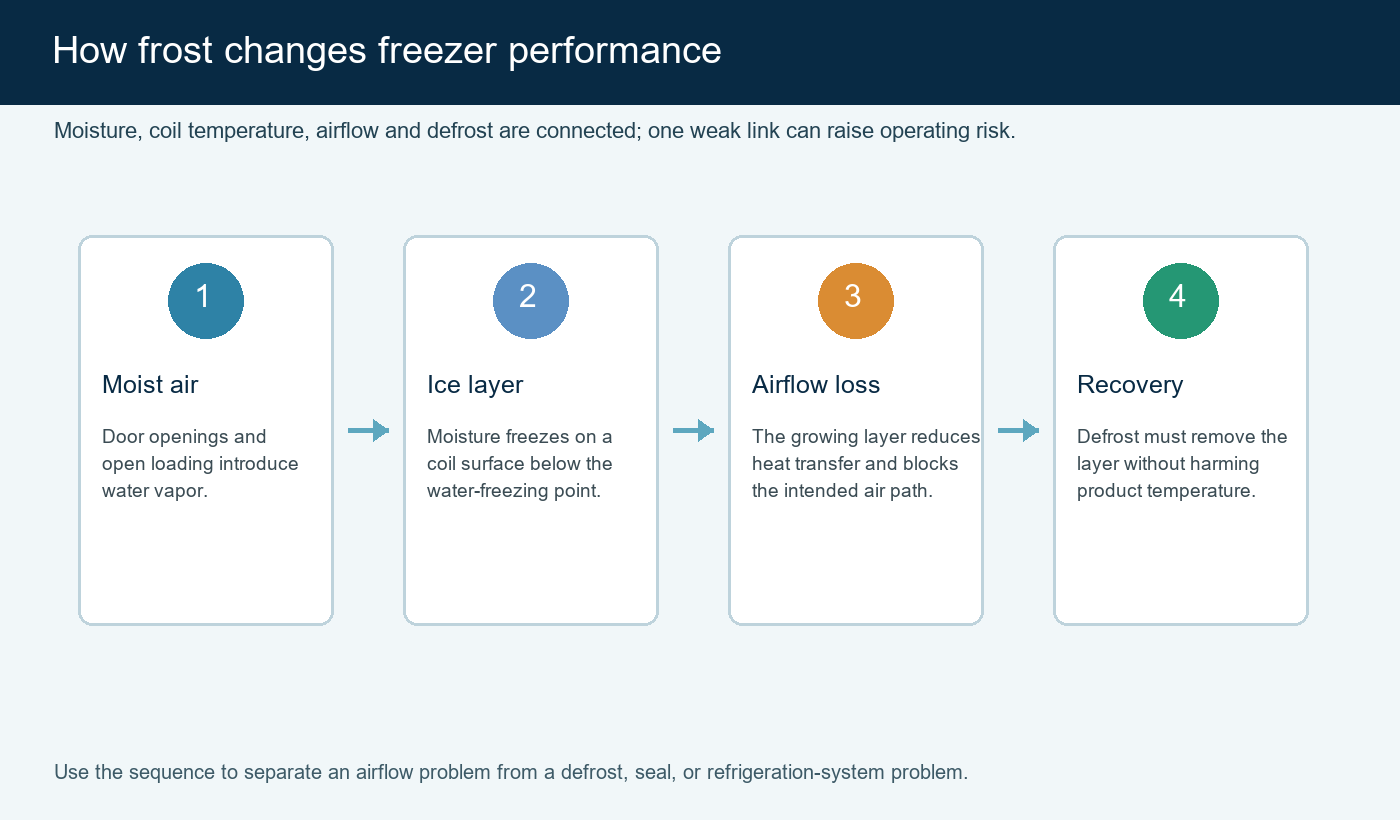
The practical sequence is simple: document where the frost starts, check the air path and cabinet habits, verify the defrost response, and only then investigate refrigerant or component performance. The correct solution depends on the cabinet type, product load, ambient conditions, refrigerant, control design, and service capability in the destination market.
Why evaporator frost matters in a commercial freezer
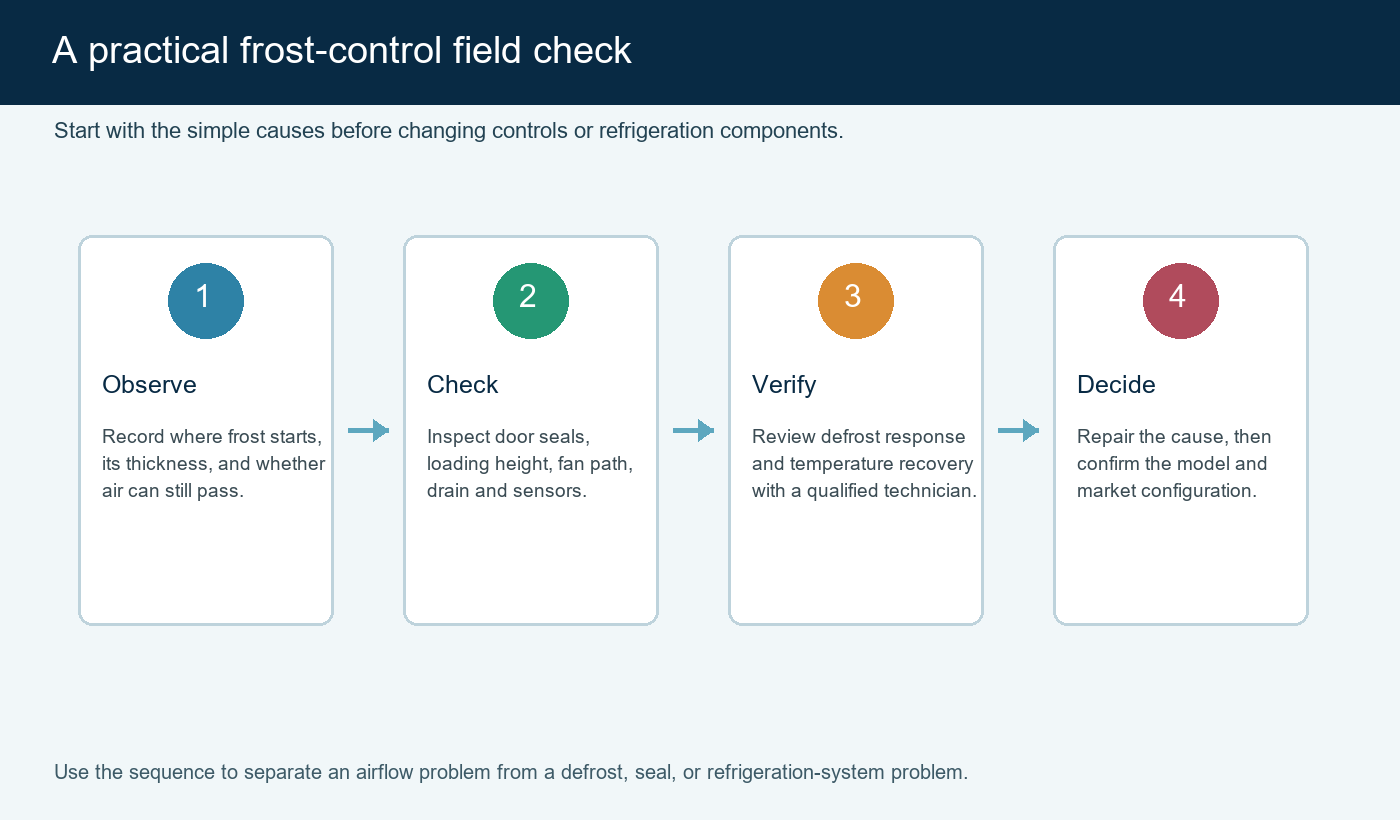
The evaporator absorbs heat from the cabinet air and stored product. When moisture freezes on the coil, the ice layer adds thermal resistance and can reduce the open area available for air movement. The result may be slower pull-down, longer recovery after loading, warmer zones, higher compressor run time, or a fan that sounds normal while moving less air than the design requires.
Frost is also a useful diagnostic clue. Frost concentrated near the inlet is not the same signal as a coil that is blocked from end to end. Heavy ice on one side may suggest an airflow or refrigerant distribution problem; repeated ice at the door edge may point to warm, humid air entering the cabinet. A technician should interpret the pattern together with suction pressure, temperature readings, control status, and the cabinet's operating history.
The goal is not to promise a freezer that never sees ice. The goal is to keep frost within the range the cabinet and its defrost method were designed to manage, while protecting product temperature and service life.
How frost forms: the four variables buyers should understand
1. Moisture entering the cabinet
Every door or lid opening can introduce warm, humid air. In a busy convenience store, ice cream counter, restaurant, or loading area, frequent openings can add more moisture than a quiet back-of-house cabinet. An open lid, damaged gasket, or poorly fitted sliding glass panel increases the same effect.
2. Coil surface temperature
The evaporator surface must be cold enough to remove heat from the cabinet. If the surface is below the freezing point while humid air is present, water vapor can freeze on the coil. The colder surface is not automatically the problem; the design must balance heat transfer, airflow, product load, and defrost.
3. Airflow through the coil and cabinet
Fans, coil spacing, return-air openings, shelf loading, and product placement determine whether air can reach the evaporator and return to the cabinet. Blocking the return path can create local cold spots and uneven frost. A fan-cooling cabinet should not be loaded above its marked air path or in front of a sensor.
4. Defrost timing and drainage
Defrost control must remove accumulated ice before it becomes an airflow restriction. The method may be off-cycle, electric, hot gas, or another design selected for the cabinet and operating temperature. Meltwater also needs a clear drain route. A blocked drain can refreeze and make a correct defrost cycle look ineffective.
A seven-step field check before changing the controller
This checklist is intended for trained service personnel and equipment owners documenting a fault. Isolate power before opening electrical compartments, and follow the refrigerant and electrical safety rules that apply in your market.
Step 1: Record the frost pattern
Take a photo before removing ice. Note whether frost is uniform, limited to the inlet, concentrated at one end, or forming around the door or lid. Record cabinet temperature, ambient temperature, product load, and the time since the last defrost.
Step 2: Check the door, lid, and gasket
Look for a torn gasket, a lid that does not sit squarely, a hinge that has lost alignment, or a sliding glass panel that does not close fully. Clean the sealing surface. A simple paper test can show whether the gasket is gripping around the perimeter, but it should not replace a proper inspection.
Step 3: Check loading and air paths
Compare the actual load with the cabinet's marked load line or basket layout. Remove cartons covering an evaporator inlet, return grille, fan guard, or sensor. In a chest freezer, baskets and dividers should support access without creating a solid wall against the cold-air path.
Step 4: Confirm fan operation and coil cleanliness
Listen for abnormal fan noise and check for ice touching the fan blade. Inspect dust, grease, or packaging debris around the coil and condenser. Do not scrape a coil with a sharp tool; a punctured circuit can turn a frost complaint into a refrigerant repair.
Step 5: Verify the defrost sequence
Check whether the controller enters defrost, whether the heater or other defrost device responds, whether the termination sensor changes state, and whether meltwater drains. The correct interval and termination temperature are model-specific. They should come from the approved wiring diagram or service documentation, not a generic internet setting.
Step 6: Check temperature recovery
After the cabinet is returned to service, monitor several points rather than relying on one display value. A loaded test is more useful than an empty-cabinet reading. Compare the warmest product zone, the coldest zone, and the recovery trend after a normal opening or replenishment event.
Step 7: Escalate refrigeration-system checks
If the coil pattern remains abnormal after airflow, sealing, drain, and defrost checks, a qualified technician should evaluate refrigerant charge, metering device operation, compressor performance, restrictions, sensor calibration, and control wiring. Frost alone cannot identify which component has failed.
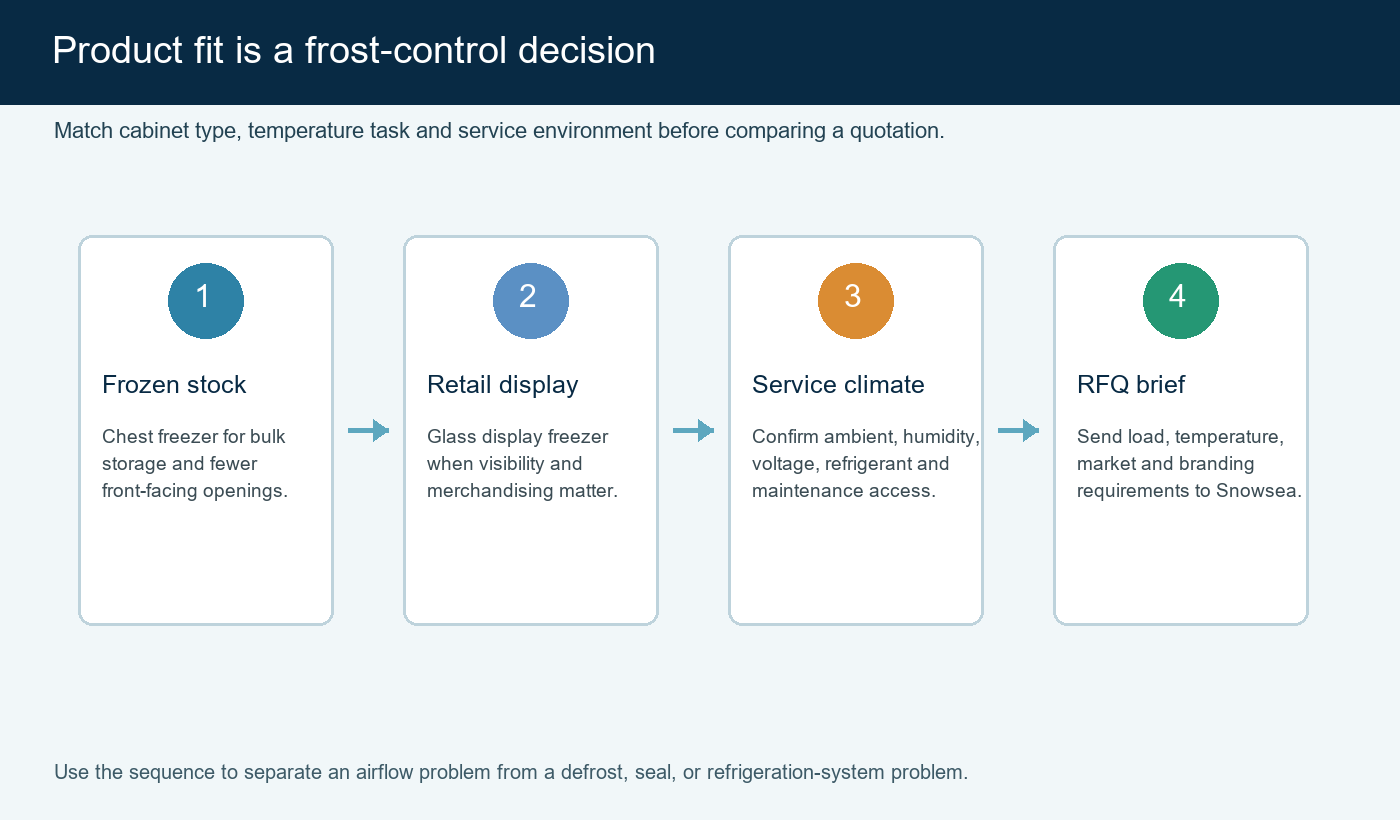
Choosing the right frost-control approach by application
Low-maintenance storage
A no-frost chest freezer can be attractive where staff cannot perform regular manual defrosting. It still needs correct loading, gasket care, drain inspection, and service access. In a B2B quotation, ask how the no-frost function is achieved, which components are serviceable, and what temperature and ambient conditions were used for validation.
Ice cream and frozen dessert display
Glass display freezers trade visibility for a larger moisture and condensation challenge. Buyers should specify the product holding range, opening frequency, glass construction, defrost behavior, basket plan, and cleaning routine. A display unit that looks clear when empty may behave differently during a humid, fully loaded retail shift.
Back-of-house food storage
Restaurants, central kitchens, and food distributors often prioritize capacity, access speed, and robust baskets or dividers. A chest design can reduce the amount of cold air lost during a short opening, while a vertical design may improve product organization. The better option depends on the storage task and floor plan, not on a single efficiency label.
Tropical, coastal, or unstable-power markets
High ambient temperature and humidity increase the load on insulation, door seals, condenser heat rejection, and defrost management. Coastal sites may add corrosion concerns. Unstable power makes the starting range, electrical protection, and restart behavior important. These conditions should be written into the RFQ and acceptance test instead of being hidden behind a general phrase such as “suitable for all climates.”
Snowsea product references for a frost-control discussion
The following examples are taken from the product pages currently visible on the Snowsea website. They are useful starting points for a project conversation, not a substitute for a market-specific specification sheet.
| Product page reference | Website-listed information | Frost-control conversation | Confirm before order |
|---|---|---|---|
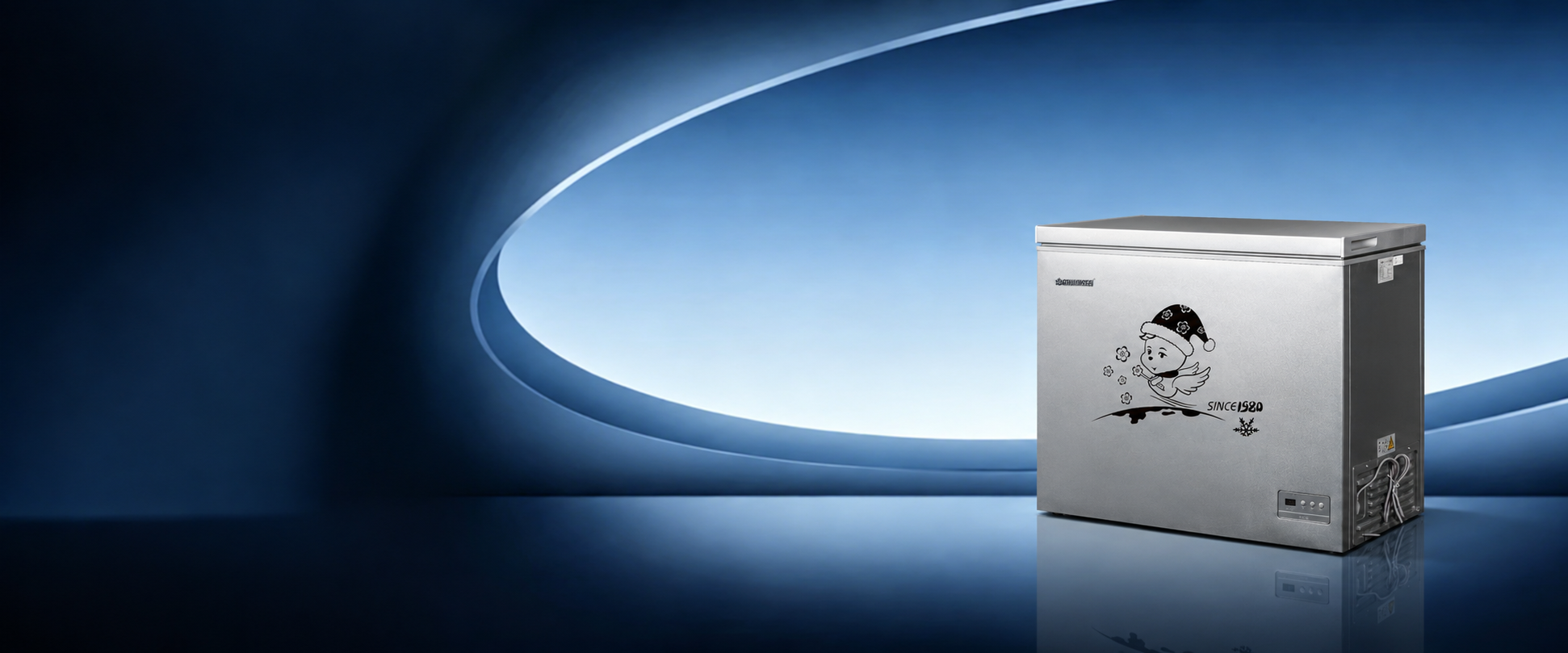
| BD/BC-227WA 227L no-frost chest freezer | Air-cooled no-frost positioning, R600a, electronic temperature control, 1050 x 560 x 880 mm, 36/40 kg, wire basket, optional LED, wheels | Suitable for buyers prioritizing low manual-defrost workload and organized chest storage | Defrost logic, climate class, noise, daily energy use, electrical version, and destination-market compliance |
| SD/SC-368Y ice cream display freezer | 368L, R290, six-position temperature adjustment, curved tempered glass, baskets and lock, -25 C wording on the product page | Useful for frozen-dessert retail where visibility and frost/condensation control must be considered together | Holding temperature under load, glass anti-condensation option, ambient class, energy data, and refrigerant service requirements |
| BD-500 chest freezer | 500L, R290, double upper doors, six-position adjustment, baskets, lock, wheels, -25 C wording on the product page | Fits higher-volume storage discussions where access pattern and load distribution affect frost and recovery | Tested temperature range, defrost method, power version, energy standard, and loading limits |
| LC-300W showcase | 300L, 0-10 C, R290, double-glazed glass, adjustable shelves, LED, lock, wheels | A chilled display reference when a project needs to separate refrigeration display from frozen storage | Confirm whether fan cooling is standard, plus humidity, condensation, energy, and climate-class data |
The BD/BC-227WA page is especially relevant to a low-maintenance brief because it presents the cabinet as an air-cooled no-frost freezer and lists electronic temperature control. For a purchase decision, Snowsea should still confirm the exact refrigerant, electrical, control, and defrost configuration for the buyer's country and voltage.
What to include in an RFQ for evaporator frost control
An accurate quotation needs more than cabinet capacity. Send the supplier:
- Product type and target use: storage, display, kitchen, distribution, or mixed use.
- Required product temperature and whether the requirement is set point, air temperature, or warmest product temperature.
- Ambient temperature, humidity, altitude, and expected opening frequency.
- Load type, package size, loading pattern, basket or shelf plan, and replenishment routine.
- Destination voltage, frequency, plug, language, labeling, and certification requirements.
- Refrigerant preference or local restrictions, with a request for the exact market version.
- Defrost method, service access, drain arrangement, controller functions, and alarm options.
- Energy, noise, temperature-uniformity, pull-down, recovery, and packaging data required for approval.
- Branding, color, handle, glass, lighting, basket, wheel, and carton requirements for OEM or private-label projects.
This brief lets an engineer judge whether the frost-control issue is a cabinet design question, an installation question, or a maintenance question. It also gives the factory a clear basis for sample testing and final inspection.
Maintenance habits that prevent repeat frost complaints
Keep the gasket and mating surface clean. Do not pack product against the air return or sensor. Keep the condenser area clear and inspect it on a schedule that matches dust and grease exposure. Confirm that drain outlets remain open. Train staff to close lids and doors promptly and to report a change in frost pattern before it becomes a full ice blockage.
When manual defrost is required, use the method approved for the cabinet. Avoid knives, screwdrivers, open flames, or uncontrolled hot water near the liner, wiring, and refrigeration circuit. After defrost, dry the cabinet, verify the drain, restore the load gradually, and record the recovery result.
For R600a or R290 models, service work must follow the equipment instructions and local flammable-refrigerant requirements. A low-cost shortcut around refrigerant safety can create a much larger operational and compliance risk.
FAQ
Is frost on a commercial freezer evaporator always a fault?
No. A light, controlled layer can occur during normal operation. Rapid growth, uneven coverage, blocked airflow, repeated refreezing after defrost, or rising product temperature deserves investigation.
Can increasing the defrost frequency solve every frost problem?
No. More frequent defrost may mask a leaking gasket, blocked drain, poor loading pattern, fan fault, sensor problem, or refrigeration-system issue. It can also add temperature fluctuation and energy use if applied without testing.
What is the first thing a store manager should check?
Check whether the door or lid closes completely, whether product is blocking an air path, and whether the frost pattern has changed. Take a photo and record cabinet and ambient temperatures before calling service.
Does a no-frost freezer need no maintenance?
No. No-frost reduces the need for routine manual ice removal, but seals, fans, drains, condenser surfaces, sensors, controls, and product loading still affect performance.
Is R290 or R600a automatically better for frost control?
Refrigerant choice alone does not determine frost performance. Coil design, system matching, controls, insulation, airflow, defrost, and service quality all matter. The selected refrigerant must match the approved product version and local safety rules.
What should a buyer request from a freezer manufacturer?
Request the exact market specification, temperature and energy test conditions, defrost description, electrical data, service documentation, spare-parts plan, and a clear list of options. For an OEM project, request sample validation before mass production.
A practical next step for buyers
If frost is reducing capacity, recovery, or product confidence, begin with a one-page RFQ rather than a generic request for a “frost-free freezer.” Include the cabinet type, load, climate, voltage, temperature task, opening pattern, and required evidence. Snowsea can then recommend a product family, review the configuration, and identify which performance points need confirmation for the destination market.
See the Snowsea freezer range, review the BD/BC-227WA product page, or send the project details through the Snowsea contact page. For OEM and private-label work, include the target market, capacity, temperature range, certification standard, and estimated order quantity so the engineering team can respond with a useful starting point.
Technical reference note
For final design and service decisions, use the approved product manual, wiring diagram, destination-market safety rules, and the applicable refrigeration standards. This article explains the decision process; it does not replace a technician's diagnosis or a model-specific test report.