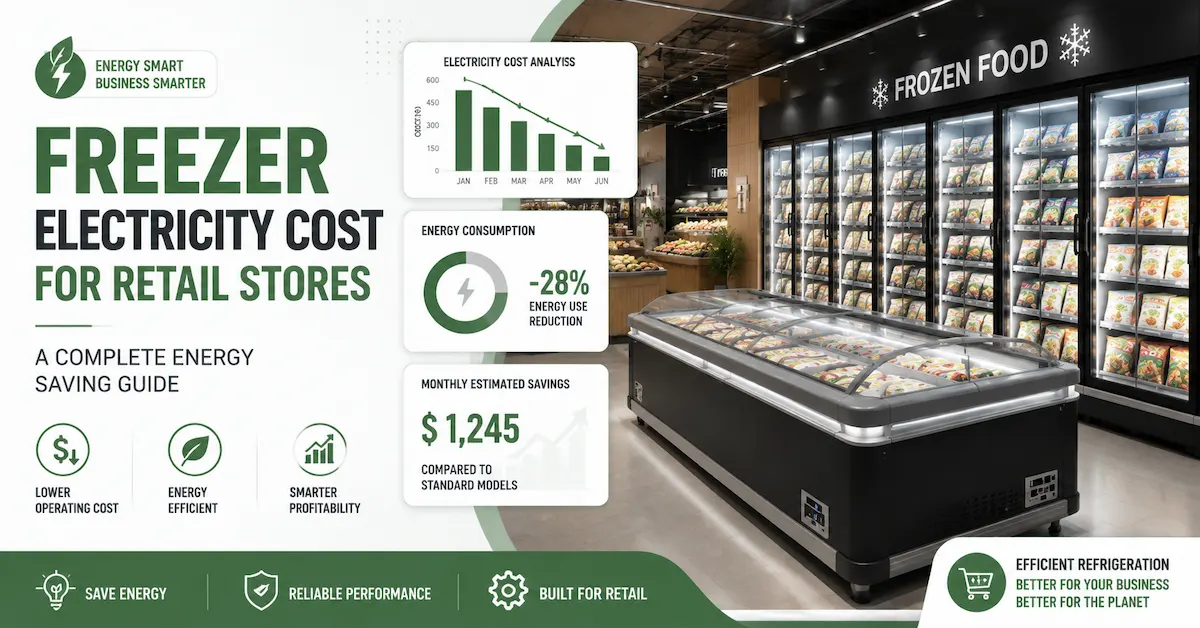
For supermarkets, frozen-food retailers, and commercial refrigeration operators, electricity expenses represent a significant part of daily operating costs.
Unlike many other types of equipment, commercial freezers often operate continuously, usually 24 hours a day. Even small differences in energy efficiency can create noticeable cost differences over several years.
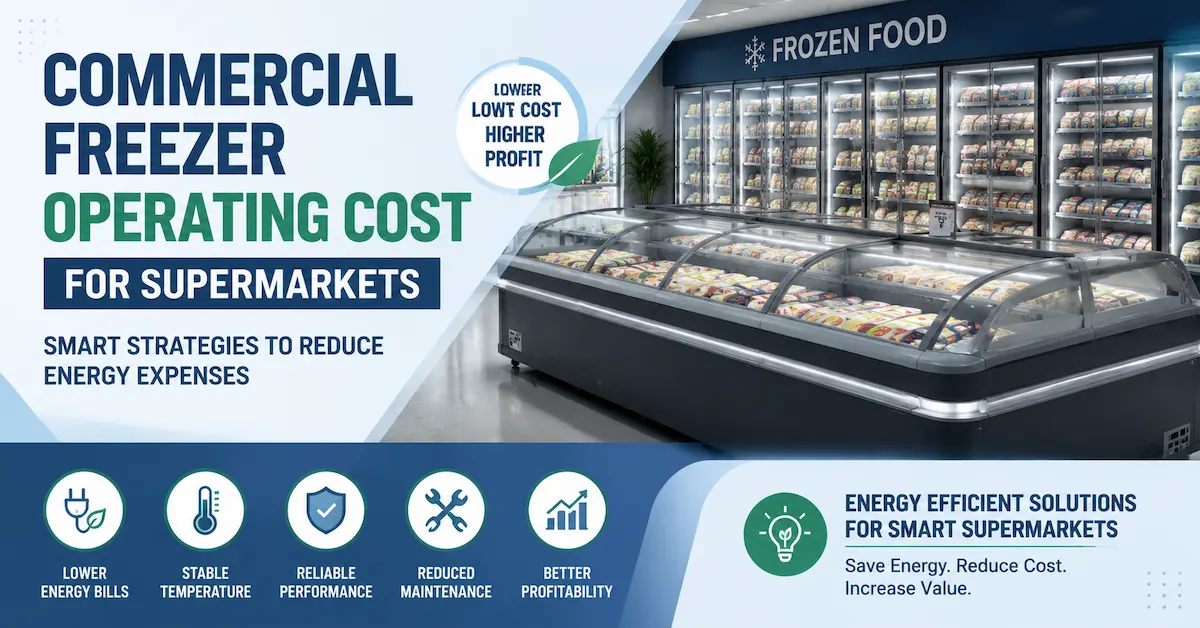
Understanding commercial freezer operating cost helps supermarket owners and refrigeration buyers make better purchasing decisions.
The total operating cost of a commercial freezer is affected by:
- Electricity consumption
- Compressor efficiency
- Insulation performance
- Door design
- Temperature settings
- Maintenance frequency
- Store environment
- Usage habits
- Equipment lifespan
Reducing energy expenses does not always mean buying the cheapest freezer. A lower-priced unit may consume more electricity and create higher long-term costs.
A properly selected energy-efficient commercial freezer can help supermarkets:
- Reduce monthly electricity bills
- Improve refrigeration reliability
- Lower maintenance costs
- Protect frozen product quality
- Increase long-term profitability
What Is Commercial Freezer Operating Cost?
Commercial freezer operating cost refers to the total expense required to run and maintain refrigeration equipment throughout its service life.
The main cost components include:
| Cost Factor | Description |
|---|---|
| Electricity cost | Power required for daily operation |
| Maintenance cost | Cleaning, repairs, and replacement parts |
| Service cost | Technician support and troubleshooting |
| Product loss | Cost caused by temperature problems |
| Replacement cost | Future equipment replacement |
For supermarkets, electricity consumption is usually the largest ongoing expense.
A freezer that saves only a small amount of energy per day can create significant savings when multiplied by:
- Multiple freezer units
- Long operating hours
- Several years of operation
Why Freezer Energy Cost Matters for Supermarkets
Supermarkets often operate:
- Multiple display freezers
- Island freezers
- Upright glass-door freezers
- Beverage refrigeration systems
- Storage freezers
The total energy consumption can become substantial.
For example, a supermarket operating 20 commercial freezers may spend significantly more on electricity than a small store using only two or three units.
Energy efficiency directly affects:
- Profit margins
- Product pricing
- Store operating expenses
- Business competitiveness
Therefore, buyers should evaluate not only the purchase price but also the long-term commercial freezer energy cost.
Main Factors Affecting Commercial Freezer Operating Cost
1. Compressor Efficiency
The compressor is one of the most important components affecting energy consumption.
A high-efficiency compressor can help:
- Reduce electricity usage
- Maintain stable temperatures
- Improve cooling performance
- Reduce operating stress
Older or lower-efficiency compressors may:
- Run longer
- Consume more power
- Generate more heat
- Require more maintenance
When selecting commercial freezers, buyers should evaluate:
- Compressor brand
- Cooling capacity
- Energy efficiency rating
- Operating stability
- Expected lifespan
2. Insulation Performance
Insulation quality directly affects how well a freezer maintains cold temperatures.
Good insulation helps:
- Reduce cold-air loss
- Lower compressor workload
- Improve energy efficiency
Important insulation factors include:
- Insulation thickness
- Material quality
- Cabinet structure
- Door sealing performance
Poor insulation forces the refrigeration system to work harder, increasing electricity consumption.
3. Door Design and Opening Frequency
Doors have a major impact on freezer efficiency.
Glass-Door Freezers
Advantages:
- Better product visibility
- Reduced cold-air loss
- Improved temperature stability
Suitable for:
- Supermarkets
- Convenience stores
- Retail displays
Open Display Freezers
Advantages:
- Easy customer access
- Strong promotional effect
However, they may require:
- Stronger refrigeration capacity
- Optimized airflow design
For supermarkets with high customer traffic, door design should balance sales convenience and energy efficiency.
4. Freezer Size and Capacity Selection
Choosing the correct freezer size is important.
An oversized freezer may:
- Waste floor space
- Increase electricity costs
- Reduce operational efficiency
An undersized freezer may:
- Require frequent restocking
- Increase product handling
- Reduce customer experience
The ideal freezer size depends on:
- Product volume
- Sales speed
- Store layout
- Storage requirements
Choosing the correct capacity is one of the simplest ways to control operating costs.
5. Temperature Settings
Incorrect temperature settings can increase energy consumption.
Lower-than-required temperatures may cause:
- Higher electricity usage
- Longer compressor operation
- Additional frost formation
Supermarkets should maintain temperatures according to:
- Product requirements
- Local regulations
- Manufacturer recommendations
Regular temperature monitoring helps maintain efficiency.
6. Store Environment Conditions
The installation environment affects freezer performance.
Important factors include:
- Ambient temperature
- Humidity
- Air circulation
- Sunlight exposure
- Store ventilation
Freezers installed near:
- Entrance doors
- Heat sources
- Direct sunlight
may consume more energy.
Proper placement helps reduce unnecessary refrigeration load.
Energy Efficient Commercial Freezer Features
An energy efficient commercial freezer usually includes:
High-Efficiency Compressor
Benefits:
- Lower electricity consumption
- Stable cooling performance
- Longer service life
Improved Insulation
Benefits:
- Better temperature retention
- Reduced compressor workload
LED Lighting
Compared with traditional lighting:
- Lower power consumption
- Longer lifespan
- Less heat generation
Efficient Glass Systems
Features may include:
- Double-layer glass
- Anti-fog systems
- Heated glass technology
These improve visibility while reducing cooling loss.
Smart Temperature Controllers
Advanced controllers help:
- Monitor temperature
- Optimize operation
- Reduce unnecessary energy use
How Supermarkets Can Reduce Freezer Energy Expenses
Optimize Freezer Placement
Avoid installing freezers near:
- Entrance doors
- Heating equipment
- Direct sunlight
Choose locations with:
- Stable temperatures
- Good airflow
- Appropriate ventilation
Maintain Proper Loading Levels
Overloading or underloading can affect performance.
Products should be arranged according to:
- Manufacturer recommendations
- Airflow requirements
- Loading lines
Blocked airflow can increase energy consumption.
Clean Condensers Regularly
Dust accumulation reduces refrigeration efficiency.
Regular cleaning helps:
- Improve heat exchange
- Reduce compressor workload
- Extend equipment life
Check Door Seals
Damaged seals allow cold air to escape.
Regular inspection should include:
- Door gasket condition
- Closing performance
- Frost around doors
Replacing damaged seals can reduce unnecessary energy loss.
Schedule Preventive Maintenance
Regular maintenance helps identify:
- Refrigeration problems
- Component wear
- Temperature issues
Preventive maintenance is usually cheaper than emergency repairs.
Choose Low Operating Cost Commercial Freezers
A low operating cost commercial freezer should provide a balance between:
- Purchase price
- Energy efficiency
- Reliability
- Maintenance requirements
Buyers should compare:
| Evaluation Area | Importance |
|---|---|
| Energy consumption | High |
| Compressor quality | High |
| Insulation | High |
| Product capacity | Medium |
| Maintenance cost | Medium |
| Purchase price | Medium |
The cheapest freezer is not always the most economical option.
Commercial Freezer Electricity Consumption Comparison
Different freezer types have different energy requirements.
| Freezer Type | Energy Consideration |
|---|---|
| Chest freezer | Usually strong energy efficiency |
| Upright glass-door freezer | Good balance of display and efficiency |
| Island freezer | Higher display requirements |
| Open display freezer | Higher refrigeration demand |
| Beverage cooler | Moderate energy consumption |
Actual consumption depends on:
- Model design
- Compressor
- Store environment
- Usage frequency
- Temperature settings
How to Calculate Commercial Freezer Energy Cost
A basic calculation can be:
Daily energy cost = Power consumption × Operating hours × Electricity rate
Example factors:
- Rated power
- Hours per day
- Electricity price
- Number of units
For supermarket planning, buyers should estimate:
- Monthly energy consumption
- Annual electricity cost
- Expected equipment lifespan
This provides a more accurate comparison between freezer models.
Best Freezer Types for Energy Saving in Supermarkets
Upright Glass-Door Freezers
Advantages:
- Good temperature control
- Efficient vertical storage
- Reduced cold-air loss
Suitable for:
- Frozen food aisles
- Premium products
- Multiple SKUs
Chest Display Freezers
Advantages:
- Strong insulation
- High storage efficiency
- Lower cold loss
Suitable for:
- Bulk frozen products
- Wholesale stores
Island Display Freezers
Advantages:
- Strong merchandising performance
- Large display capacity
Suitable for:
- Supermarket promotions
- Frozen-food sections
Buyers should select equipment based on both sales requirements and energy goals.
How to Choose the Best Freezer for Supermarket Energy Saving
When selecting the best freezer for supermarket energy saving, buyers should evaluate:
Energy Performance
Check:
- Power consumption
- Compressor efficiency
- Temperature stability
Product Requirements
Consider:
- Frozen food type
- Product turnover
- Display needs
Store Conditions
Evaluate:
- Store temperature
- Customer traffic
- Installation location
Supplier Capability
Choose manufacturers that provide:
- Technical specifications
- Energy information
- Quality testing
- Long-term support
Common Mistakes That Increase Freezer Operating Costs
Buying Only Based on Price
Low purchase prices may lead to higher electricity costs.
Choosing the Wrong Capacity
Incorrect sizing reduces efficiency.
Ignoring Maintenance
Poor maintenance increases energy consumption.
Leaving Doors Open Too Long
Frequent unnecessary opening increases cooling load.
Installing in Poor Locations
Heat sources and sunlight increase operating costs.
How Snowsea Helps Reduce Commercial Freezer Operating Cost
Snowsea provides commercial refrigeration solutions designed for supermarkets, retailers, distributors, and food businesses.
Solutions include:
- Energy-efficient commercial freezers
- Display freezers
- Island freezers
- Upright glass-door freezers
- Chest freezers
- Customized refrigeration systems
Snowsea supports buyers with:
- Product selection
- Energy-efficient solutions
- OEM customization
- Quality inspection
- Export packaging
- International shipping
Explore Snowsea’s commercial refrigeration products.
FAQ
What factors affect commercial freezer operating cost?
The main factors include electricity consumption, compressor efficiency, insulation quality, door design, maintenance, and store environment.
How can supermarkets reduce freezer electricity costs?
Supermarkets can reduce costs by selecting energy-efficient freezers, maintaining equipment regularly, optimizing placement, and controlling temperature settings.
Are premium commercial freezers more energy efficient?
Many premium freezers use better compressors, insulation, and control systems, which can reduce long-term energy expenses.
Which freezer type saves the most energy?
Chest freezers often provide strong energy efficiency, while upright glass-door freezers offer a good balance between display and energy performance.
How often should commercial freezers be maintained?
Regular inspection and cleaning schedules help maintain efficiency and prevent unnecessary energy consumption.
Is a cheaper freezer always more economical?
No. A lower purchase price may result in higher electricity bills, maintenance costs, and shorter service life.
Conclusion
Understanding commercial freezer operating cost helps supermarkets make smarter equipment decisions and reduce long-term energy expenses.
The most effective cost-saving strategy is not simply choosing the cheapest freezer. Businesses should consider energy efficiency, compressor performance, insulation quality, maintenance requirements, and total ownership cost.
By selecting the right freezer model and applying proper operating practices, supermarkets can reduce electricity consumption while maintaining reliable frozen product storage.
Snowsea provides commercial refrigeration solutions with energy-efficient designs, OEM customization, quality control, and export experience for global buyers.