Entering a new commercial refrigeration market involves more than finding a factory, importing several freezer models, and offering them to local customers.
Importers must understand local demand, customer applications, purchasing budgets, certification requirements, logistics costs, competitor positioning, and after-sales expectations before committing to inventory.
A practical freezer market entry strategy for importers helps businesses reduce uncertainty and answer several important questions:
- Which freezer types should be introduced first?
- Who are the most valuable target customers?
- What pricing level can the market accept?
- How many units should be included in the first order?
- Should the products use the importer’s private label?
- What service and spare-parts support will customers expect?
- Which sales channels can generate repeat orders?
A successful strategy connects market research with product selection, sourcing, pricing, distribution, and long-term business development.
Step 1: Define the Target Market Clearly
“Entering a new market” is too broad to guide purchasing decisions.
Importers should first define the market by:
- Country or region
- Customer type
- Product application
- Retail channel
- Expected price level
- Required service model
For example, a freezer importer may focus on:
- Supermarkets and grocery chains
- Frozen-food distributors
- Hotels and restaurants
- Convenience stores
- Ice cream retailers
- Meat and seafood shops
- Commercial kitchen equipment dealers
Each segment requires different freezer designs, capacities, display formats, and purchasing terms.
A supermarket may need island display freezers and upright glass-door freezers. A hotel kitchen may prioritize solid-door upright freezers and high-capacity chest freezers. A small frozen-food retailer may need compact glass-lid models.
Defining the target customer prevents the importer from purchasing an unfocused product range.
Step 2: Research Local Freezer Demand
Market research should identify what customers already purchase and what problems remain unsolved.
Importers can study:
- Popular freezer categories
- Common capacities
- Preferred cabinet colors
- Local voltage and plug requirements
- Temperature expectations
- Typical store sizes
- Average purchasing budgets
- Competitor product ranges
- Distributor pricing
- Customer complaints
Useful questions include:
- Are customers more concerned about price or operating cost?
- Is floor space limited?
- Are glass-door products popular?
- Do buyers require private-label branding?
- Are replacement parts difficult to obtain?
- Is there demand for large supermarket projects?
- Are local suppliers offering sufficient customization?
The objective is not simply to copy the most common products. Importers should identify gaps where a better configuration, price position, packaging method, or service model can create an advantage.
Step 3: Select the Right Entry Product Portfolio
The first product portfolio should be focused, commercially practical, and easy to support.
Launching too many models creates:
- Higher inventory investment
- More spare-parts complexity
- Difficult sales training
- Lower quantity per model
- Higher sourcing costs
- Slower inventory turnover
A practical entry portfolio may include three groups.
Core Volume Models
These should address the largest customer group and generate regular sales.
Examples include:
- Standard chest freezers
- Upright glass-door freezers
- Sliding-glass display freezers
- Commercial storage cabinets
Differentiated Models
These help the importer compete on more than price.
Differentiation may include:
- Improved energy efficiency
- Better product visibility
- Customized dimensions
- Stronger shelves
- Premium glass systems
- Exclusive cabinet colors
Project Models
These are designed for larger customers such as supermarket chains, distributors, hotels, and frozen-food brands.
Project models may include:
- Island display freezer lines
- Multi-door upright freezers
- Customized meat or seafood display solutions
- Private-label refrigeration products
Importers can compare suitable configurations through Snowsea’s commercial refrigeration product range.
Step 4: Match Products to Local Applications
Product selection should begin with applications rather than catalog appearance.
| Customer Type | Typical Freezer Direction |
|---|---|
| Supermarket | Island, upright glass-door, chest display |
| Convenience store | Compact upright and glass-lid freezer |
| Hotel kitchen | Upright storage and chest freezer |
| Frozen-food retailer | Display freezer and promotional island |
| Meat shop | Heavy-duty storage and meat display freezer |
| Seafood retailer | Glass-door or island display freezer |
| Ice cream seller | Curved-glass or sliding-glass freezer |
| Distributor | Mixed commercial freezer range |
Importers should ask potential customers for:
- Product package dimensions
- Daily sales volume
- Required capacity
- Store layout
- Installation conditions
- Customer access requirements
- Replenishment frequency
This information helps the supplier recommend the correct cabinet type and internal configuration.
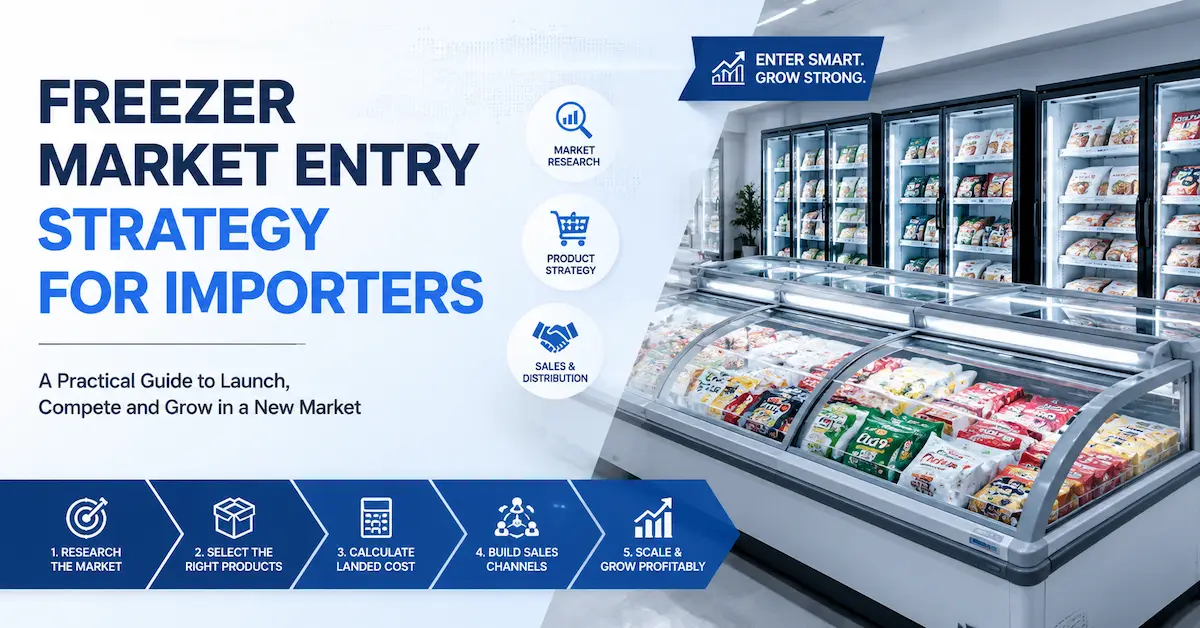
Step 5: Calculate the True Landed Cost
Factory price is only one part of the market-entry budget.
The complete landed cost may include:
- Freezer unit price
- OEM customization
- Export packaging
- Factory-to-port transportation
- Ocean freight
- Insurance
- Customs duties
- Import taxes
- Port charges
- Customs clearance
- Local delivery
- Inspection fees
- Warehousing
Importers should calculate the landed cost per unit for every model.
| Cost Area | Questions to Confirm |
|---|---|
| Product | Is the quotation based on the final specification? |
| Packaging | Is export protection included? |
| Freight | How many units fit in a container? |
| Customs | What classification and duties may apply? |
| Local handling | What are port and warehouse charges? |
| Service | Are spare parts included in the initial plan? |
A low-priced model with poor container utilization may have a higher landed cost than a slightly more expensive model with optimized dimensions and packaging.
Step 6: Build a Competitive Pricing Structure
The importer’s selling price should cover more than the landed cost.
It may need to include:
- Warehousing
- Sales commissions
- Marketing
- Dealer margins
- Installation
- Warranty reserves
- Spare parts
- Technical support
- Financing costs
- Profit margin
A useful pricing structure can contain:
Distributor Price
For buyers purchasing in volume.
Dealer Price
For regional resellers or equipment companies.
Project Price
For supermarkets, hotels, or multi-unit installations.
Suggested Retail Price
For smaller commercial buyers.
Importers should avoid competing only through the lowest price. Better product selection, reliable supply, local service, and clear warranty support can justify a stronger market position.
Step 7: Decide Between Standard Products and Private Label
Standard models allow faster market testing and lower development complexity.
Private-label products provide greater control over:
- Brand identity
- Product positioning
- Packaging
- Model numbers
- Customer loyalty
- Distributor exclusivity
A phased approach is often effective.
Initial Stage
Use existing models with limited branding to test demand.
Growth Stage
Introduce:
- Custom logos
- Rating labels
- Manuals
- Cartons
- Cabinet graphics
Expansion Stage
Develop:
- Exclusive dimensions
- Special configurations
- Custom product families
- Market-specific features
Snowsea provides OEM and ODM freezer customization for importers building private-label or market-specific refrigeration ranges.
Step 8: Confirm Compliance Before Ordering
Importers should confirm applicable requirements before approving production.
Requirements may relate to:
- Electrical safety
- Energy efficiency
- Refrigerants
- Product labeling
- User manuals
- Plug configurations
- Import documentation
- Local registration
- Food-retail installation
The exact requirements vary by destination and may change over time. Importers should verify current rules with qualified local authorities, testing organizations, customs brokers, or compliance consultants.
The supplier should receive a written list of required standards before sample production.
Late compliance changes can cause:
- New component requirements
- Revised labels
- Additional testing
- Production delays
- Higher project costs
Step 9: Start With a Controlled Trial Order
A trial order helps validate assumptions before a large inventory commitment.
A good trial order should test:
- Product demand
- Customer feedback
- Price acceptance
- Installation requirements
- Cooling performance
- Packaging quality
- Shipping damage rate
- Spare-parts needs
- Sales-channel performance
The trial order should be large enough to produce meaningful market feedback but small enough to control risk.
Importers should avoid including too many models. A focused trial allows more accurate evaluation of each product’s sales performance.
Step 10: Plan Container Utilization Carefully
Commercial freezers are large-volume products. Freight efficiency has a major impact on profitability.
Importers should request:
- Carton dimensions
- Product dimensions
- Gross weight
- Loading quantity
- Mixed-model loading plan
- Container arrangement
- Loading photos
Better container utilization reduces the freight cost per unit.
However, loading density should not compromise:
- Glass protection
- Cabinet protection
- Packaging strength
- Safe unloading
- Product orientation
The best loading plan balances shipping efficiency and product safety.
Step 11: Build the Right Sales Channels
A complete freezer market entry strategy for importers should identify how products will reach customers.
Potential channels include:
- Direct sales
- Regional dealers
- Commercial kitchen suppliers
- Supermarket equipment contractors
- Online B2B platforms
- Frozen-food distributors
- Hospitality equipment companies
- Local refrigeration installers
Direct Sales
Provides stronger margins and customer feedback but requires more sales resources.
Dealer Network
Expands geographic coverage but requires competitive dealer pricing and training.
Project Sales
Can generate larger orders but involves longer sales cycles, technical coordination, and installation planning.
A combination of direct sales and dealer development often provides a practical market-entry model.
Step 12: Prepare Sales and Technical Materials
Importers should not rely only on product images and basic price lists.
Effective sales materials may include:
- Product specification sheets
- Capacity comparisons
- Application recommendations
- Energy-consumption information
- Installation requirements
- Product videos
- User manuals
- Warranty policies
- Spare-parts lists
- Container-loading data
Sales teams should understand:
- Which model fits each customer
- How products differ
- What affects price
- How to explain operating costs
- What customization is available
- How warranty claims are handled
Clear information improves customer confidence and reduces quotation errors.
Step 13: Develop After-Sales and Spare-Parts Support
Commercial buyers evaluate the supplier’s service capability as well as the freezer itself.
Importers should prepare:
- Common spare parts
- Controllers
- Door gaskets
- Fans
- Sensors
- Handles
- Hinges
- Lighting parts
- Technical diagrams
- Troubleshooting procedures
Service planning should clarify:
- Warranty duration
- Parts coverage
- Local labor responsibility
- Claim approval
- Response time
- Replacement process
A weak after-sales structure can damage the brand even when the product quality is acceptable.
Step 14: Measure Market-Entry Performance
Importers should define performance indicators before launching.
Useful metrics include:
- Sales by model
- Gross margin
- Inventory turnover
- Dealer recruitment
- Quotation conversion rate
- Warranty claim rate
- Customer acquisition cost
- Repeat-order rate
- Average order value
- Time required to sell the first shipment
These results help determine whether to:
- Increase inventory
- Remove weak models
- Adjust pricing
- Add customization
- Expand dealer coverage
- Enter adjacent customer segments
Common Market-Entry Mistakes
Launching Too Many Models
A broad catalog can create inventory and support complexity before demand is validated.
Choosing Products Only by Factory Price
Importers must compare landed cost, market demand, service needs, and operating performance.
Ignoring Local Customer Applications
A successful model in one country may not fit another market’s stores, products, or purchasing habits.
Underestimating After-Sales Requirements
Commercial refrigeration customers expect spare parts and technical assistance.
Ordering Large Inventory Too Early
The market should be tested before committing to aggressive quantities.
Competing Only on Low Price
Price competition is difficult to sustain without differentiation and service.
Delaying Compliance Confirmation
Compliance should be checked before samples and mass production.
Market Entry Checklist for Freezer Importers
| Planning Area | Required Decision |
|---|---|
| Target market | Country, segment, customer type |
| Product range | Core, differentiated, project models |
| Pricing | Landed cost and channel margins |
| Compliance | Local standards and documentation |
| Branding | Standard, OEM, or private label |
| Trial order | Models, quantity, success criteria |
| Logistics | Packaging and loading plan |
| Sales channels | Direct, dealers, project partners |
| Service | Warranty and spare parts |
| Growth | Inventory and portfolio expansion |
How Snowsea Supports Importer Market Entry
Snowsea provides commercial refrigeration solutions for importers, distributors, supermarkets, frozen-food companies, hospitality suppliers, and private-label brands.
Support may include:
- Application-based model selection
- Product portfolio planning
- OEM and ODM customization
- Sample development
- Production scheduling
- Quality inspection
- Export packaging
- Container-loading coordination
- Technical documentation
- Spare-parts planning
Importers can review Snowsea’s manufacturing and export experience through the About Snowsea page.
FAQ
What is the best freezer market entry strategy for importers?
Importers should begin with market research, a focused product portfolio, accurate landed-cost calculations, a controlled trial order, suitable sales channels, and a clear after-sales plan.
How many freezer models should an importer launch first?
The first portfolio should remain focused. A small number of models covering the main customer applications is easier to sell, stock, and support.
Should importers start with private-label freezers?
Private labeling can strengthen brand value, but importers may first test standard product platforms before investing in advanced customization.
How can importers reduce freezer market-entry risk?
Use realistic demand forecasts, confirm compliance early, begin with a trial order, optimize container loading, and avoid excessive inventory.
Which customers should freezer importers target?
Potential customers include supermarket chains, refrigeration dealers, frozen-food distributors, restaurants, hotels, convenience stores, and equipment contractors.
How important is local after-sales service?
It is essential. Commercial buyers often require technical support, spare parts, warranty handling, and fast troubleshooting.
Conclusion
A successful freezer market entry strategy for importers combines market demand, product selection, pricing, compliance, logistics, sales channels, and service support.
Importers should avoid treating market entry as a single purchase. It is a structured business-development process that begins with research and continues through product validation, inventory planning, dealer development, and customer support.
Snowsea supports global importers with commercial freezer manufacturing, customized product development, quality control, export packaging, and long-term supply coordination.