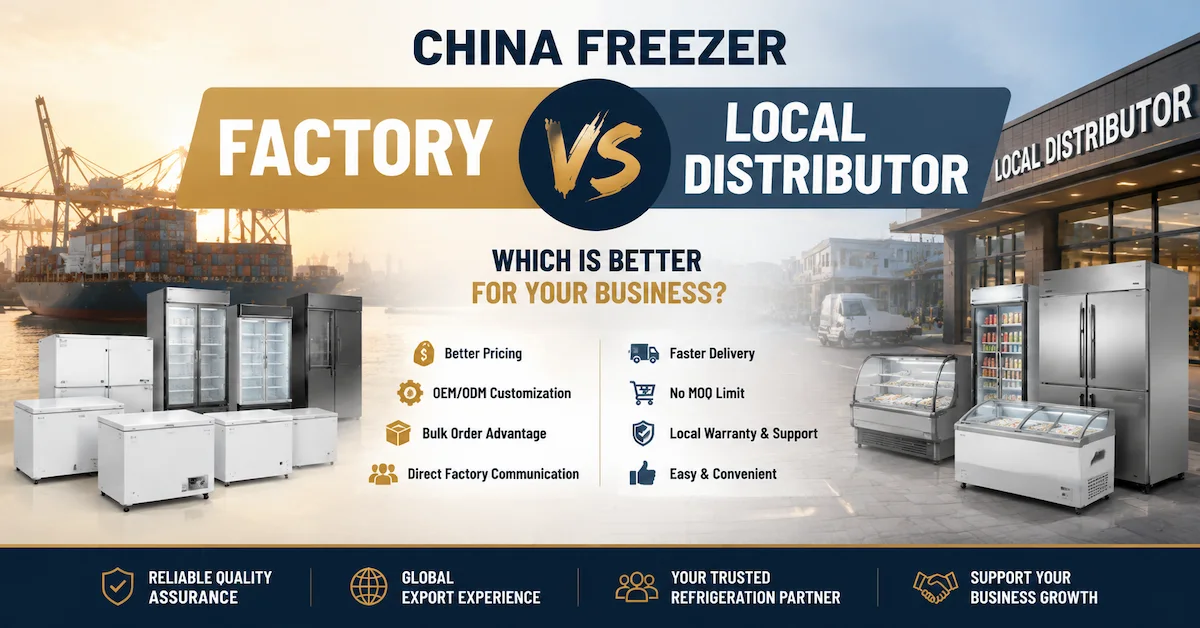
Commercial refrigeration buyers can purchase equipment directly from a factory or through a reseller that sources, stocks, and sells finished products.
The commercial freezer direct factory vs reseller decision affects more than the quoted unit price. It can influence minimum order quantity, customization, delivery speed, warranty handling, product availability, technical communication, and total landed cost.
A direct factory is usually better for buyers that need:
- Bulk orders
- OEM or private-label branding
- Customized specifications
- Stable repeat production
- More control over quality and packaging
A reseller is often more suitable for buyers that need:
- One or several units
- Immediate local inventory
- Faster Stable domestic delivery
- Local payment and communication
- Easier installation or warranty support
The better sourcing channel depends on the buyer’s volume, technical requirements, timeline, import capability, and long-term business model.
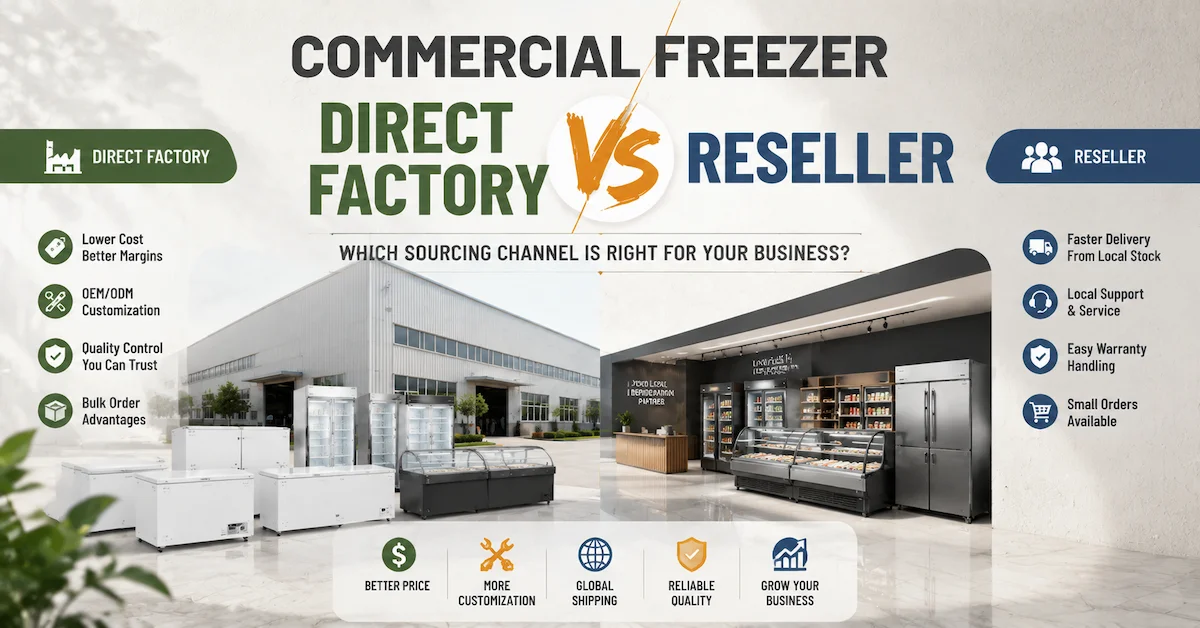
What Is a Commercial Freezer Direct Factory?
A direct factory manufactures or assembles commercial refrigeration equipment within its own production facility.
Its responsibilities may include:
- Product development
- Material purchasing
- Cabinet production
- Refrigeration-system assembly
- Electrical installation
- Cooling-performance testing
- Final quality inspection
- Export packaging
- Container loading
Direct factory customers commonly include importers, refrigeration distributors, supermarket chains, private-label brands, food-service equipment companies, and retail-project contractors.
Snowsea supplies chest freezers, display freezers, upright glass-door freezers, island freezers, and customized commercial refrigeration products. Buyers can review available models on the Snowsea product page.
What Is a Commercial Freezer Reseller?
A reseller purchases completed freezers from manufacturers, importers, or wholesalers and sells them to end users or smaller commercial buyers.
A reseller may provide:
- Local inventory
- Individual-unit sales
- Domestic delivery
- Installation coordination
- Local warranty service
- Spare-parts support
- Product demonstrations
- Local-language communication
Some resellers specialize in commercial refrigeration and provide strong technical service. Others mainly focus on product sales and depend on external technicians or manufacturer support.
Before purchasing, buyers should confirm whether the reseller provides genuine technical assistance or only order processing.
Direct Factory vs Reseller: Quick Comparison
| Evaluation Area | Direct Factory | Reseller |
|---|---|---|
| Unit price | More competitive for volume orders | Usually includes additional margin |
| MOQ | Normally applies | One unit may be available |
| OEM customization | Strong | Usually limited |
| Product selection | Full factory range | Limited to stocked models |
| Delivery | Production and international shipping | Fast when locally stocked |
| Quality control | Direct factory inspection | Inspection of finished inventory |
| Technical communication | Direct access to production team | Managed through reseller |
| Warranty | Remote or partner-based | Local support may be available |
| Import responsibility | Buyer may manage import | Already handled |
| Best for | Importers, brands, bulk buyers | Small businesses, urgent purchases |
Pricing and Total Purchasing Cost
Factory-direct quotations are usually based on:
- Materials
- Components
- Labor
- Production quantity
- Customization
- Packaging
- Factory overhead
Reseller prices may also include:
- International freight
- Import duties
- Customs clearance
- Local warehousing
- Sales expenses
- Warranty reserves
- Domestic delivery
- Reseller margin
A factory quotation can appear significantly lower, but buyers must calculate the complete landed cost.
This may include:
| Cost Item | Factory Purchase | Reseller Purchase |
|---|---|---|
| Product price | Lower | Higher |
| International freight | Buyer responsibility | Included |
| Duties and customs | Buyer responsibility | Included |
| Local delivery | Separate | Often available |
| Inventory cost | Higher for bulk orders | Lower for small orders |
| Customization | More flexible | Usually restricted |
For one or two freezers, a reseller can be more economical because the buyer avoids container freight, customs procedures, and MOQ requirements.
For regular wholesale orders, direct factory sourcing normally offers stronger long-term cost control.
MOQ offers stronger long-term cost control.
MOQ and Order Flexibility
Minimum order quantity is a major difference in the commercial freezer direct factory vs reseller comparison.
Factories set MOQ because production may require:
- Material preparation
- Production-line setup
- Component purchasing
- Custom labels
- Printed packaging
- Model-specific testing
MOQ may apply to:
- Each model
- Each color
- Each voltage configuration
- Each branding version
A reseller can normally sell one unit from existing inventory. This is useful for:
- New restaurants
- Small grocery stores
- Replacement purchases
- Market testing
- Short-term projects
Buyers that want to reduce factory MOQ can consider standard models, regular colors, basic logo customization, or mixed-model container orders.
OEM and Private-Label Customization
A direct factory provides more control over product customization.
Common OEM options include:
- Buyer logo
- Customized rating labels
- Model numbers
- Cabinet colors
- Printed graphics
- Shelf configurations
- Basket layouts
- Voltage and frequency
- Plug types
- User manuals
- Export cartons
ODM projects may include changes to:
- Cabinet dimensions
- Door structures
- Refrigeration systems
- Controllers
- Lighting
- Internal storage layouts
Resellers generally sell finished inventory and may offer only simple customization, such as external labels or local branding.
For private-label brands and refrigeration distributors, working directly with a factory usually provides better product differentiation and specification consistency.
Snowsea’s customization capabilities are available through its OEM and ODM refrigeration service.
Delivery Time and Product Availability
Resellers have a clear advantage when the required freezer is already in stock.
Local inventory may support:
- Same-week delivery
- Emergency replacement
- Immediate inspection
- Faster store installation
Factory-direct purchasing normally includes:
- Specification confirmation
- Deposit and order approval
- Material preparation
- Production scheduling
- Assembly and testing
- Packaging
- Container booking
- International transportation
- Customs clearance
- Local delivery
Direct factory sourcing is therefore better suited to planned purchasing rather than urgent replacement.
Buyers with seasonal demand or store-opening deadlines should confirm both the production lead time and shipping transit time before ordering.
Product Range and Model Choice
A factory can usually provide access to its full product portfolio.
This may include:
- Chest freezers
- Glass-lid freezers
- Island freezers
- Upright freezers
- Meat display freezers
- Ice cream freezers
- Commercial refrigeration cabinets
A reseller normally stocks models with proven local demand. This makes purchasing faster but may limit choices in:
- Dimensions
- Capacity
- Temperature range
- Door configuration
- Cabinet color
- Electrical system
- Internal accessories
A factory is more suitable when buyers want to build a coordinated commercial freezer range. A reseller is practical when a standard local model already meets the application.
Quality Control and Inspection
Direct factory buyers can define inspection requirements before production.
Inspection may cover:
- Product dimensions
- Cabinet appearance
- Door and gasket alignment
- Electrical specifications
- Cooling performance
- Temperature stability
- Controller accuracy
- Accessories
- Packaging
- Container loading
Buyers may request factory inspection reports or arrange an independent pre-shipment inspection.
A reseller allows the buyer to inspect the completed unit locally before delivery. This is useful for confirming appearance and basic operation but provides less influence over the original production process.
For large or customized orders, direct control over manufacturing and inspection standards is usually more valuable.
Warranty and Technical Support
Resellers may provide easier local warranty service because they can maintain:
- Local technicians
- Spare-parts inventory
- Replacement units
- Domestic service networks
- Local-language support
Factory after-sales support may include:
- Remote troubleshooting
- Wiring diagrams
- Technical manuals
- Spare-parts supply
- Component recommendations
- Warranty claim assessment
Direct factory purchasing is more suitable when the buyer has local refrigeration technicians or operates its own service network.
Before choosing either option, confirm:
- Warranty period
- Parts coverage
- Labor coverage
- Claim procedure
- Spare-parts availability
- Technical response time
- Replacement responsibility
Export Packaging and Shipping Protection
Commercial freezers contain glass, compressors, electrical components, painted surfaces, and refrigeration piping.
A direct factory can design packaging according to the structure of each model.
Export packaging may include:
- Protective film
- Foam inserts
- Corner guards
- Reinforced cartons
- Pallet bases
- Wooden frames
- Moisture protection
- Loading restraints
A reseller normally receives products after the import process has already been completed. The buyer does not need to manage international packaging or container loading.
Factory-direct buyers should request packaging specifications, loading quantities, and loading photos before shipment.
Inventory and Cash-Flow Risk
Buying directly from a factory normally requires a larger purchasing commitment.
This can create:
- Higher initial investment
- Warehouse requirements
- Slower inventory turnover
- Currency exposure
- Unsold-stock risk
Reseller purchasing allows businesses to buy closer to actual demand.
This can reduce:
- Inventory pressure
- Storage costs
- Capital requirements
- Forecasting risk
However, repeated reseller purchases at a higher unit price may reduce profit margins as sales volume increases.
Growing businesses should regularly compare local purchasing costs with the cost of importing full or mixed containers.
When Is a Direct Factory Better?
Choose a direct factory when:
- You purchase wholesale quantities
- You need OEM branding
- You require customized dimensions or configurations
- You want consistent repeat production
- You can plan orders in advance
- You understand international sourcing
- You have local technical-service capability
- You want stronger long-term margins
This route is especially suitable for importers, distributors, private-label brands, and supermarket equipment companies.
When Is a Reseller Better?
Choose a reseller when:
- You need one or several units
- Delivery is urgent
- You do not want to manage import procedures
- You require local installation
- You need immediate warranty support
- You prefer local payment
- You have limited warehouse space
- A standard stocked model meets your needs
This route is suitable for restaurants, independent retailers, small supermarkets, and replacement equipment purchases.
Can Buyers Use Both Sourcing Channels?
Many businesses benefit from a hybrid purchasing strategy.
For example:
- Import high-volume core models directly from a factory
- Buy urgent replacement units from local resellers
- Source customized products from the manufacturer
- Purchase low-volume specialty models locally
This strategy provides better pricing on planned orders while maintaining flexibility when immediate local supply is required.
Buyer Decision Checklist
| Buyer Requirement | Recommended Channel |
|---|---|
| One replacement freezer | Reseller |
| Full-container purchase | Direct factory |
| Private-label branding | Direct factory |
| Immediate local delivery | Reseller |
| Customized specifications | Direct factory |
| Local installation | Reseller |
| Long-term wholesale program | Direct factory |
| Limited import experience | Reseller |
| Stronger QC control | Direct factory |
| Lower inventory risk | Reseller |
Common Purchasing Mistakes
Comparing Only the Unit Price
Factory prices may exclude freight, duties, customs fees, and local delivery.
Importing Too Few Units
Small shipments can create a high transportation cost per freezer.
Ignoring Service Requirements
A lower product price may not compensate for unavailable technicians or spare parts.
Assuming Every Reseller Provides Technical Support
Some resellers offer only commercial sales services.
Ordering Too Much Inventory
Bulk pricing is not valuable when products remain unsold.
Failing to Confirm the Real Manufacturer
Buyers should verify factory facilities, production capability, testing processes, and export experience.
Why Buyers Source Commercial Freezers From Snowsea
Snowsea provides commercial refrigeration solutions for importers, distributors, supermarkets, frozen-food retailers, and private-label brands.
Snowsea supports buyers with:
- Commercial freezer manufacturing
- Product and capacity selection
- OEM and ODM customization
- Quality inspection
- Export packaging
- Container-loading planning
- Technical documentation
- Long-term supply coordination
Buyers can learn more about Snowsea’s manufacturing experience through the About Snowsea page.
FAQ
Is buying from a commercial freezer factory always cheaper?
Factory-direct sourcing is usually more competitive for larger orders, but buyers must include freight, duties, customs fees, inspection, storage, and local delivery.
Can a reseller provide customized commercial freezers?
Some resellers can arrange special orders, but customization is generally more limited and may require factory MOQ.
Which option has a lower minimum order quantity?
A reseller can often sell one unit, while direct factories normally apply a minimum quantity per model or configuration.
Which sourcing channel provides faster delivery?
A reseller is faster when the required model is locally stocked. Factory orders require production and international transportation.
Which option provides better warranty service?
Resellers may provide faster local support. Direct factories are suitable for buyers with technical teams or local service partners.
Can distributors purchase from both factories and resellers?
Yes. Distributors can import core products directly and use resellers for urgent, low-volume, or specialty purchases.
Conclusion
The commercial freezer direct factory vs reseller decision should be based on purchasing volume, customization requirements, delivery urgency, inventory strategy, import capability, and service expectations.
A direct factory provides better control over specifications, OEM development, manufacturing, quality inspection, packaging, and long-term pricing. A reseller provides smaller quantities, faster local delivery, lower import complexity, and easier local service.
Snowsea supports global commercial refrigeration buyers with direct manufacturing, customized solutions, quality control, export packaging, and international supply coordination.