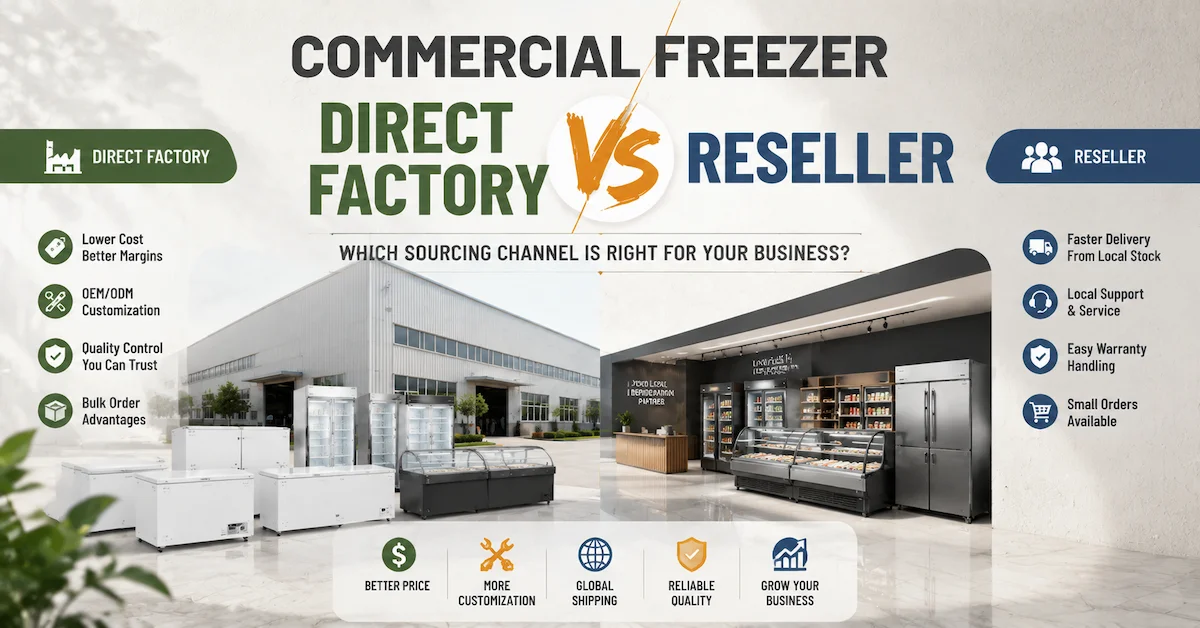
Commercial refrigeration buyers generally have two purchasing routes: importing directly from a manufacturer or buying through a distributor in their own market.
The China freezer factory vs local distributor decision affects far more than the unit price. It can influence customization, minimum order quantity, delivery speed, inventory investment, warranty handling, technical communication, and long-term profitability.
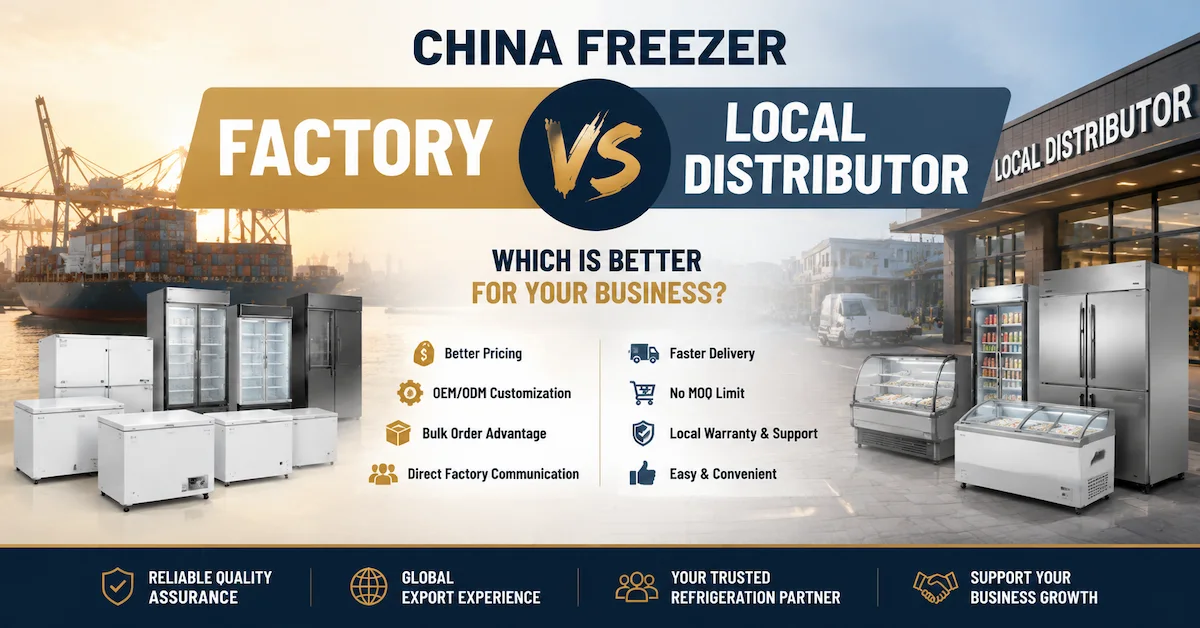
Buying from a China freezer factory usually provides stronger pricing and customization advantages for bulk orders. Buying from a local distributor usually provides faster delivery, smaller quantities, local communication, and easier after-sales service.
The better option depends on:
- Required order quantity
- Product customization
- Available purchasing budget
- Delivery deadline
- Import experience
- Local service requirements
- Long-term sales plans
What Does Buying From a China Freezer Factory Mean?
Buying directly from a China freezer factory means working with the company responsible for producing or assembling the commercial refrigeration equipment.
The factory may manage:
- Product design
- Component purchasing
- Cabinet manufacturing
- Refrigeration assembly
- Quality inspection
- OEM branding
- Export packaging
- Container loading
Direct factory buyers commonly include:
- Refrigeration importers
- Commercial equipment distributors
- Supermarket chains
- Private-label brands
- Food-service equipment wholesalers
- Retail-project contractors
Snowsea provides commercial freezer manufacturing and customized refrigeration solutions for global buyers. Available product categories can be reviewed on the Snowsea commercial refrigeration product page.
What Does Buying From a Local Distributor Mean?
A local distributor purchases refrigeration equipment from manufacturers and resells it within a specific country or region.
The distributor may provide:
- Local inventory
- Smaller order quantities
- Local-language communication
- Installation coordination
- Warranty support
- Spare parts
- Local delivery
- Payment in local currency
Local distributors are often more convenient for restaurants, independent retailers, small supermarkets, and buyers who need only one or several units.
However, the distributor’s price normally includes import expenses, warehousing, sales costs, service costs, and profit margin.
Quick Comparison
| Evaluation Area | China Freezer Factory | Local Distributor |
|---|---|---|
| Unit price | Usually lower for bulk orders | Usually higher |
| MOQ | Moderate to high | One unit may be available |
| Customization | Strong | Usually limited |
| Delivery speed | Longer international process | Fast when in stock |
| Product selection | Factory product range | Local inventory range |
| Import responsibility | Buyer may manage import | Distributor manages import |
| Warranty service | Remote or partner-based | Local service |
| Spare parts | Factory supply | Faster local availability |
| Best for | Importers and bulk buyers | Small and urgent purchases |
Factor 1: Purchase Price
Factory-direct purchasing usually provides a lower product price because fewer sales layers are involved.
A direct quotation may include:
- Product cost
- OEM customization
- Export packaging
- Factory-side handling
A local distributor’s price may also include:
- International freight
- Import duties
- Customs clearance
- Local warehousing
- Sales expenses
- Warranty reserves
- Local delivery
- Distributor margin
This does not mean the factory option is always cheaper. Buyers must calculate the complete landed cost rather than compare only the factory price with the local retail price.
For one or two units, the distributor may be more economical because the buyer avoids international freight, customs procedures, and minimum-order requirements.
For container quantities, factory-direct purchasing usually becomes more competitive.
Factor 2: Minimum Order Quantity
MOQ is one of the clearest differences in the China freezer factory vs local distributor comparison.
A factory must consider:
- Production-line efficiency
- Component purchasing
- Custom labels
- Packaging
- Model setup
- Container loading
The MOQ may apply to:
- Total order quantity
- Each freezer model
- Each cabinet color
- Each electrical configuration
A local distributor can usually sell:
- One freezer
- Several mixed models
- In-stock units
- Replacement equipment
A local distributor is therefore more suitable for small businesses that do not need wholesale quantities.
Importers can sometimes reduce factory MOQ by choosing standard models, using regular colors, simplifying packaging, or combining models in one shipment.
Factor 3: OEM and Private-Label Customization
Direct factories generally provide stronger customization support.
Common OEM services include:
- Buyer logo
- Rating labels
- Model numbers
- Cabinet colors
- Printed graphics
- Shelves and baskets
- Voltage and frequency
- Plug configuration
- User manuals
- Export cartons
More advanced projects may involve modified dimensions, door structures, controllers, lighting systems, or internal layouts.
A local distributor usually sells completed products from existing inventory. Some distributors can arrange branding or special orders, but customization may require factory coordination and a longer lead time.
Buyers building their own commercial refrigeration brand will usually receive more flexibility through a factory relationship.
Snowsea’s available customization services are described on its OEM and ODM refrigeration solutions page.
Factor 4: Delivery Time
Local distributors have a major advantage when products are already in stock.
Local purchasing may provide:
- Same-week delivery
- Short domestic transportation
- Faster replacement
- Immediate product inspection
Factory-direct delivery includes several stages:
- Specification confirmation
- Deposit and order approval
- Material preparation
- Production
- Testing
- Packaging
- Container booking
- International transportation
- Customs clearance
- Local delivery
For urgent store openings or equipment replacement, a local distributor may be the safer choice.
For planned projects, seasonal purchasing, and repeat wholesale orders, factory production can be scheduled in advance.
Factor 5: Product Selection
A factory normally provides access to its complete manufacturing range, which may include:
- Chest freezers
- Glass-lid freezers
- Island freezers
- Upright glass-door freezers
- Display freezers
- Refrigeration cabinets
A local distributor may stock only the models that sell most frequently in its market.
Local inventory provides convenience, but buyers may have fewer choices in:
- Dimensions
- Capacity
- Door configuration
- Cabinet color
- Voltage
- Internal layout
A factory is more suitable when the buyer needs a coordinated product line rather than a single standard model.
Factor 6: Quality Control and Product Inspection
Factory-direct buyers can establish inspection standards before shipment.
Inspection may cover:
- Product appearance
- Dimensions
- Electrical specifications
- Cooling performance
- Controller accuracy
- Door and gasket quality
- Accessories
- Packaging
- Container loading
Buyers can request factory inspection reports or appoint an independent inspection company.
When purchasing locally, the buyer can inspect the physical product before accepting delivery. This reduces uncertainty but provides less influence over the original manufacturing process.
For large orders, direct control over inspection standards can be more valuable than inspecting only the final delivered unit.
Factor 7: Warranty and After-Sales Service
Local distributors usually provide easier warranty communication because service teams, spare parts, and technicians may already be located in the buyer’s market.
Advantages can include:
- Local technical support
- Faster technician visits
- Local spare-parts inventory
- Simpler product returns
- Local consumer-law compliance
Factory support may include:
- Remote troubleshooting
- Wiring diagrams
- Technical manuals
- Spare-parts supply
- Replacement-component guidance
- Warranty agreements
For distributors and technically experienced importers, factory support may be sufficient. Small retailers without refrigeration technicians may prefer local service.
Before ordering directly, buyers should confirm:
- Warranty period
- Parts coverage
- Claim procedure
- Spare-parts list
- Technical response time
- Responsibility for local labor costs
Factor 8: Import and Customs Responsibility
Buying locally removes most international trade responsibilities from the final customer.
The distributor normally manages:
- Freight
- Customs clearance
- Import duties
- Certification
- Local taxes
- Warehousing
Factory-direct buyers may need to coordinate these tasks with a freight forwarder or customs broker.
Direct importers should understand:
- Shipping terms
- Destination requirements
- Product documentation
- Import duties
- Port charges
- Customs procedures
- Local certification
Businesses without import experience should calculate the administrative workload before choosing the factory-direct route.
Factor 9: Inventory and Cash-Flow Risk
Factory orders usually involve larger quantities and longer purchasing cycles.
This can create:
- Higher initial investment
- Warehouse requirements
- Slower inventory turnover
- Currency risk
- Forecasting risk
Local distributors allow buyers to purchase closer to actual demand.
This reduces:
- Inventory pressure
- Warehouse costs
- Unsold-stock risk
- Capital tied up in equipment
However, frequent local purchases at a higher price may reduce long-term profit margins.
Importers should compare inventory risk with expected annual sales volume.
Factor 10: Long-Term Business Value
Direct factory cooperation can become more valuable as purchasing volume grows.
Long-term benefits may include:
- Better unit pricing
- Stable specifications
- Custom product development
- Production forecasting
- Private-label growth
- Improved packaging
- Priority scheduling
Local distributors provide long-term value through:
- Fast availability
- Market knowledge
- Local service
- Lower purchasing complexity
- Flexible quantities
A growing business may begin with local distributor purchases and later move to factory-direct sourcing when demand becomes predictable.
When Should You Buy From a China Freezer Factory?
Factory-direct purchasing is generally suitable when:
- You purchase in wholesale quantities
- You need OEM branding
- You require customized specifications
- You have import experience
- You can plan orders in advance
- You want to build a freezer product line
- You have local technical-service resources
This option is particularly suitable for refrigeration distributors, importers, supermarket chains, and private-label equipment brands.
When Should You Buy From a Local Distributor?
A local distributor is generally suitable when:
- You need only one or several units
- Delivery is urgent
- You cannot manage import procedures
- Local installation is required
- You need immediate warranty support
- You want to inspect equipment before purchase
- You have limited storage space
This option is practical for restaurants, independent shops, small supermarkets, and replacement purchases.
Decision Checklist
| Buyer Requirement | Recommended Direction |
|---|---|
| One or two freezers | Local distributor |
| Full-container order | China freezer factory |
| Private-label branding | China freezer factory |
| Urgent replacement | Local distributor |
| Customized dimensions | China freezer factory |
| Local installation support | Local distributor |
| Long-term wholesale program | China freezer factory |
| Limited import experience | Local distributor |
| Better control over QC | China freezer factory |
| Lower inventory commitment | Local distributor |
Common Buyer Mistakes
Comparing Factory Price With Local Retail Price
The factory quotation may not include freight, duties, customs fees, and local delivery.
Importing Too Few Units
Small international shipments may create a high freight cost per freezer.
Ignoring Local Service Requirements
A low purchase price may not compensate for unavailable technicians or spare parts.
Ordering Too Much Inventory
Bulk pricing is not valuable when products remain unsold.
Choosing a Distributor With No Technical Capability
Not every local seller provides professional refrigeration support.
Failing to Confirm Factory Experience
Buyers should verify manufacturing, quality control, export packaging, and production capacity.
Why Global Buyers Work With Snowsea
Snowsea provides commercial refrigeration solutions for importers, distributors, supermarket equipment companies, frozen-food retailers, and private-label brands.
Snowsea supports:
- Commercial freezer manufacturing
- Model and capacity selection
- OEM and ODM customization
- Electrical configuration
- Quality inspection
- Export packaging
- Container-loading planning
- Technical documentation
Buyers can learn more about Snowsea’s manufacturing and export capabilities on the About Snowsea page.
FAQ
Is buying directly from a China freezer factory cheaper?
It is generally more cost-effective for larger orders, but buyers must include freight, duties, customs fees, inspection, and local delivery in the total cost.
Can a local distributor provide customized freezers?
Some distributors can arrange special orders, but customization options may be more limited and require longer delivery times.
Which option has a lower MOQ?
Local distributors normally allow single-unit purchases, while factories usually require a production or model-based MOQ.
Which option provides better after-sales service?
Local distributors usually provide faster local assistance. Factory support is more suitable for importers with technical teams or service partners.
Is factory-direct purchasing suitable for small retailers?
It may not be economical when the required quantity is very small or the retailer has no import and customs experience.
Can buyers use both purchasing models?
Yes. A company can import core models directly while purchasing urgent replacements or low-volume products from local distributors.
Conclusion
The China freezer factory vs local distributor decision depends on purchasing volume, customization requirements, delivery urgency, import capability, inventory strategy, and after-sales expectations.
A China freezer factory generally provides better pricing for bulk orders, stronger OEM customization, broader model access, and greater production control. A local distributor offers faster delivery, smaller quantities, easier warranty handling, and lower import complexity.
Snowsea supports global refrigeration buyers with commercial freezer manufacturing, customization, quality control, export packaging, and international supply coordination. Explore Snowsea’s commercial refrigeration products to compare suitable models for wholesale and project purchasing.