Understanding commercial freezer delivery time is important for importers, distributors, supermarket chains, restaurant suppliers, frozen-food companies, and commercial refrigeration project contractors.
Delivery time affects more than the expected arrival date. It can influence:
- Store-opening schedules
- Customer installation plans
- Seasonal promotions
- Warehouse inventory
- Cash-flow planning
- Freight arrangements
- Project profitability
Commercial freezers are large technical products that require component sourcing, cabinet production, refrigeration-system assembly, testing, packaging, and international transportation.
A standard freezer already available in the manufacturer’s production plan may be delivered relatively quickly. A customized OEM freezer with special dimensions, branding, voltage, packaging, or certification requirements usually needs more preparation.
Buyers should therefore confirm the complete delivery process before placing an order rather than focusing only on the factory production date.
What Does Commercial Freezer Delivery Time Include?
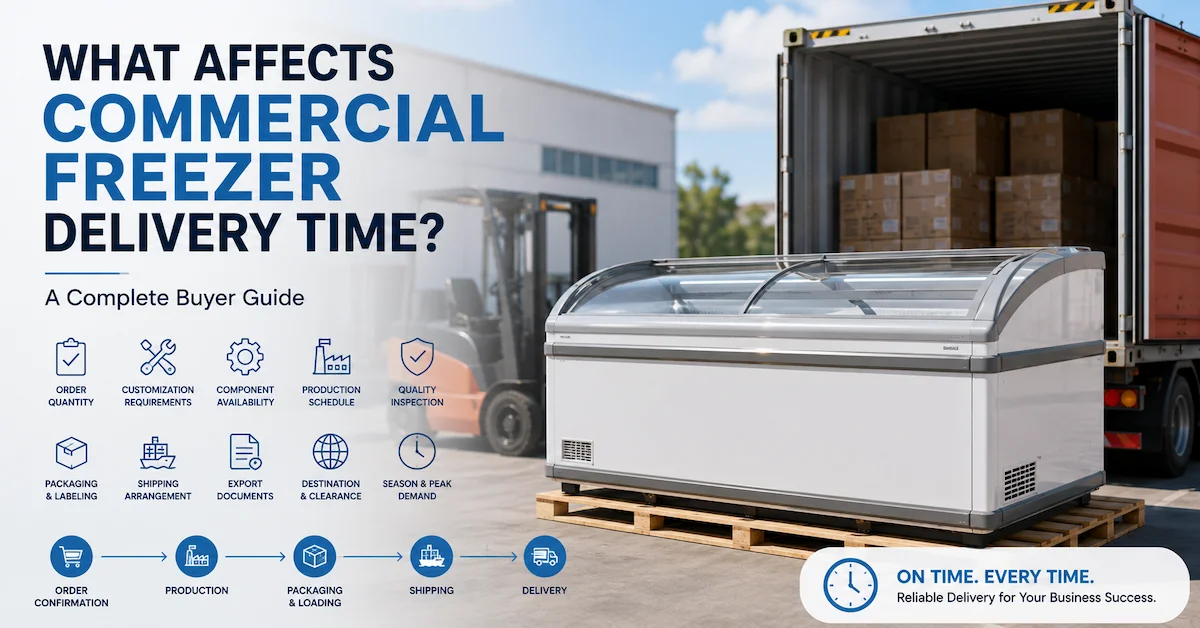
Commercial freezer delivery time may include several separate stages:
- Product and specification confirmation
- Sample production and approval
- Material and component preparation
- Production scheduling
- Cabinet manufacturing and assembly
- Cooling-performance testing
- Final quality inspection
- Export packaging
- Container booking and loading
- International transportation
- Customs clearance and local delivery
Some suppliers quote only production lead time, while buyers may interpret the quotation as the complete time required for the products to arrive.
These are not the same.
| Time Category | What It Usually Covers |
|---|---|
| Sample lead time | Sample preparation, testing, and buyer approval |
| Production lead time | Material preparation, manufacturing, assembly, and inspection |
| Shipping preparation | Packaging, documentation, container booking, and loading |
| Transit time | Transportation from the origin to the destination |
| Final delivery time | Customs clearance and transport to the buyer’s warehouse |
Buyers should ask the manufacturer to clarify which stages are included in the quoted schedule.
Factor 1: Product Model Availability
The selected commercial freezer model has a direct effect on delivery time.
A manufacturer may already have:
- Standard materials
- Regular components
- Existing production tooling
- Approved technical drawings
- Established testing procedures
- Standard packaging
When buyers choose an existing model, the factory can usually begin production more efficiently.
New or uncommon models may require:
- Engineering confirmation
- Structural drawings
- New components
- Alternative materials
- Prototype production
- Additional testing
Buyers can review Snowsea’s existing commercial refrigeration products before requesting a delivery estimate.
Selecting a proven product platform can reduce development time and technical uncertainty.
Factor 2: Order Quantity
Order volume is another major factor affecting commercial freezer delivery time.
A small trial order may require fewer production days, but it must still be arranged within the factory’s existing schedule.
A large wholesale or project order may require:
- More raw materials
- Additional compressors
- More cabinet-production capacity
- Longer assembly time
- Larger testing areas
- More packaging materials
- Multiple containers
The manufacturer must also consider whether the complete order will be produced in one batch or divided into several production and shipping stages.
For large projects, buyers should provide:
- Initial order quantity
- Number of models
- Quantity per model
- Required shipment date
- Whether partial shipment is acceptable
- Expected repeat-order volume
A clear order forecast helps the manufacturer reserve materials and production capacity.
Factor 3: OEM and ODM Customization
Customization can extend freezer production time because the factory must confirm and prepare project-specific requirements.
Common OEM requirements include:
- Buyer logo
- Rating labels
- Custom model numbers
- User manuals
- Cabinet colors
- Printed side panels
- Branded lightboxes
- Custom cartons
- Voltage and plug changes
- Shelf or basket configurations
Basic logo and label changes may require only artwork confirmation. More complex customization may require engineering development, material sourcing, sample approval, and new production procedures.
Full ODM projects may involve:
- New cabinet dimensions
- New door structures
- Modified refrigeration systems
- Exclusive product appearances
- New molds or tooling
- Special temperature controls
- Customized internal layouts
Buyers should finalize customization details early. Repeated design changes after production planning can delay material purchasing and factory scheduling.
Snowsea provides OEM and ODM commercial refrigeration solutions for buyers requiring private-label or project-specific freezer configurations.
Factor 4: Sample Approval
Some commercial freezer projects require a sample before mass production.
The sample may be used to confirm:
- Cooling performance
- Product dimensions
- Cabinet appearance
- Door operation
- Shelf configuration
- Branding
- Electrical specifications
- Packaging
- User manuals
Mass production may not begin until the buyer approves the sample.
Delays often occur when:
- Feedback is incomplete
- Artwork is changed repeatedly
- Samples require physical delivery
- Technical requirements are revised
- Decision-makers are unavailable
- Approval documents are not signed promptly
Buyers can reduce delays by creating a structured approval checklist and consolidating feedback into one response.
Factor 5: Component Availability
Commercial freezers contain many components, including:
- Compressors
- Temperature controllers
- Condensers
- Evaporators
- Fans
- Glass doors
- LED lighting
- Shelves
- Casters
- Electrical parts
- Power cords
- Plugs
Standard components may already be available in the manufacturer’s inventory or supply chain.
Special components may require longer sourcing periods, particularly when buyers request:
- A specific compressor brand
- Market-specific electrical parts
- Uncommon voltage configurations
- Special refrigerants
- Customized controllers
- Nonstandard glass
- Exclusive accessories
Component shortages can affect the entire production schedule even when most other materials are ready.
Buyers should distinguish between essential component requirements and optional preferences. Allowing the manufacturer to recommend equivalent approved components may improve delivery flexibility.
Factor 6: Cabinet Materials and Color Requirements
Commercial freezer cabinets may use painted steel, stainless steel, coated metal, glass, aluminum, plastic, insulation foam, and other materials.
Standard finishes are generally easier to schedule.
Custom finishes may require:
- Special material purchasing
- Color matching
- Sample panels
- Buyer approval
- Separate coating production
- Additional quality inspection
An exclusive cabinet color based on a Pantone or RAL code may take longer than a standard white, black, or stainless-steel finish.
Large retail projects may also require consistent color matching across multiple freezer models. This requires stronger coordination between production batches.
Factor 7: Factory Production Schedule
Factories normally manage multiple customer orders at the same time.
Delivery estimates may be affected by:
- Existing production commitments
- Available assembly lines
- Model-change frequency
- Worker scheduling
- Maintenance periods
- Peak purchasing seasons
- Public holidays
- Component delivery schedules
Orders placed before major retail seasons or long holidays may face tighter factory schedules.
Buyers with fixed project dates should place orders earlier and clearly communicate:
- Required arrival date
- Installation date
- Store-opening date
- Promotional schedule
- Latest acceptable shipping date
A required arrival date is more useful than simply asking for the shortest possible production time.
Factor 8: Number of Freezer Models
A single-model order is usually easier to plan than a mixed order containing many freezer types.
For example, a container may include:
- Chest freezers
- Upright freezers
- Island freezers
- Display freezers
- Beverage coolers
Each model may require different:
- Materials
- Components
- Production lines
- Testing procedures
- Packaging
- Loading arrangements
Mixed-model orders can help distributors expand their product range, but excessive model variety may increase scheduling complexity.
Buyers can reduce delays by limiting the number of models in the first shipment or choosing products based on shared components and standard configurations.
Factor 9: Quality Inspection and Performance Testing
Commercial freezers should be tested before shipment.
Quality-control procedures may include:
- Appearance inspection
- Cabinet-dimension verification
- Electrical-safety inspection
- Cooling-performance testing
- Temperature-stability testing
- Door and lid testing
- Controller inspection
- Lighting inspection
- Noise inspection
- Packaging inspection
Testing requires time, but reducing inspection time can increase the risk of product problems after delivery.
When an issue is found, the manufacturer may need to:
- Adjust the refrigeration system
- Replace a component
- Repair cabinet damage
- Repeat temperature testing
- Reinspect the product
Professional buyers should include quality inspection in the project schedule instead of treating it as an optional delay.
Factor 10: Certification and Documentation
Destination markets and customer projects may require specific certifications or documents.
These may include:
- Product test reports
- Compliance certificates
- Commercial invoices
- Packing lists
- Certificates of origin
- User manuals
- Product labels
- Warranty documents
- Customs documentation
If existing certificates cover the selected model and configuration, document preparation may be straightforward.
However, a new model, major structural change, or special electrical configuration may require additional evaluation or testing.
Certification requirements should be confirmed before sample development or bulk production begins.
Factor 11: Packaging Requirements
Commercial freezers require protective packaging because they may contain:
- Glass doors
- Painted surfaces
- Refrigeration systems
- Electronic controllers
- Shelves and baskets
- External handles and accessories
Standard factory packaging may be prepared quickly when materials are available.
Customized packaging may require:
- Artwork design
- Carton printing
- Shipping-mark confirmation
- Pallet production
- Wooden-frame preparation
- Additional corner protection
- Label printing
Packaging suppliers may also have minimum order quantities and separate production schedules.
Buyers should confirm packaging requirements together with the product specifications, not after the freezers have been completed.
Factor 12: Container Booking and Shipping Space
Finished products cannot be shipped until suitable freight space is available.
International shipping schedules may be affected by:
- Vessel frequency
- Container availability
- Port congestion
- Peak shipping seasons
- Freight-forwarder arrangements
- Route changes
- Weather conditions
- Customs inspections
A factory may complete production on schedule but still experience a later departure date because the original vessel or container booking is unavailable.
Buyers should confirm:
- Preferred shipping term
- Destination port
- Freight-forwarder responsibilities
- Container type
- Estimated loading quantity
- Planned vessel schedule
- Whether alternative routes are acceptable
Early container booking can reduce the waiting time between production completion and shipment.
Factor 13: Payment and Order Confirmation
Production normally begins only after the supplier receives the required deposit and confirms the commercial terms.
Delays may occur when:
- Payment arrives late
- Bank information is incomplete
- The purchase order contains errors
- Specifications remain unconfirmed
- Artwork approval is pending
- Contract terms are still under negotiation
The official lead time should usually be calculated from a clearly defined starting point, such as:
- Deposit receipt
- Purchase-order confirmation
- Final specification approval
- Artwork approval
- Sample approval
Buyers and suppliers should record this starting date in the contract or order confirmation.
Factor 14: Changes Made After Production Begins
Late changes are one of the most common causes of delivery delays.
Examples include:
- Changing the cabinet color
- Replacing the compressor
- Modifying the voltage
- Adding custom cartons
- Changing the logo
- Revising the manual
- Adding certifications
- Increasing the order quantity
- Changing the destination port
Some changes may require new components, labels, packaging, or engineering verification.
Before approving production, buyers should conduct a final review covering technical, visual, commercial, packaging, and shipping requirements.
Commercial Freezer Delivery Planning Checklist
| Planning Area | Information to Confirm |
|---|---|
| Product | Model, capacity, dimensions, temperature |
| Quantity | Total quantity and quantity per model |
| Customization | Logo, color, labels, manuals, packaging |
| Electrical system | Voltage, frequency, plug type |
| Components | Standard or specified brands |
| Sample | Whether sample approval is required |
| Certification | Destination-market requirements |
| Production | Confirmed lead time and starting date |
| Inspection | Factory QC or third-party inspection |
| Packaging | Standard or reinforced export packaging |
| Shipping | Trade term, destination port, forwarder |
| Deadline | Required arrival and installation dates |
Providing this information at the inquiry stage helps the manufacturer prepare a more realistic schedule.
How Buyers Can Reduce Commercial Freezer Lead Time
Select an Existing Product Platform
Standard models reduce engineering, tooling, and component-sourcing requirements.
Confirm Specifications Early
Finalize the temperature, capacity, voltage, color, branding, and packaging before production begins.
Use Standard Components
Standard components are generally easier to source than uncommon buyer-specified parts.
Approve Artwork Promptly
Delays in logos, labels, cartons, and manuals can prevent production from moving forward.
Provide a Purchasing Forecast
An annual or quarterly forecast helps the manufacturer reserve materials and production capacity.
Book Shipping Early
Container reservations can be planned while production is underway.
Allow Partial Shipments
Large orders may be shipped in phases when the first units are needed urgently.
Avoid Unnecessary Late Changes
Late revisions can affect finished products as well as materials already in production.
How to Compare Delivery Estimates From Manufacturers
A shorter delivery promise does not always mean a more reliable supplier.
Buyers should compare:
| Evaluation Area | What to Check |
|---|---|
| Lead-time definition | Production only or complete delivery |
| Starting date | Deposit, artwork, or sample approval |
| Component status | In stock or still being sourced |
| Production capacity | Ability to support the complete order |
| Quality testing | Included in the schedule |
| Packaging | Standard or customized |
| Shipping plan | Confirmed booking or estimated departure |
| Delay communication | How changes will be reported |
| Track record | Experience with similar export projects |
A realistic schedule supported by production planning is usually more valuable than an unusually short promise without clear details.
How Snowsea Supports Delivery Planning
Snowsea provides commercial refrigeration solutions for importers, distributors, supermarkets, food retailers, hospitality suppliers, and cold-chain businesses.
Project support may include:
- Model recommendations
- Technical specification confirmation
- OEM and ODM customization
- Production planning
- Quality inspection
- Export packaging
- Container-loading coordination
- Shipping-document preparation
- Order-progress communication
Buyers can learn more about Snowsea’s manufacturing and export capabilities on the About Snowsea page.
FAQ
What is the normal commercial freezer delivery time?
The schedule depends on the model, quantity, customization, component availability, factory capacity, packaging, testing, and shipping route. Buyers should request separate estimates for production and international transportation.
Does OEM customization increase freezer delivery time?
Yes. Custom colors, logos, packaging, electrical systems, structural changes, and new components may require additional design, sourcing, approval, and testing time.
When does the production lead time begin?
It normally begins after the required deposit, purchase order, technical specifications, and customization artwork have been confirmed. The exact starting point should be written in the order agreement.
Can a large commercial freezer order be shipped in stages?
Many projects can use partial shipments, depending on production planning, container quantities, and buyer requirements.
Can changing the freezer specification delay delivery?
Yes. Changes made after material purchasing or production begins may require new components, revised drawings, additional testing, or reworked packaging.
How can buyers receive a more accurate delivery estimate?
Provide the product model, quantity, customization, electrical requirements, certification needs, packaging, destination port, and required arrival date.
Conclusion
Commercial freezer delivery time is influenced by product availability, order quantity, customization, component sourcing, factory scheduling, quality inspection, packaging, payment confirmation, and international transportation.
Buyers can reduce unnecessary delays by choosing existing models, confirming specifications early, approving samples and artwork promptly, using standard components, and planning shipping before production is completed.
Snowsea supports global commercial refrigeration projects with product selection, OEM customization, quality control, production scheduling, export packaging, and shipping coordination.
Explore Snowsea’s commercial refrigeration products or submit project requirements through the OEM and ODM service page to receive a more accurate production and delivery plan.