What Is Commercial Freezer Capacity?
Commercial freezer capacity refers to how much frozen product a freezer can store under normal operating conditions.
However, freezer capacity is not simply the number shown on a product specification sheet.
Buyers should understand several different capacity measurements:
- Gross capacity
- Net capacity
- Usable storage capacity
- Internal volume
- Product loading capacity
A freezer with a larger rated volume does not always provide more practical storage space.
The actual storage performance depends on:
- Cabinet design
- Insulation thickness
- Shelving system
- Evaporator location
- Door structure
- Product arrangement
This Commercial Freezer Capacity Guide helps B2B buyers select suitable storage capacity based on real business requirements rather than only comparing numbers.
Snowsea provides commercial refrigeration products for supermarkets, restaurants, catering companies, distributors, and global refrigeration buyers.
Gross Capacity vs Usable Storage Capacity
Understanding the difference between rated capacity and usable capacity is essential when selecting commercial freezers.
Gross Capacity
Gross capacity refers to the total internal volume of the freezer cabinet.
It includes:
- Storage area
- Internal structures
- Cooling components
- Shelving space
Gross capacity is useful for comparing general product specifications.
However, it does not represent the amount of food that can actually be stored.
Net Capacity
Net capacity refers to the practical storage volume available after considering internal structures.
It excludes some areas occupied by:
- Evaporators
- Shelves
- Baskets
- Air channels
- Mechanical components
Net capacity is usually more meaningful for purchasing decisions.
Usable Storage Capacity
Usable storage capacity represents the space that can realistically hold products while maintaining proper airflow and temperature performance.
A freezer should not always be filled to 100% of its internal volume.
Leaving proper circulation space helps maintain:
- Cooling efficiency
- Temperature stability
- Product quality
Snowsea's commercial freezer airflow circulation design guide explains why internal loading methods affect actual freezer performance.
How Is Commercial Freezer Capacity Measured?
Commercial freezer capacity is usually measured in liters or cubic feet.
Liters
Many international refrigeration products use liters as a capacity measurement.
For example:
- 300L freezer
- 600L freezer
- 1000L freezer
However, buyers should always confirm whether the number refers to gross or net capacity.
Cubic Feet
Some markets use cubic feet.
Conversion:
1 cubic foot ≈ 28.3 liters
Different markets may use different measurement systems, so suppliers should provide clear specifications.
Internal Storage Volume
For commercial applications, internal dimensions can sometimes be more useful than a single capacity number.
Important measurements include:
- Internal width
- Internal depth
- Internal height
- Shelf spacing
- Basket volume
This information helps buyers understand whether the freezer fits their actual products.
Commercial Freezer Capacity Guide by Application
Different businesses require different storage capacities.
There is no universal “best” freezer size.
The correct capacity depends on:
- Product type
- Daily sales volume
- Delivery frequency
- Storage period
- Available space
- Peak demand
Restaurant Freezer Capacity
Restaurants usually need freezers for:
- Frozen ingredients
- Meat
- Seafood
- Prepared foods
- Desserts
Capacity planning should consider:
- Daily consumption
- Supplier delivery schedule
- Menu complexity
- Kitchen space
Many restaurants prefer several medium-capacity freezers because they allow better organization between different ingredients.
For vertical storage applications, buyers can review Snowsea's upright freezer wholesale supplier guide.
Supermarket Freezer Capacity
Supermarkets often require higher capacity because they manage:
- Multiple frozen product categories
- Customer-facing displays
- Backroom inventory
Capacity planning should consider:
- Store size
- Product turnover
- Display requirements
- Storage reserve
Large supermarkets often combine:
- Glass door freezers
- Chest freezers
- Upright freezers
- Storage freezers
Snowsea's supermarket freezer project supplier guide provides additional information for larger retail projects.
Convenience Store Freezer Capacity
Convenience stores usually have limited floor space.
They often prioritize:
- Compact footprint
- Vertical storage
- Easy product access
- High turnover efficiency
A smaller freezer with better organization may outperform a larger unit that reduces customer space.
Catering Freezer Capacity
Catering companies often experience demand fluctuations.
Capacity should consider:
- Normal inventory
- Large events
- Seasonal demand
- Multiple food categories
A catering operation may need additional safety capacity because running out of frozen ingredients during an event can create operational problems.
See Snowsea's commercial freezer supplier for caterers guide for food-service purchasing considerations.
Ice Cream Shop Freezer Capacity
Ice cream businesses usually need capacity combined with product presentation.
Important factors include:
- Product variety
- Tub quantity
- Display requirements
- Customer access
Snowsea's ice cream freezer wholesale supplier guide covers product-specific purchasing factors.
How to Calculate the Right Commercial Freezer Capacity
A practical capacity calculation method is:
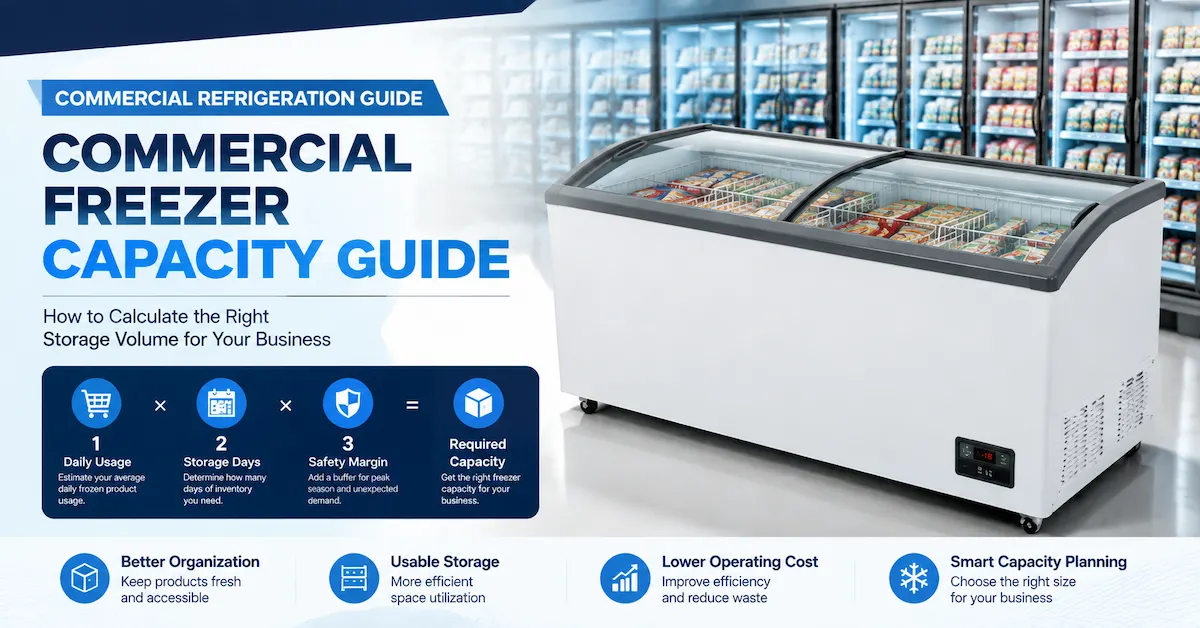
Daily Frozen Product Usage × Storage Days × Safety Margin = Required Freezer Capacity
Step 1: Calculate Daily Product Usage
Estimate how much frozen product is consumed or sold each day.
Consider:
- Average sales
- Production volume
- Seasonal changes
Step 2: Calculate Storage Days
Determine how many days of inventory the freezer should support.
Examples:
- Daily delivery business: fewer storage days
- Weekly delivery business: more storage capacity needed
Step 3: Add Safety Margin
A safety margin helps handle:
- Unexpected demand
- Supplier delays
- Seasonal peaks
- Special promotions
Step 4: Consider Product Organization
Different products require different storage efficiency.
For example:
- Boxes may stack efficiently
- Seafood may need separate organization
- Prepared meals may require shelving
- Ice cream may need specific layouts
Capacity should reflect actual product handling.
How Much Capacity Do Different Products Need?
Product characteristics influence freezer planning.
Frozen Meat
Meat products often require:
- Strong storage organization
- Easy access
- Reliable temperature control
Large packages may require more internal space than their weight suggests.
Seafood
Seafood storage often requires:
- Organized separation
- Stable freezing conditions
- Sufficient inventory space
Buyers should consider packaging sizes and storage duration.
Ice Cream
Ice cream products usually require:
- Stable temperatures
- Easy product identification
- Customer-friendly access
Prepared Food
Prepared meals may require:
- Shelving systems
- Label organization
- Frequent inventory rotation
The freezer capacity should support efficient stock management.
Why Usable Capacity Matters More Than Rated Capacity
A freezer may have impressive advertised capacity but poor practical usability.
Reasons include:
- Thick insulation
- Large compressor compartment
- Fixed shelves
- Limited loading area
- Air circulation requirements
A well-designed freezer balances:
- Storage volume
- Cooling performance
- Accessibility
- Energy efficiency
For buyers, the question should not only be:
“How many liters does this freezer have?”
It should also be:
“How much usable product storage does this freezer provide?”
How Loading Methods Affect Freezer Capacity
Correct loading improves real storage efficiency.
Overloading Problems
Overfilling may cause:
- Poor airflow
- Uneven temperature
- Longer compressor operation
- Reduced efficiency
Airflow Blocking
Products should not block:
- Air outlets
- Return air paths
- Cooling channels
Product Organization
Good organization improves:
- Inventory visibility
- Staff efficiency
- Product rotation
- Available capacity
A freezer with organized loading can often perform better than an overloaded larger freezer.
Should You Choose One Large Freezer or Multiple Smaller Units?
Both approaches have advantages.
| Option | Advantages | Limitations |
|---|---|---|
| One large freezer | Centralized storage, fewer units | Less flexible |
| Multiple smaller freezers | Better organization, backup capacity | More equipment management |
The right choice depends on:
- Product categories
- Business size
- Space availability
- Operational risk
For many commercial users, a combination approach provides better flexibility.
Capacity Planning for Business Expansion
Growing businesses should consider future demand.
Capacity planning should include:
- New store openings
- Increased product range
- Higher sales volume
- Seasonal growth
Buying only for current demand may create replacement costs later.
However, buying excessive capacity too early can increase:
- Purchase cost
- Floor-space usage
- Energy expenses
A balanced growth plan is usually the best approach.
Capacity and Energy Consumption
Freezer capacity affects refrigeration requirements.
Larger freezers generally require:
- More insulation materials
- Larger refrigeration systems
- More cabinet materials
However, capacity alone does not determine energy efficiency.
Performance also depends on:
- Compressor efficiency
- Insulation quality
- Door sealing
- Temperature control
- Usage habits
Snowsea's commercial freezer compressor reliability guide explains why refrigeration components also influence operating performance.
Capacity and Commercial Freezer Price
Capacity is one factor affecting freezer cost.
Other factors include:
- Cabinet materials
- Compressor type
- Refrigeration system
- Door configuration
- Customization
- Quantity
For B2B buyers, larger orders may change pricing through production efficiency.
See Snowsea's commercial freezer bulk order price guide.
How Suppliers Recommend Freezer Capacity
A professional supplier should not recommend capacity based only on one number.
Buyers should provide:
- Business type
- Product categories
- Daily storage requirement
- Delivery frequency
- Available installation space
- Temperature requirements
- Quantity needed
- Target market
A supplier can then recommend:
- Freezer type
- Capacity range
- Quantity
- Configuration
Common Mistakes When Choosing Freezer Capacity
Choosing Only Based on Available Space
A freezer that fits physically may still be too small for actual operations.
Confusing Size With Capacity
A large external cabinet does not always provide maximum usable storage.
Ignoring Peak Inventory
Average demand is not enough for businesses with seasonal fluctuations.
Using Maximum Loading All the Time
Freezers need proper airflow and organization.
Buying Too Much Capacity
Oversized equipment may increase unnecessary costs.
Buying Too Little Capacity
Insufficient storage can affect purchasing efficiency and daily operations.
What Information Should You Send a Freezer Supplier?
To receive accurate capacity recommendations, buyers should provide:
- Application
- Product type
- Required storage volume
- Daily usage
- Delivery frequency
- Available space
- Preferred freezer type
- Temperature requirement
- Voltage and frequency
- Quantity
- Destination market
Technical drawings or store layouts can help suppliers recommend more suitable solutions.
FAQ
What is commercial freezer capacity?
Commercial freezer capacity refers to the amount of frozen product storage space available inside a commercial refrigeration unit.
Is a larger freezer always better?
No. The best freezer capacity depends on product volume, storage requirements, available space, and operating conditions.
What is the difference between gross and usable freezer capacity?
Gross capacity includes total internal volume, while usable capacity refers to the practical storage space available for products.
How do I calculate the freezer capacity I need?
Estimate daily frozen product usage, storage days, and safety margin, then select equipment that matches your operational requirements.
How much freezer capacity does a restaurant need?
It depends on menu type, inventory turnover, delivery frequency, and available kitchen space.
Should supermarkets choose multiple freezers instead of one large freezer?
Many supermarkets use multiple freezer types because different products require different storage and display solutions.
Does freezer capacity affect electricity consumption?
Capacity affects refrigeration requirements, but energy efficiency also depends on insulation, compressor performance, sealing, and usage conditions.
Can a supplier recommend the right freezer capacity?
Yes. Professional suppliers can recommend models based on application, inventory requirements, available space, and target market.
Why is usable storage more important than advertised capacity?
Because shelves, airflow space, and internal components affect how much product can actually be stored.
Can Snowsea provide freezer capacity recommendations?
Yes. Snowsea supports B2B buyers with commercial refrigeration solutions. Customers can provide application details, storage requirements, dimensions, and quantity for model recommendations.
Conclusion
This Commercial Freezer Capacity Guide shows why selecting refrigeration equipment requires more than comparing liters or cabinet volume.
Businesses should evaluate usable storage capacity, product types, inventory cycles, peak demand, available space, and future growth before purchasing commercial freezers.
The right freezer capacity should provide enough storage while maintaining efficient operation, product organization, and long-term value.
Snowsea supports global B2B buyers with commercial refrigeration products and OEM/ODM solutions. Explore Snowsea's commercial refrigeration products, review its OEM/ODM solutions, or contact Snowsea with your application, capacity requirements, quantity, and target market.