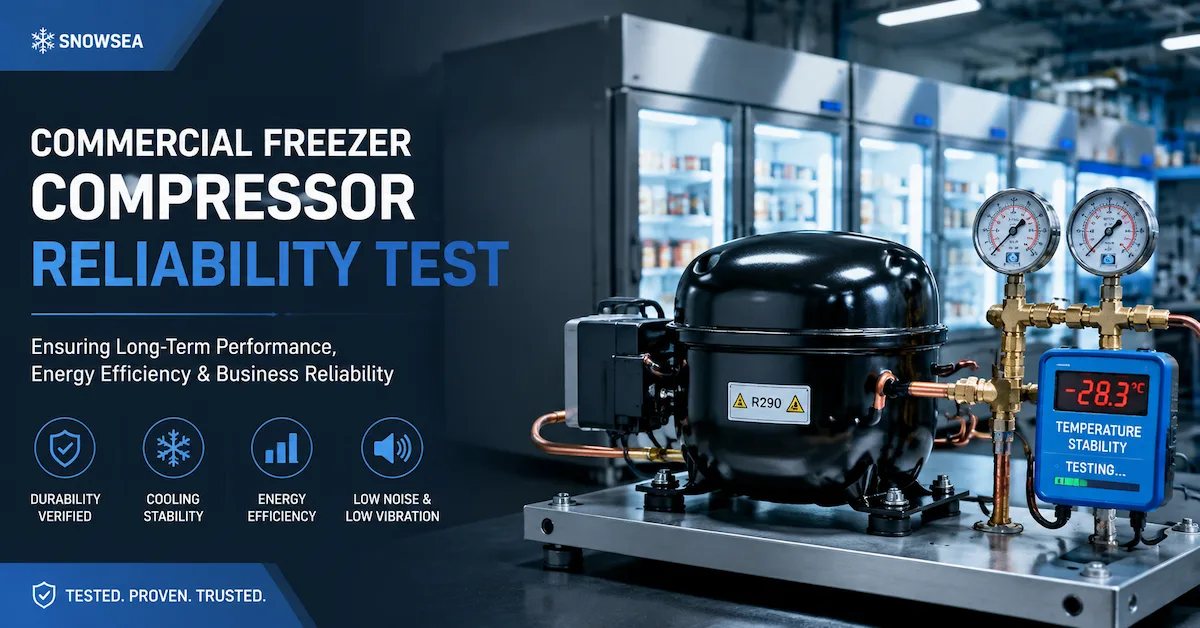
A Commercial Freezer Compressor Reliability Test is an important evaluation method used to verify whether a refrigeration compressor can maintain stable cooling performance, energy efficiency, and long-term operation under commercial working conditions.
For supermarkets, convenience stores, food retailers, restaurants, cold-chain operators, and refrigeration equipment distributors, compressor reliability directly influences equipment lifespan, maintenance costs, product protection, and operating expenses.
The compressor is often considered the “heart” of a commercial freezer because it drives the refrigeration cycle by compressing and circulating refrigerant. However, compressor reliability is not determined by the compressor alone. It depends on the complete refrigeration system, including condenser design, evaporator performance, refrigerant selection, cabinet insulation, temperature control, and manufacturing quality.
When selecting a commercial freezer supplier, buyers should evaluate not only product appearance and cooling capacity but also how the manufacturer tests compressor durability and system reliability.
Snowsea integrates refrigeration system assembly, performance testing, and quality inspection into its manufacturing process. Buyers can explore Snowsea’s complete range of commercial refrigeration products when evaluating equipment for different applications.
What Is a Commercial Freezer Compressor Reliability Test?
A commercial freezer compressor reliability test is a series of evaluations designed to confirm whether a compressor can operate consistently under expected commercial conditions.
Unlike a simple startup test, reliability testing focuses on long-term performance, including:
- Continuous operation capability
- Cooling performance stability
- Energy consumption control
- Noise and vibration levels
- Temperature maintenance
- System compatibility
- Durability under repeated operation
Commercial freezers often operate for many hours every day. A compressor that performs well during initial operation may still experience problems under continuous workload, high ambient temperature, frequent cycling, or heavy product loading.
The Role of Compressor Testing in Refrigeration Performance
A compressor must work together with other refrigeration components to create an efficient cooling system.
The refrigeration cycle includes:
- Compressor
- Condenser
- Expansion device
- Evaporator
- Refrigerant
- Temperature control system
If any component is poorly matched, the compressor may experience excessive workload, unstable pressure conditions, or inefficient operation.
Therefore, professional manufacturers evaluate compressor performance as part of the complete refrigeration system rather than as an isolated component.
Why Compressor Reliability Affects Operating Cost
For commercial users, compressor problems can create significant financial impact.
A reliable compressor helps reduce:
- Unexpected repairs
- Equipment downtime
- Product loss risk
- Excessive electricity consumption
- Maintenance frequency
For distributors and private-label brands, compressor reliability also affects customer satisfaction and long-term brand reputation.
Key Tests Used to Evaluate Commercial Freezer Compressor Reliability
Continuous Running Test
Commercial freezers frequently operate for extended periods, especially in supermarkets, warehouses, and food-service environments.
Continuous running tests help evaluate whether the compressor can maintain stable performance during long operating cycles.
Manufacturers may monitor:
- Operating stability
- Temperature changes
- Compressor cycling frequency
- Abnormal noise
- System pressure changes
A reliable compressor should maintain consistent operation without excessive stress.
Cooling Performance Test
Cooling performance testing evaluates whether the compressor can provide sufficient refrigeration capacity.
Important factors include:
- Cooling speed
- Target temperature achievement
- Heat removal capability
- Temperature recovery performance
A compressor with insufficient capacity may struggle when the freezer experiences:
- Frequent door opening
- Warm product loading
- High ambient temperature
- Heavy commercial usage
Buyers can also review Snowsea’s guide on commercial freezer temperature recovery to understand how cooling recovery performance affects real-world operation.
Temperature Stability Test
Commercial refrigeration equipment must maintain stable temperatures to protect stored products.
Temperature stability testing evaluates:
- Temperature fluctuation range
- Cooling consistency
- Air circulation performance
- Control system response
Stable compressor operation helps maintain consistent refrigeration conditions over long periods.
Energy Consumption Test
Energy efficiency is an important purchasing factor for commercial freezer buyers.
A compressor that operates inefficiently may increase:
- Electricity costs
- Heat generation
- Operating workload
- Long-term ownership cost
A reliable refrigeration system balances cooling performance with energy efficiency.
According to ENERGY STAR, commercial refrigeration equipment efficiency depends on the overall equipment design, including refrigeration components and operating performance. Buyers should therefore consider the complete system rather than only one component. (ENERGY STAR Commercial Refrigerators and Freezers)
Noise and Vibration Test
Noise and vibration are important factors for retail environments, restaurants, cafes, and urban commercial locations.
Excessive vibration may indicate:
- Poor compressor mounting
- Mechanical imbalance
- System stress
- Insufficient vibration control
A well-designed refrigeration system should maintain reliable operation while controlling operational noise.
High Ambient Temperature Test
Many commercial freezers operate in challenging climates, including tropical and high-temperature regions.
High ambient temperature testing evaluates whether the compressor can maintain cooling performance when surrounding temperatures increase.
Important considerations include:
- Condenser efficiency
- Compressor capacity
- Refrigerant selection
- Heat dissipation
- Cabinet insulation
This is especially important for export markets where environmental conditions vary significantly.
What Factors Influence Commercial Freezer Compressor Reliability?
Compressor Quality and Design
The compressor design determines important performance characteristics, including:
- Cooling capacity
- Operating efficiency
- Mechanical durability
- Temperature range capability
However, even a high-quality compressor requires proper system matching.
Refrigerant Compatibility
The refrigerant used in a commercial freezer influences system performance.
Common refrigerants include:
- R600a
- R290
The compressor, refrigeration circuit, and refrigerant must be correctly matched to achieve reliable operation.
Poor matching can affect:
- Cooling efficiency
- Pressure balance
- Compressor workload
- Long-term durability
Refrigeration System Matching
A reliable commercial freezer requires balanced engineering.
Key matching factors include:
- Compressor capacity
- Condenser size
- Evaporator design
- Refrigerant charge
- Temperature control
- Cabinet volume
A compressor that is too small may struggle under load, while an oversized system may reduce efficiency.
Cabinet Insulation and Heat Load
The compressor workload is directly affected by heat entering the freezer cabinet.
Important factors include:
- Insulation thickness
- Door sealing performance
- Cabinet structure
- Ambient temperature
- Product loading conditions
Good insulation reduces compressor workload and supports longer equipment life.
Snowsea also focuses on related performance factors such as freezer door gasket sealing performance, because reducing heat infiltration helps improve refrigeration efficiency.
How Compressor Reliability Impacts Commercial Freezer Performance
Stable Cooling Performance
A reliable compressor helps maintain consistent cooling conditions during daily commercial operation.
This is especially important for:
- Frozen food retailers
- Ice cream businesses
- Supermarkets
- Food-service kitchens
Longer Equipment Lifespan
Compressor reliability contributes to overall equipment durability.
Stable operation reduces unnecessary mechanical stress and helps extend service life.
Lower Maintenance Cost
Reliable compressors reduce the risk of:
- Frequent repairs
- Component replacement
- Operational interruptions
For businesses operating multiple freezers, reducing maintenance requirements can create significant savings.
Better Energy Efficiency
A properly tested compressor can operate more efficiently by matching cooling demand with system design.
Energy efficiency should be evaluated together with:
- Temperature stability
- Cooling capacity
- Refrigeration system design
- Operating environment
How Manufacturers Test Commercial Freezer Compressors Before Shipment
Professional manufacturers use multiple quality-control steps before commercial refrigeration equipment reaches customers.
Typical processes include:
Refrigeration System Inspection
Manufacturers check:
- Refrigeration circuit installation
- Component connections
- System operation
- Cooling response
Temperature and Performance Verification
Testing may include:
- Target temperature achievement
- Cooling performance
- Temperature stability
- Operating condition checks
Final Quality Inspection
Before shipment, manufacturers typically verify:
- Product appearance
- Electrical safety
- Mechanical operation
- Packaging condition
Snowsea’s manufacturing process includes refrigeration system installation, performance and temperature testing, final inspection, and packing before shipment.
For businesses requiring customized configurations, buyers can review Snowsea’s OEM/ODM commercial freezer solutions.
How Should Buyers Evaluate Compressor Reliability When Choosing a Supplier?
When selecting a commercial freezer manufacturer, buyers should ask:
| Buyer Question | Why It Matters |
|---|---|
| What compressor models are available? | Determines system compatibility |
| How is compressor reliability tested? | Shows supplier quality control capability |
| Are temperature tests performed before shipment? | Confirms real operating performance |
| Can compressor specifications be customized? | Supports different market requirements |
| How does the freezer perform in high temperatures? | Important for export markets |
| Are spare parts available? | Reduces after-sales risk |
| Does the supplier provide technical support? | Helps long-term operation |
A reliable supplier should provide clear technical information instead of only focusing on price.
FAQ
What is a commercial freezer compressor reliability test?
It is a series of tests used to evaluate compressor durability, cooling performance, energy efficiency, and operating stability under commercial refrigeration conditions.
Why is compressor reliability important for commercial freezers?
Because compressors operate continuously in commercial environments, reliability affects equipment lifespan, energy cost, maintenance requirements, and product protection.
What tests should manufacturers perform on freezer compressors?
Common evaluations include continuous operation testing, cooling performance testing, temperature stability testing, energy consumption evaluation, and noise testing.
Does a better compressor always mean a better freezer?
Not necessarily. Compressor performance depends on system matching, including condenser design, evaporator efficiency, refrigerant selection, insulation, and controls.
How does compressor reliability affect energy efficiency?
A reliable compressor can maintain cooling performance with fewer unnecessary operating cycles, helping reduce long-term energy consumption.
Can compressor performance change in different climates?
Yes. Ambient temperature, humidity, and operating conditions can influence refrigeration performance.
How long should a commercial freezer compressor last?
Service life depends on compressor quality, operating conditions, maintenance, system design, and usage frequency.
Should buyers consider compressor brand when purchasing freezers?
Compressor brand can be a reference factor, but buyers should also evaluate the complete refrigeration system and supplier testing process.
Can Snowsea customize compressor configurations for OEM projects?
Yes. OEM projects can be evaluated according to market requirements, product specifications, electrical standards, and application conditions.
What documents should buyers request from freezer manufacturers?
Buyers should request product specifications, testing information, technical documents, certification information, and after-sales support details.
Conclusion
A Commercial Freezer Compressor Reliability Test is an important indicator of refrigeration equipment quality and long-term performance.
For distributors, importers, supermarket projects, and private-label brands, compressor reliability directly affects operating cost, maintenance risk, and customer satisfaction.
However, compressor reliability should never be evaluated separately. The best commercial freezer performance comes from the combination of compressor quality, refrigeration system design, insulation, temperature control, sealing performance, and manufacturing quality.
By selecting a manufacturer with professional testing procedures and OEM capabilities, buyers can reduce supply risks and build more reliable refrigeration solutions.
Snowsea provides commercial freezer manufacturing and OEM/ODM solutions for global distributors, brands, and project buyers. Contact Snowsea to discuss product specifications, market requirements, and customized refrigeration solutions.