What Does a Commercial Freezer Energy Consumption Test Measure?
A commercial freezer energy consumption test measures how much electrical energy a defined freezer configuration uses over a specified period under stated operating conditions.
That definition matters because an isolated figure such as:
1.8 kWh/day
does not tell a buyer enough on its own.
Was the cabinet empty or loaded? What temperature was it maintaining? What was the ambient condition? Were the doors opened? Was lighting operating? Did the test include defrost events where relevant?
Without that context, two energy figures may look comparable when the freezers were doing very different jobs.
For B2B procurement, the better question is not simply:
“How many kWh does it use?”
It is:
“Under what conditions was that energy consumption measured?”
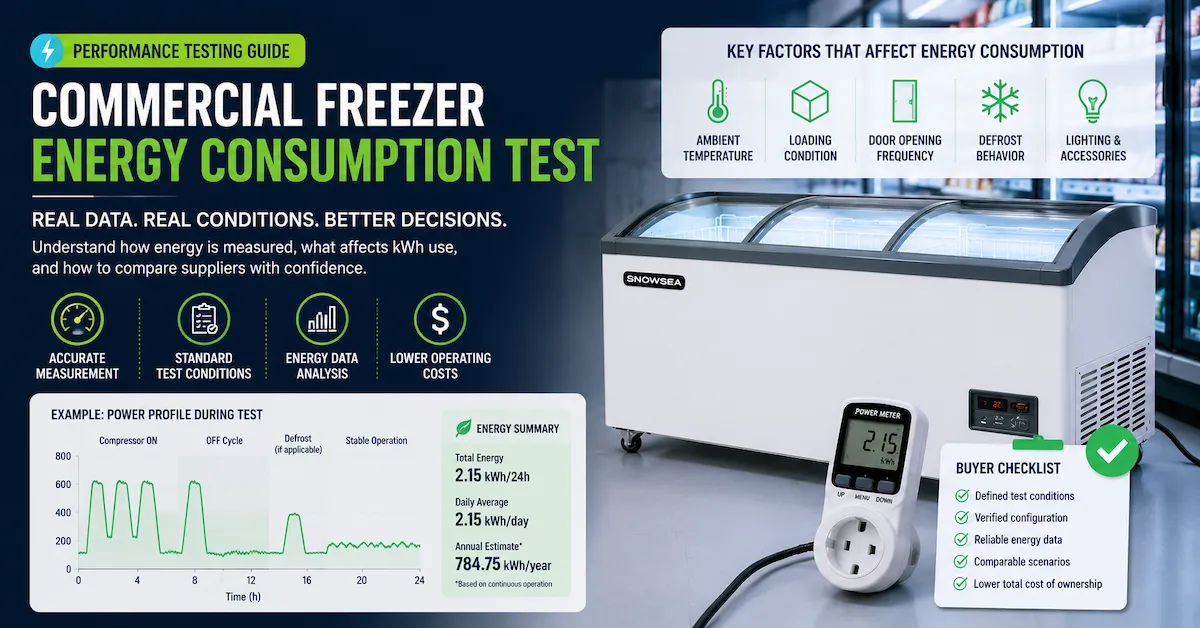
The Test Conditions Matter as Much as the kWh Result
Before comparing supplier data, check what was actually tested.
| Test Information | Why It Matters |
|---|---|
| Freezer model | Identifies the tested configuration |
| Cabinet dimensions | Different sizes have different cooling loads |
| Target temperature | Changes refrigeration demand |
| Ambient condition | Changes heat entering the cabinet |
| Empty or loaded | Changes operating behavior |
| Door operation | Adds heat when access occurs |
| Defrost behavior | May affect energy use where applicable |
| Lighting/accessories | Adds electrical load |
| Measurement period | Affects representativeness |
| Electrical configuration | Must match the tested product |
A technically useful report should connect the energy number to the freezer configuration and test method.
Otherwise, the result is difficult to use for supplier comparison.
Rated Power Is Not the Same as Energy Consumption
This is a common source of confusion during freezer sourcing.
Rated or instantaneous power describes electrical power at a particular operating condition.
Energy consumption measures electricity accumulated over time.
Commercial freezers do not necessarily operate every electrical component continuously at the same power level. During normal operation, the system may cycle between different states.
These can involve:
- Compressor operation
- Fan operation
- Controller operation
- Lighting
- Defrost where applicable
- Other electrical accessories
So a freezer showing a higher power figure at one moment does not automatically have higher total energy consumption over a full operating period.
For purchasing decisions, kWh over a defined test period is usually much more informative than compressor wattage alone.
Why Compressor Wattage Cannot Tell the Whole Story
The compressor is important, but energy performance belongs to the entire refrigeration system.
A commercial freezer's electrical demand is influenced by the interaction of:
- Compressor
- Condenser
- Evaporator
- Airflow
- Insulation
- Door sealing
- Cabinet geometry
- Controller logic
- Temperature setting
- Lighting
- Ambient environment
For example, an inefficiently matched refrigeration system may run for longer periods even if one individual component appears attractive on paper.
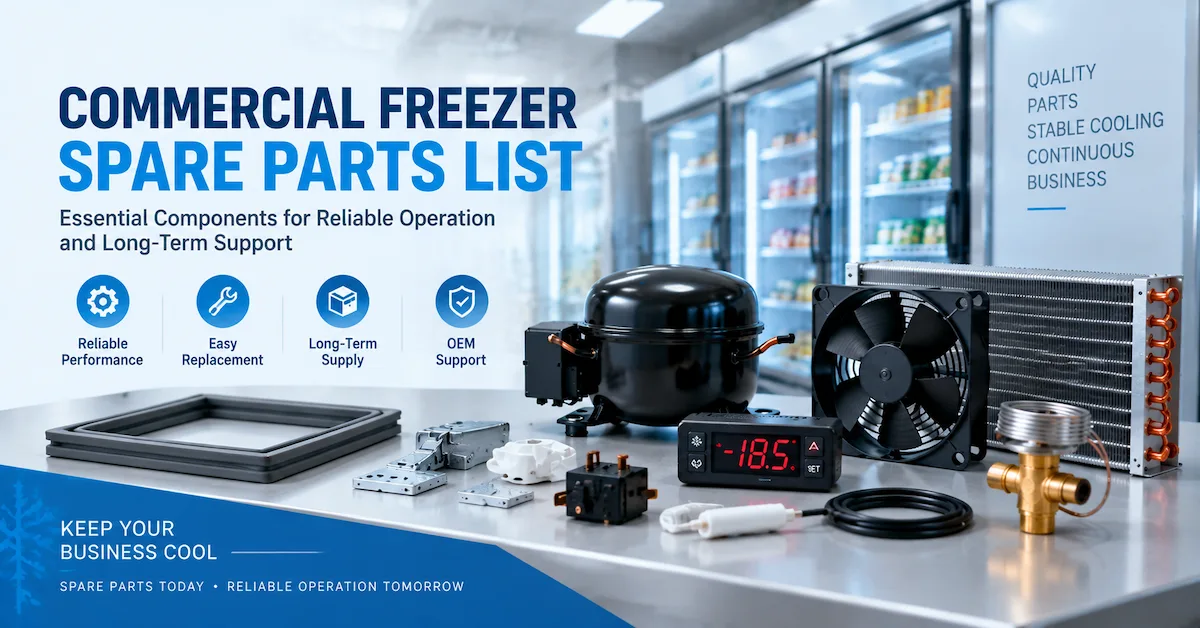
That is why Snowsea's commercial freezer compressor sizing guide should be read together with commercial freezer condenser design and commercial freezer airflow design.
Commercial freezer energy consumption is a system result, not a compressor-nameplate result.
Why Ambient Temperature Changes the Result
The surrounding environment constantly adds heat to a freezer.
As operating conditions change, so does the refrigeration load.
This means an energy test performed under one ambient condition should not be casually compared with a test carried out under another.
A technically serious supplier comparison should therefore state the test environment instead of presenting kWh data without context.
The same principle applies to freezers intended for hotter operating environments: buyers should evaluate energy use together with refrigeration capacity and temperature performance rather than judging energy consumption in isolation.
Temperature Setting Also Matters
A freezer maintaining one operating temperature is not performing exactly the same task as another running at a different target.
Before comparing energy data, confirm that the temperature requirements are comparable.
Differences in:
- Target temperature
- Controller settings
- Operating range
- Product application
can change how often and how long the refrigeration system operates.
If your project requires a specific operating range, see Snowsea's OEM freezer custom temperature range guide.
Empty Cabinet or Loaded Cabinet?
Both test approaches can be useful, but buyers need to know which one produced the result.
| Test Condition | Useful For | What Buyers Should Check |
|---|---|---|
| Empty cabinet | Controlled engineering comparison | May not represent real product loading |
| Loaded cabinet | Application-oriented testing | Load quantity and arrangement must be defined |
| Simulated load | Repeatable controlled testing | Test load must be explained |
A loaded freezer contains additional thermal mass.
The result can be influenced by:
- Amount of product
- Package dimensions
- Product placement
- Shelf arrangement
- Initial product condition
- Airflow clearance
So the phrase “loaded energy test” is not enough by itself.
The loading method should also be recorded.
Door Opening Can Change Energy Use
A commercial freezer in a warehouse and a freezer repeatedly accessed in a retail store may experience very different operating patterns.
Opening a door introduces warmer surrounding air and changes the thermal condition inside the cabinet.
If one supplier performs an energy test with the door continuously closed while another includes a defined access pattern, their results are not directly equivalent.
Door behavior should therefore be treated as part of the test scenario.
For the thermal side of this issue, see Snowsea's commercial freezer temperature recovery guide.
Temperature recovery answers:
How does the freezer recover after access?
Energy testing answers:
How much electricity does operation require under the defined scenario?
They are related, but they measure different things.
What About Defrost?
Defrost behavior should also be understood where it is relevant to the product design.
A test period containing a defrost event may show a different power profile from a period without one.
However, it would be misleading to conclude that one defrost approach is always more energy efficient than another without considering the complete refrigeration design and operating conditions.
Buyers should instead ask whether the supplier's test method clearly identifies relevant operating events.
For a broader comparison, see manual defrost vs automatic defrost freezer.
Display Freezers Should Be Compared With Comparable Products
Energy data is easiest to misuse when completely different freezer applications are placed side by side.
A glass-door display freezer may be designed around:
- Product visibility
- Customer access
- Lighting
- Merchandising
- Glass performance
A closed storage freezer serves a different commercial purpose.
The lowest kWh figure does not automatically identify the better product if the two cabinets perform different jobs.
A fair comparison should consider:
Application + cabinet size + target temperature + door configuration + storage function + test conditions
For display equipment, Snowsea also discusses display freezer LED lighting efficiency.
Insulation and Door Sealing Affect the Thermal Load
Heat entering through the cabinet must eventually be removed by the refrigeration system.
This makes insulation and sealing relevant to energy performance.
Important design areas can include:
- Cabinet insulation
- Structural thermal paths
- Door construction
- Gasket sealing
- Openings around the cabinet
However, insulation should not be reduced to a simple “thicker is always better” rule.
The design must also consider cabinet dimensions, usable capacity and complete thermal performance.
For related technical information, review Snowsea's commercial freezer insulation thickness guide and freezer door gasket sealing performance.
How Should Buyers Read an Energy Test Report?
Start with the test setup, not the final kWh number.
A useful review should identify:
- Exact freezer model
- Tested configuration
- Cabinet dimensions
- Target temperature
- Ambient condition
- Loading state
- Door-operation condition
- Test duration
- Energy-measurement method
- Significant operating events
- Total measured energy
- Whether the cabinet had reached stable operation
Time-based power data can be especially useful.
Instead of showing only total energy, it may help buyers understand when electrical demand increased and how the freezer cycled during the test.
A total kWh figure tells you how much electricity was used.A time-based power profile can help explain why it was used.
Energy Consumption and Temperature Performance Must Be Read Together
A very low electricity figure is not useful if the freezer fails to maintain the required product-storage condition.
Energy performance should therefore be checked alongside:
- Operating temperature
- Temperature stability
- Temperature uniformity
- Pull-down behavior
- Door-opening recovery
Snowsea's commercial freezer temperature uniformity guide and commercial freezer pull down time guide provide useful complementary checks.
A freezer should first do its refrigeration job correctly. Energy data then helps buyers understand how efficiently that performance is achieved.
Turning kWh Into Estimated Operating Cost
Energy testing becomes commercially useful when procurement teams translate consumption into operating cost.
A simple estimate is:
Estimated annual electricity cost = measured daily kWh × 365 × local electricity price
For example, a buyer can insert the measured daily consumption and its own local electricity rate.
This is still an estimate rather than a guaranteed field cost.
Actual operation can differ because of:
- Local ambient conditions
- Door-opening frequency
- Loading
- Maintenance
- Temperature settings
- Installation
- User behavior
But the calculation is valuable when comparing large purchasing programs.
A small per-unit difference becomes more significant across dozens or hundreds of freezers operating every day.
Purchase Price Is Only One Part of Cost
For B2B buyers, energy testing belongs in the total-cost discussion.
| Procurement Factor | What to Compare |
|---|---|
| Purchase price | Initial equipment cost |
| Energy data | Tested kWh under defined conditions |
| Temperature performance | Whether storage requirements are met |
| Operating estimate | Expected electricity cost |
| Maintenance | Service and component considerations |
| Production consistency | Whether bulk units match the approved design |
The lowest purchase price does not necessarily create the lowest long-term equipment cost.
Likewise, paying more for a freezer does not automatically guarantee better energy performance.
The decision should be supported by comparable technical evidence.
Common Mistakes When Comparing Energy Data
Several shortcuts can create misleading conclusions.
Comparing kWh without test conditions: the cabinets may have been tested under different loads or environments.
Using rated power as daily energy use: these are different measurements.
Ignoring cabinet size: larger and smaller freezers may be serving different storage requirements.
Ignoring temperature setting: refrigeration demand may not be comparable.
Comparing display and storage freezers directly: their functions can differ substantially.
Ignoring door and defrost conditions: operational events can alter the result.
Testing one sample but ordering another configuration: changed components may make earlier data less representative.
That last point is particularly important for OEM projects.
Energy Data Should Follow the Actual Production Configuration
Performance data belongs to the configuration that produced it.
If an approved sample is later changed by modifying the:
- Compressor
- Controller
- Cabinet dimensions
- Glass door
- Insulation
- Fan
- Lighting
- Refrigeration configuration
the previous energy result may need to be reviewed.
This is also why energy testing and OEM labeling should remain connected.
Snowsea's OEM freezer custom energy label guide explains why approved energy information should correspond to the defined production configuration.
For wider batch-control considerations, see the commercial freezer quality testing procedure.
What Should Buyers Ask Different Freezer Suppliers?
| Evaluation Area | Question to Ask |
|---|---|
| Tested model | Which exact configuration produced the data? |
| Ambient condition | Under what environment was it tested? |
| Temperature | What operating target was maintained? |
| Loading | Was the cabinet empty or loaded? |
| Door operation | Was access included in the method? |
| Defrost | How was it treated where relevant? |
| Test duration | How long was energy recorded? |
| Data | Is the kWh figure supported by test information? |
| Production | Will bulk units match the tested configuration? |
| OEM | Can our energy target or test method be evaluated? |
A supplier that can answer these questions clearly gives procurement teams more usable information than one that simply advertises “energy saving.”
Can Snowsea Evaluate an OEM Energy Target?
If a buyer already has an internal benchmark, energy target, or reference freezer, that information can be useful during OEM development.
Depending on the project, Snowsea can evaluate areas such as:
- Cabinet dimensions
- Refrigeration-system matching
- Insulation
- Airflow
- Door configuration
- Controller settings
- Lighting
- Intended operating conditions
Feasibility depends on the selected freezer platform, target performance and project requirements.
Buyers can send technical requirements through Snowsea's OEM/ODM service rather than relying on a generic “low energy” specification.
What Should Buyers Send Snowsea for Evaluation?
For a useful technical discussion, provide:
- Freezer type or reference model
- Required cabinet dimensions
- Target operating temperature
- Intended application
- Expected ambient condition
- Solid or glass-door requirement
- Product being stored
- Typical loading arrangement
- Expected door-opening scenario, if defined
- Existing energy-consumption target
- Benchmark product data, if available
- Customer test method,if available
- Electrical configuration
- Required report format
- Sample/testing requirement
- Initial order quantity
- Annual purchasing forecast
- Project schedule
The more clearly the operating scenario is defined, the more meaningful the technical comparison becomes.
FAQ
What is a commercial freezer energy consumption test?
It measures the electrical energy used by a defined freezer configuration over a specified period under stated operating conditions.
How is commercial freezer energy consumption measured?
Electrical energy is recorded during a defined test period while variables such as cabinet configuration, temperature, ambient condition, loading and operating state are controlled or documented.
Is freezer rated power the same as energy consumption?
No.Power describes the rate of electrical use at a given moment, while energy consumption measures electricity accumulated over time.
How many kWh does a commercial freezer use per day?
There is no meaningful universal figure. Cabinet size, freezer type, target temperature, ambient condition, loading, door configuration, controls and test method can all change daily consumption.
Does ambient temperature affect freezer energy consumption?
Yes. Ambient conditions influence the heat load on the cabinet and therefore affect refrigeration-system operation.
Does product loading affect the test?
It can. Product quantity, thermal mass, arrangement and airflow clearance may influence freezer operation.
Do glass-door freezers always consume more energy?
A universal conclusion should not be made without comparing products of similar size, function, temperature requirement and test conditions.
Does defrost affect freezer energy use?
Where defrost is part of the freezer's operation, it can affect the power profile during the test period and should be understood when interpreting the result.
How should buyers compare energy-test reports?
First compare the freezer configuration, cabinet size, target temperature, ambient condition, loading, test duration and operating method. Only then compare the measured energy figures.
Can an OEM freezer be developed around an energy target?
Buyers can provide their performance target or benchmark for engineering evaluation. Feasibility depends on the freezer platform, operating conditions, test method and requested configuration.
Conclusion
A commercial freezer energy consumption test should give buyers more than a marketing number.
Before comparing kWh figures, verify:
- What freezer was tested
- Cabinet size
- Temperature setting
- Ambient condition
- Empty or loaded state
- Door operation
- Relevant operating events
- Test duration
- Electrical configuration
- Whether the sample matches mass production
Energy performance should also be evaluated alongside temperature uniformity, cooling performance and the freezer's actual commercial function.
If your project has a defined energy target, send Snowsea your freezer type, cabinet dimensions, target temperature, ambient condition, door configuration, product-loading scenario, existing energy benchmark or test method, electrical requirements, sample needs, and estimated order quantity through the Snowsea contact page.
Snowsea can evaluate the refrigeration configuration, cabinet thermal design, testing scope, OEM feasibility, production requirements, and commercial project needs before preparing a technical proposal and quotation.