What Is Commercial Freezer Evaporator Design?
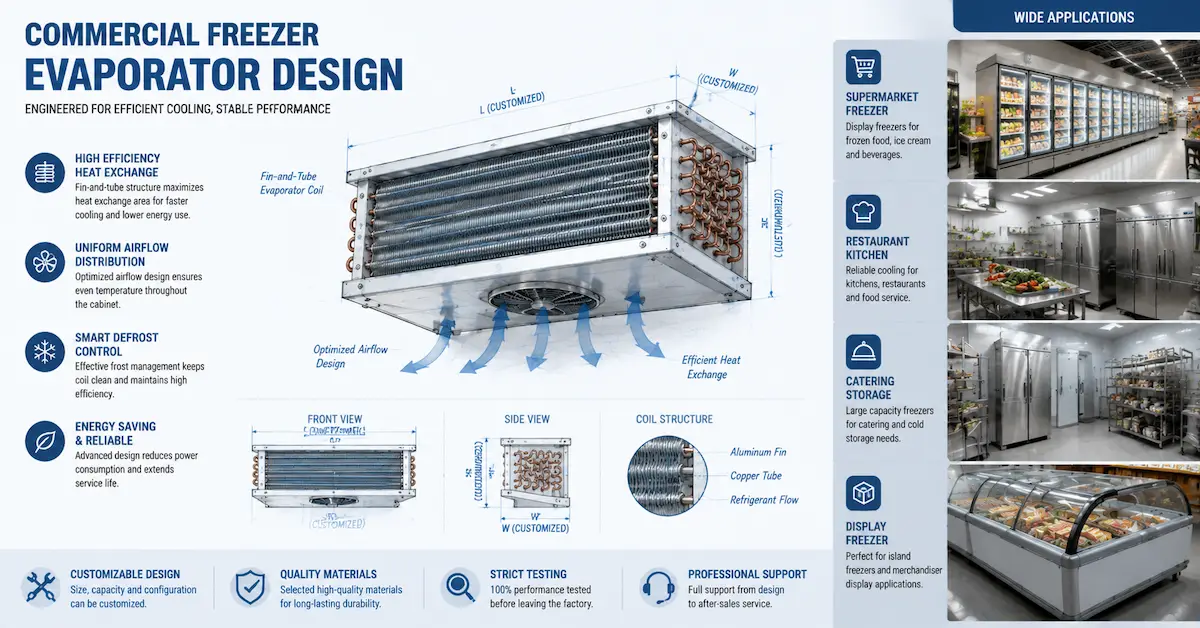
Commercial Freezer Evaporator Design refers to the engineering design of the evaporator component responsible for absorbing heat from inside a commercial freezer cabinet.
The evaporator is a key part of the refrigeration cycle:
Compressor → Condenser → Expansion Device → Evaporator
During operation, the evaporator allows refrigerant to absorb heat from the freezer interior. This process creates the low-temperature environment required for frozen food storage and commercial refrigeration applications.
A well-designed evaporator helps improve:
- Cooling efficiency
- Temperature consistency
- Frost control
- Energy performance
- Refrigeration reliability
Snowsea provides commercial refrigeration products designed for supermarkets, restaurants, catering businesses, and global B2B refrigeration applications.
Why Does Evaporator Design Matter for Commercial Freezers?
The evaporator directly affects how efficiently a freezer transfers heat from the cabinet to the refrigeration system.
A poor evaporator design may result in:
- Slow cooling performance
- Uneven temperature distribution
- Excessive frost formation
- Higher energy consumption
A properly designed evaporator improves:
Faster Cooling Performance
An optimized evaporator provides:
- Efficient heat absorption
- Faster temperature pull-down
- Better cooling recovery after door opening
This is important for commercial environments where freezers operate continuously.
Better Temperature Uniformity
A good evaporator design helps distribute cooling more evenly.
Benefits include:
- Reduced temperature fluctuation
- Better product protection
- More stable storage conditions
For temperature requirements, see Snowsea's commercial freezer temperature range guide.
Improved Energy Efficiency
Efficient heat exchange reduces refrigeration workload.
This helps:
- Reduce compressor operating time
- Lower electricity consumption
- Improve overall system efficiency
For energy performance, see Snowsea's commercial freezer power consumption guide.
The Role of an Evaporator in Commercial Refrigeration
The evaporator performs several important functions.
Heat Absorption
The evaporator absorbs heat from:
- Cabinet air
- Stored products
- Internal environment
The refrigerant changes from liquid to gas while absorbing heat.
Refrigerant Evaporation
The expansion device reduces refrigerant pressure before it enters the evaporator.
Inside the evaporator:
Liquid refrigerant → absorbs heat → evaporates into gas
This process creates the cooling effect.
Air Cooling Distribution
In fan-assisted systems, the evaporator works together with fans to distribute cold air throughout the cabinet.
This affects:
- Cooling speed
- Temperature balance
- Product storage quality
Common Types of Commercial Freezer Evaporators
Different freezer applications use different evaporator designs.
| Evaporator Type | Characteristics | Applications |
|---|---|---|
| Tube Evaporator | Simple structure and reliable cooling | Chest freezers |
| Fin-and-Tube Evaporator | Large heat exchange area | Commercial freezers |
| Plate Evaporator | Compact design | Specific refrigeration applications |
| Fan-Assisted Evaporator | Improved air circulation | Display freezers |
Tube Evaporator Design
Tube evaporators are commonly used in commercial chest freezers.
Advantages include:
- Simple structure
- Reliable performance
- Easy maintenance
Important design factors include:
- Tube arrangement
- Refrigerant flow path
- Heat exchange area
A properly arranged tube system improves cooling efficiency.
Fin-and-Tube Evaporator Design
Fin-and-tube evaporators use metal fins to increase heat exchange surface area.
Advantages include:
- Higher heat transfer efficiency
- Better airflow performance
- Suitable for larger cooling requirements
Important design factors include:
- Fin spacing
- Coil size
- Air velocity
- Refrigerant distribution
Direct Cooling vs Fan Cooling Evaporator
| Factor | Direct Cooling | Fan Cooling |
|---|---|---|
| Cooling Method | Natural heat transfer | Forced air circulation |
| Temperature Uniformity | Moderate | Better |
| Noise Level | Lower | Higher |
| Application | Storage freezers | Display freezers |
Direct cooling systems are often used where simplicity and reliability are important.
Fan cooling systems provide better air distribution for commercial applications requiring consistent temperatures.
Evaporator Size and Cooling Capacity
The evaporator must be matched with the complete refrigeration system.
Important factors include:
- Compressor capacity
- Refrigerant flow
- Cabinet volume
- Required temperature
- Operating environment
An undersized evaporator may cause:
- Slow cooling
- Insufficient refrigeration capacity
- Temperature instability
An oversized evaporator may increase:
- Equipment cost
- Cabinet design complexity
Proper matching between compressor, condenser, and evaporator is essential.
For compressor matching, see Snowsea's commercial freezer compressor sizing guide.
Evaporator Design and Temperature Stability
A high-quality evaporator design helps maintain stable internal temperatures.
Important factors include:
- Coil placement
- Airflow direction
- Refrigerant distribution
- Heat exchange efficiency
Stable temperature control is especially important for:
- Frozen food storage
- Supermarkets
- Catering operations
Evaporator Design and Frost Control
Frost accumulation can reduce evaporator performance.
Excess frost may cause:
- Reduced heat transfer
- Restricted airflow
- Higher energy consumption
Effective frost control strategies include:
- Proper evaporator temperature design
- Optimized airflow
- Suitable defrost systems
Materials Used in Commercial Freezer Evaporators
Common evaporator materials include:
| Material | Characteristics |
|---|---|
| Copper Tube | Excellent heat transfer performance |
| Aluminum Fin | Lightweight and efficient |
| Aluminum Tube | Corrosion resistant |
Material selection affects:
- Heat exchange efficiency
- Durability
- Long-term reliability
Evaporator Design for Different Applications
Supermarket Freezers
Supermarkets require:
- Uniform cooling
- Frequent access performance
- Stable operation
An efficient evaporator helps maintain product quality during long operating hours.
For retail applications, see Snowsea's supermarket freezer project supplier guide.
Restaurant Freezers
Restaurants often require:
- Fast temperature recovery
- Compact equipment design
- Reliable daily operation
Catering Storage Freezers
Catering businesses need:
- Large storage capacity
- Stable temperature control
- Continuous refrigeration performance
For catering solutions, see Snowsea's commercial freezer supplier for caterers guide.
Evaporator Design and Ambient Temperature
Ambient conditions influence evaporator performance.
In hot environments:
- Refrigeration load increases
- Heat exchange requirements become higher
- Cooling systems need better performance
A suitable evaporator design helps maintain stable cooling under different operating conditions.
For environmental considerations, see Snowsea's commercial freezer ambient temperature guide.
Evaporator Maintenance Requirements
Regular maintenance helps maintain evaporator efficiency.
Important maintenance tasks include:
- Removing excessive frost
- Cleaning evaporator surfaces
- Checking airflow
- Inspecting fan operation
Proper maintenance helps:
- Maintain heat exchange performance
- Reduce energy waste
- Extend equipment lifespan
How Manufacturers Test Evaporator Performance
Professional manufacturers evaluate evaporator performance through testing.
Heat Exchange Testing
Measures:
- Cooling capacity
- Heat absorption efficiency
Temperature Distribution Testing
Checks:
- Cabinet temperature uniformity
- Cooling consistency
Frost Performance Testing
Evaluates:
- Frost formation
- Defrost performance
Energy Efficiency Testing
Measures:
- Power consumption
- Refrigeration efficiency
For overall product evaluation, see Snowsea's commercial freezer quality testing guide.
Common Mistakes When Evaluating Evaporator Design
Ignoring Cooling Distribution
A freezer needs more than low temperature; it also requires uniform cooling.
Choosing a Small Evaporator to Reduce Cost
An undersized evaporator may reduce cooling performance.
Not Matching Refrigeration Components
Evaporator, compressor, and condenser must work together.
Ignoring Frost Control
Poor frost management can reduce efficiency.
Overlooking Maintenance Requirements
Easy maintenance improves long-term reliability.
How to Choose a Commercial Freezer With Good Evaporator Design
A practical selection process includes:
Step 1: Identify Application Requirements
Confirm:
- Freezer type
- Storage purpose
- Temperature requirements
Step 2: Evaluate Evaporator Structure
Review:
- Evaporator type
- Coil design
- Heat exchange area
Step 3: Check System Matching
Evaluate:
- Compressor compatibility
- Condenser design
- Refrigerant type
Step 4: Verify Supplier Capability
Check:
- Engineering experience
- Testing procedures
- Quality control
What Information Should You Send a Freezer Supplier?
To receive accurate recommendations, buyers should provide:
- Application type
- Required temperature
- Freezer capacity
- Ambient temperature
- Refrigerant preference
- Cooling performance requirements
- Operating hours
- Energy efficiency targets
- Certification requirements
- Customization needs
FAQ
What is commercial freezer evaporator design?
Commercial freezer evaporator design refers to the engineering of the heat absorption component used in refrigeration systems.
Why is evaporator design important?
A good evaporator design improves cooling efficiency, temperature stability, and energy performance.
What types of evaporators are used in commercial freezers?
Common types include tube evaporators, fin-and-tube evaporators, plate evaporators, and fan-assisted evaporators.
How does an evaporator create cooling?
The evaporator absorbs heat as refrigerant changes from liquid to gas.
Does evaporator design affect energy consumption?
Yes. Efficient heat exchange reduces compressor workload and improves energy efficiency.
What is the difference between direct cooling and fan cooling evaporators?
Direct cooling uses natural heat transfer, while fan cooling uses forced air circulation for better temperature distribution.
How does frost affect evaporator performance?
Excess frost reduces heat transfer efficiency and restricts airflow.
What materials are used in freezer evaporators?
Common materials include copper tubes, aluminum fins, and aluminum components.
Should evaporator size match compressor capacity?
Yes. Proper matching improves refrigeration performance and system reliability.
Can Snowsea customize evaporator designs?
Yes. Snowsea can provide commercial refrigeration solutions based on application requirements and technical specifications.
Conclusion
Commercial Freezer Evaporator Design is a key factor in achieving efficient cooling, stable temperatures, and reliable refrigeration performance.
A well-designed evaporator improves heat exchange efficiency, supports better temperature control, reduces energy consumption, and helps commercial freezers operate reliably in different applications.
For supermarkets, restaurants, catering companies, and global refrigeration buyers, evaluating evaporator structure, cooling capacity, airflow design, and supplier testing capability helps ensure better equipment performance.
Snowsea supports global B2B customers with commercial refrigeration products and OEM/ODM solutions. Explore Snowsea's commercial refrigeration products, review its OEM/ODM solutions, or contact Snowsea with your evaporator design requirements, application details, and project goals.