What Is Commercial Freezer Fan Airflow Rate?
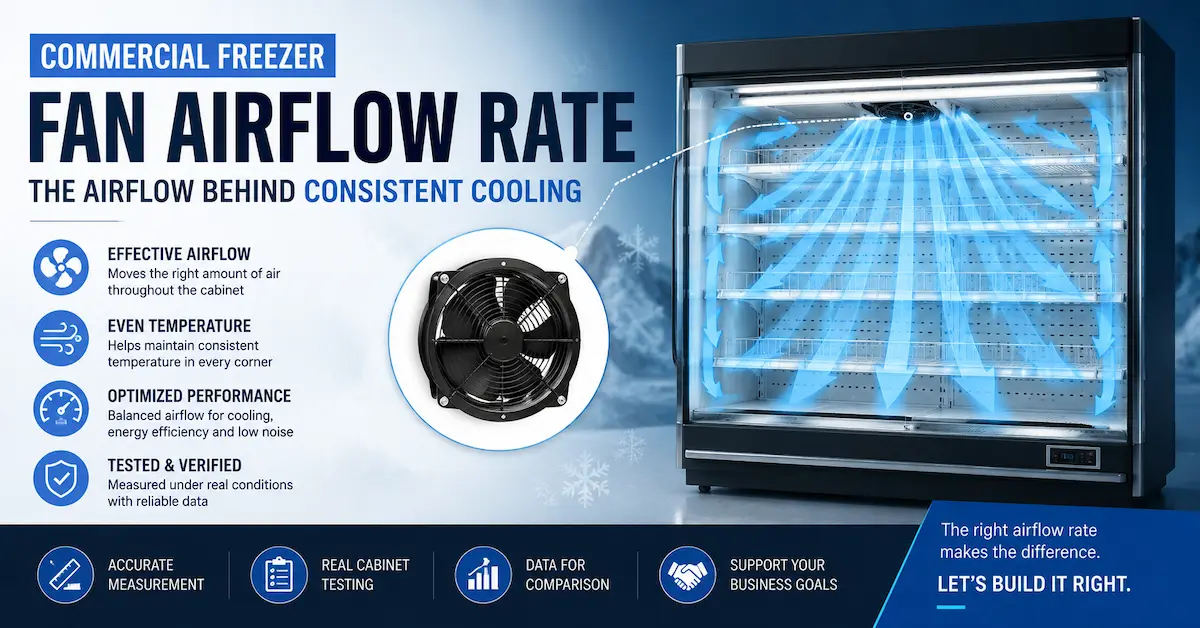
Commercial freezer fan airflow rate describes the volume of air moved by a fan over a given period under defined operating conditions.
In commercial refrigeration, that number is useful—but only when buyers know what it refers to.
A supplier might provide an airflow figure from a fan datasheet. Another may measure air at a cabinet outlet. A third may quote air velocity at one point.
Those figures do not necessarily describe the same thing.
The more useful procurement question is:
How much effective airflow does the complete freezer produce after the fan is installed with the evaporator, ducts, shelves, products, and actual cabinet airflow path?
The files supplied for this content framework do not provide Snowsea-specific fan airflow values, static-pressure data, or fixed CFM/m³/h targets. For that reason, this guide focuses on engineering and purchasing logic rather than inventing product specifications.
First Confirm Which Fan the Supplier Is Talking About
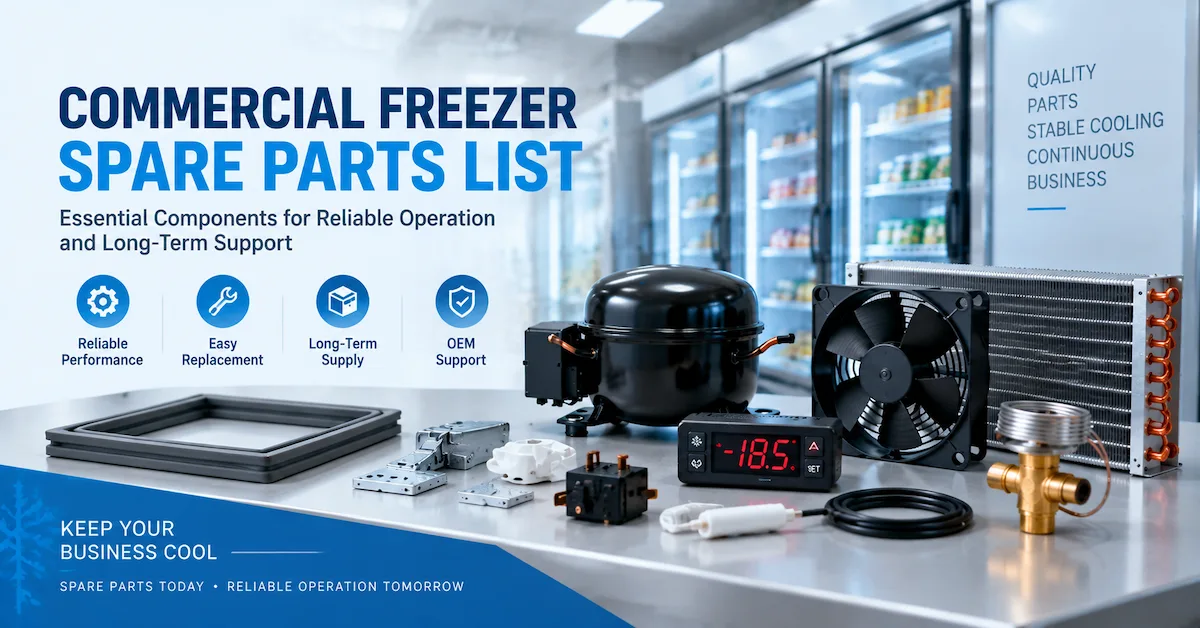
A commercial freezer can contain fans serving very different functions.
Evaporator or Cabinet Circulation Fan
This fan is associated with moving air through or around the evaporator and circulating cooled air through the storage space.
Its performance can affect:
- Heat exchange
- Pull-down behavior
- Cabinet circulation
- Temperature consistency
- Product-zone airflow
Condenser Fan
A condenser fan operates on the heat-rejection side of the refrigeration system.
Its job is related to:
- Condenser airflow
- Heat dissipation
- Machine-compartment ventilation
- High-ambient performance
If a supplier simply says “airflow is 300 CFM,” the buyer should ask which fan that figure describes.
Snowsea's commercial freezer condenser heat rejection guide covers the condenser side in more detail.
Airflow Rate and Air Velocity Are Not the Same Measurement
These terms are often mixed during sourcing.
Airflow rate describes the volume of air moved over time. Common engineering units may include m³/h or CFM.
Air velocity describes how fast air moves at a specific location.
A high velocity at one outlet does not prove that the total cabinet airflow is high.
Likewise, a strong total airflow figure does not tell a buyer whether that air reaches every important storage zone.
| Measurement | What It Describes | Procurement Limitation |
|---|---|---|
| Fan rated airflow | Fan performance under stated conditions | May not represent installed freezer |
| Installed airflow | Air movement after system installation | Depends on measurement method |
| Air velocity | Speed at one measurement point | Does not show total airflow |
| Temperature mapping | Thermal result across cabinet zones | Does not directly measure air volume |
This distinction becomes important when comparing technical quotations from different suppliers.
Why Fan Datasheet Airflow Can Differ From Installed Airflow
A fan does not operate in open space once it becomes part of a commercial freezer.
Air may need to pass through:
- Evaporator coil
- Fan guard
- Internal ducting
- Louvers or outlets
- Return-air passages
- Shelves
- Baskets
- Product packages
Each part can alter resistance or redirect the airflow.
The result is simple:
A fan's catalog airflow and the airflow available inside the finished freezer can be different numbers.
That does not make the fan datasheet useless. It simply means procurement teams should understand what that number represents.
For important projects, ask whether the airflow figure comes from:
- Fan supplier data
- Bench testing
- Measurement after installation
- Cabinet outlet measurements
- A complete freezer performance test
More Airflow Is Not Automatically Better
It is tempting to compare two suppliers and choose the larger airflow number.
That shortcut can be misleading.
Too little airflow may contribute to poor heat transfer or weak circulation. But simply increasing fan speed or fan capacity can introduce other trade-offs.
These may include:
- Higher fan electricity use
- Increased noise
- Strong local air jets
- Air bypass
- Unnecessary flow in areas that do not improve cooling
- Different interaction with frost or evaporator conditions
The goal is not maximum airflow.
It is matched airflow.
The fan has to work with the evaporator, refrigeration capacity, cabinet dimensions, air path, storage layout, temperature target, noise requirement, and expected product load.
The Evaporator Changes the Airflow the Fan Sees
On the cold side of a forced-air freezer, the evaporator is not simply a cooling component. It also sits in the airflow path.
Air moving through the coil encounters resistance.
Actual behavior can be affected by factors such as:
- Coil geometry
- Air passages
- Surface condition
- Frost accumulation where relevant
- Fan position
- Duct arrangement
That is why copying the same fan into a different evaporator or cabinet does not guarantee the same installed airflow.
For related system design considerations, see Snowsea's commercial freezer evaporator design guide.
Frost Can Change Air-Side Conditions
If frost develops around the evaporator, the open path available for air can change.
How much that matters depends on the freezer design and actual operating condition.
Technical buyers should therefore be cautious when comparing airflow data collected under different evaporator states.
Useful questions include:
- Was the evaporator clean?
- Was frost present?
- Was the unit before or after defrost?
- Was the test performed after stabilization?
- Was the same condition used for competing samples?
There is no basis in the supplied Snowsea files for claiming a fixed percentage airflow loss from frost, so procurement decisions should rely on actual test conditions rather than universal assumptions.
Product Loading Can Change Effective Cabinet Airflow
An empty freezer and a fully stocked freezer can have very different internal air paths.
Cartons may sit in front of an outlet. Baskets may reduce open circulation space. Dense loading may restrict a return-air path.
That can produce a situation where the fan itself is functioning normally but the useful circulation inside the cabinet has changed.
For OEM and private-label buyers, realistic loading matters.
Provide:
- Product dimensions
- Package dimensions
- Loading quantity
- Shelf arrangement
- Basket configuration
- Preferred product orientation
during engineering review.
Snowsea's OEM freezer custom interior layout guide explains why usable storage layout and airflow should be considered together.
Shelf Layout Can Help or Hurt the Air Path
Changing shelf count seems like a storage-capacity decision.
It can also be an airflow decision.
Very tight vertical spacing or poorly positioned products can interfere with circulation even when the fan specification remains unchanged.
This is one reason maximum theoretical storage density is not always the best operational layout.
If a project requires customized shelves, review the OEM freezer custom shelf system guide.
The supplier should evaluate storage capacity and cooling performance together instead of optimizing one at the expense of the other.
Airflow Rate Does Not Guarantee Good Temperature Uniformity
This is one of the most important distinctions for technical buyers.
A fan can move a large volume of air while the cabinet still develops uneven thermal zones if the distribution path is poorly designed.
For example, cooled air may favor one region while another receives weaker circulation.
So:
Airflow rate tells you how much air is moving; temperature uniformity helps show what thermal result that airflow produces across the cabinet.
The two metrics should complement each other.
See Snowsea's commercial freezer temperature uniformity guide for multi-point temperature evaluation.
This also prepares the next engineering question: not simply how much air moves, but where the cold air actually goes.
Does Higher Airflow Reduce Pull Down Time?
It may influence heat transfer, but there is no simple proportional rule.
Doubling fan airflow does not mean pull-down time will be cut in half.
Cooling speed also depends on:
- Refrigeration capacity
- Starting condition
- Cabinet dimensions
- Product thermal mass
- Insulation
- Ambient environment
- Evaporator performance
- Temperature target
A poorly matched refrigeration system will not become a high-performance freezer simply because a larger fan is installed.
For performance comparisons, see commercial freezer pull down time.
Noise and Airflow Need to Be Balanced
A freezer operating in a warehouse and one installed beside customers may have different acoustic priorities.
Fan speed and airflow design can influence noise.
This matters in applications such as:
- Convenience stores
- Cafés
- Supermarkets
- Customer-facing retail areas
The highest fan speed is therefore not automatically the best commercial configuration.
A buyer may need to balance:
Cooling performance + temperature consistency + airflow + fan noise + energy consumption
If noise requirements are important, they should be included in the RFQ rather than discovered after sample delivery.
Fan Airflow Is Also an Energy Question
The fan consumes electrical energy, but its effect on total freezer energy performance cannot be judged from fan wattage alone.
Airflow can influence heat exchange, cabinet temperatures, and the operating behavior of the refrigeration system.
That means a lower-power fan does not automatically produce a more efficient freezer, just as a higher-airflow fan does not automatically reduce total consumption.
For commercial evaluation:
Fan energy + compressor operation + cabinet temperature performance should be read together.
Snowsea's commercial freezer energy consumption test guide explains how to compare whole-unit energy data under defined test conditions.
How Should Commercial Freezer Fan Airflow Be Measured?
A useful airflow figure needs a clear measurement context.
| Test Information | What the Buyer Should Confirm |
|---|---|
| Fan function | Evaporator, circulation, or condenser fan? |
| Fan model | Exact component installed |
| Operating condition | What speed or control state? |
| Measurement location | Fan, duct, outlet,or cabinet zone? |
| Measurement type | Airflow rate or air velocity? |
| Evaporator state | Clean, frosted, or post-defrost? |
| Cabinet loading | Empty or loaded? |
| Air path | Shelves and products installed? |
| Door condition | Closed or defined access pattern? |
| Tested configuration | Same model/BOM as quotation? |
An airflow number without its measurement location and operating condition is difficult to use for supplier comparison.
For major projects, ask the supplier to explain the test method instead of relying on one number in a brochure.
What Should Buyers Ask When a Supplier Quotes CFM or m³/h?
A sensible follow-up sequence is:
- Is this free-air fan rating?
- Is it measured after installation?
- Is the evaporator installed during measurement?
- Where is airflow measured?
- What system restriction is present?
- Is the cabinet empty or loaded?
- Is this one outlet or total airflow?
- What fan speed is used?
- Does the tested fan match mass production?
These questions usually reveal much more than simply asking which supplier uses the bigger fan.
A fan datasheet value and a complete-freezer airflow result answer different questions.
Common Procurement Mistakes
| Mistake | Why It Creates Risk |
|---|---|
| Comparing fan catalog numbers only | Installed airflow may differ |
| Comparing CFM directly with air velocity | They describe different quantities |
| Not confirming which fan is measured | Evaporator and condenser fans serve different roles |
| Testing only an empty cabinet | Product loading can change the air path |
| Ignoring evaporator restriction | Coil resistance affects installed behavior |
| Assuming more airflow is always better | Noise, power, or distribution can become worse |
| Ignoring measurement location | Supplier figures may not be comparable |
| Changing fan or cabinet BOM after testing | Earlier results may no longer represent production |
These are practical supplier-comparison risks rather than theoretical airflow problems.
Sample Testing Should Be Tied to Production Configuration
A strong sample result only has commercial value when mass production follows the approved configuration.
QC should verify relevant items such as:
- Correct fan model
- Correct fan quantity
- Correct installation direction
- Correct evaporator configuration
- Correct duct or air-path components
- Correct controller settings where applicable
- Correct shelf/interior structure
- Fan operation
- Abnormal vibration or noise
- Approved sample conformity
For broader checks, see Snowsea's commercial freezer quality testing procedure.
A distributor buying repeated containers needs consistent production, not one well-performing development sample.
How Should Buyers Compare Freezer Suppliers?
| Evaluation Area | What to Ask |
|---|---|
| Fan type | Which fan does the airflow figure describe? |
| Rated airflow | What does the component datasheet show? |
| Installed performance | Is airflow evaluated after assembly? |
| Evaporator | Is coil restriction considered? |
| Air path | How are supply and return paths designed? |
| Loading | Has realistic product loading been tested? |
| Uniformity | Does cabinet temperature remain consistent? |
| Noise | Is acoustic performance considered? |
| Energy | Is fan performance evaluated with total energy use? |
| Production QC | Will mass production use the approved components? |
| OEM capability | Can buyer-defined requirements be evaluated? |
A supplier who can explain this relationship is more useful to a technical purchasing team than one who simply advertises “high airflow.”
What Should Buyers Send Snowsea for an OEM Evaluation?
For a commercial freezer fan airflow rate project, useful inputs include:
- Freezer type or reference model
- Cabinet dimensions
- Target operating temperature
- Expected ambient condition
- Product being stored
- Product/package dimensions
- Typical loading quantity
- Shelf or basket arrangement
- Cooling or circulation requirement
- Airflow target, if already defined
- Air-velocity target,if separately defined
- Temperature-uniformity requirement
- Pull-down target
- Noise requirement, if defined
- Energy benchmark
- Mandatory fan specification, if any
- Customer airflow test method
- Destination market
- Sample/testing requirement
- Initial order quantity
- Annual purchasing forecast
- Project schedule
Snowsea can evaluate the requested fan, evaporator, airflow path, cabinet layout, and refrigeration-system configuration according to the selected platform and engineering feasibility through its OEM/ODM service.
FAQ
What is commercial freezer fan airflow rate?
It describes the volume of air a freezer fan moves over time under defined operating conditions.
What is the difference between airflow rate and air velocity?
Airflow rate measures air volume over time, while air velocity measures how fast air moves at a specific location.
Is evaporator fan airflow the same as condenser fan airflow?
No. The evaporator or circulation fan supports cold-side heat transfer and cabinet circulation, while the condenser fan supports heat rejection.
How is commercial freezer fan airflow measured?
The method depends on the fan and system. Buyers should confirm the measurement location, operating state, airflow unit, evaporator condition, cabinet loading, and complete tested configuration.
Does higher fan airflow always improve cooling?
No. Airflow must be matched to the evaporator, refrigeration capacity, cabinet geometry, distribution path, noise target, and energy requirements.
Does product loading affect freezer airflow?
Yes. Packages, baskets, and shelves can restrict or redirect internal air paths.
Can evaporator frost affect airflow?
It can change the air-side condition around the evaporator. The effect should be evaluated according to the freezer design and actual frost condition.
Does fan airflow affect temperature uniformity?
It can influence circulation, but airflow rate alone does not guarantee uniform temperatures. Distribution design is also important.
Can higher airflow increase freezer noise or energy use?
Fan selection and operating speed can affect both. The final choice should balance airflow with complete freezer performance.
What airflow information should B2B buyers request?
Ask for fan type, fan model, rated airflow, measurement method, installed condition, evaporator configuration, loading condition, and temperature-performance evidence.
Conclusion
Commercial freezer fan airflow rate should not be judged from one fan datasheet number.
For a meaningful B2B comparison, buyers need to understand:
- Which fan is being measured
- Whether the figure is airflow or velocity
- Where the measurement is taken
- How the evaporator affects the air path
- Whether the cabinet is empty or loaded
- How shelves and products change circulation
- Whether airflow supports temperature uniformity
- How noise and energy are affected
- Whether the tested configuration matches mass production
The best airflow specification is not necessarily the largest number. It is the one that works with the complete freezer to deliver the required cooling result.
Send Snowsea your freezer type, cabinet dimensions, target temperature, ambient condition, product dimensions, loading pattern, shelf or basket arrangement, airflow or velocity requirement, temperature-uniformity target, pull-down target, noise requirement, existing fan specification, test method, destination market, and estimated order quantity through the Snowsea contact page.
Snowsea can evaluate the fan, evaporator, cabinet air path, refrigeration-system matching, testing scope, OEM feasibility, and commercial project requirements before preparing a technical proposal and quotation.